


C9 Christmas Lights: Sizes, Spacing, C9 vs C7, and How to Buy Them
C9 Christmas lights are the big, traditional roofline bulbs: about 1⅛ to 1½ inches wide and 3 inches tall, on an E17 intermediate screw base. C7s are the smaller cousin, about 2 inches tall on an E12 candelabra base, so the two don’t swap sockets.
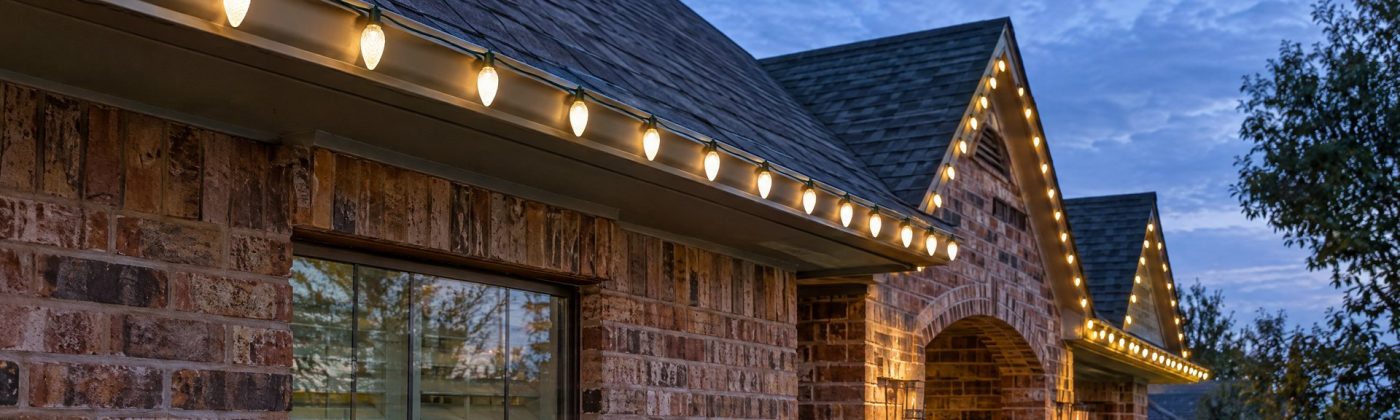
For a roofline seen from the street, our answer is simple: LED C9s at 12-inch spacing, about one bulb per foot, drawing under 1 watt each against 7 watts for the old incandescent bulb. That’s what our Austin Christmas light installation crews hang, on commercial socket wire cut to fit each roofline run. The rest of this page is the buying decisions in the order you’ll face them, then three real-size Austin rooflines counted out bulb by bulb.
C9 or C7? Let viewing distance decide
The name tells you the size. “C” is the cone shape, and the number is the widest diameter in eighths of an inch. A C9 is nominally 9/8 inch across, a C7 is 7/8 inch. Real LED bulbs run bigger because faceted plastic lenses are bulkier than the old glass: Christmas Lights Etc. measures its C9s at about 1.5 inches wide and 3 inches tall, and its C7s at about 1.25 by 2 inches.
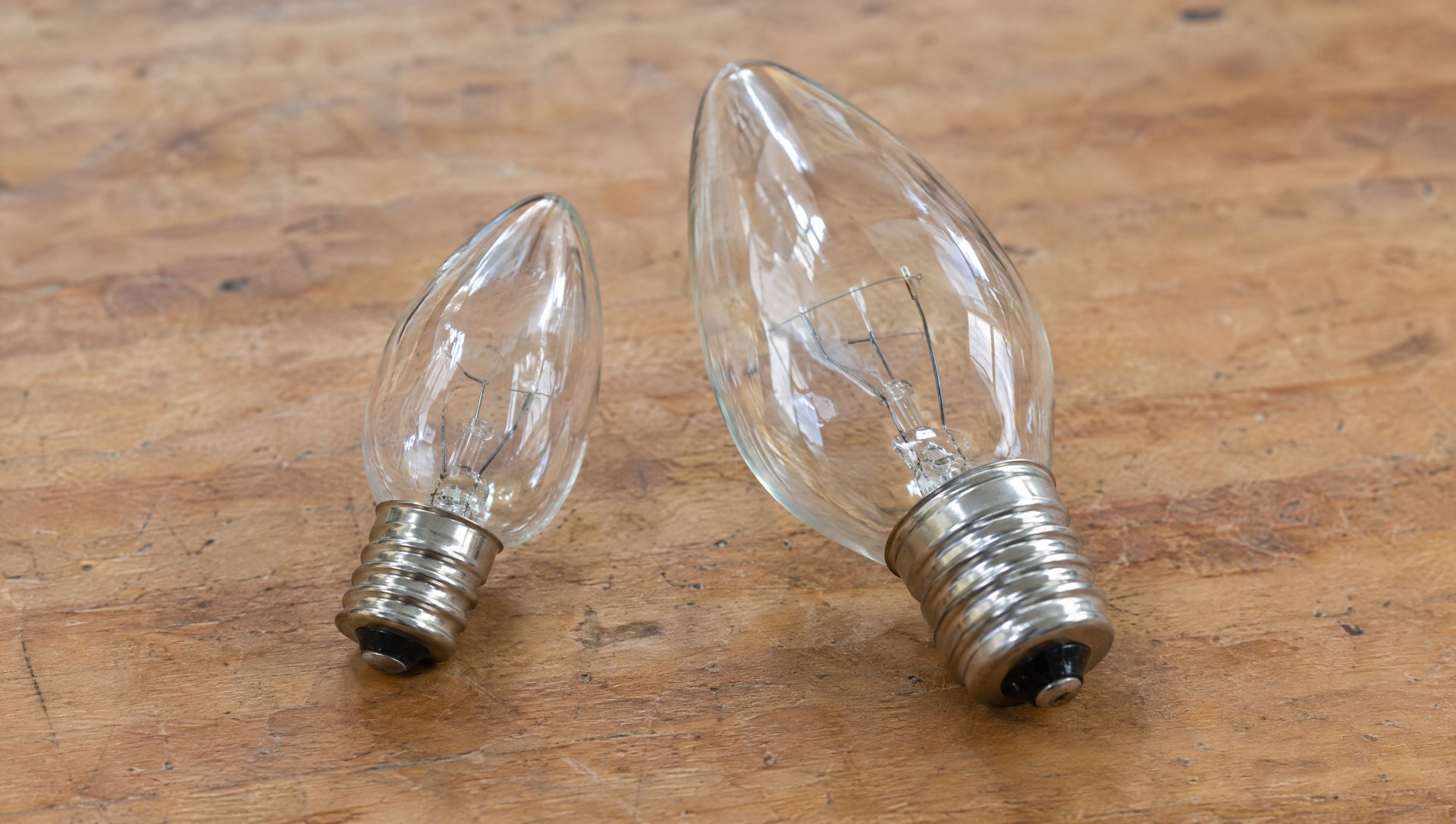
| Spec | C9 | C7 |
|---|---|---|
| Typical size | ~1⅛–1½ in. wide, ~3 in. tall | ~⅞–1¼ in. wide, ~2 in. tall |
| Screw base | E17 intermediate | E12 candelabra |
| Incandescent watts | 7 W per bulb | Typically 5 W per bulb |
| LED watts | About 0.5–1 W per bulb | About 0.5–1 W per bulb |
| Where it looks right | Rooflines and gables seen from the curb | Porches, windows, rails, walkways |
Decide by where people stand. Most front yards put the roofline 40 to 80 feet from the street. From there, a C7 roofline reads as a thin dotted line, and a C9 reads as an outline. Up close, the opposite happens: C9s around a small window or along a porch rail people brush past look oversized and clunky. So C9 on the roofline and C7 on the porch, windows or walkway below is a normal, good-looking mix. Keep one size per continuous edge.
Trees are a third answer. C9s are too big to follow a trunk or limb, so we wrap trees with 5mm wide-angle LED mini lights instead.
The base matters more than the lens. A C7 won’t screw into a C9 socket, and socket adapters don’t belong outside in the rain. If you’re matching bulbs you already own, look for the E-number on the old box, or measure across the threads of the old base: about 17 mm is a C9 socket, about 12 mm is a C7.
Decision 1: a boxed set, or stringer plus bulbs?
This is the choice that decides whether your roofline looks custom or store-bought, and most people don’t realize they’re making it.
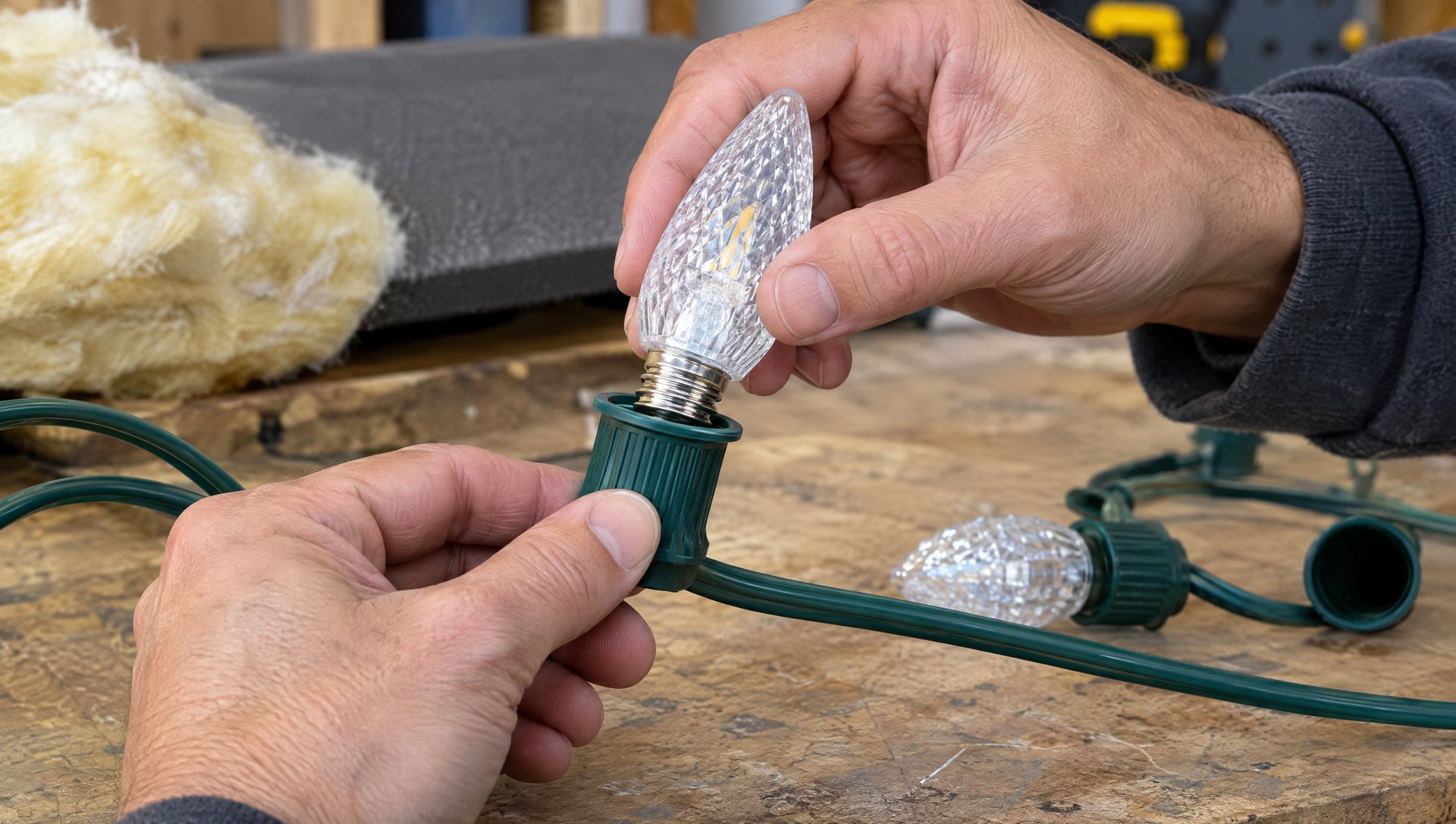
Integrated “C9” sets. Retail sets where the LED is molded into the wire. Cheap, light and easy, but there’s no socket. When one bulb fails or gets crushed, you can’t replace it, and you can’t upgrade the color later. Fine for a single season or a porch. Not what we’d put on a roofline you want to reuse.
Pre-sized stringers. Socket wire with a plug at each end, sold empty, and you add the bulbs. Christmas Lights Etc. sells them in lengths from 10 to 119 feet, so you can buy close to each run instead of rounding up to the next 25 feet. Each carries a polarized fused plug that caps the run at 960 watts. If a run goes dark all at once, check that fuse first; our fuse guide shows how.
Bulk spool. Socket wire on 500- or 1,000-foot spools with no plugs. You cut each run to length and add a zip plug (a clamp-on plug that bites into the wire) at the end that goes to power. The far end gets capped with a zip plug or a sealant matched to the wire type. This is what professionals use because the last bulb lands exactly at the corner. It’s also the option where small mistakes, like a zip plug clamped on crooked, show up as a dead run in the first rain.
Wire weight. Commercial C9 stringers are typically 18-gauge, in SPT-1 or SPT-2 insulation. SPT-1 handles most seasonal displays; SPT-2 has a thicker jacket for harsher weather. For a display that comes down every January, SPT-1 is fine.
Our position: for a DIY roofline you’ll reuse, buy pre-sized stringers in the closest length to each run and add LED bulbs. Spools only make sense once you’re comfortable fitting zip plugs.
Decision 2: spacing, and how many bulbs you need
Twelve-inch spacing is the residential standard and our default for rooflines. From the curb it reads as a continuous line without crowding.
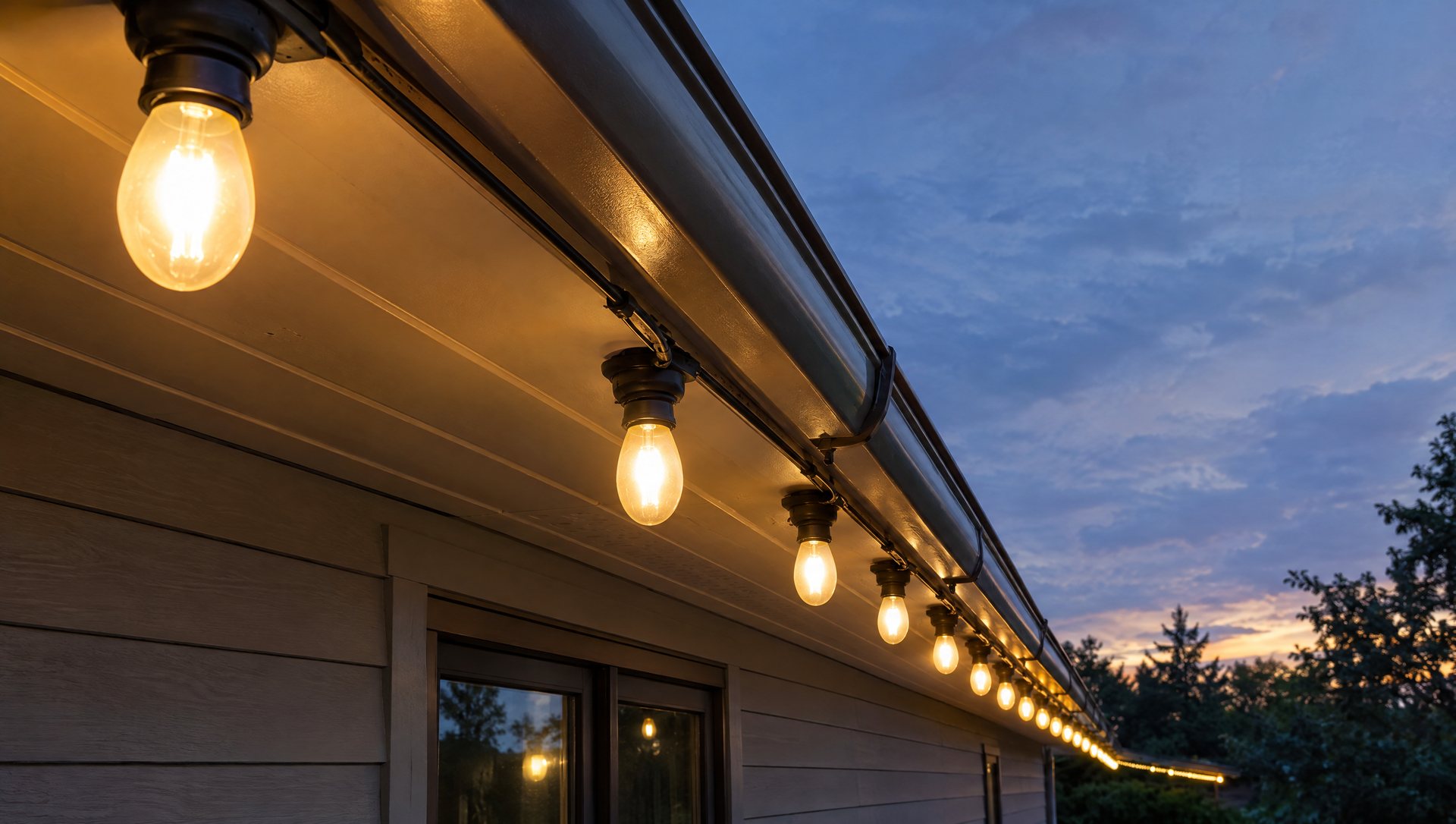
Fifteen-inch spacing looks looser and more vintage and uses 20% fewer bulbs. It suits a long, plain ranch roofline, or a house with stonework you don’t want to bury under light. C9 stringers also come in 6, 18 and 24-inch spacing. Six inches is for tight detail work; 18 and 24 inches start to look gappy on a house.
Spacing is built into the socket wire, not the bulb, so you choose it when you buy the stringer. The bulb math:
- 12-inch spacing: one bulb per foot. 100 feet takes about 100 bulbs.
- 15-inch spacing: feet × 0.8. 100 feet takes about 80 bulbs.
Measure the actual edges, not the house footprint. Gables are where people come up short: the sloped edge is longer than the ground below it. Multiply the horizontal distance by about 1.12 for a 6/12 roof pitch, 1.20 for 8/12 and 1.41 for 12/12. Our step-by-step hanging guide shows how to measure every run from the ground.
Buy 5 to 10% extra bulbs from the same order as spares. You’ll crush a couple on the ladder, and a replacement from a different batch rarely matches.
Decision 3: lens finish and color
Faceted lenses sparkle and throw light sideways. They’re the most common LED C9 and read well from the street. Smooth transparent lenses show a cleaner single point of light, closer to the old glass bulbs. Opaque (ceramic-look) bulbs give solid, saturated color and a retro feel, especially in multicolor.
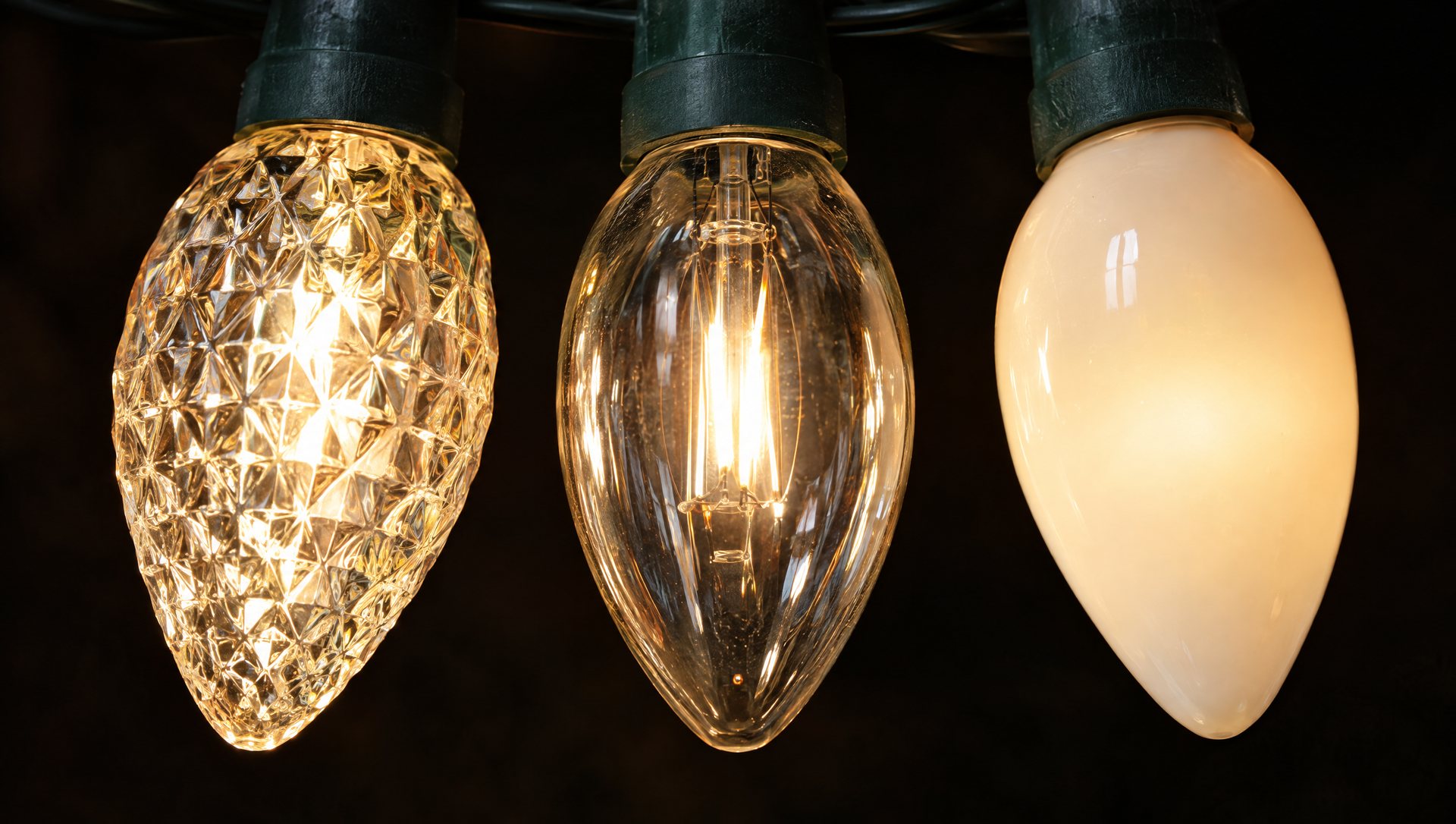
Pick one finish per run. A few smooth replacements scattered through a faceted roofline look like mistakes, even to people who couldn’t tell you why.
Color is the bigger trap. “Warm white” varies by brand and even by production batch. Two boxes labeled warm white can look visibly different side by side on one gutter, one a little pink, one a little yellow. Buy every bulb for one continuous edge in a single order of one product. If you’re adding LEDs next to incandescent bulbs you like, screw one sample into the run and look at it from the street before buying 150.
Whether to go warm white or multicolor at all is a separate argument, and we make it in our guide to colored vs white Christmas lights.
Decision 4: wire color, because the lights are off 18 hours a day
C9s are switched off most of the day. In daylight your neighbors see the wire, the clips and which way the bulbs point, not the glow.
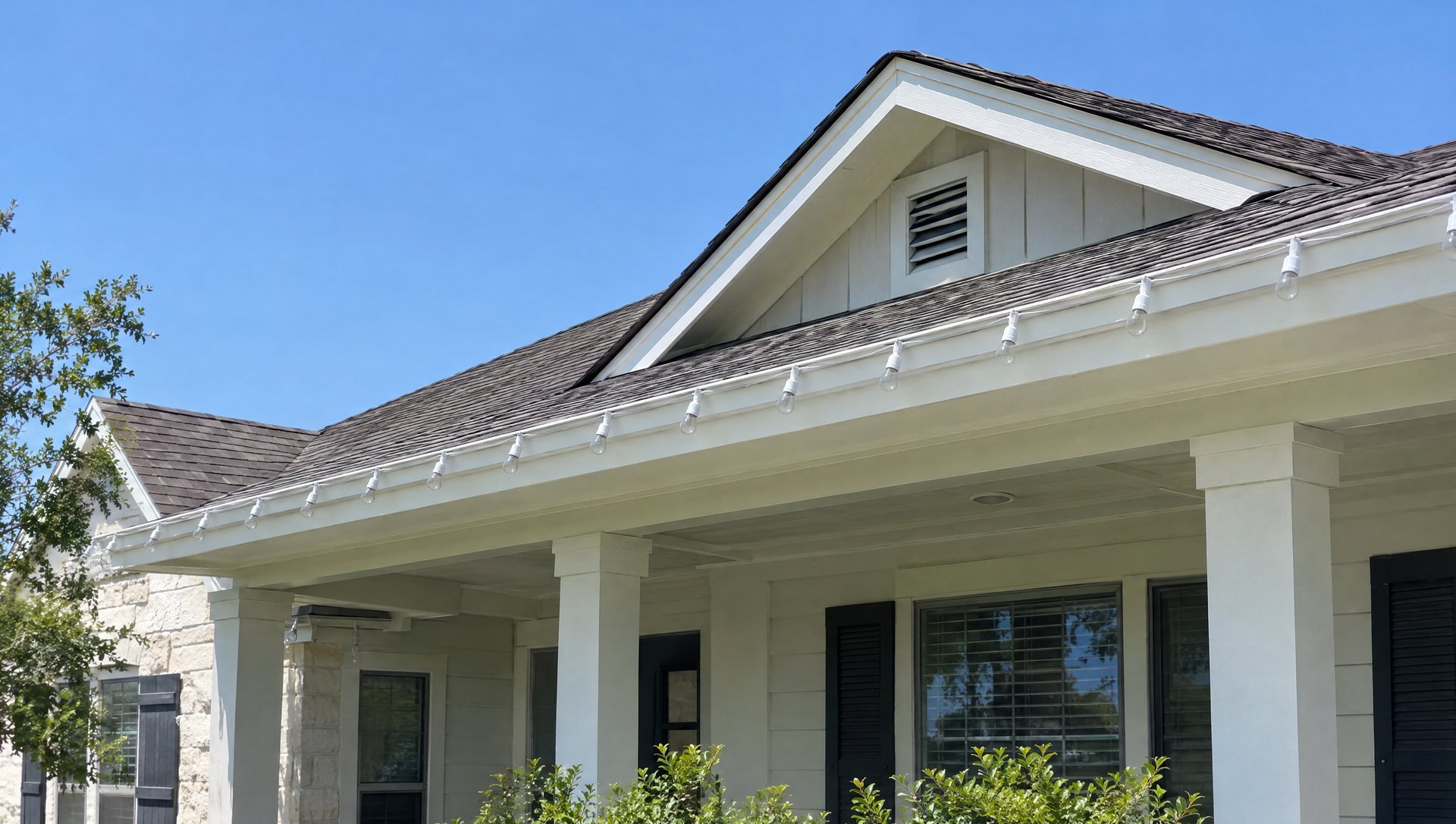
Match the wire to the trim. White wire on white fascia and white gutters. Green or black on dark trim, dark gutters or a dark shingle edge. Brown wire exists too and disappears against some stained wood and darker stone trim. Christmas Lights Etc. stocks stringers in green, white, black and brown.
Then make every bulb point the same way. A row with half the bulbs pointing up and half sideways looks untidy even unlit. Clips that hold each socket at the same angle fix that; the clip goes on at every bulb.
Decision 5: LED or incandescent C9s
An incandescent C9 draws 7 watts. Common LED C9s draw about 0.5 to 1 watt; Christmas Lights Etc. lists its standard LED C9s at 0.8 watts. That’s roughly 90% less power.
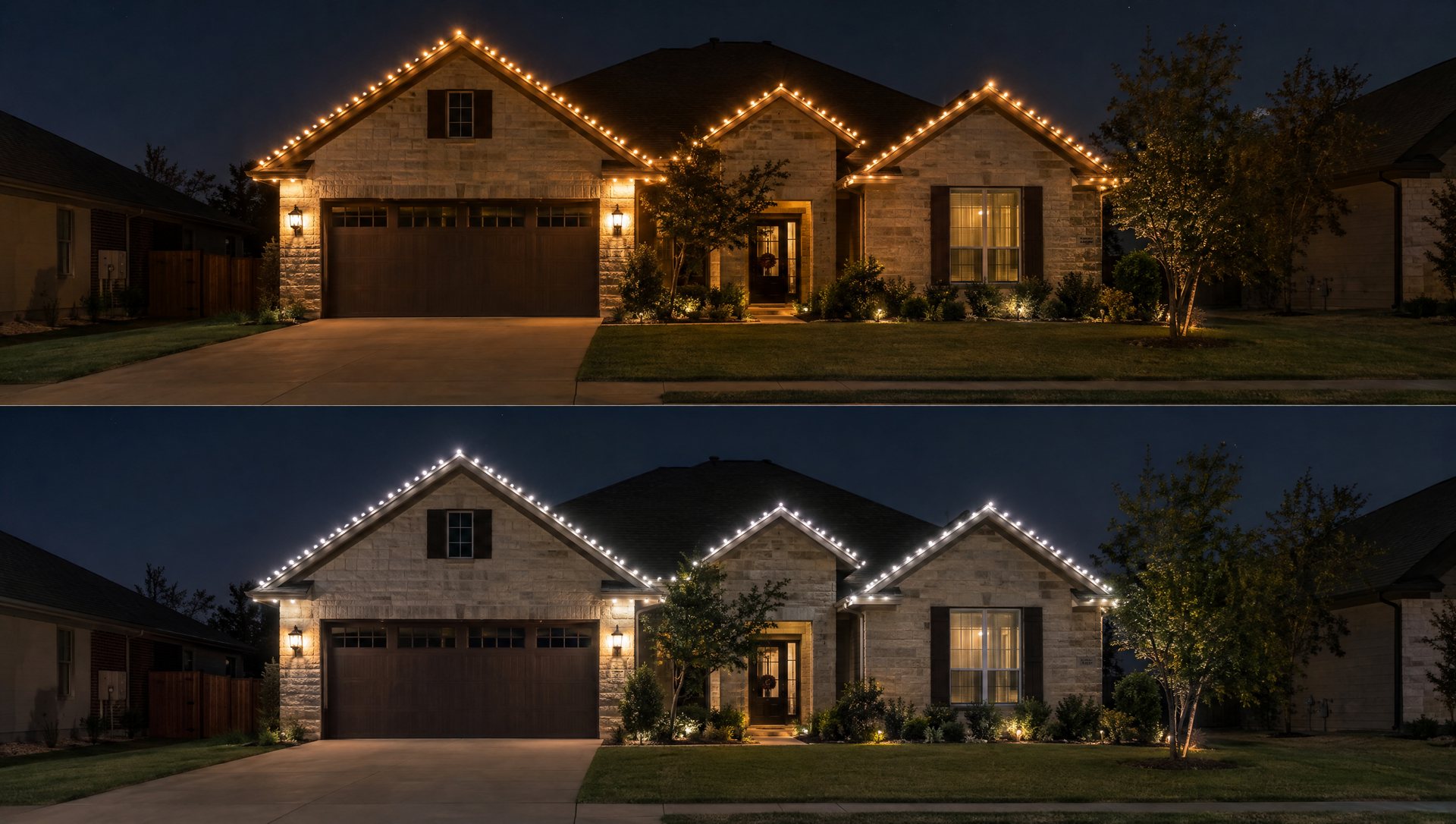
A 150-foot roofline at 12-inch spacing, 150 bulbs, on six hours a night for 40 nights:
| Bulb | Load | Amps at 120 V | Season use | Season cost in Austin |
|---|---|---|---|---|
| Incandescent C9, 7 W | 1,050 W | About 8.75 | 252 kWh | About $31–$37 |
| LED C9, 0.8 W | 120 W | About 1 | 28.8 kWh | About $3.50–$4.25 |
Rate inputs: Austin Energy’s residential rates, checked October 2026. Each added kilowatt-hour costs about 12.2¢ if your monthly use falls in Tier 2 (301–900 kWh) or about 14.7¢ in Tier 3 (901–2,000 kWh), counting the tier energy charge plus the power supply adjustment, community benefit and regulatory charges, under the FY2027 tariff in effect for bills from October 1, 2026, through September 30, 2027.
The bill isn’t the strongest argument. The circuit is. That incandescent roofline pulls more than half of a typical 15-amp household circuit before anything else on that circuit turns on, and it’s over the 960-watt cap of a single fused stringer, so it has to be split into two runs. The LED version runs on one stringer and barely registers. Incandescent C9s still have fans for their glass-and-filament warmth, and our LED vs incandescent comparison gives them a fair hearing. On a roofline, though, we’d pick LED every time.
Retrofitting an old cord. Standard LED C9 bulbs are made for the same 120-volt E17 sockets as incandescent C9 stringers, so you can usually screw them straight into an old cord. It’s the cheapest way to cut a roofline’s power by 90%. Two exceptions: integrated sets have no sockets to fill, and the cord itself has to be sound. If the insulation is cracked or stiff, sockets are broken or the plug is damaged, the cord goes in the trash, not up on the house.
Three Austin rooflines, counted out
Here’s how the decisions play out on three house types we see constantly around Austin. All at 12-inch spacing with 0.8-watt LED C9s.
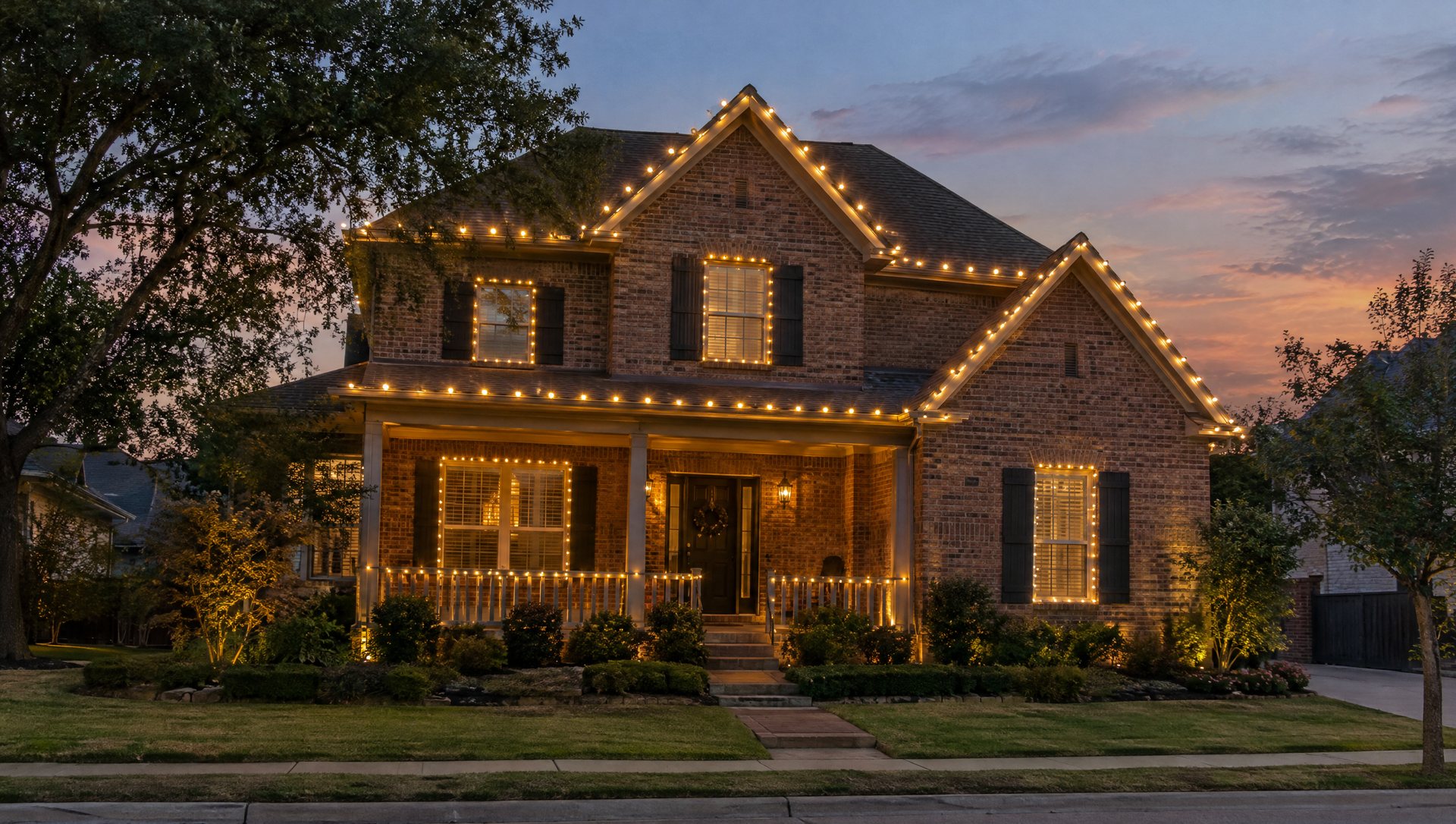
A one-story ranch, roofline only
A 1980s brick ranch with a long, flat front eave and an attached garage, no front-facing gables. Front eave 70 feet, garage eave 24 feet: 94 feet.
- Bulbs: 94, plus 6 spares = 100
- Stringers: two pre-sized stringers cut to each eave, or four 25-foot sets with about 6 feet of leftover wire to hide
- Load: about 75 watts, well under 1 amp
- Our take: 15-inch spacing works well here too. A long, plain eave doesn’t need density, and about 75 bulbs instead of 94 still reads as a confident line.
A two-story with two front gables
A newer two-story in the suburbs north of the river: lower eave across the garage and porch, an upper eave, and two front gables at 8/12 pitch.
- Lower eave 70 feet, upper eave 40 feet
- Each gable is 26 feet wide, so each sloped side covers 13 feet horizontally: 13 × 1.20 = 15.6 feet, about 31 feet per gable, 62 for both
- Total: 172 feet, so about 172 bulbs plus spares
- Load: about 138 watts in LED. The same house in incandescent C9s would be about 1,200 watts and 10 amps, needing at least two runs and likely two circuits
- Season cost: at 6 hours a night for 40 nights, about 33 kWh in LED, roughly $4 to $5 on Austin Energy’s marginal rates
This is the house where gables make the display. Outlining both gables and the upper eave frames the whole facade. It’s also two-story ladder work, which is where most homeowners call someone.
A small bungalow with a deep porch
An older central-Austin bungalow, about 44 feet of visible front roofline, sitting 30 feet from the sidewalk, with a porch rail people walk right past.
- Roofline: 44 C9s at 12 inches
- Porch rail: 16 feet of C7s at 12 inches, so 16 bulbs. At arm’s length, C9s on the rail would look heavy
- Load: under 50 watts total in LED
Here a C9-and-C7 mix earns its keep. The roofline reads from the street, the porch reads from the walk, and nothing looks oversized at either distance.
The bulb-count trap at the end of a run
Boxed C9 sets come in fixed lengths, usually 25 feet. A 41-foot eave doesn’t divide into 25-foot sets, so you either get a dark gap near the corner or 9 extra feet of lit bulbs with nowhere to go.
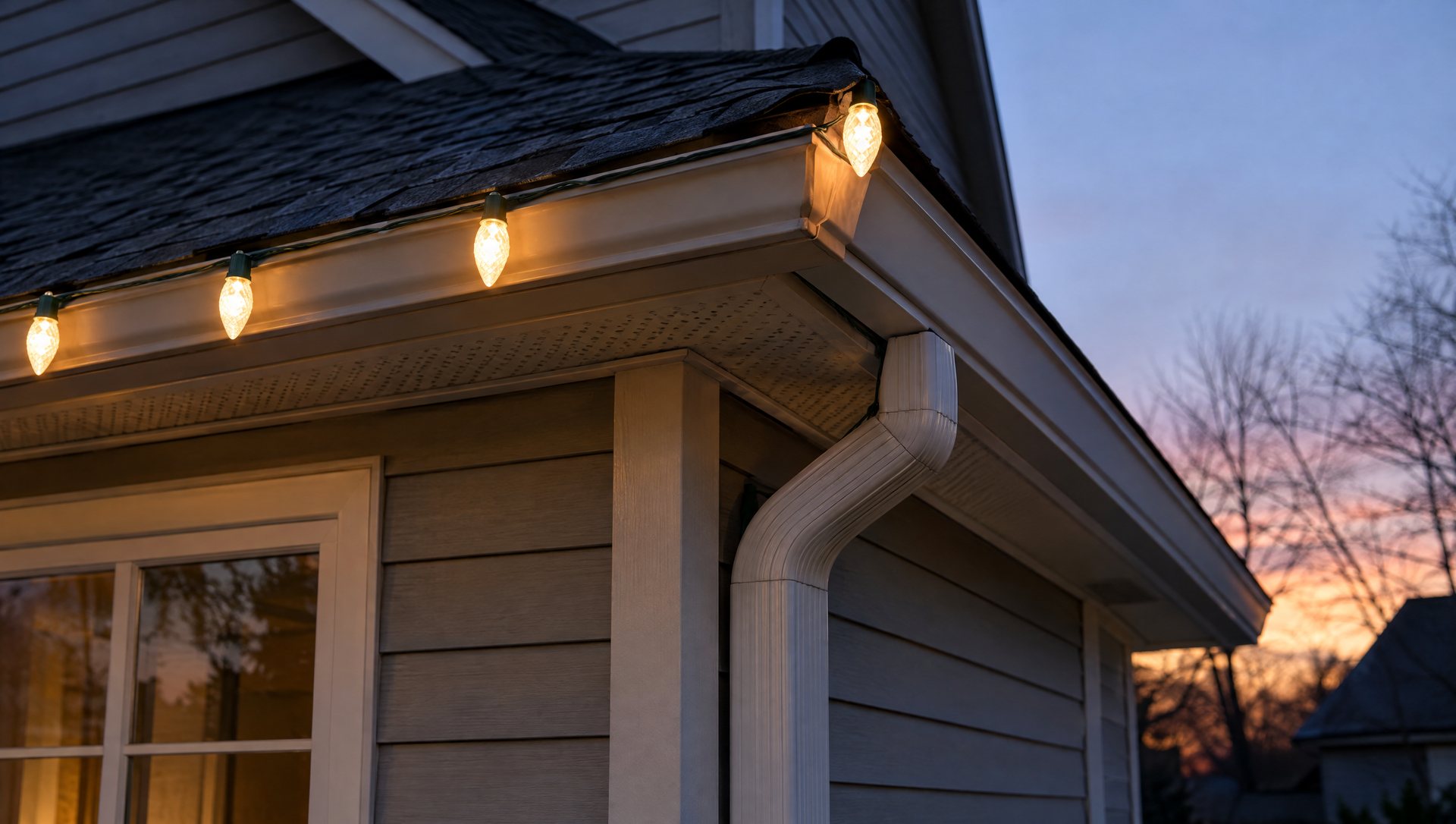
Pre-sized stringers in odd lengths, or spool wire cut to length, solve it at the source: the last bulb lands at the corner. That’s why professional installs cut wire to each run on site.
With boxed sets, plan the leftover before you hang anything. Start at the end that should be crisp, usually the front corner by the driveway, and let the extra end at a downspout or a back corner you can’t see from the street. Never fold lit bulbs back on themselves along the same gutter. It doubles the brightness in one spot, and it’s the first thing the eye finds.
What we’d skip
- “C9-style” sets with no E17 base if you want a roofline you can repair and reuse.
- Mixed warm whites along one edge, even from the same brand in different years.
- Incandescent C9s on a long roofline. The glow is lovely, but the amps aren’t worth it.
- Adapters and splitters to make C7 bulbs fit C9 wire, or to squeeze another run onto a crowded outlet.
- More sets end to end than the label allows, in either technology. The printed maximum is a safety limit, not a suggestion.
- Ladder work past your comfort. Follow UL’s holiday safety guidance, and stop where the job needs roof access. Outlet faults and new circuits belong to a licensed electrician.
If you want C9s that never come down, that’s a different product with different specs; our permanent lighting guide covers it.
Not sure whether your roofline wants C9s at 12 or 15 inches, or where the gables should start and stop? Text a daytime photo of the front of your house to (737) 777-9099 or use our contact page, and we’ll tell you how we’d light it.
Sources
About the author. Rick Safeman owns Sapien Lighting & Installation in Austin, Texas.