


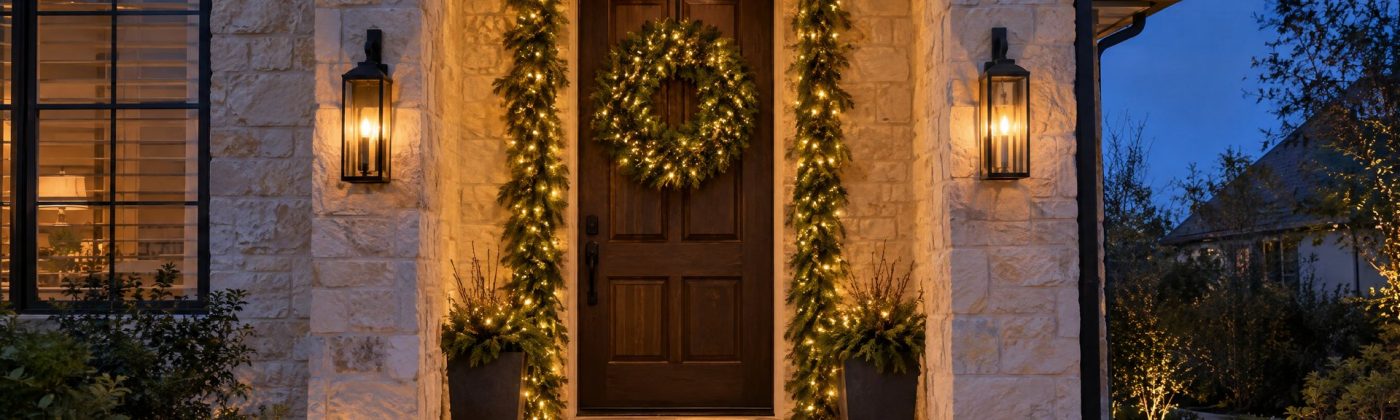
Christmas Door Decorations: Wreath and Garland Sizes for Four Real Doors
For Christmas door decorations that look right, size the wreath at about two-thirds of the door’s width (a 24-inch wreath on a standard 36-inch door) and plan about 17 feet of garland to frame a standard 36-by-80-inch door, which is two 9-foot lengths. Those two numbers solve most doors. The rest of this page is about the doors they don’t solve.
Because almost nobody in Austin has the catalog door. You have a storm door in the way, or an 8-foot door under a two-story entry, or double doors set into limestone with nothing to hang anything from, or a bungalow door that’s half glass. So after the basic rules, we size four real door types, with the numbers, the hardware and the lighting for each. Sapien hangs wreaths and garland as part of our Austin seasonal lighting work.
The two numbers that size everything
Wreath: two-thirds of the door width. On a 36-inch door, that’s 24 inches, leaving about 6 inches of door showing on each side. Wreath retailers such as Balsam Hill suggest the same 6-inch margin for a standard door. Size up when the door is mostly seen from far away; size down when glass, a big handle set or a decorative grille leaves less flat door to work with.
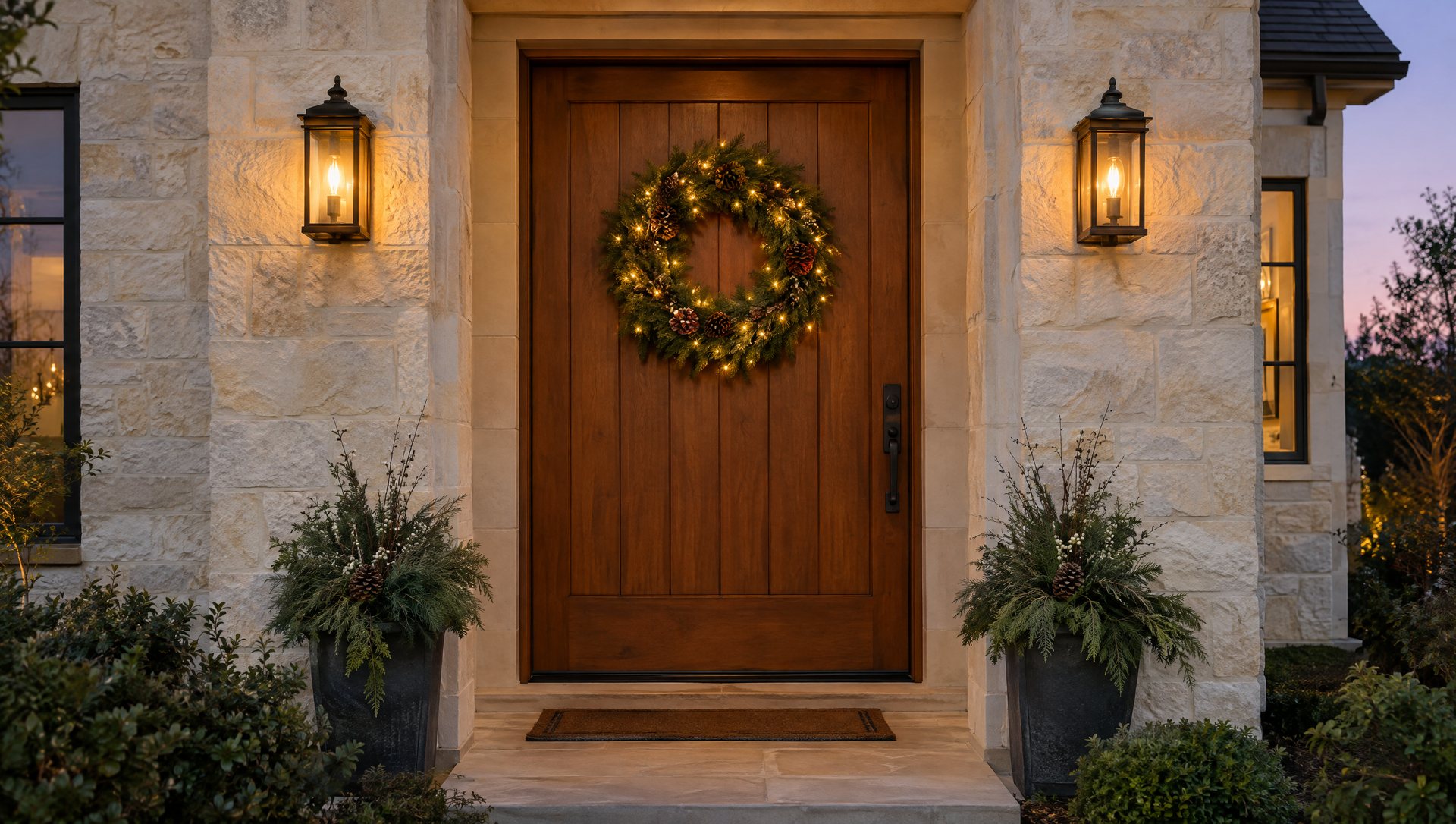
Garland: two sides plus the top. A 36-by-80-inch door is 80 + 80 + 36 = 196 inches, about 16 feet. Follow the trim instead of the door edge and it’s closer to 17. Garland is commonly sold in 9-foot lengths, so two cover a standard door with a little left over.
| Door | Wreath | Garland to frame it |
|---|---|---|
| 30–32 in. wide, 80 in. tall | 20–22 in. | About 16 ft |
| 36 in. wide, 80 in. tall | 24 in. | About 17 ft (two 9-ft lengths) |
| 36 in. wide, 96 in. tall | 24–28 in. | About 19 ft (three 9-ft lengths) |
| 42 in. wide or oversized | 28–30 in. | About 18 ft at 80 in. tall |
| Double doors, 6-ft opening | Two matching wreaths, ~20 in. on 30-in. leaves | About 20 ft |
Then add for anything that isn’t a straight run. Balsam Hill suggests 1.5 to 2 feet of garland for every foot of span you want to drape in a swag. Add 1 to 2 feet for each tail that hangs down beside the door, and a few inches for every joint between lengths.
Measure the door you actually have
The nominal door width is the wrong number for the wreath. Measure the clear, flat panel between the trim, the glass and the hardware. A 36-inch door with a big lever set and a center grille might only have 26 inches of usable face.
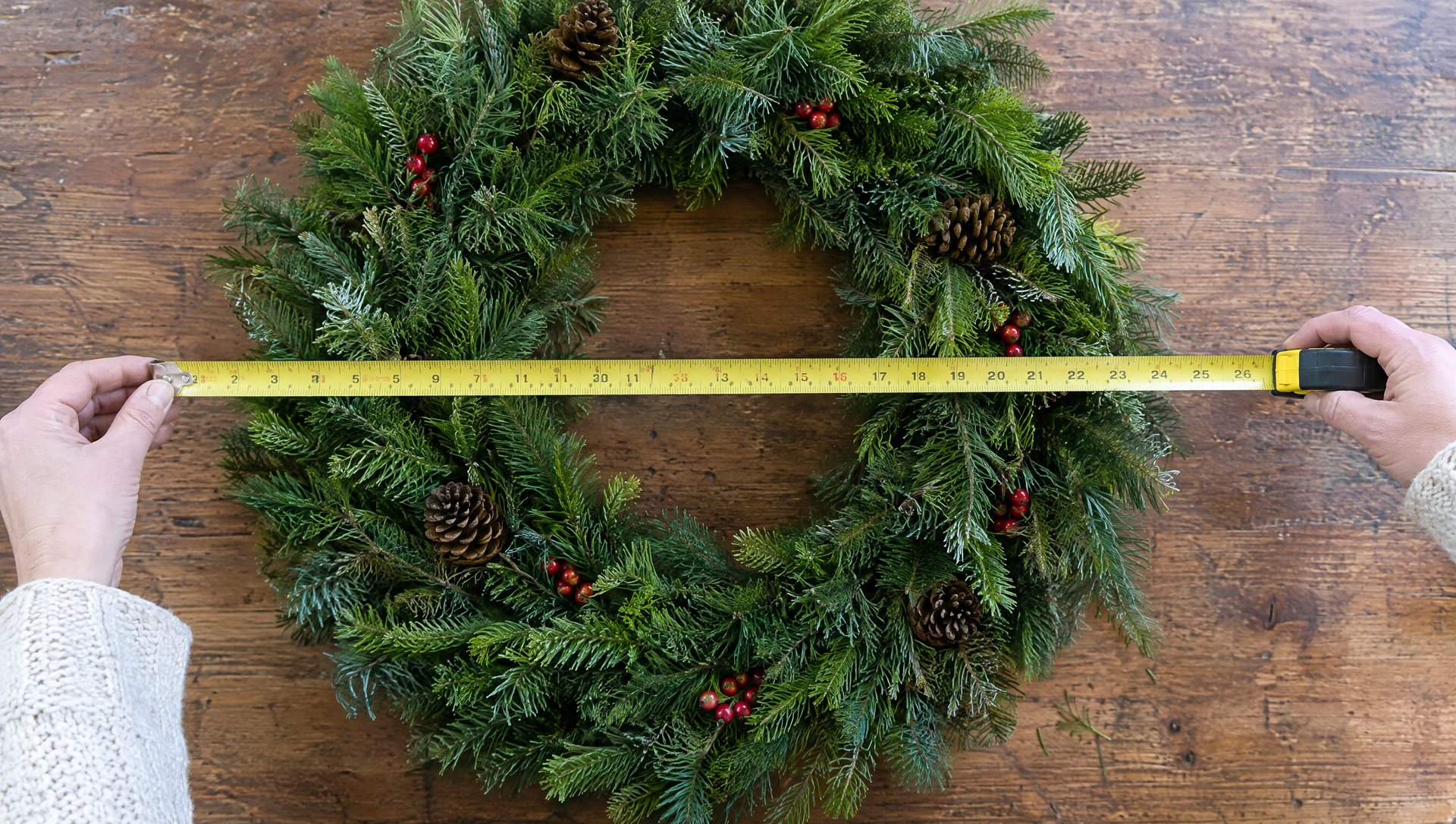
Measure the wreath the same way. A wreath’s advertised size can be the wire frame or the finished branches. You want the product’s outside diameter, including foliage, ornaments and bow. A “24-inch frame” with full branches and a big bow can be 30 inches across.
Then do the paper test. Cut 24- and 28-inch circles from wrapping paper, tape each one to the door and look from the sidewalk and from arm’s length. The bigger circle often looks right from the street and crowds the handle up close. That 5-minute test saves most wreath returns.
Height: center the wreath side to side, with its middle at about eye level in the upper half of the door, and clear of the peephole and knocker. Adjustable over-the-door hangers make it easy to hit the height you want.
Door 1: the standard 36-inch door with a storm door
The setting: a 1970s or 1980s ranch, a 36-by-80 entry door, a full-view storm door in front of it, a covered stoop with a porch light beside the frame.
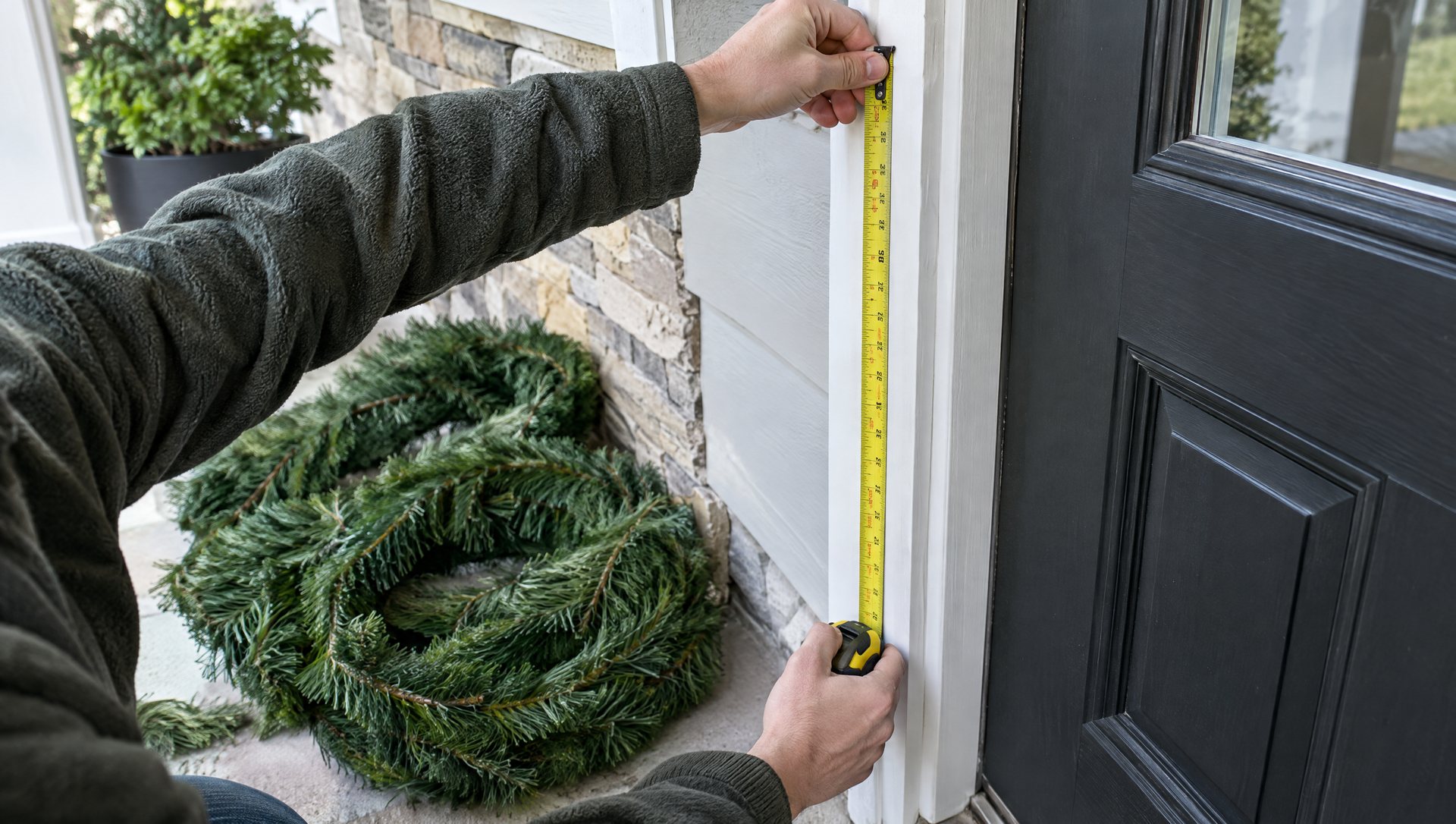
The problem is depth. The gap between an entry door and its storm door is often only a couple of inches. A full wreath stops the storm door from closing, or presses against the glass until the branches flatten. Measure the gap before you buy. You have three choices:
- A flat-back wreath that fits the gap, hung on the entry door behind the glass. It reads through the glass at night if it’s lit.
- A full wreath on the outside of the storm door, on a hanger made for it.
- A full garland frame around the outside trim and no wreath at all.
The numbers: a 24-inch wreath, about 17 feet of garland for the frame. Hang garland on the outer trim, beyond where the storm door’s hinges and closer sit, so the storm door still opens fully.
The light: battery lights on the wreath, since a cord can’t cross the opening. The porch light beside the frame will wash out a dim wreath after dark. Either pick a wreath with more lights or let the garland carry the light and keep the porch light on; people still need to see the step.
Door 2: the 8-foot door under a tall entry
The setting: newer construction, a 36-by-96-inch door, sometimes a transom window above, a two-story entry that people see from 60 feet away at the curb.
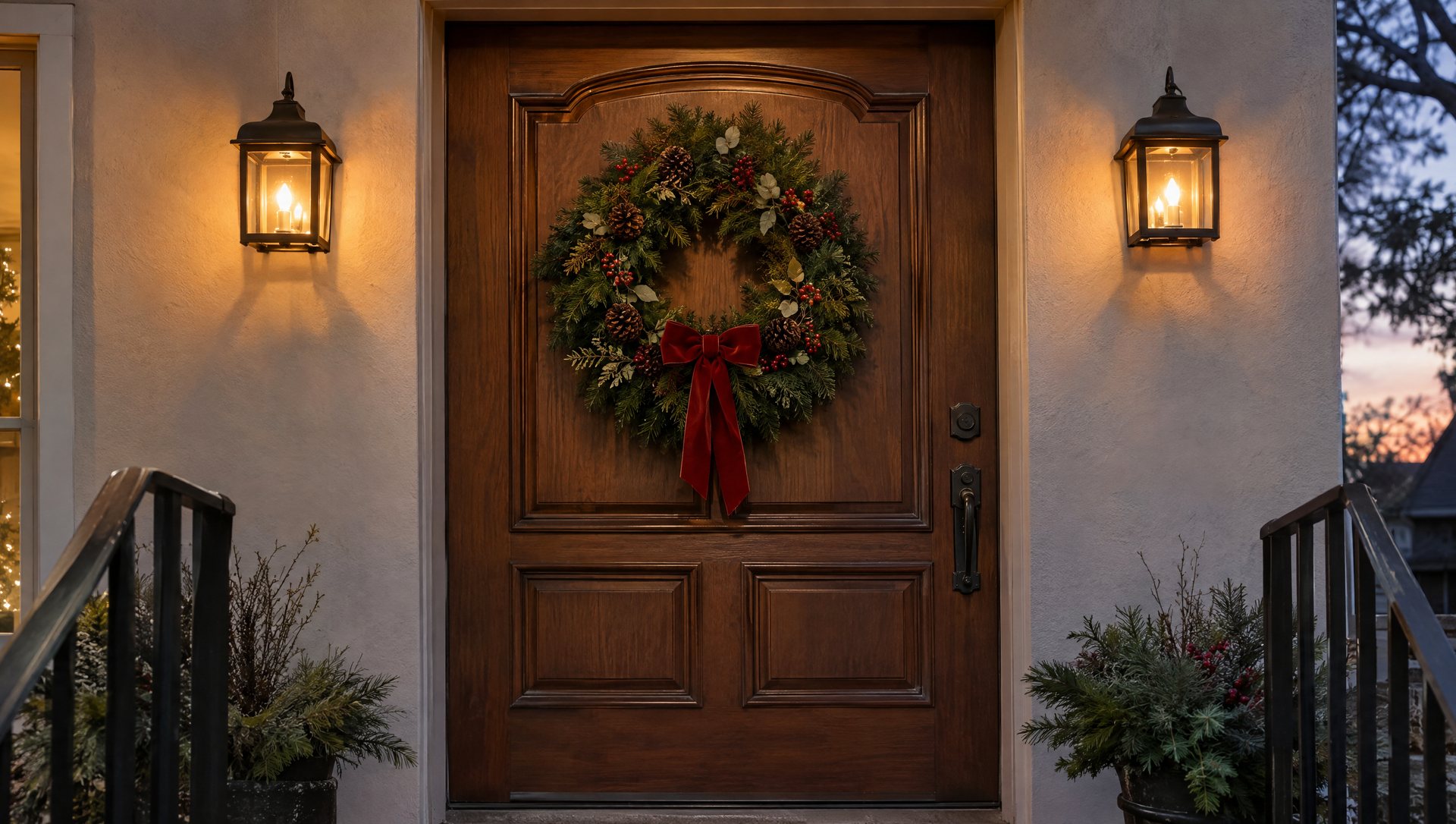
The wreath goes up a size. By the two-thirds rule a 36-inch door still wants a 24-inch wreath, but a door this tall, seen from this far, makes a 24-inch wreath look like a coaster. Go to 28 inches, and check it with the paper test from the street.
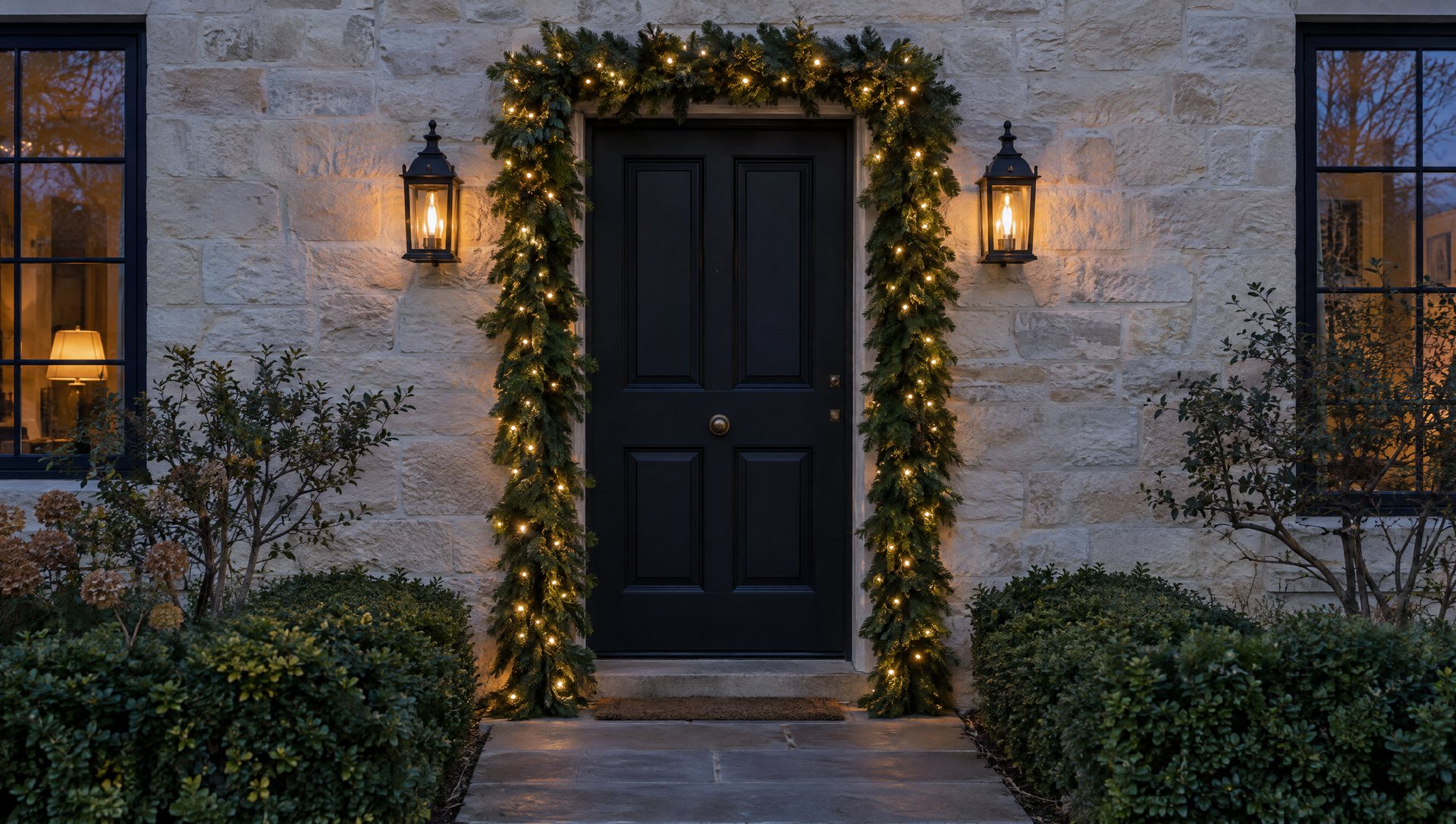
The garland needs a third length. 96 + 96 + 36 = 228 inches, 19 feet before tails. Two 9-foot lengths fall short, so buy three and tuck the excess as tails.
Use the height. A wreath hung on the door alone can get lost in a two-story entry. A garland frame turns the whole doorway into a shape you can read from the street. If there’s a transom, a second, smaller wreath centered above the door looks better than stretching the garland over the glass.
Get the top run hung safely. At 8 feet plus trim, the top of the garland is ladder work. A step ladder on a flat, dry porch is fine; a ladder on steps or a sloped walk is not.
Door 3: double doors set into limestone
The setting: Hill Country-style house, a pair of 30-inch doors under a limestone arch or surround, no wood trim to hook anything to.
Two wreaths, not one. One wreath per leaf, each about two-thirds of that leaf: a 20-inch wreath on each 30-inch door. A single wreath centered across the pair blocks the opening and has nothing solid to hang from. If the doors have a lot of glass or carving, a single larger wreath on the wall above them is the other good answer.
Garland on stone is the hard part. Adhesive hooks don’t hold on rough limestone. 3M specifies its outdoor clips for smooth, sealed surfaces like doors, flat vinyl siding and finished fences, not natural stone. Brick clips that grip a brick face don’t fit the irregular edges of cut limestone either. Your options:
- Garland only around the door frame itself, if there’s a wood or metal frame inside the stone
- A pair of tall planters or urns on either side, with greenery and lights, instead of a frame
- If you must anchor into the wall, anchor into the mortar joint, never the stone face. Mortar can be patched in January; a hole in a limestone block is there forever
The numbers: about 20 feet of garland for a 6-foot opening at 80 inches tall, more if you follow an arch. Measure an arch with a flexible tape along the curve; it’s longer than it looks.
Door 4: the bungalow door with glass and sidelights
The setting: an older central-Austin bungalow or craftsman, a door with a large glass panel, narrow sidelights on one or both sides, a deep porch.
The wreath’s back is now on display. On a door that’s half glass, everyone inside sees the back of the wreath all season: wire frame, zip ties and a battery box. Choose a wreath that’s finished on the back, or hang it on the outside of a storm door, or put the wreath on the wall beside the door instead.
Size to the panel, not the door. If the glass takes the top half, the wreath goes on the solid lower panel or on the glass itself, sized to that panel. A 20-inch wreath centered on the glass often looks better than a 24-inch one hanging off the edges of it.
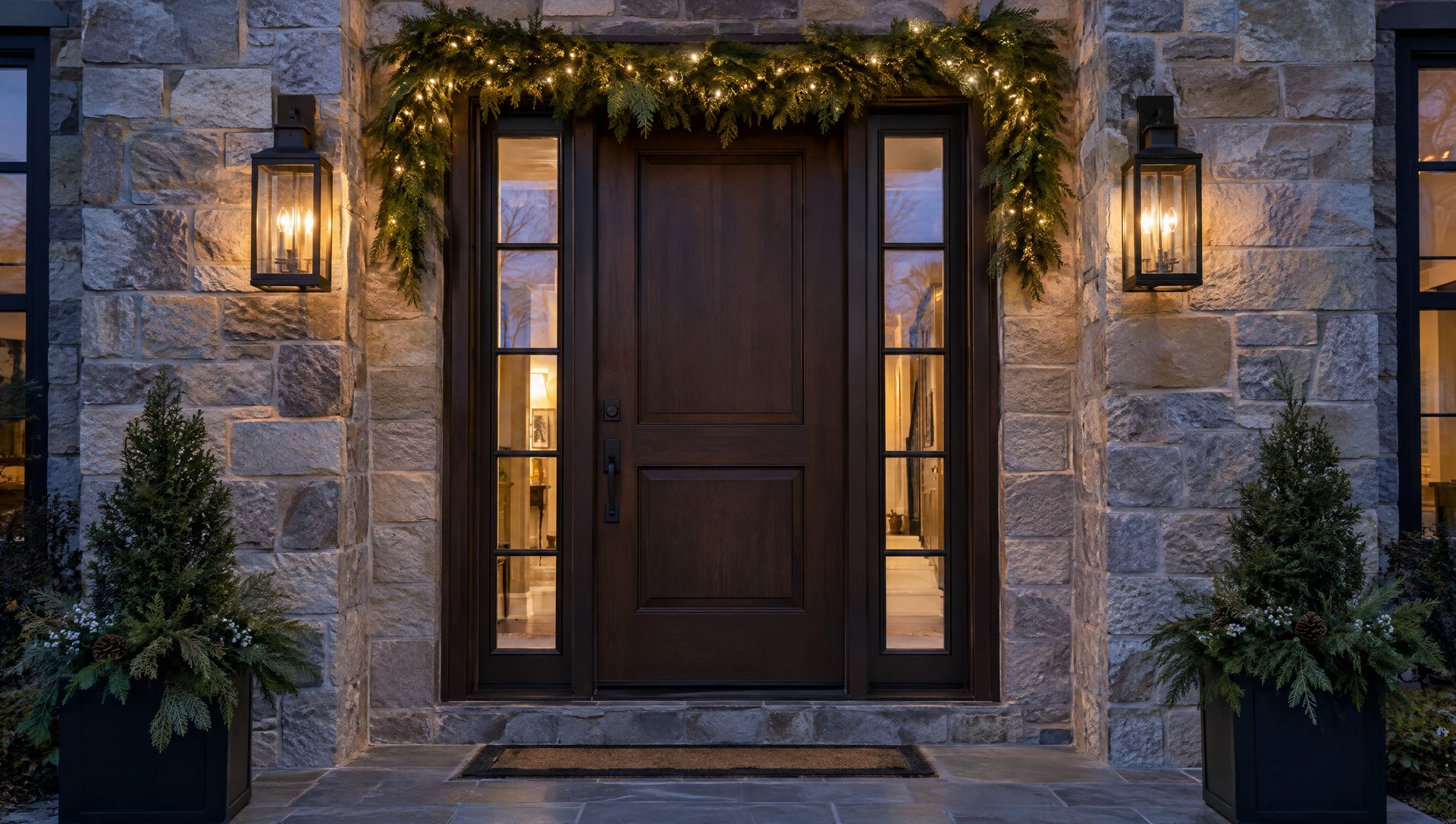
Frame the whole unit. With sidelights, the “door” is really door plus sidelights. A top swag across the full width suits this entry better than a full frame, which can crowd the narrow sidelights. Measure the full width of the unit, then add 1.5 to 2 feet of garland per foot of span if you want it to drape. A 6-foot-wide unit with a gentle swag takes about 9 to 12 feet across the top.
Use the porch. A deep porch can carry an off-center arrangement: one large planter on the side with more room, a smaller wreath on the door, a short garland on the opposite upper corner. Keep one piece dominant. Our front porch lighting guide has more for porches like this.
Hanging hardware by surface
Give the wreath and the garland separate supports. The light wire should never be the thing holding anything up, and a sagging garland gets fixed at its supports, not by pulling on the wire.
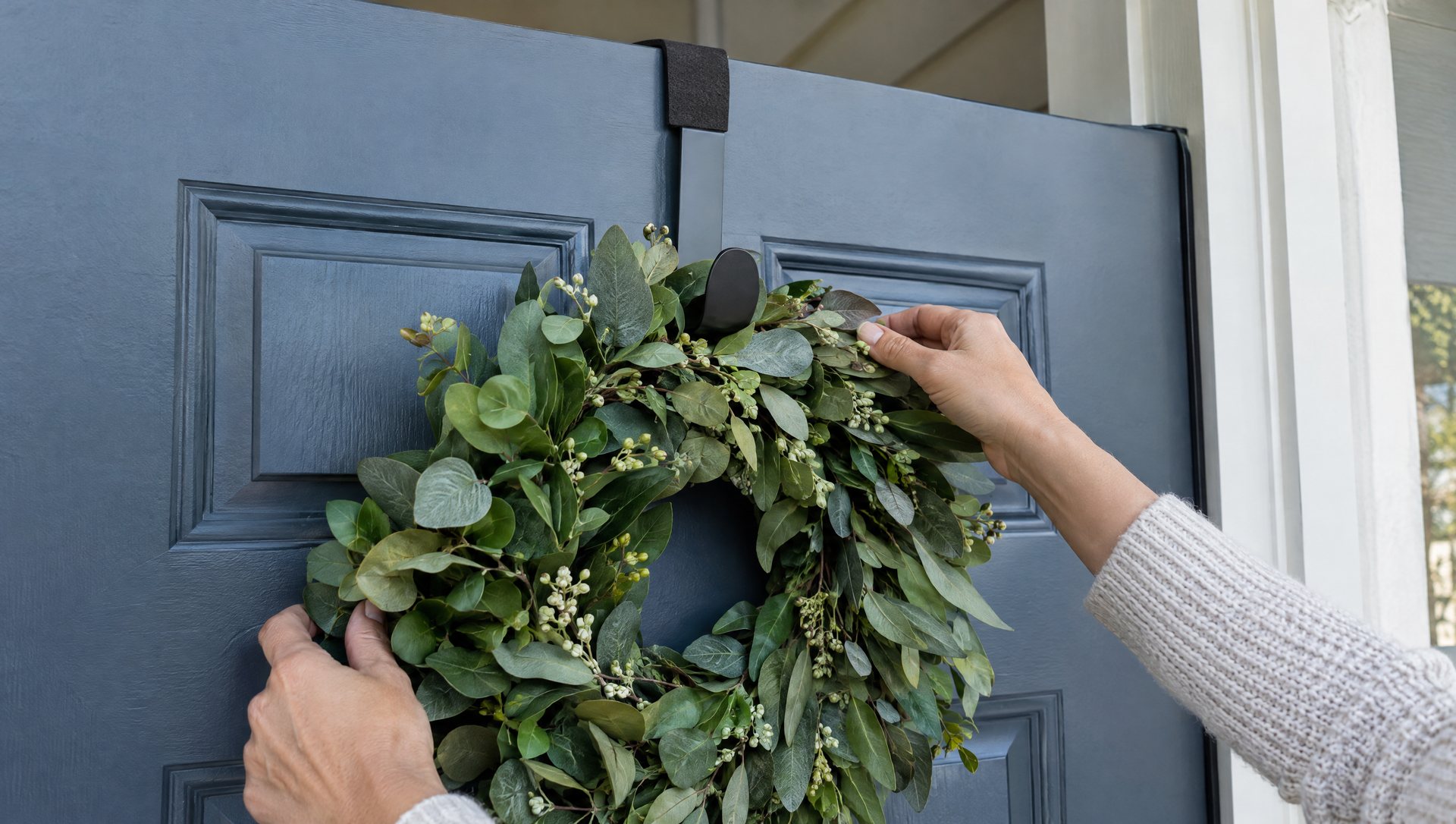
- Over-the-door hanger: the easy choice for most wreaths. Pick one with a felt or rubber back, then check that the door still latches and seals with it in place.
- Magnetic hanger: for steel doors only; it leaves no marks. Check its weight rating against the whole wreath, batteries included.
- Adhesive hooks and clips: only on smooth, sealed surfaces such as painted wood trim, vinyl and smooth metal. Not on limestone, stucco or rough brick.
- Door-frame garland hooks: purpose-made hangers that hook over the top of the trim, so no nails go in.
- Tension rods: for a recessed entry with flat side walls, a spring-tension rod across the top of the opening can carry a light garland without touching the stone.
If you aren’t sure what will hold, or it needs high access, ask an installer before you drill into the house.
Lighting a wreath and garland
Battery or plug-in. Battery lights belong on any wreath that hangs on a door, because nothing crosses the opening. Look for a built-in timer, commonly 6 hours on and 18 off, so you set it once. Plug-in lights suit a wall-mounted wreath or a garland frame with an outlet nearby. Never run a cord through a closing door; it gets pinched every time someone comes in. Our battery-operated outdoor lights guide covers runtime and brightness in more depth.
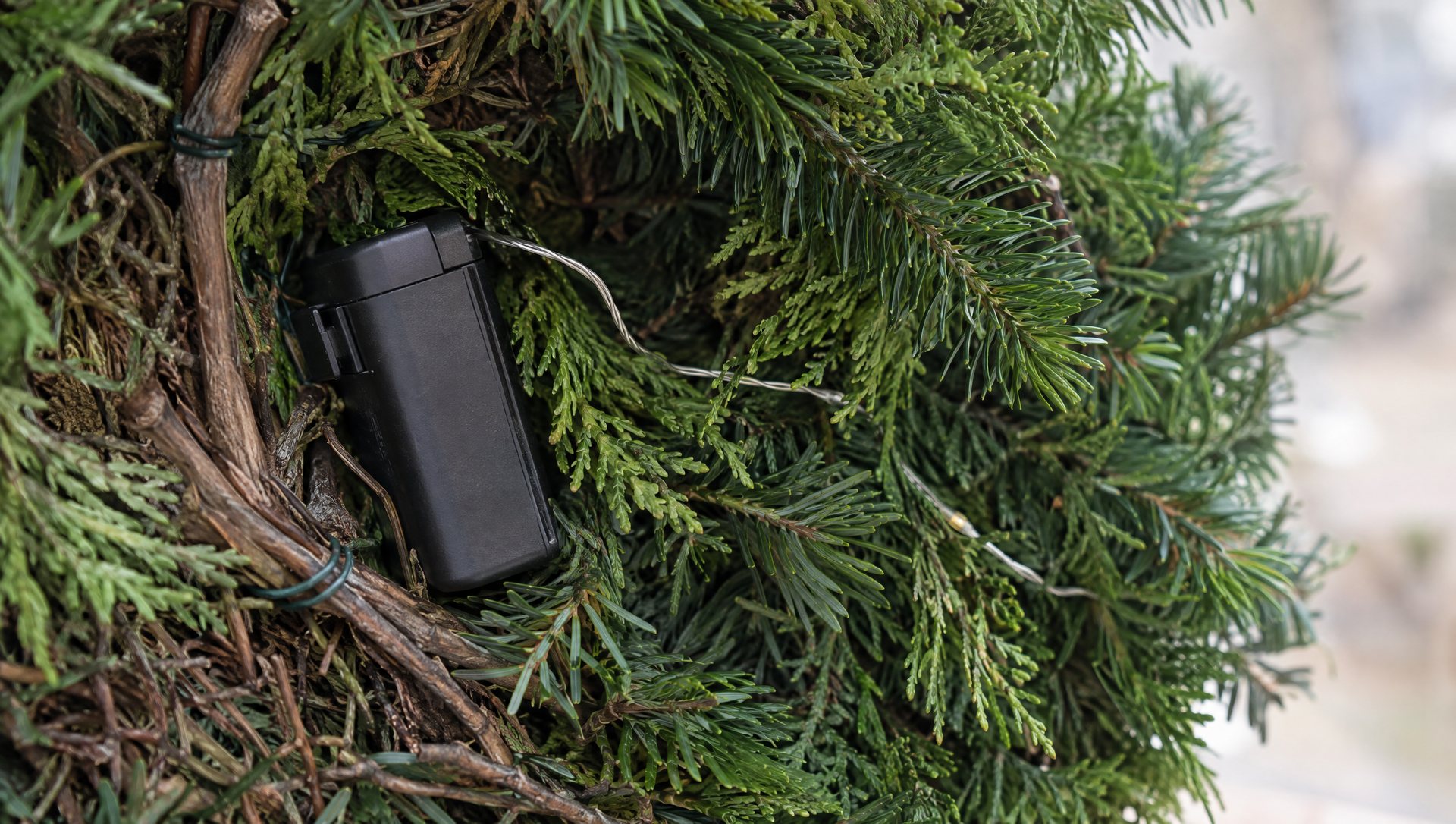
Hide the hardware. Tuck the battery box at the bottom back of the wreath, where it’s easy to reach and water drains off it. Weave the string from the back and point the bulbs outward. A sheltered door still gets rain when a cold front blows through, so the box, the timer and any controller need to suit an outdoor spot.
Match the whites. Hold the wreath next to your roofline or tree lights before you buy. “Warm white” covers visibly different colors, and a mismatch is most obvious when two whites sit in the same garland. If you can’t match them, keep each white on its own feature.
Balance density. A heavily lit wreath can become a glowing disk while a sparse garland around it nearly disappears. Look at the pair from the curb and from the doorstep before you call it done.
Real greenery in an Austin December
Fresh fir, cedar and pine garland look and smell wonderful. In a warm, sunny Austin entry, they also dry out faster than they would somewhere colder, and December here can bring days in the 70s. Dry greenery drops needles on the doormat and isn’t something you want lights buried in.