


Landscape Lighting in Austin
Uplit live oaks, glowing limestone, safe paths and a patio you actually use after dark. We design, install and support low-voltage landscape lighting for Austin-area homes.
Landscape lighting that makes your home look its best at night
| Question | Answer |
|---|---|
| What do you light? | Trees, house facades, stone walls, walkways, steps, driveways, patios, pergolas, outdoor kitchens, pools and pet areas |
| What kind of system? | Low-voltage LED lighting run from a transformer, with cable buried in beds and lawn |
| What does it cost? | Quoted per property. Fixture count, cable runs, transformer size and fixture finish set the price |
| Do I need an electrician? | Usually not, if there is an outdoor GFCI outlet. If a new outlet or circuit is needed, a licensed electrician adds it first |
| Can I control it from my phone? | Yes. Timers, zones and smart home integration are available |
| How do I start? | Text photos of your yard and house to (737) 777-9099, or call 9 am to 11 pm daily |
What we light
Good landscape lighting does three jobs at once: it makes the house and trees look beautiful, it makes steps, paths and doors safe, and it lets you use the yard after dark. Each system is designed around those three for your property.
Trees and live oaks
Uplights at the base of the trunk carry light up through the limbs. On a big live oak, two or three fixtures from different angles bring out the shape of the whole canopy.
House facade and stone
Soft light washed or grazed across limestone, brick and columns gives the house depth instead of a flat, floodlit look.
Paths and driveways
Low path lights spaced to make pools of light, so a walk is easy to follow without looking like a runway.
Steps and walls
Step lights set into risers and retaining walls light every tread, the spot where most nighttime trips happen.
Patios and outdoor living
Downlights, pergola lights and soft accents around seating, kitchens and fire pits, on their own zone so you can set the mood.
Pet areas
The back door, steps, gate and the route to the dog run, lit so late-night trips are safe for you and your dog.
Landscape lighting techniques, and where each one works
Most beautiful yards use several techniques together. These are the ones we use most on Austin homes.
Uplighting
A fixture at the base of a tree, column or wall, aimed up. It is the most common technique and the one that makes a live oak glow. On wide trees we light from more than one side so the canopy doesn't look flat.
Moonlighting
Fixtures mounted high in a tree, aimed down through the branches. The light falls on the lawn and patio as soft, moving leaf shadows, like a full moon. It is one of the best looks for a backyard under big oaks.
Shadowing and silhouetting
A light placed in front of a plant throws its shadow onto the wall behind it, larger than life. Agave, yucca, mountain laurel and Texas sage make striking shadows on limestone. Silhouetting does the reverse: the wall is lit and the plant stands dark in front of it.
Grazing and washing
Grazing puts the light close to a textured surface such as cut limestone or a stone wall, so every edge casts a small shadow. Washing sets the light back for an even, soft glow on smoother walls.
Path and area lighting
Shielded fixtures that put light on the ground, not in your eyes, spaced so pools of light overlap a little.
Step and hardscape lighting
Small louvered fixtures built into steps, walls and seat walls, so the light is there but the fixture almost disappears.
Downlighting
Light from eaves, pergolas or trees aimed down onto patios, driveways and doors. Good for security without harsh floodlights.
Avoiding glare matters as much as adding light. Read our guides to outdoor light shields, common lighting mistakes and Texas lighting regulations.
Patio, outdoor living and pet-area lighting
In Austin, the best hours to be outside from May to October are after sunset. Lighting is what turns a patio into a room you use at night.
- Downlights in the patio ceiling and on pergola beams
- String lights on pergolas and guide wires, hung straight and secure
- Soft light on seating, outdoor kitchens and fire pits, on a separate zone
- Step and path lights from the patio to the yard, pool and gate
- Pet routes and dog runs lit, with cable protected from digging and chewing
Planning a patio? Start with eight deck and patio lighting mistakes and lighting options for pets.
How we design a landscape lighting system
A lighting plan starts with how the yard is seen and used, not with a box of fixtures.
1. Views
Where the house is seen from: the street, the driveway, the back windows, the patio. Each view gets a focal point, usually the best tree or the front entry.
2. Layers
Focal points first, then the facade, then paths and steps, then soft fill so nothing falls into a black hole between them.
3. Warm, consistent color
One warm white across the property, usually 2700K to 3000K, so the trees, stone and windows look like they belong together.
4. No glare
Shielded fixtures, careful aiming and the right brightness, so you see the tree, not the bulb, and the neighbors don't see your lights in their windows.
5. Shadow mapping
We plan with the sun's path: which walls bake all afternoon, where solar can charge, and where summer shade falls on the yard. How shadow mapping works.
6. Zones and control
Front yard, backyard and patio on separate zones, on timers that follow sunset or tied into your smart home.
What's different about lighting an Austin yard
Live oaks
Austin's broad, low live oaks are the best thing to light in most yards, and they deserve care. The Texas A&M Forest Service warns against wounding oaks because of oak wilt, so fixtures in a canopy are strapped on, not nailed, and uplights sit clear of the trunk.
Limestone and thin soil
Much of the area has only a few inches of soil over rock. Cable routes are planned around it, using beds, edges and conduit where trenching isn't possible.
Heat and storms
Summer heat bakes fixtures on west walls, and spring storms bring heavy rain. Fixtures and connections are chosen and placed for it. See 11 weather-related landscape lighting mistakes.
Dark-sky neighbors
Parts of the Hill Country take dark skies seriously. Shielded, warm, well-aimed light keeps your yard beautiful without lighting up the sky.
How a low-voltage landscape lighting system works
Most home landscape lighting is low voltage. A transformer, mounted on the house near an outdoor outlet, steps household power down to 12 volts. Low-voltage cable runs from it through beds and lawn to each fixture. A timer or smart control switches each zone on at dusk and off when you choose.
- Safer to work around than line voltage, and easy to adjust as plants grow
- LED fixtures use far less power than older halogen systems
- Usually plugs into an existing outdoor GFCI outlet
- If you need a new outlet or circuit, a licensed electrician adds it first
More detail: when you need an electrician for landscape lighting in Austin and what IP ratings mean outdoors.
Our process
Send photos
Text photos of your house and yard to (737) 777-9099 and tell us what you want lit and how you use the space.
Consultation and design
We visit your home, look at the landscape and talk through your goals, then design a lighting plan that fits the property and your smart home setup.
Professional installation
Our technicians install the system with commercial-grade equipment and methods, with care for your lawn, beds and trees.
Support after install
System checks, adjustments as plants grow and smart home updates. We're available 9 am to 11 pm daily.
What does landscape lighting cost in Austin?
Every system is quoted per property, because two yards rarely need the same thing. These are the things that set the price:
| Cost factor | Why it matters |
|---|---|
| Number of fixtures | The biggest driver: each tree, wall, path and step light adds up |
| Cable runs | Distance from the transformer, and trenching through lawn, beds or rock |
| Transformer and control | Size of the system, number of zones, timers or smart control |
| Fixture quality and finish | Solid brass and copper last longer outdoors than painted aluminum |
| Hardscape work | Step and wall lights built into stone take more labor |
| Power | Whether an existing outdoor outlet works, or an electrician must add one |
Many homeowners start with the front yard and add the backyard and patio later; a system can be designed with room to grow. Text photos to (737) 777-9099 to start a quote.
What our customers say
Reviews from Sapien Lighting's Google listing, word for word. Read them all on Google.
Make the same yard shine for the holidays
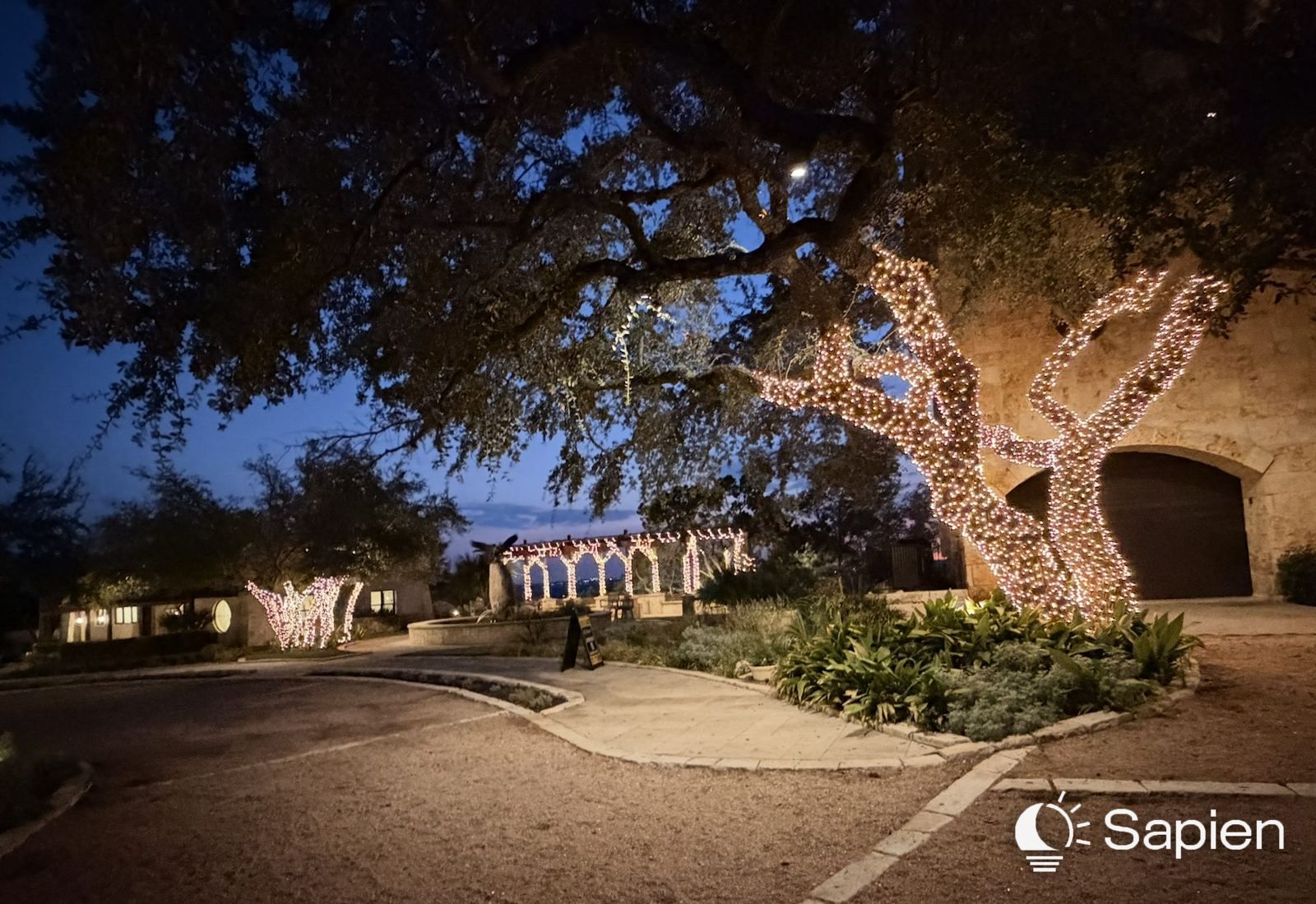
The live oaks you uplight all year are the same trees that look best wrapped for Christmas. Sapien installs seasonal Christmas lights and tree light wrapping with January takedown, and permanent, app-controlled holiday lighting that stays up all year.
Or read about permanent Christmas lights.
Where we install landscape lighting
Sapien is based in North Austin and works across the Austin area:
- Austin
- Round Rock
- Cedar Park
- Steiner Ranch
- Lakeway
- Bee Cave
- West Lake Hills
- Barton Creek
- Brushy Creek
- Hutto
- And nearby: just ask
Frequently asked questions
How much does landscape lighting cost?
Every landscape lighting system is quoted per property, because the price depends on how many fixtures you need, how long the cable runs are, the transformer size, the fixture finish and how much hardscape gets lit. Send photos of your yard to (737) 777-9099 to start, and we'll come out to design the system and give you an exact price.
What is low-voltage landscape lighting?
Most home landscape lighting runs at 12 volts. A transformer steps your household power down to low voltage, and low-voltage cable runs from it to each fixture, buried shallow in beds and lawn. It is safer to work around than line voltage and makes it easy to move or add fixtures later.
Do I need an electrician for landscape lighting?
Usually not for a low-voltage system that plugs into an existing outdoor GFCI outlet. If your yard has no usable outdoor outlet, or the system needs a new dedicated circuit, a licensed electrician adds that first. Our guide on when you need an electrician for landscape lighting in Austin covers the details.
What color of light looks best on a home and trees?
Warm white, around 2700K to 3000K, flatters limestone, brick, wood and green leaves and feels like a home rather than a parking lot. Cooler light can work on a modern facade or a silver-leaf plant, but we use it sparingly.
Can landscape lights run on a timer or an app?
Yes. Systems can run on a timer that follows sunset, on zones you control separately, or tied into a smart home setup so the yard, patio and holiday lighting work from your phone.
Will landscape lighting bother my neighbors?
It shouldn't. Good design aims light at the tree, wall or path and keeps it off the neighbor's windows and the sky. We use shielded fixtures and careful aiming to avoid glare and light trespass. More in our post on light trespass.
Do warm LEDs attract fewer bugs?
Generally, yes. Insects are drawn more to blue and ultraviolet light, so warm white LEDs tend to attract fewer of them than cool white or older bulbs. It matters most around patios and doors.
Are solar landscape lights good enough?
For a few accents in full sun, they can be. They are dimmer, fade on cloudy days and in the shade of a live oak, and rarely light a tree well. A wired low-voltage system is brighter, aimable and consistent. See our solar landscape lights review for where solar works.
Do you light patios, pergolas and outdoor living areas?
Yes. Patio and outdoor living lighting is a big part of what we do: downlights, step lights, string lights on pergolas and soft light around seating and kitchens.
Can you light a dog run or the path the dog uses at night?
Yes. Pet-area lighting covers the back door, steps, gate, the route to the yard and the dog run, with the cable protected where pets dig or chew. Read the best outdoor lighting options for pets.
What is shadow mapping?
Shadow mapping means working out where the sun and its shadows fall on your property through the day and year, then using that map to place lights, solar panels and fixtures that would otherwise bake on a west wall. Sapien uses it when planning outdoor lighting. Here's how the sun's path should shape your outdoor lighting.
Will fixtures hurt my live oaks?
Not when they're installed with care. Uplights sit at the base of the tree, and fixtures mounted in a canopy are strapped on rather than nailed in, so the tree isn't wounded. Wounds on oaks can let oak wilt in, which is why the Texas A&M Forest Service warns against them.
Do you also put up Christmas lights?
Yes. Sapien installs seasonal Christmas lights and permanent holiday lighting too, and the same trees you uplight all year can be wrapped for the holidays. See Christmas light installation in Austin.
What areas do you serve?
Austin and nearby cities, including Round Rock, Cedar Park, Steiner Ranch, Lakeway, Bee Cave, West Lake Hills, Barton Creek, Brushy Creek and Hutto. Just outside that area? Text us your address and we'll tell you.
Start your landscape lighting design
Text photos of your house and yard to (737) 777-9099 and tell us what you'd like to see at night. Prefer to talk? Call us, 9 am to 11 pm daily.