


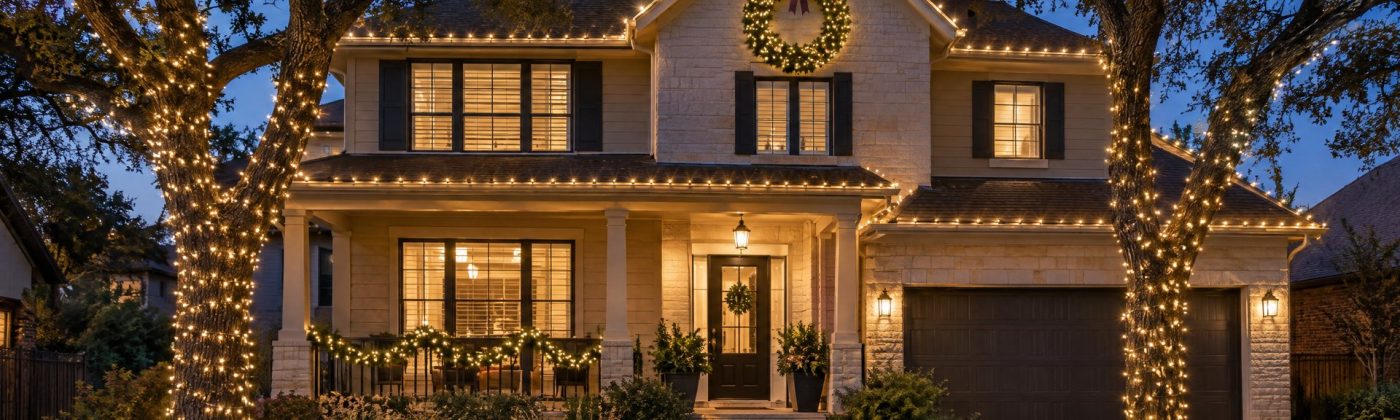
Outdoor Christmas Decorations That Look Best Lit at Night, Ranked
The outdoor Christmas decorations that look best at night are the ones made of light and shape: a wrapped tree, a C9 roofline, a lit wreath, garland framing the door, a single big star, light spheres in a canopy and wire-frame figures against a dark lawn. Unlit ornaments, ribbon, small signs and deflated inflatables mostly disappear once the sun goes down at 5:30.
That’s the whole trick of a night display: after dark, the house itself is gone. What’s left is whatever you drew in light. So below, the usual suspects are ranked by how much they do for a house seen from the street at night, roughly in the order we’d spend money on them. Then we build three real displays out of the list.
Why the night changes the list
In daylight, a front yard is full of information: brick, stone, lawn, shrubs, the color of the door. Decorations compete with all of it. At night, almost none of that shows. A string of lights along the eave becomes the house. A wrapped trunk becomes the tree.
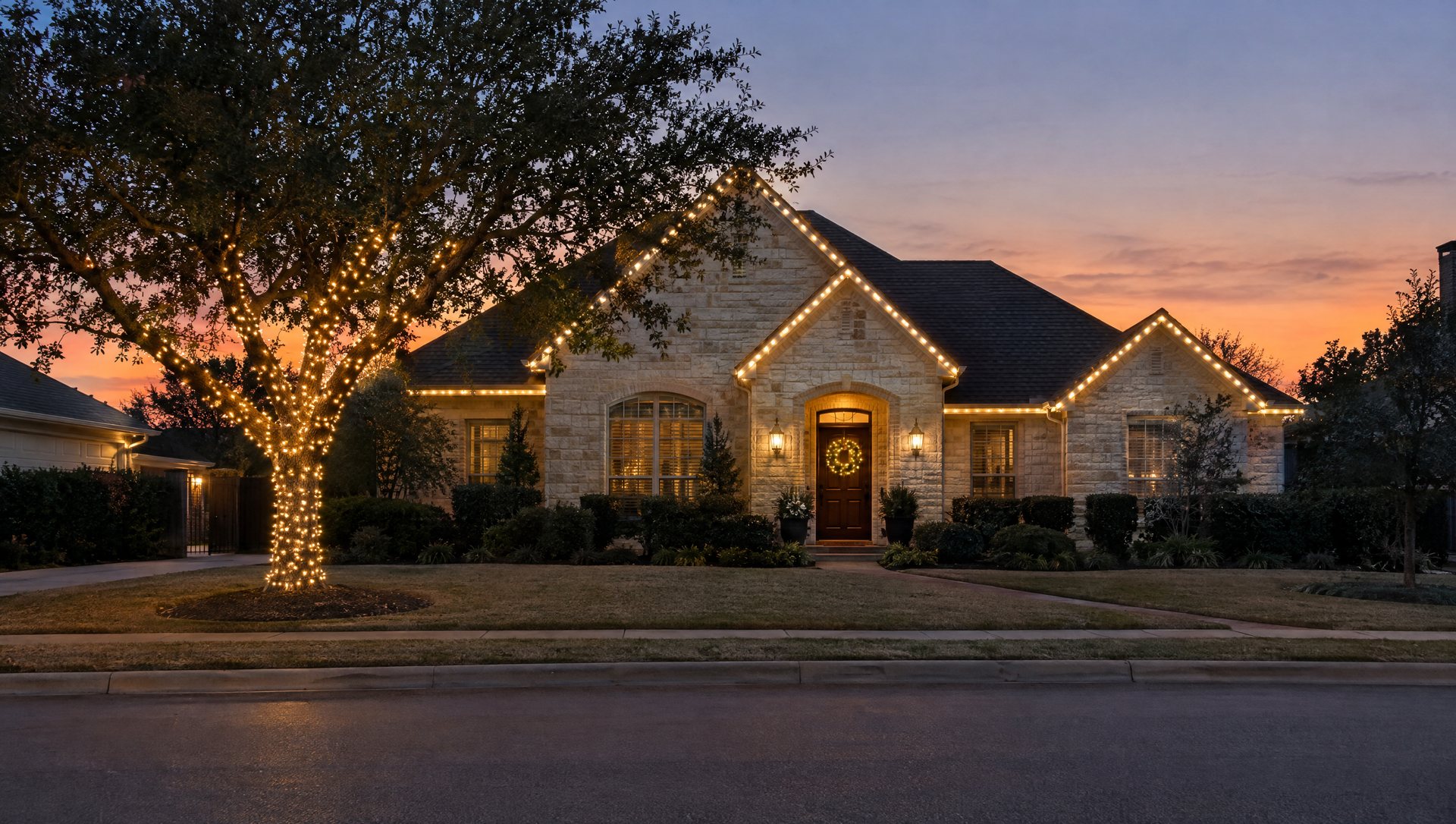
Three things follow from that, and they drive the ranking:
- Shape beats stuff. A decoration that draws a line or an outline (a roofline, a trunk, a door frame) reads from the street. A collection of small objects reads as a blur.
- Size is relative to distance. Most Austin front yards put the house 40 to 80 feet from the street. Anything that looks big from the porch looks small from there.
- Dark space is part of the design. A lit tree has more presence when the bushes next to it stay dark.
Here’s the whole list at a glance, before the detail:
| Decoration | Night impact from the street | In daylight | Needs a tall ladder? |
|---|---|---|---|
| Wrapped tree (trunk and limbs) | Very high | Wire visible on bark, fairly tidy | Usually, for the limbs |
| C9 roofline | Very high | Wire and clips along the eave | Yes |
| Uplit tree | High | Small fixtures at the base | No |
| Lit wreath, high | High | Looks like a wreath | Yes |
| Garland around the door | Medium | Looks like garland | No |
| Window candles | Medium, high on two stories | Barely noticeable | No |
| One big star | Medium to high | Wire frame on the gable | Yes |
| Light spheres | Medium to high | Wire balls in the tree | Usually |
| Wire-frame figures | Medium | Nearly invisible | No |
| Net-lit hedge | Low to medium | Net visible on the shrub | No |
| Path markers | Low | Stakes along the walk | No |
Tier 1: the decorations that carry a whole house
If you only do one thing, do one of these.
A wrapped tree, trunk and main limbs
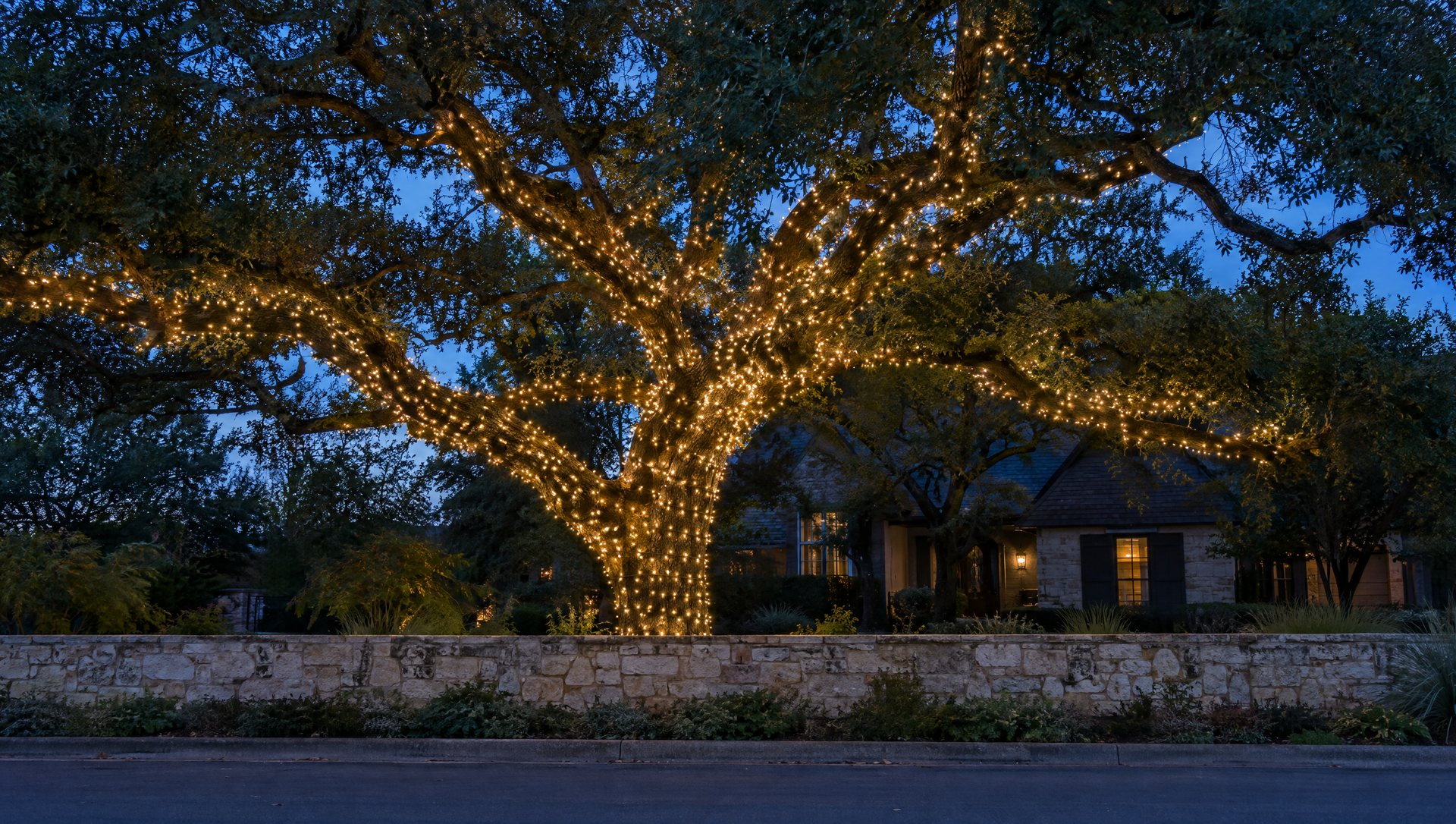
In Austin, a big live oak or cedar elm is often the best “decoration” on the property. Wrapped lights draw its structure, and no yard prop can compete with a 40-foot shape traced in light.
There are three levels. Trunk-only makes a strong vertical mark. Trunk plus main limbs shows the tree’s actual shape and is where most of the payoff is. A full canopy treatment is a much bigger job and rarely looks proportionally better from the street.
Pick the tree you can see from the sidewalk and the driveway, not the prettiest one in the backyard. And don’t overlook crape myrtles: they drop their leaves for winter, so their bare, sculptural limbs show every wrapped line, where an evergreen live oak hides half its limbs behind leaves.
For an oak, nothing should wound the bark. The Texas A&M Forest Service explains why fresh wounds matter for oak wilt. Sapien uses small removable staples where a wrap won’t hold and removes them in January, and we do staple-free wraps on request.
A C9 roofline outline
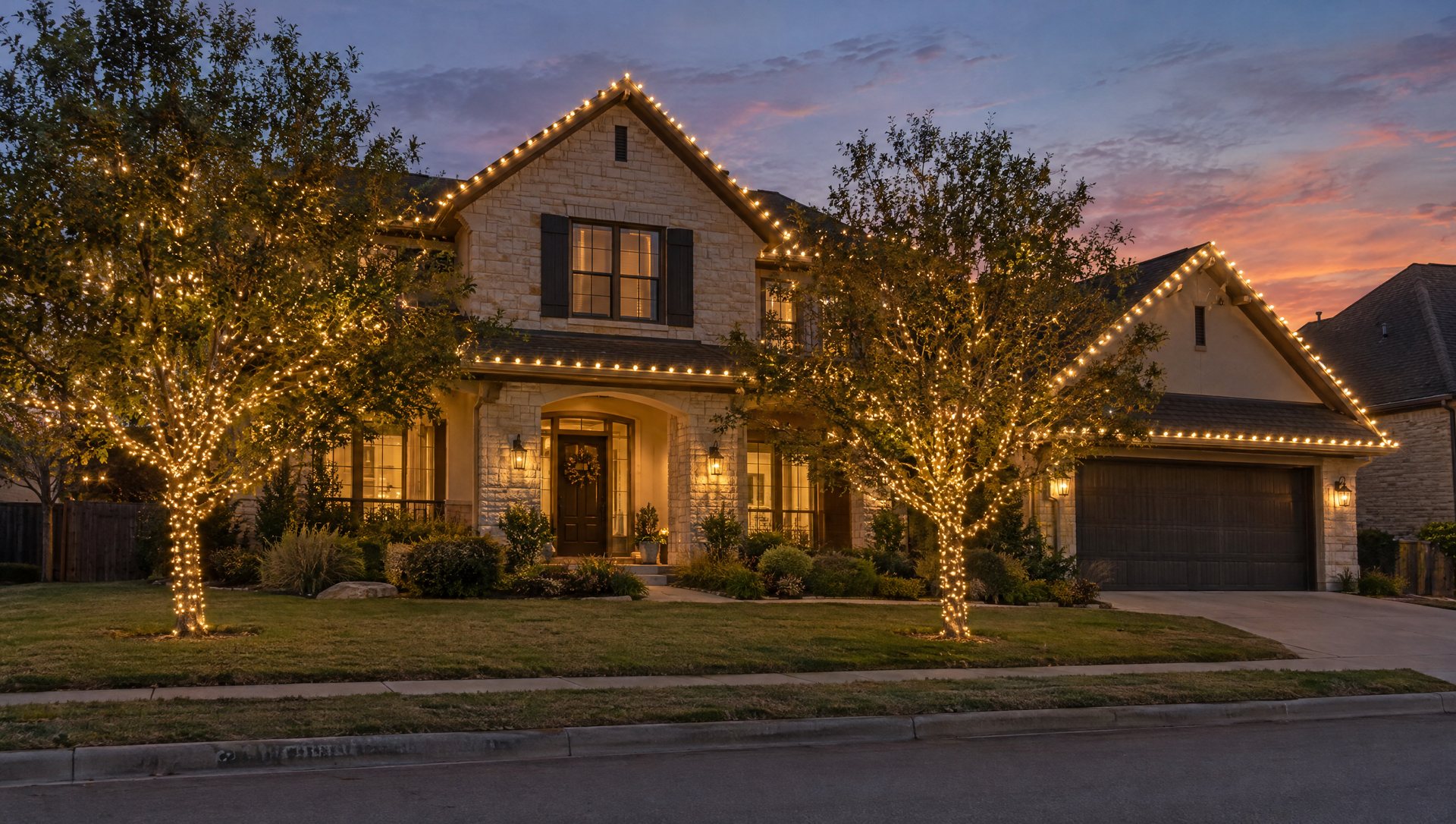
After sunset, the building disappears, and the line of bulbs gives it back its shape. A clean roofline is the decoration that most makes a house look finished at night.
Use one bulb style, one color plan and one bulb angle along every run. On a complicated roof, light the edges people actually see from the street and skip the hidden returns. A partial outline that follows the main gable and front eave looks more deliberate than tracing every dormer.
Sapien uses C9 LED bulbs on commercial wire cut to fit each run. Our C9 guide covers spacing, bulb counts and viewing distance.
An uplit tree
Warm landscape uplights at the base of a live oak or a limestone wall give a dramatic, quiet glow, and they work every other night of the year too. In December, an uplit oak plus a simple roofline can be the whole display.
Tier 2: the entry, where eyes land
Once the house has a shape, the eye looks for a destination. That’s the front door.
A lit wreath, sized for the street
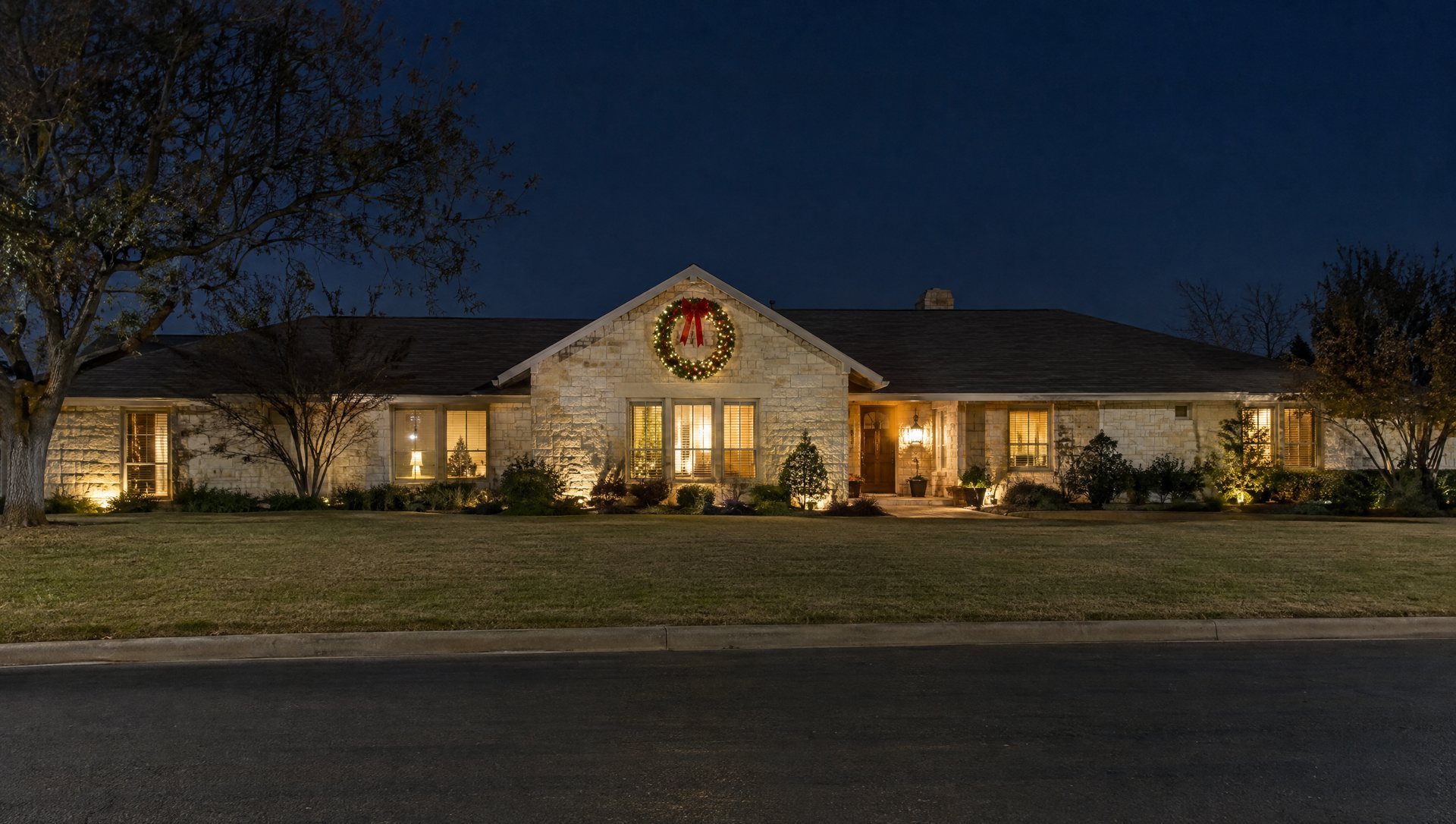
A wreath gives the eye somewhere to land and marks the center of a long ranch house. Pre-lit or wrapped in mini lights, it holds up at night; a plain green wreath next to a bright porch lantern mostly vanishes.
Scale matters more after dark. A 24-inch door wreath reads well from the walk and looks like a dot from across the street. For a gable, a chimney or the wall above a garage, think 48 inches or larger. Our door decorations guide covers sizing and hanging the door wreath itself.
Lighted garland framing the door
Garland with mini lights around the door frame turns the entry into a lit rectangle. It pairs with a wreath, and on a deep covered porch, where a wreath alone sits in shadow, it’s often the better piece. One framed doorway beats garland on every railing.
Window candles
A warm electric candle in every front window is one of the oldest night decorations, and it repeats beautifully across a two-story facade. Most battery window candles have built-in timers. Light every front window or none: one dark window in a lit row looks like a mistake.
Tier 3: shapes in the yard
These add a second focal point or fill a big, dark lawn. Pick one, not all three.
One big star
A single large lit star on the main gable or chimney is a simple, strong shape, especially on a house where a full roofline isn’t practical. Center it on the peak, hang it level and hide the power lead. Buy bigger than feels right: a star that looks huge on the driveway looks modest 25 feet up. One star is plenty.
Light spheres in a canopy
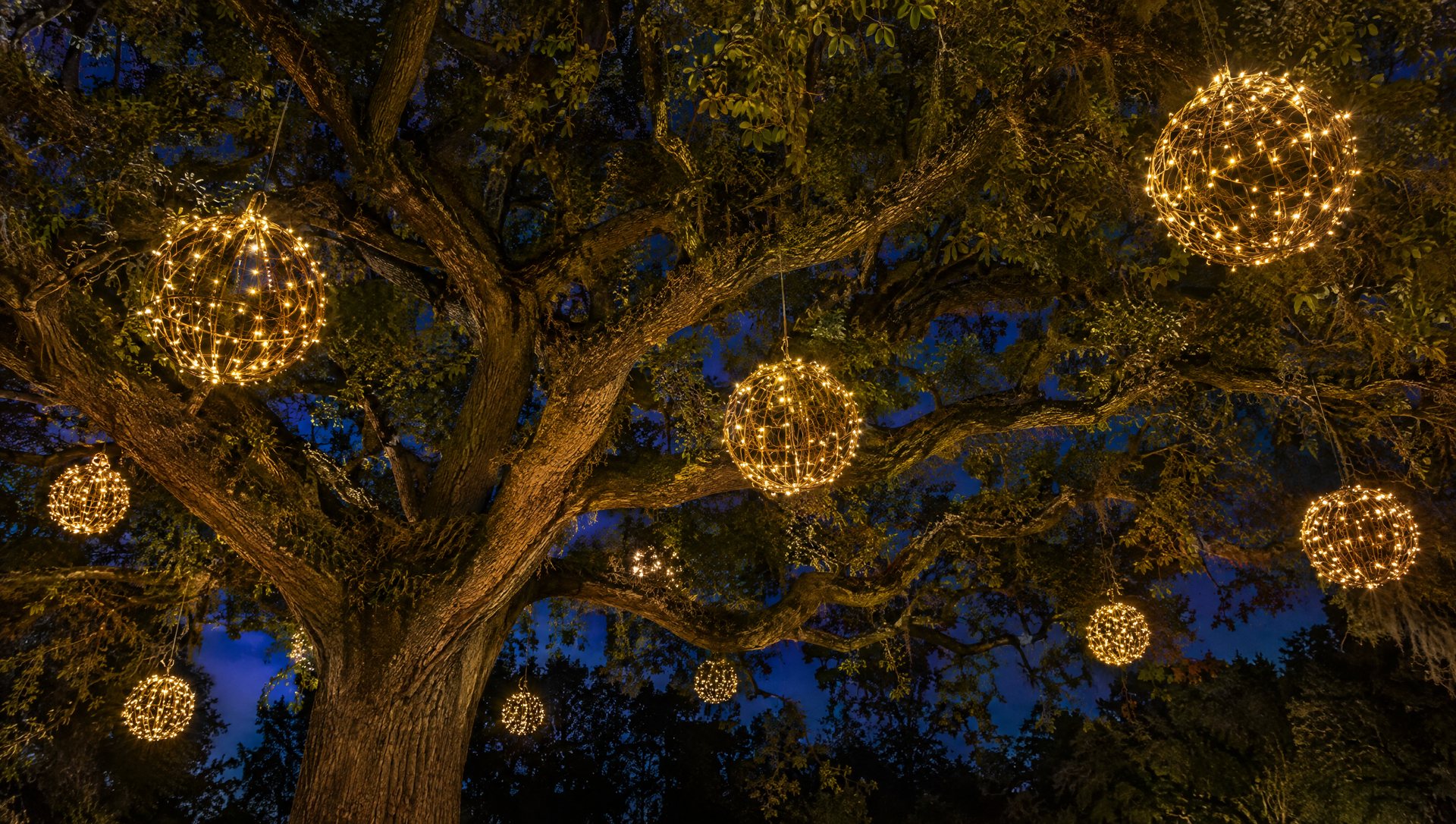
Light spheres are wire balls wrapped in mini lights, hung at staggered heights in a tree. At night they seem to float. They suit a big, spreading live oak, where wrapping every limb would be a huge job, and the evergreen canopy hides the hanging lines.
Hang an odd number at different heights so they don’t line up into a row. In daylight you’ll see the frames, so this is a night-first decoration.
Wire-frame deer, sleighs and trees
Lighted wire figures are nearly invisible by day and only come alive after dark. They depend on their outline, so each one needs a dark background.
Stagger them from the angle people actually see them. A group that looks well spaced from the lawn can collapse into one tangle from the driveway. Put the tallest figure where nothing bright sits directly behind it. On west Austin lots where a few inches of soil sit over limestone, the stakes that come with the figures hit rock; weight the bases with sandbags tucked behind them instead.
Tier 4: ground-level glow
Low light balances a roofline above it and leads people to the door. It’s supporting cast, not the star.
One net-lit hedge or shrub group
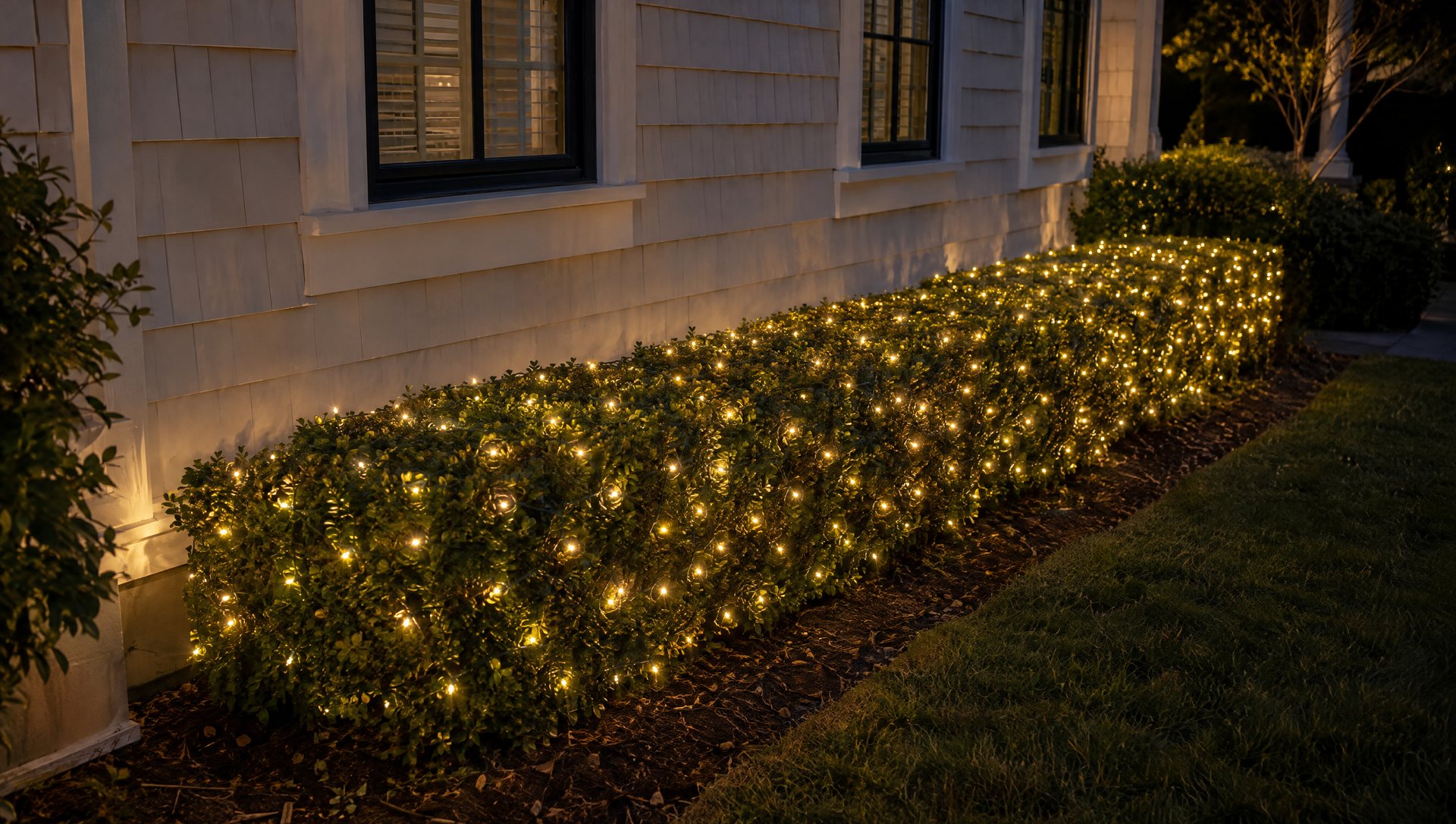
Net lights give a hedge a smooth, even glow. Choose one hedge or one bed, the one closest to the entry, and leave the rest dark. Our guide to lights on bushes compares nets with hand-wrapping.
Lit pathway markers
Lit stakes or electric luminaria along the walk draw a line to the door. Set them just outside the walking path so nobody catches a foot on a stake or cord, and keep your normal path lighting working. Our pathway and driveway guide has setback numbers.
What disappears after dark
- Unlit ornaments, ribbon and garland without lights. Beautiful at noon, gone at 6 pm unless something else lights them.
- Small yard signs. Unreadable from the street at night.
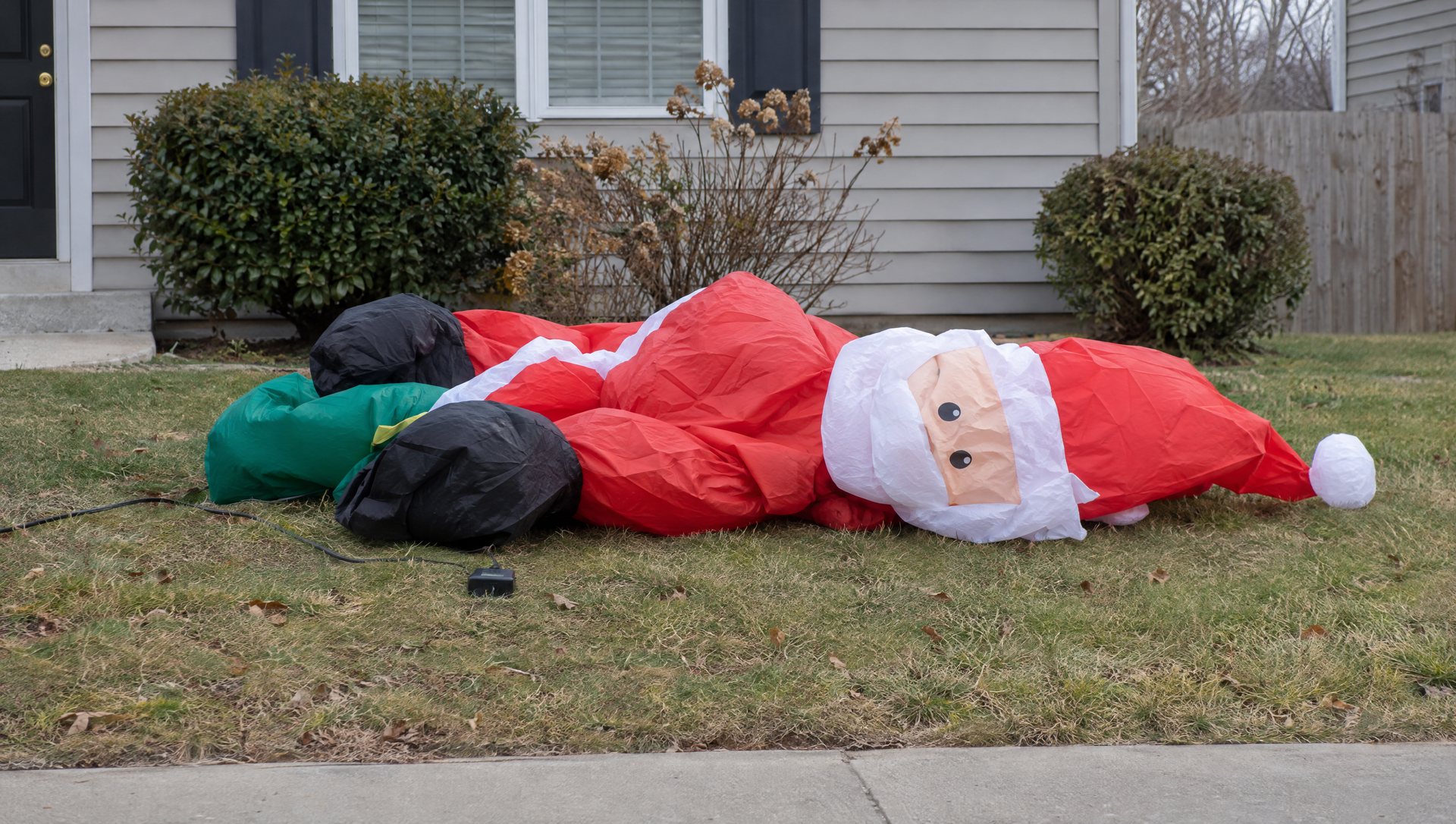
- Inflatables. They have two looks: lit and inflated at night, collapsed on the lawn all day. If you love one, put it where the daytime version isn’t the first thing people see.
- Projectors. They wash a wall in pattern but don’t add shape, so they tend to fight a roofline rather than complete it. Our projector review covers when they do work.
None of these are bad decorations. They belong to the daytime display, not the night one.
Three displays built from this list
Here’s how the ranking plays out on three common Austin house types. None of them use more than four items from the list.
A small bungalow with no roof work
An older central-Austin bungalow with a deep porch and one crape myrtle by the walk.
- Main feature: the crape myrtle, trunks and main limbs wrapped. Bare in winter, it shows every line.
- Entry: lighted garland framing the door, with a lit wreath on it.
- Windows: a candle in each of the two front windows.
- Left dark: the foundation shrubs.
No ladder above porch height, and it reads as a complete design from across the street.