


Christmas Lights on Live Oak Trees: How to Light Austin’s Signature Tree
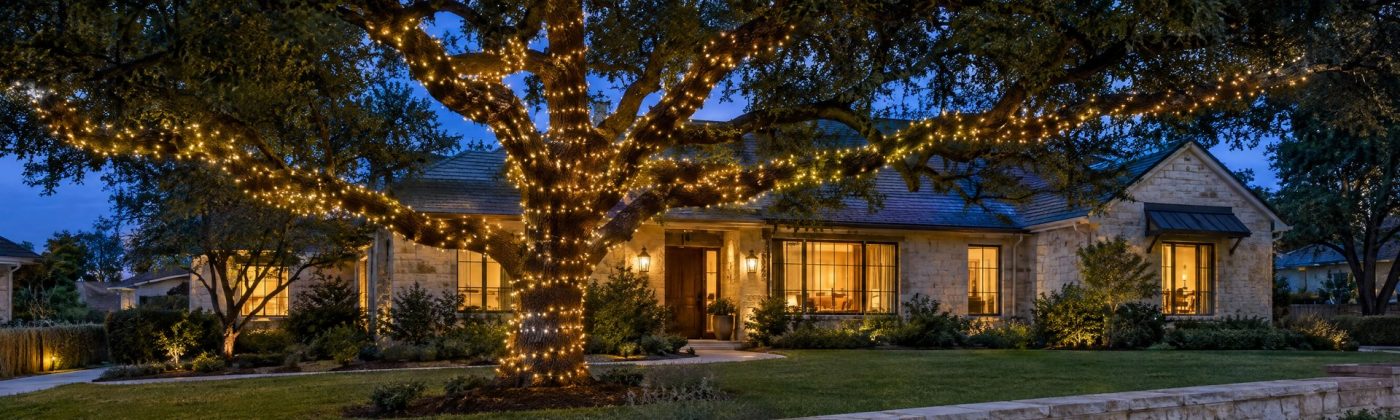
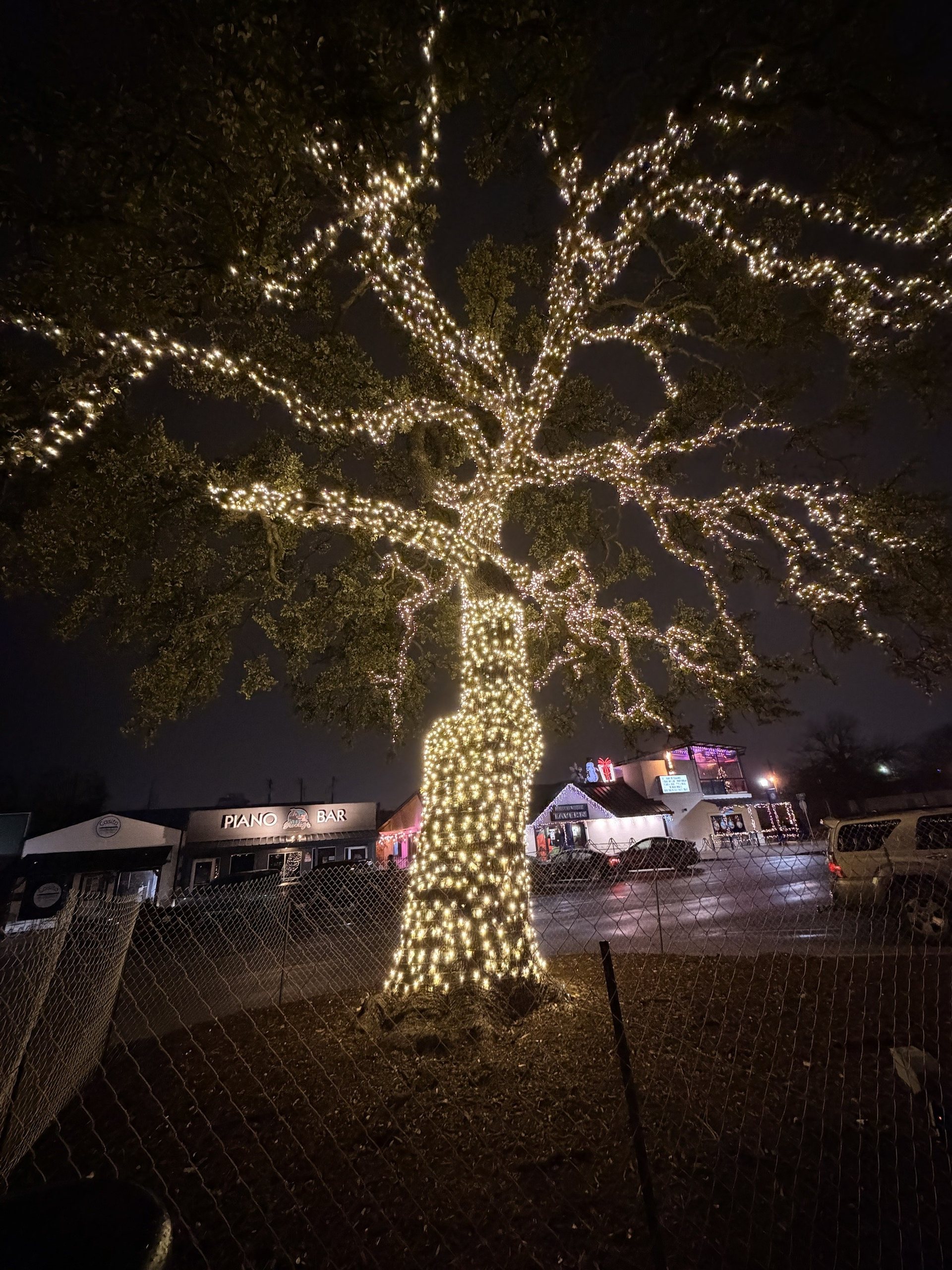
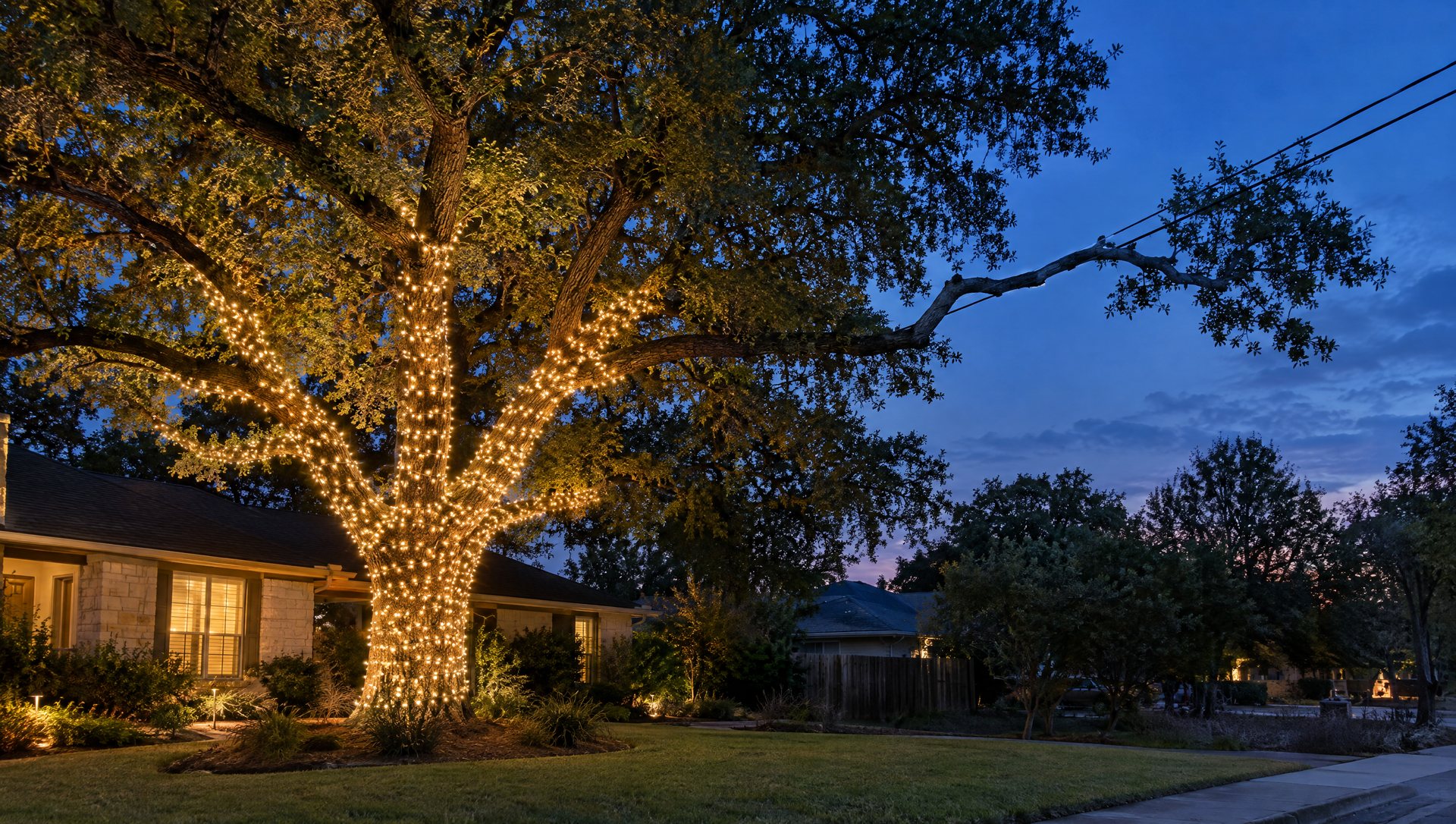
To put Christmas lights on a live oak, wrap the trunk and carry the wrap well out along the main limbs. For the biggest effect, go full canopy, with lights out through the branches and into the crown. Austin’s live oaks hold their leaves until late February or March, so canopy lights glow through the foliage all season. On a big oak, most of the string goes on the limbs, not the short trunk. Wrap snug, not cinched, drive nothing into the bark, cut nothing, and take it all down every year.
The short version
- Most of the lights go on the limbs. Decide how far out each main limb gets wrapped before you buy lights.
- Full canopy is the showstopper. Live oak leaves stay on through the holidays, so canopy lights glow through the foliage.
- Pick the wrap gap by where the tree is seen from: tighter up close, more open from the street.
- Do not nail, screw or cut an oak, and on an oak we’d skip staples too. Paint any oak wound right away, in any season.
- Take the wrap off every year, after the season and before spring growth.
This guide is for Austin homeowners lighting a big live oak. For prices and the full footage tables, see what it costs to wrap a tree in Christmas lights.
How do you light a live oak for Christmas?
Plan from the limbs inward: the trunk is short, and the long side limbs carry the look. Texas A&M Forest Service describes the live oak as a short, stout trunk that splits into several large, twisting limbs. The crown can spread more than 100 feet, and on open-grown trees the limbs often touch the ground. The Hill Country form, the escarpment live oak, is 20 to 40 feet tall with gnarled limbs that reach far sideways, per the Wildflower Center.
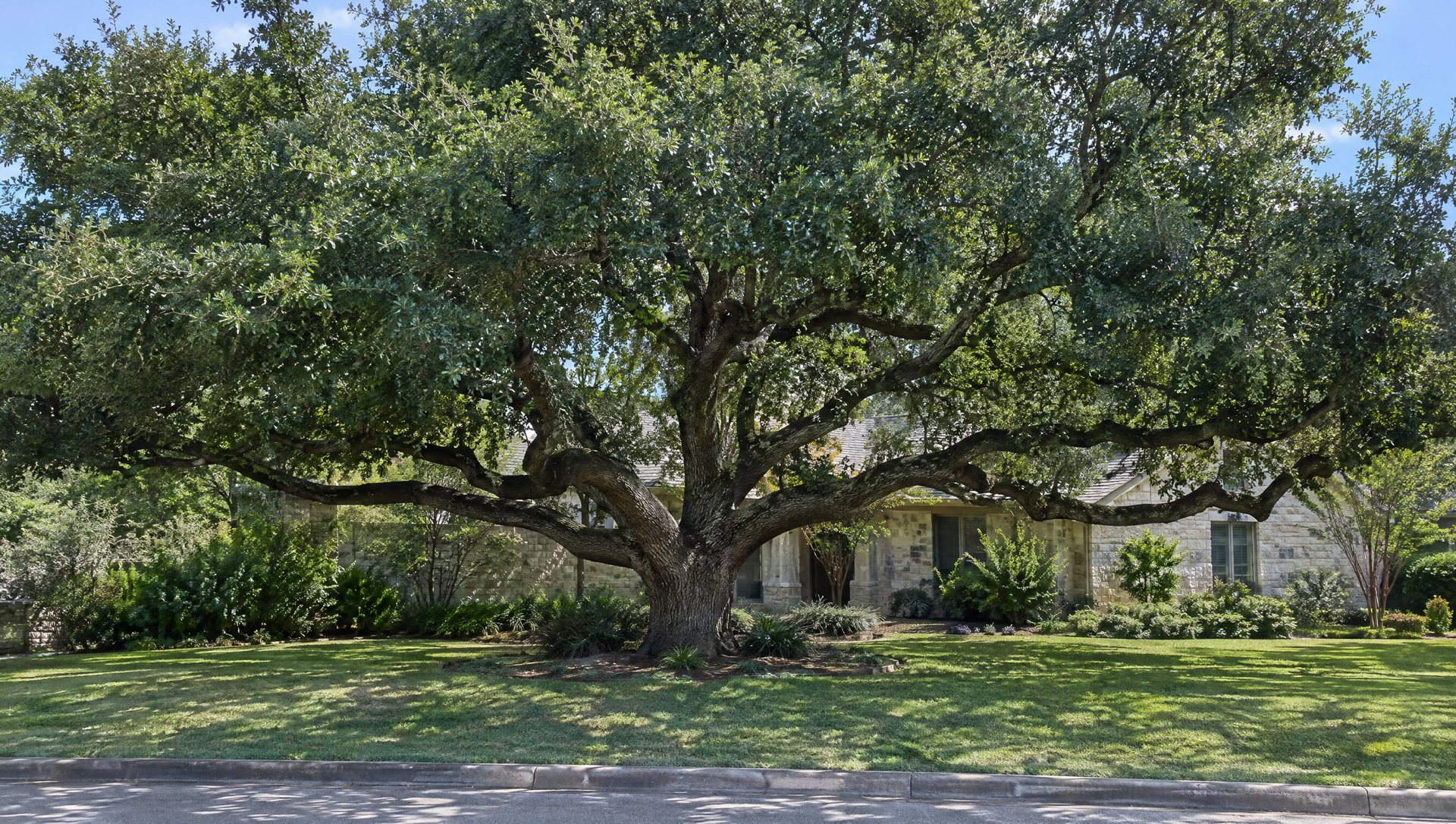
A simple order of work:
- Stand where people see the tree, usually the street.
- Pick the main limbs that face that view.
- Decide how far out each one gets wrapped, and the gap.
- Then work out the footage and the power.
Trunk, limbs or canopy: which parts of a live oak to light
Light the trunk and main limbs at the least; full canopy is the top of the range. The three coverage levels, as this page uses them:
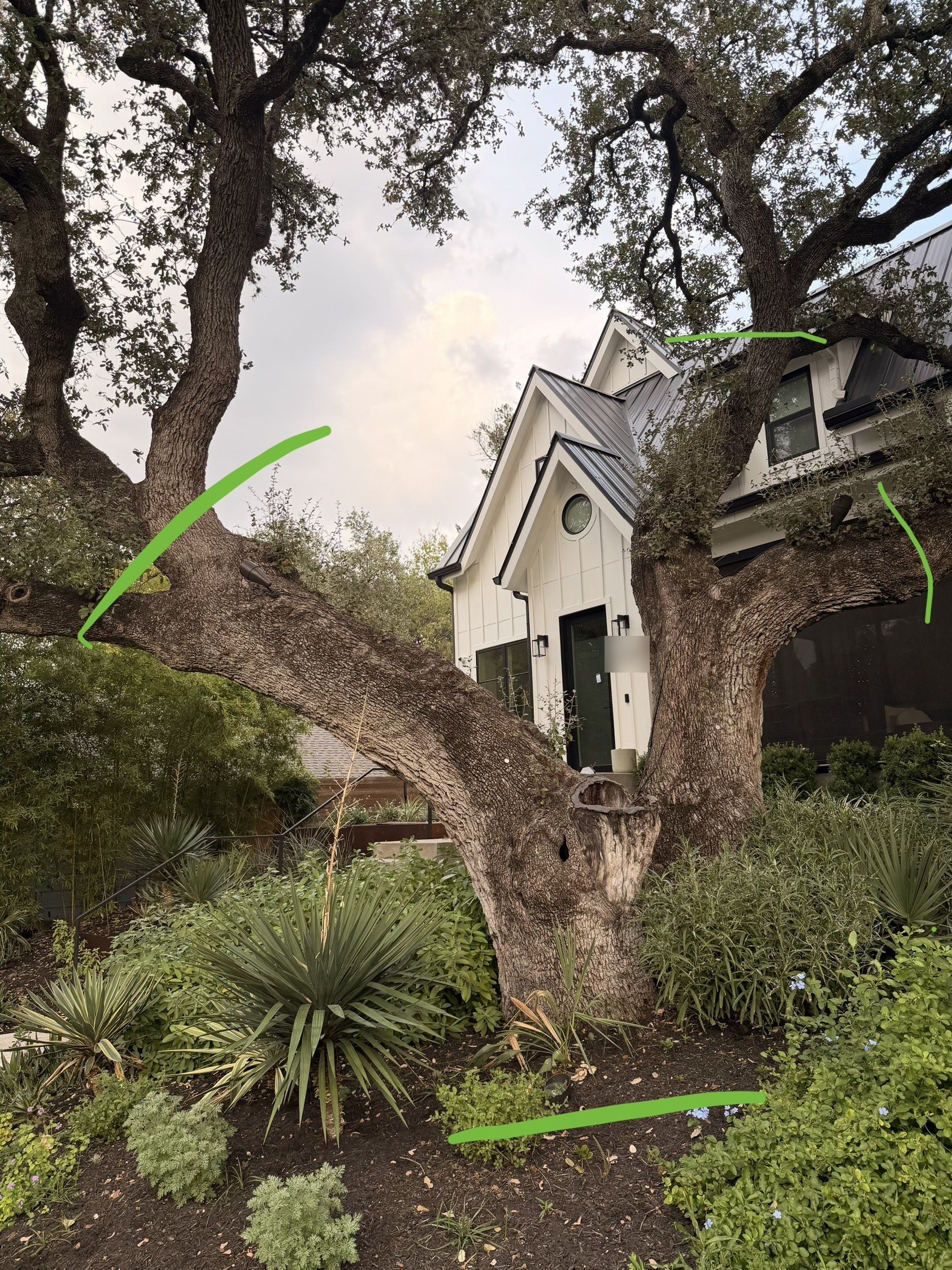
- Trunk wrap: a string spiraled up the trunk to the first fork.
- Trunk-and-limb wrap: the spiral carried out along the main limbs.
- Canopy lighting: lights in the smaller branches and leafy crown, wrapped or draped.
A trunk-only wrap on a live oak often looks like a lit post under a dark mass, because the trunk is so short. Wrapping the limbs shows the tree’s wide, low shape at night.
Will the leaves hide the lights?
In the crown, they soften rather than hide. The Wildflower Center says the escarpment live oak swaps its leaves in late February or March, and the southern live oak drops its old leaves late each winter as new ones appear. So the crown is full all season, and lights inside it read as a soft glow through the foliage rather than crisp lines. A full canopy also takes far more lights and time than a limb wrap. As Rick puts it: “You’re going to love it, but you may not love the price!”
Can you drape lights over the branches instead of wrapping them?
Yes. Davey Tree says lights laid over branches can be acceptable, while spiral wraps eventually girdle if left on. On a live oak, draped strings sit among the leaves for a soft glow, while a wrap on the bark gives crisp lines; together they give the fullest look.
How far out the limbs should the lights go?
Go as far out as budget and reach allow, and stop every limb at about the same point. Christmas Lights Etc says in its tree-wrapping guide that most trees are wrapped about 3 to 4 feet up the main branches. On a live oak 50 or more feet wide, the City’s Grow Green figure, 3 to 4 feet barely leaves the fork. People often size a tree job by height, but on a live oak, limb diameter, limb count, how far out you go and the gap set the footage.
Think of it as a limb budget. Davey Tree’s trunk formula (circumference ÷ gap × height), rewritten with diameter and applied to a limb, gives: 3.14 × limb diameter (in) ÷ gap (in) = feet of lights per foot of limb.
| Limb diameter | 3-in gap, ft per ft of limb | 3-in gap, per 10 ft of limb | 6-in gap, ft per ft of limb | 6-in gap, per 10 ft of limb |
|---|---|---|---|---|
| 6 in | 6.3 ft | 63 ft | 3.1 ft | 31 ft |
| 8 in | 8.4 ft | 84 ft | 4.2 ft | 42 ft |
| 12 in | 12.6 ft | 126 ft | 6.3 ft | 63 ft |
| 18 in | 18.8 ft | 188 ft | 9.4 ft | 94 ft |
The table is our arithmetic. Real bark takes more. On an 18-inch pecan at about a 6-inch gap, Christmas Light Source measured 11 feet per vertical foot, where the formula gives 9.4, and it adds 10% or at least one extra string. Old live oak bark is deeply furrowed, so plan at the high end.
Opening a limb from a 3-inch to a 6-inch gap halves its footage, and the Christmas Light Emporium’s wrapping guide already suggests 6 to 8 inches on branches. Christmas Lights Etc wraps each branch out with gaps and back to fill them, so the string ends near the trunk and the cord.
How many lights does a big live oak take?
By the standard formula, a big live oak with a 36-inch trunk and five main limbs takes roughly 500 to 800 feet of mini lights. How far out the limbs are wrapped decides most of it.
Example (our arithmetic): a 36-inch trunk, 6 feet to the fork, at a 3-inch gap takes about 226 feet. Five 12-inch limbs, each wrapped 15 feet out at a 6-inch gap, add about 471 feet. With 10% extra, that is about 767 feet, or roughly 33 mini strings of about 23 lit feet each (70 bulbs at 4-inch spacing). Our tree-wrap cost guide wraps the same limbs only 8 feet out and gets about 525 feet. Limbs taper, so treat these as planning numbers.
Where to stop: reach
Fifteen feet out along a live oak limb can be well above ladder height. Wrap only what you can reach from the ground, or from a ladder on firm, level ground without standing on its top rungs, per the American Ladder Institute’s ladder safety basics. Never rest a ladder against a limb, which can flex under load. A limb you could reach only by climbing the tree, or by coming within 10 feet of a power line, stays dark or goes to a crew with a lift.
Does a multi-trunk live oak take more lights?
Per foot of height, usually yes. Every stem gets its own wrap, and three 10-inch stems have more bark around them than one 24-inch trunk.
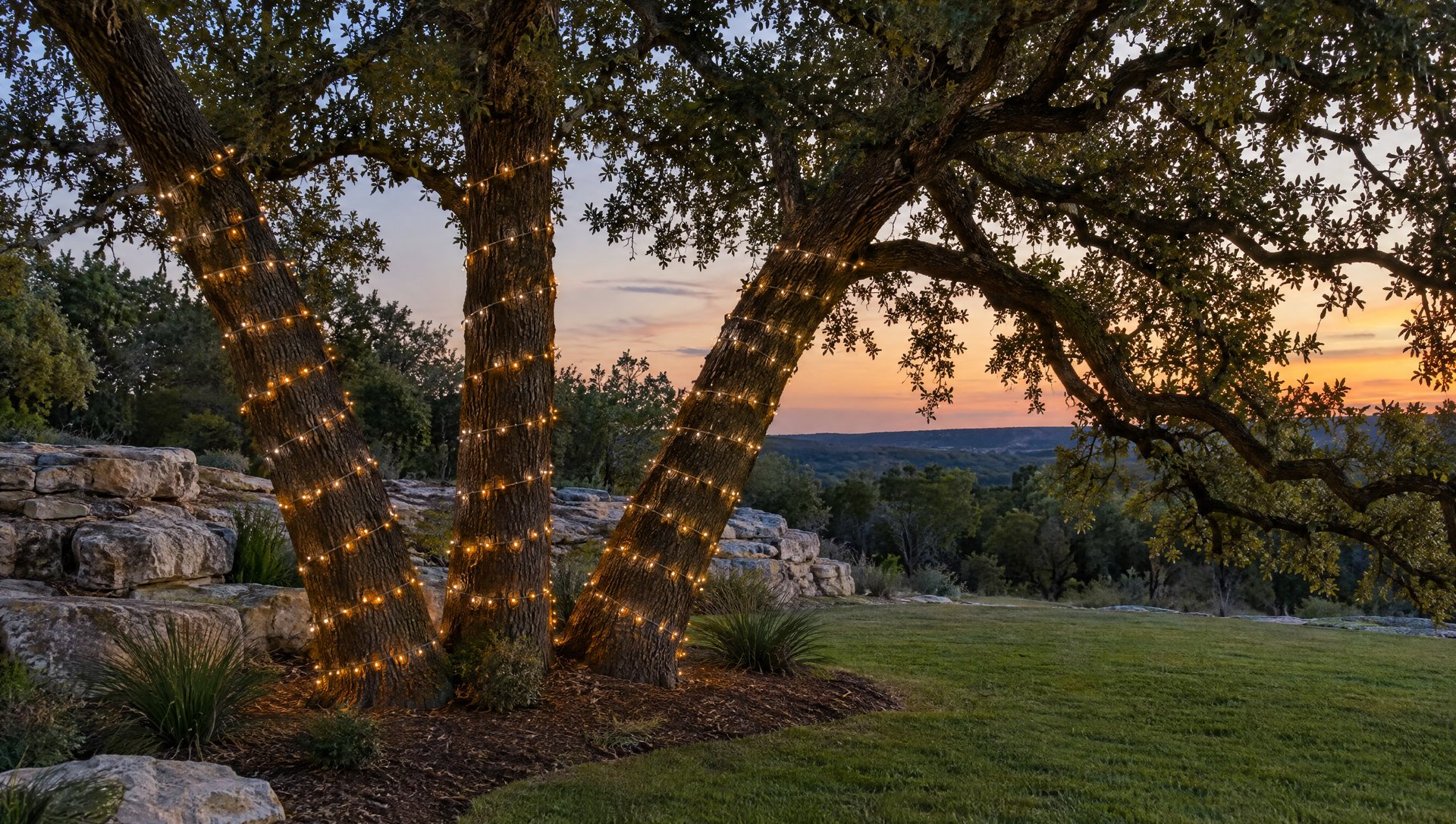
Example (our arithmetic, 3-inch gap): three 10-inch stems take about 31.4 feet of lights per foot of height, two 14-inch stems about 29.3 feet, and one 24-inch trunk about 25.1 feet. Escarpment oaks are smaller overall, though, so the whole tree may still take less.
Multi-trunk oaks fork low, so more of the tree is usually in reach from the ground.
What spacing, bulb and color look right on a live oak?
Choose the gap by where the tree is seen from. Up close, by a walk or patio, every gap shows, so go tight if you want solid light: Davey gives 2 or 3 inches as usual. From the street, gaps close up by eye, so 4 to 6 inches on the limbs still reads as lit wood and uses far less string. Christmas Lights Etc says 6 to 8 inches gives a lighter look.
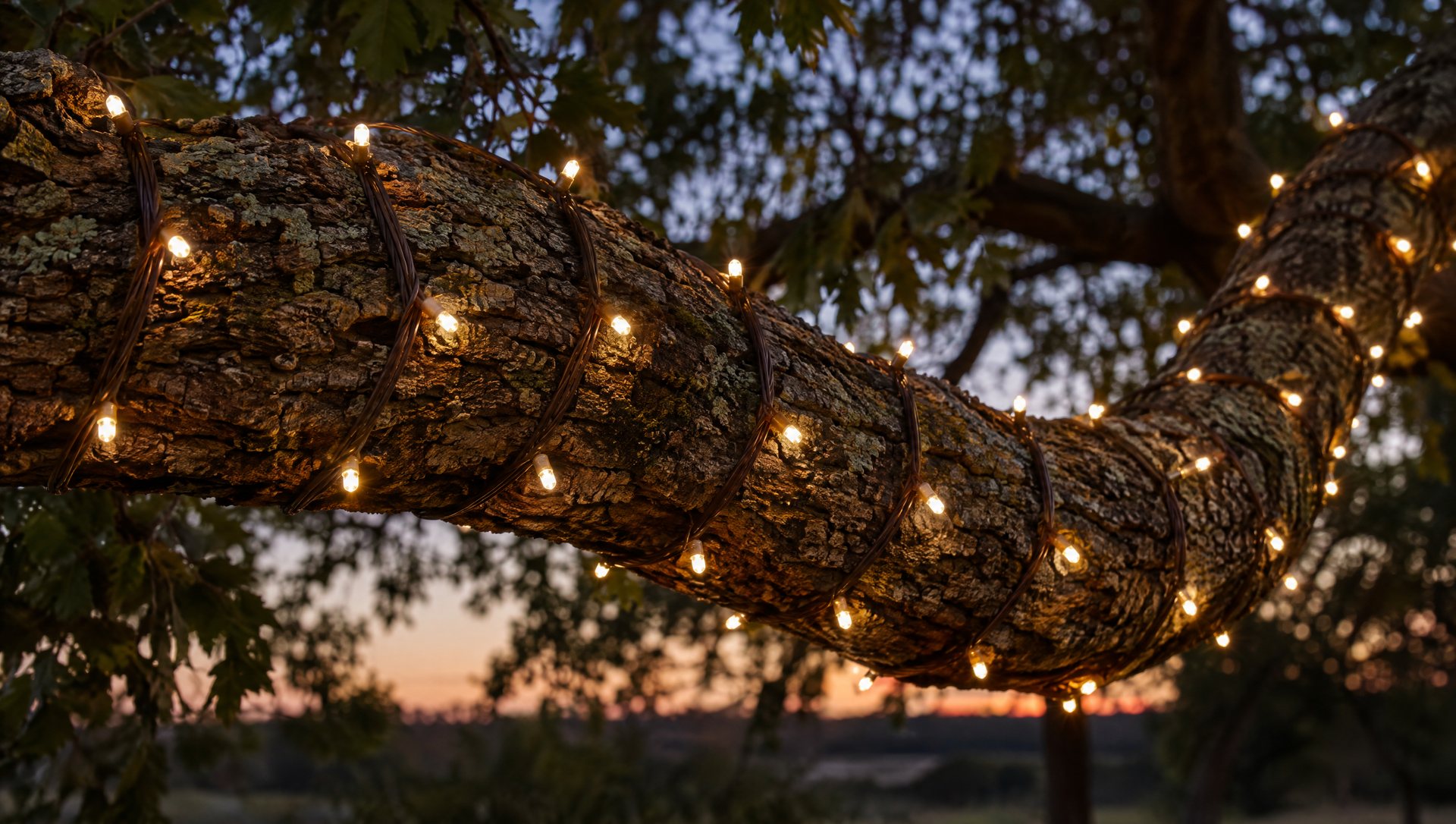
Bulb spacing on the string also sets the density. Christmas Light Source says LED mini strings come with 4- or 6-inch bulb spacing. At 4 inches you get three bulbs per foot instead of two.
Bulbs. Christmas Designers says in its tree-wrapping article that most professional installers wrap trees with 5mm wide-angle LED minis, and suggests brown or green wire to blend in by day. That is what Sapien wraps trees with too. For a bolder look, Christmas Light Source wraps large trees with C9 bulbs on cords at 12- or 15-inch socket spacing. Our guide to C9 Christmas lights covers that bulb.
Color. “Warm white” is not one shade. A Minleon spec page lists warm whites at 2600 K and 2700 K, while the Christmas Light Emporium’s warm white is 3000 K. The Emporium says to buy one product line for one area. On one tree, a limb of a different white stands out. Our comparison of colored and white Christmas lights covers the wider choice.
Will Christmas lights hurt a live oak?
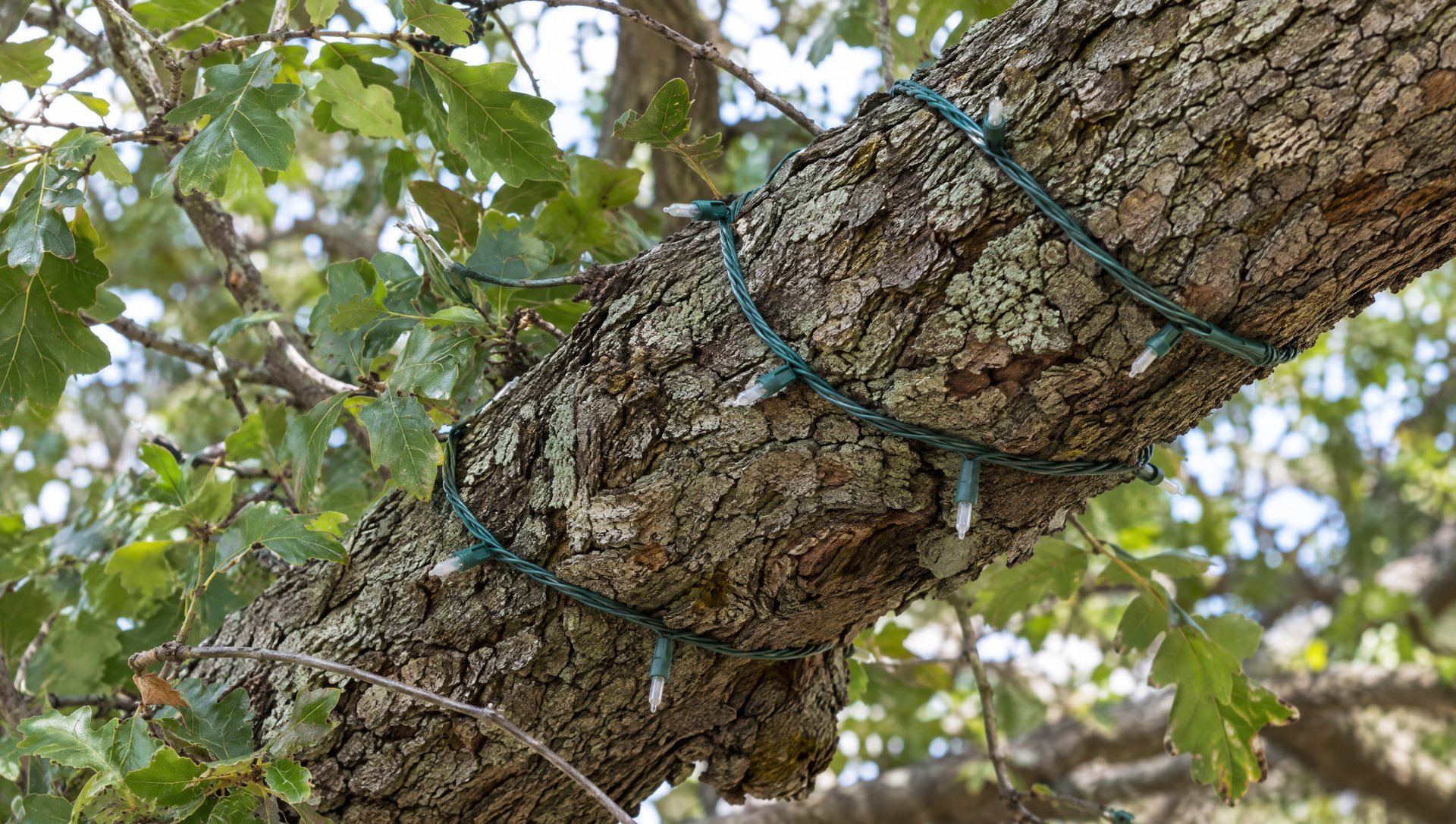
In our reading of the arborist guidance, a healthy oak is at low risk if nothing breaks the bark, no twigs snap and the lights come off every year. The two known risks are wounds, which can let in oak wilt, and wire left on long enough to girdle a limb. If the tree is healthy and nobody plans to cut anything, a removable wrap does not need an arborist’s visit first.
Oak wilt and wounds
Texas A&M Forest Service’s oak wilt overview calls live oak the most seriously affected oak, because live oaks share connected root systems. The City’s oak wilt program calls it the most frequently infected tree in Austin.
No source we found ties oak wilt to lights. Wounds let it in: the Forest Service’s February 2025 release says any new wound on an oak can be an entry point. Its pruning guidelines say to avoid wounding oaks from February 1 through June 30, and to paint every oak wound right away in any season. Any paint works. That matters most when oak wilt is already in the neighborhood: avoid any wound, paint any nick at once, and skip a tree that shows symptoms.
A nail or screw in oak bark makes a wound, and so does a staple. That is our reading of the rule; the Forest Service does not mention light fasteners. Some crews, ours included, use small removable staples on trees where a wrap would otherwise slip, and pull them in January. On a live oak, ask for a staple-free wrap; we will wrap without staples whenever a customer asks. If a limb cracks or the bark is gouged during install or takedown, paint the wound right away, and have an arborist handle a broken limb.
Girdling: take the wrap off every year
Wire left on a limb cuts in as the wood grows, which the Morton Arboretum says can kill the branch or the tree. A Davey arborist said on the company’s podcast that girdling starts two to three years on. Our advice: snug enough to stay put for one season, never cinched, and off every year.
No Texas source sets a takedown date. We’d have live oak wraps off before February 1, so any takedown nick falls outside the no-wounding window, and well before new leaves in late February or March. Sapien’s takedowns run January 2 to 15. For timing across the whole display, see when to take the Christmas lights down.
Can you trim a live oak to make room for lights in Austin?
We would not cut a live oak to fit lights, and in Austin it can be a legal question. The City Arborist’s office answers questions about a specific tree.
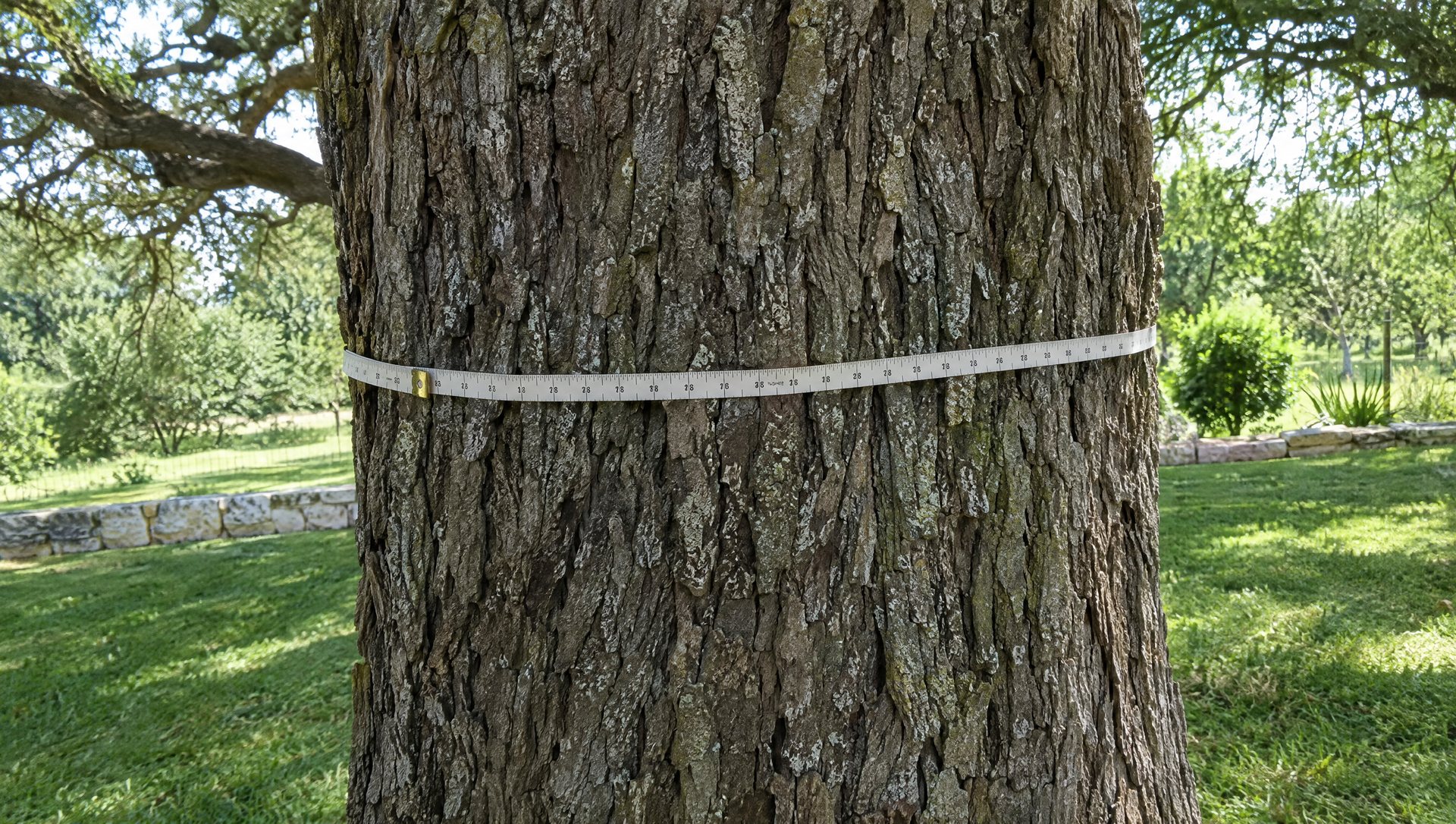
The City Arborist page and the Land Development Code measure trunk diameter 4.5 feet above the ground. A tree of 19 inches or more is protected. A tree of 24 inches or more on the species list, which includes all oaks, is a heritage tree. No more than 25% of a regulated tree’s canopy may be removed without a permit.
To check your tree, wrap a tape around the trunk 4.5 feet up and divide by 3.14. About 60 inches around is near 19 inches across; about 75 inches around is near 24 inches (our arithmetic).
A multi-trunk oak can be a heritage tree even when no single stem is 24 inches. The City’s trees on residential property page counts the largest stem plus half of each other stem. Example: 18-inch and 14-inch stems count as 25 inches.
We found no City rule on lights in trees. A street right-of-way tree may be a public tree under City Code chapter 6-3. Pruning, removing or damaging one needs the urban forester’s approval. The code text we read does not say whether lights on one need approval, so ask the City before lighting a tree by the street.
The root zone. Austin defines a tree’s critical root zone as a circle whose radius in feet equals its trunk diameter in inches, so a 36-inch oak’s zone reaches 36 feet. The residential page warns that disturbance there, including soil compaction from construction equipment, can harm or kill a tree. Those rules target construction, but it is still worth asking any installer where a lift would sit. A lift parked on the driveway or street stays off the root zone; one on the lawn should stay off wet soil and make as few passes as it can.
Power lines, plugs, squirrels and cold fronts
Power lines. Austin Energy’s home safety guidance says to keep ladders and tools at least 10 feet from power lines, and its tree trimming FAQ says not to trim a limb within 10 feet of a line yourself. We apply the same 10 feet to the light strings, so any limb near a line stays dark. Long limbs can reach toward the line to the house, so look up first. See our ladder and installation safety page.
Plugs. Stay under the connected-sets limit on each set’s tag, and never bypass a blown plug fuse; our guide to Christmas light fuses explains why. Sapien installs plug-in lighting only. A new outdoor outlet is work for an electrician licensed by the Texas Department of Licensing and Regulation (Texas Occupations Code chapter 1305).
Squirrels. Texas A&M AgriLife says urban fox squirrels, the common central Texas squirrel, may gnaw wiring. Check the wrap for chewed wire about once a week.
Wind and ice. The National Weather Service’s Austin climate summary notes gusty north winds after winter fronts. ESFI says to fasten outdoor lights securely without damaging the cord’s insulation, and a wrap that follows the bark holds better than loose drapes. The Weather Service says a quarter inch of ice can bring down branches. After ice, stay out from under loaded limbs and leave the lights alone until it melts.
Where can you see lit oaks around Austin?
See a few lit oaks before choosing a gap. Details are as organizers posted them, checked October 2026; check again before you go.
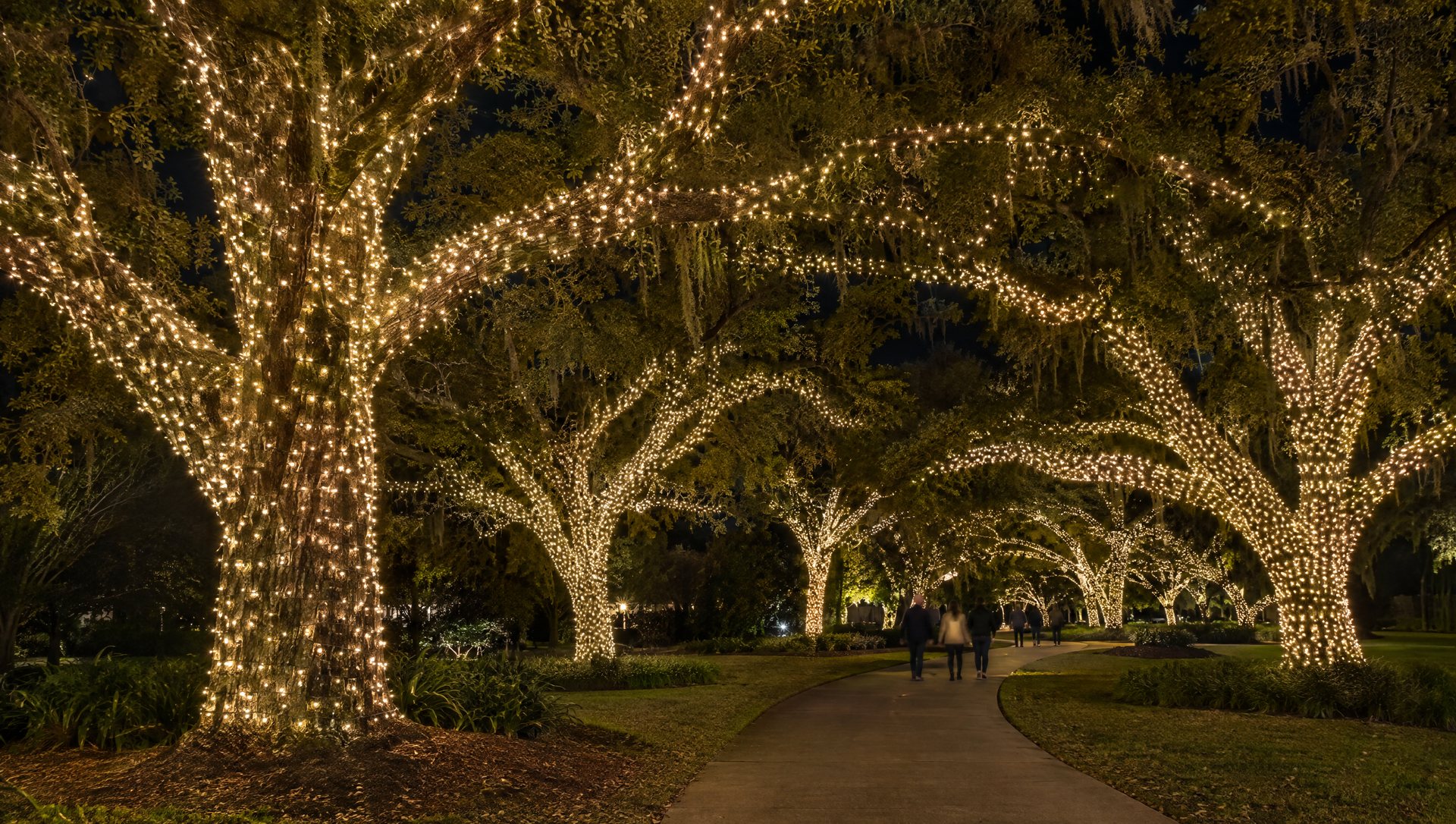
- Cedar Park. The city says it lights its largest live oak with more than 30,000 lights. The Heritage Oak Tree Lighting is listed for Wednesday, December 2, 2026. More on that area is in our guide to Christmas lights in Round Rock, Georgetown and Cedar Park.
- Johnson City. Pedernales Electric Cooperative says more than 1.6 million LEDs hang in the oaks at its headquarters. Those grounds are part of Lights Spectacular, listed for November 27, 2026 through January 3, 2027.
- Your own neighborhood. Our Austin Christmas lights driving tour passes plenty of lit yard trees.
Only Cedar Park names the species; PEC just says oaks. Note how far out the limbs are wrapped, how tight the gap looks, and whether the crown is lit.
Lighting the other trees in an Austin yard
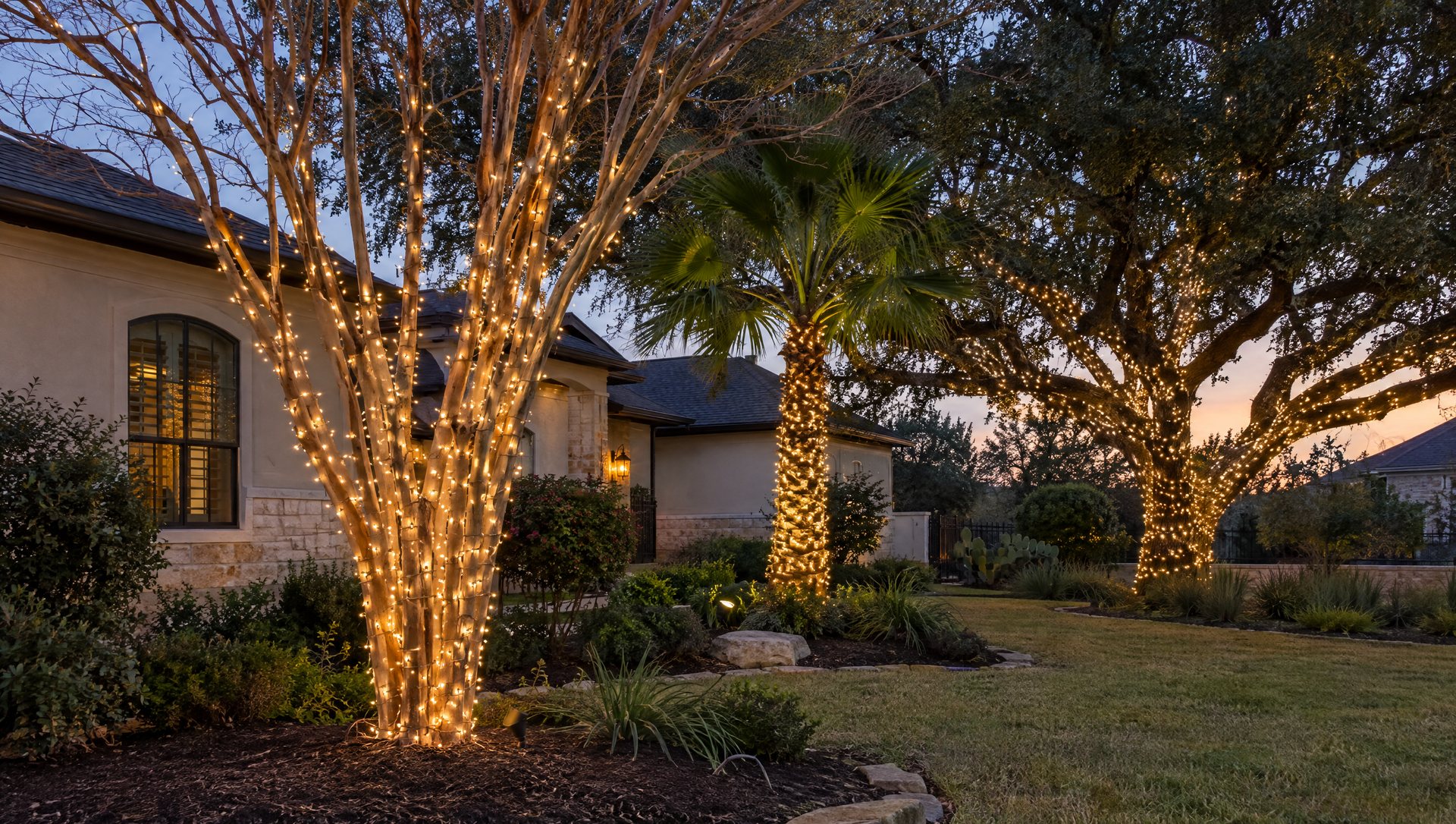
Crape myrtle (also spelled crepe myrtle). It is usually multi-trunked with smooth limbs, per Texas A&M Forest Service. Once its leaves drop, wrapped trunks and limbs show cleanly.
Cedar elm and pecan. Both are tall, per the Forest Service’s cedar elm and pecan pages, so we’d usually stick to a trunk band. Both are on Austin’s heritage list. Texas fall color comes late, so either may hold leaves at Thanksgiving.
Texas red oak. The Texas red oak drops its leaves and lights more like an elm. Red oaks are the oaks most susceptible to oak wilt, so the same no-wound rule applies.
Ashe juniper (“mountain cedar”). It is a juniper that forks near the ground under a dense, conical crown, per the Forest Service’s Ashe juniper page. There is little trunk to wrap; we’d lay C7 or C9 strings over the outside, which Christmas Lights Etc calls the most popular bulbs on large evergreens.
Palms. Wrap the trunk only. No source we found covers wrap damage on palms; we’d still take the wrap off each year. See Christmas lights on palm trees for the details.
Shrubs under the oak. Beds of boxwood, yaupon or Texas sage under a lit oak can carry net or mini lights; see Christmas lights on bushes.
What we’d skip on a live oak
- Nails, screws and staples. Each is a hole in oak bark.
- Wrapping every twig from a ladder. Canopy work on a big oak is a job for a crew with a lift.
- Limbs within 10 feet of a power line.
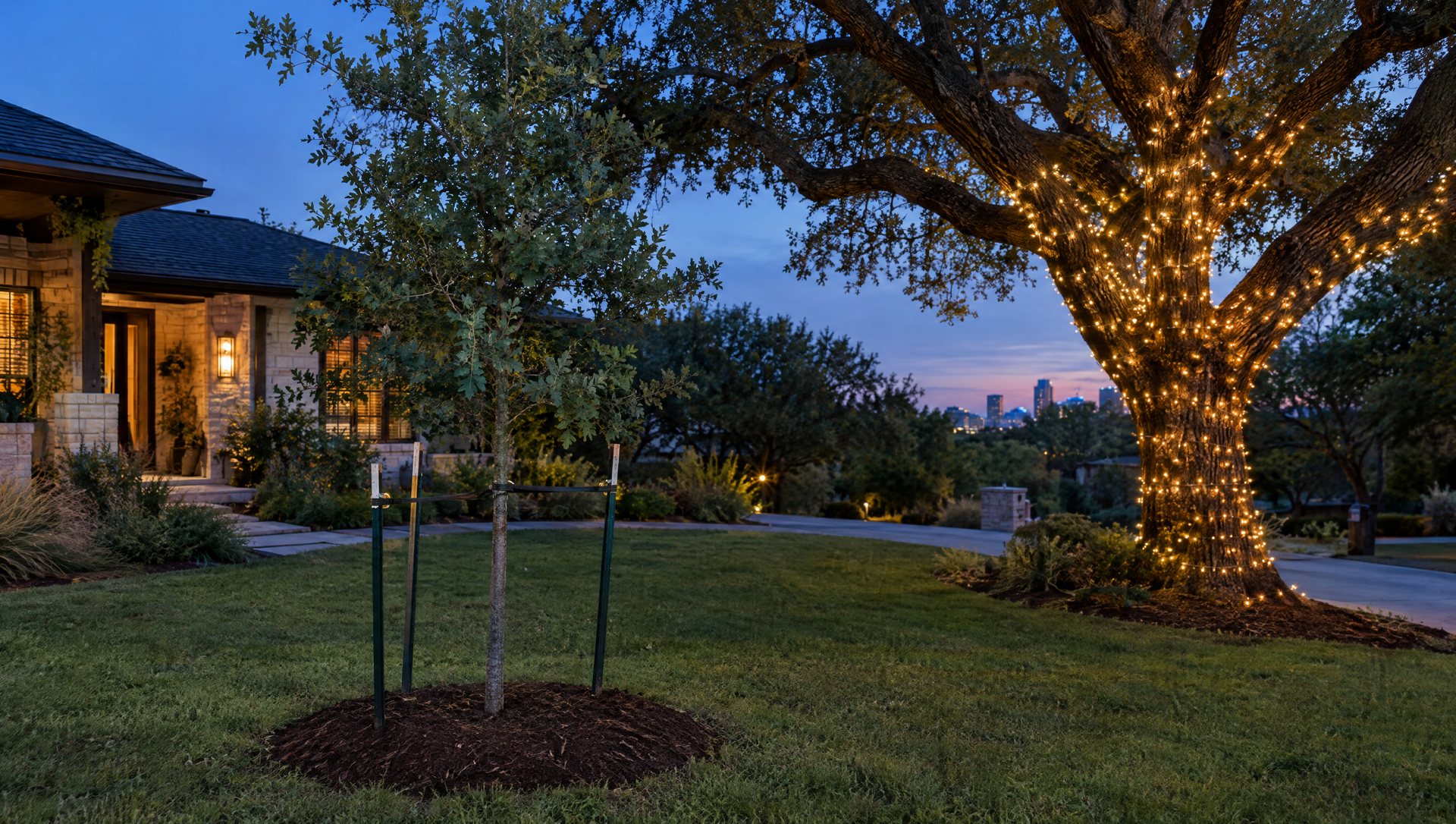
- A young or newly planted oak. Davey Tree says not to light a young, newly planted, weak or damaged tree.
- An oak that looks sick. The live oak sign of oak wilt is veinal necrosis, leaf veins turning yellow and brown, per the Forest Service. Call an arborist instead. The Forest Service points to a Texas Oak Wilt Qualified Arborist or an ISA Certified Arborist.
- Climbing into the tree. Leave limbs you cannot reach from the ground or a ladder on level ground dark, or hire them out.
For what a hired crew covers from design to takedown, see our page on Christmas light installation in Austin.
Want your live oak planned for you? Text a daytime photo of the tree from the street to (737) 777-9099, or use the contact page. Tell us trunk only, trunk and limbs, or full canopy, and, if you can, the distance around the trunk at chest height. We’ll come back with a plan and a price; the photo-quote guide lists what else helps.
Sources
- Texas A&M Forest Service, Trees of Texas: live oak (short trunk, twisting limbs, 100-foot crown, limbs touching the ground; escarpment form smaller and multi-trunked)
- Lady Bird Johnson Wildflower Center: Quercus fusiformis (20 to 40 feet, far-reaching limbs, leaf swap in late February or March)
- Lady Bird Johnson Wildflower Center: Quercus virginiana (old leaves dropped late each winter)
- City of Austin Grow Green: Oak, Southern Live (50-plus feet wide)
- Christmas Lights Etc: Wrapping Trees with Lights (3 to 4 feet up main branches; 6 to 8 inches for a lighter look; out-and-back branch wrap; C7 and C9 on large evergreens)
- Davey Tree: Wrapping Trees with Christmas Lights, The Dos and Don’ts, Dec. 6, 2019 (trunk formula, 2- to 3-inch gap, trees to skip)
- Christmas Light Source: How many light strings do I need to wrap my tree?, Nov. 29, 2021 (measured pecan example, 10% allowance, mini-string bulb spacing)
- The Christmas Light Emporium: How to Wrap Trees With Christmas Lights (6 to 8 inches on branches)
- American Ladder Institute: Basic Ladder Safety (firm, level footing; top rungs not for standing)
- Christmas Designers: How to Wrap a Tree in Christmas Lights, July 24, 2015 (5mm wide-angle minis, brown or green wire)
- Christmas Light Source: Get This Look, Wrapping Trees with C9 Bulbs, Jan. 6, 2021 (C9 cords at 12- or 15-inch spacing)
- Christmas Designers: Minleon C9 V2 Sun Warm White spec page (warm whites at 2600 K and 2700 K)
- The Christmas Light Emporium: Warm White, Pure White, Cool White (warm white 3000 K; one product line per area)
- Texas A&M Forest Service: Oak Wilt overview (live oaks most seriously affected; red oaks most susceptible)
- City of Austin: Oak Wilt program (live oak the most frequently infected tree in Austin)
- Texas A&M Forest Service: Prevent the spread of oak wilt in Texas, Feb. 4, 2025 (any new wound can be an entry point)
- Texas A&M Forest Service: Pruning Guidelines for Prevention of Oak Wilt (February 1 to June 30 window; paint wounds in every season; arborists to consult)
- The Morton Arboretum: How to Take Care of Trees and Shrubs as You Light Your Landscape (girdling from forgotten wire; avoid breaking twigs)
- Davey Tree: Talking Trees podcast, Nov. 30, 2023 (girdling at two to three years)
- City of Austin: City Arborist (protected and heritage trees; 25% canopy limit)
- Austin Land Development Code chapter 25-8, subchapter B, article 1 (19-inch and 24-inch thresholds; heritage species list includes all oaks, cedar elm and pecan)
- City of Austin: Trees on Residential Property (multi-stem measurement; root zone disturbance and compaction)
- Austin Environmental Criteria Manual, section 3 (critical root zone radius)
- Austin City Code chapter 6-3, Trees and Vegetation (public trees and the urban forester)
- Austin Energy: Safety at Home (ladders and tools 10 feet from power lines)
- Austin Energy: Tree Trimming FAQs (no trimming within 10 feet of a line)
- Texas Occupations Code chapter 1305 (electrical work requires a TDLR license)
- Texas A&M AgriLife Extension: Controlling Tree Squirrels in Urban Areas (PDF) (fox squirrel; gnawing wiring)
- National Weather Service Austin/San Antonio: Austin Climate Summary (PDF) (gusty north winds after fronts)
- ESFI: Outdoor Decoration Safety Tips (fasten lights securely without damaging insulation)
- National Weather Service: Ice Storms (ice brings down branches)
- City of Cedar Park: Heritage Oak Tree Lighting (largest live oak, more than 30,000 lights, December 2, 2026; checked October 2026)
- Pedernales Electric Cooperative: PEC Holiday Lights (more than 1.6 million LEDs in the oaks; checked October 2026)
- Lights Spectacular: FAQs (November 27, 2026 to January 3, 2027; PEC headquarters is a display site)
- Texas A&M Forest Service, Trees of Texas: crapemyrtle (multi-trunk, smooth limbs, deciduous)
- Texas A&M Forest Service, Trees of Texas: cedar elm (tall, straight trunk)
- Texas A&M Forest Service, Trees of Texas: pecan (to 120 feet)
- Texas A&M Forest Service: The magic and chemistry of fall foliage color, Nov. 5, 2025 (late Texas fall color)
- Texas A&M Forest Service, Trees of Texas: Texas oak (Texas red oak is deciduous)
- Texas A&M Forest Service, Trees of Texas: Ashe juniper (forks near the ground, dense conical crown)
- Texas A&M Forest Service: Oak Wilt Identification (veinal necrosis in live oaks)
- Davey Tree: Is It OK to Keep Outdoor Tree Lights on Year Round?, Dec. 19, 2022 (laid-over lights versus spiral wraps)
About the author. Rick Safeman owns Sapien Lighting & Installation in Austin, Texas.