


Front Porch Christmas Lights and Decor: Plans for Every Porch
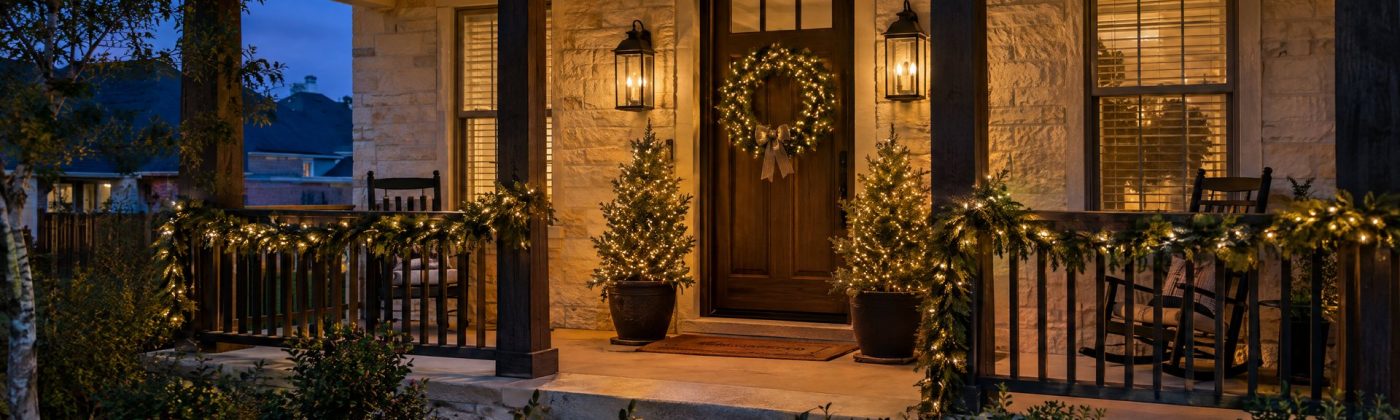
Start every porch the same way: a lit wreath on the door and lit garland framing it. Then add exactly one more layer chosen for the porch you actually have, because a stoop, a deep bungalow porch and a long ranch porch fail in completely different ways when you decorate them like the photo on the box.
This guide is built as a planner. Measure once, pick the plan that matches your porch, buy the right lengths the first time, and skip the three trips back to the store. If you’d rather hand the whole entry to someone else, our Austin installation service handles wreaths, garland and the lights that frame the porch.
Three people look at your porch
Before you buy anything, know who you are decorating for, because there are three different audiences and each one sees a different porch.
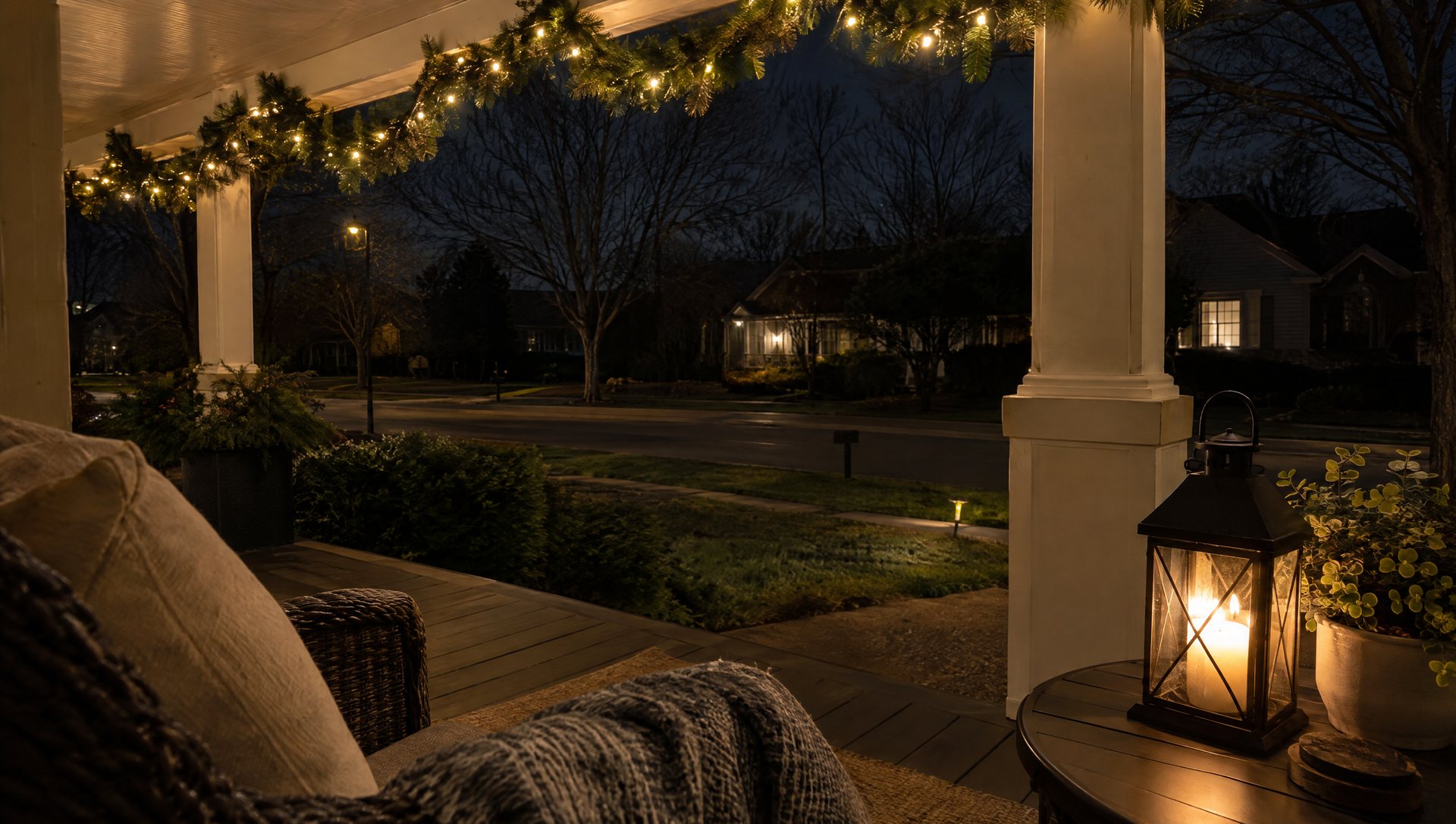
The driver going past sees a shape at 40 feet or more. Small things vanish. A wreath tucked eight feet back under a porch roof is a dim smudge from the street. What reads at that distance is a lit edge: the porch beam, the columns, the line where the porch roof meets the night.
The visitor at the door is three feet away and sees everything: the zip ties, the green wire on white trim, the battery box hanging off the back of the wreath, the bulb that’s a slightly different white from its neighbors. This is where quality of materials matters most.
You, sitting on the porch, see the lights from underneath and from the side. A bright string at eye level from a rocking chair is glare, not ambiance.
Most porches get decorated only for the visitor. That’s why so many look great in the phone photo taken from the steps and disappear from the curb. The fix is simple: give the street an edge, give the door detail, and keep the light soft at seat height. Every plan below follows that rule.
Measure first: the porch math
Garland and light strings are sold in fixed lengths, usually 9-foot garlands and 25- or 50-foot light strings, and almost every porch problem we see starts with buying by eye. Ten minutes with a tape measure fixes it.
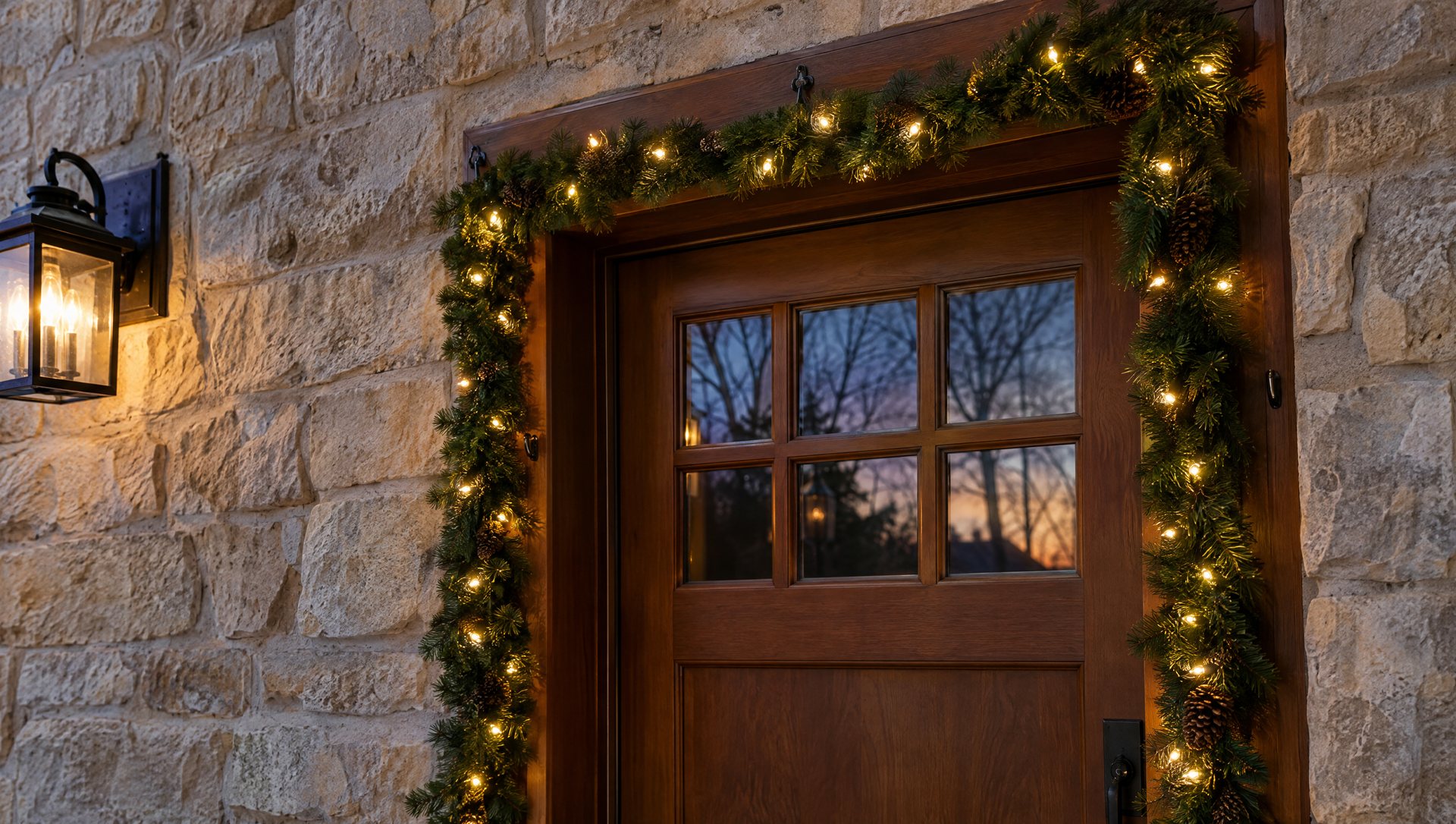
The door frame. A standard 36-by-80-inch door takes about 17 feet of garland to frame (two sides plus the top, following the trim). That’s two 9-foot garlands. Our door decorations guide has the full sizing table for wreaths and other door widths.
Swags on a beam or railing. Draped garland eats length. Balsam Hill’s greenery guide suggests about 1.5 to 2 feet of garland for every foot of span you want to swag. A 16-foot porch beam with gentle swags needs 24 to 32 feet of garland, three or four 9-foot lengths, not the two most people buy.
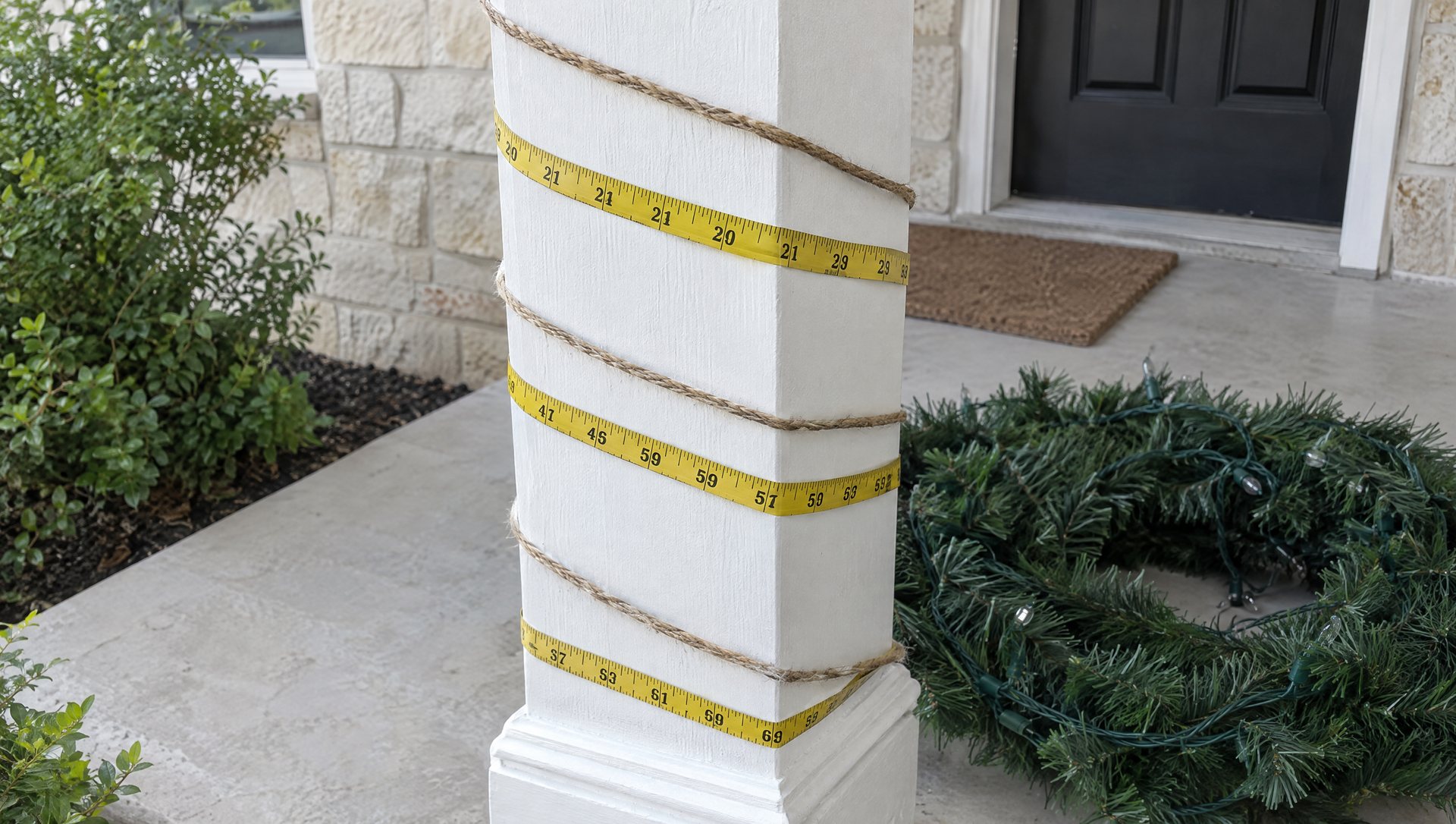
Columns. This is where the bad surprises live. A spiral wrap uses far more than the column’s height. Here’s the math for an 8-foot column with one wrap per foot of height:
- Round column, 10 inches across: circumference about 31 inches. Each wrap travels roughly 33 inches (31 around, 12 up). Eight wraps is about 22 feet per column.
- Square column, 12 inches per side: perimeter 48 inches. Each wrap travels about 50 inches. Eight wraps is about 33 feet per column.
So a porch with four square columns needs about 130 feet of lit garland or mini lights for the columns alone, before the door, the railing or the beam. If that number surprised you, that’s the point of measuring. If you want a looser spiral, one wrap every 18 inches cuts the length by about a third.
The quick field check: wrap a piece of string around one column at the spacing you like, then measure the string.
Railings. Measure only the runs you’ll decorate. Straight garland along the top or outside face of a rail is length for length, plus a foot at each end for tails.
Write down where the outlet is. Measure from the outlet to the nearest decorated point. That distance decides whether a plug-in plan works or you need batteries for some pieces.
The base layer: wreath and a garland frame
Every plan starts here. A lit wreath centers the door, and lit garland up the sides and across the top turns the entry into a glowing rectangle that reads from the street better than a wreath alone.
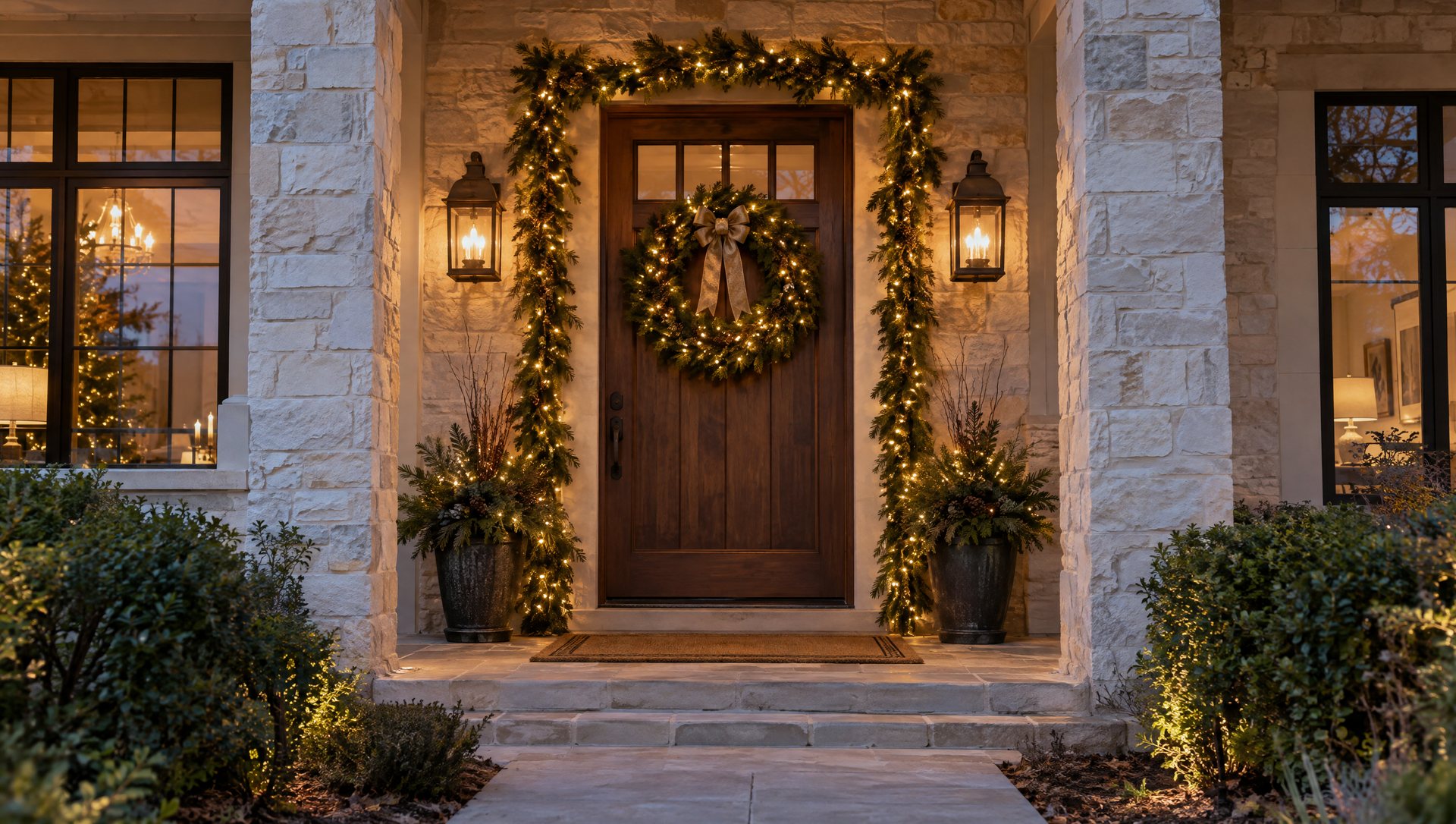
Two details separate a good base layer from a sloppy one. First, the wreath hangs from a hanger that doesn’t pinch the door seal, and on a storm door, measure the gap before buying a thick wreath. Second, the garland frame is supported by its own hooks or clips every couple of feet; the light string inside it is never the hanger. Heavy faux garland sags in the middle of the header within a week if it is only hooked at the corners.
If the wreath is the only lit thing on the porch, give it lights with some punch. Many pre-lit wreaths ship with sparse, dim mini lights that look fine in the store and like a dark ring from the walk. Tucking a second short string of warm white minis into the wreath doubles its presence for very little money.
Four porch plans
Find the plan closest to your porch and follow it. Each one starts from the wreath-and-frame base and adds one layer, plus the one mistake we see most on that porch type.
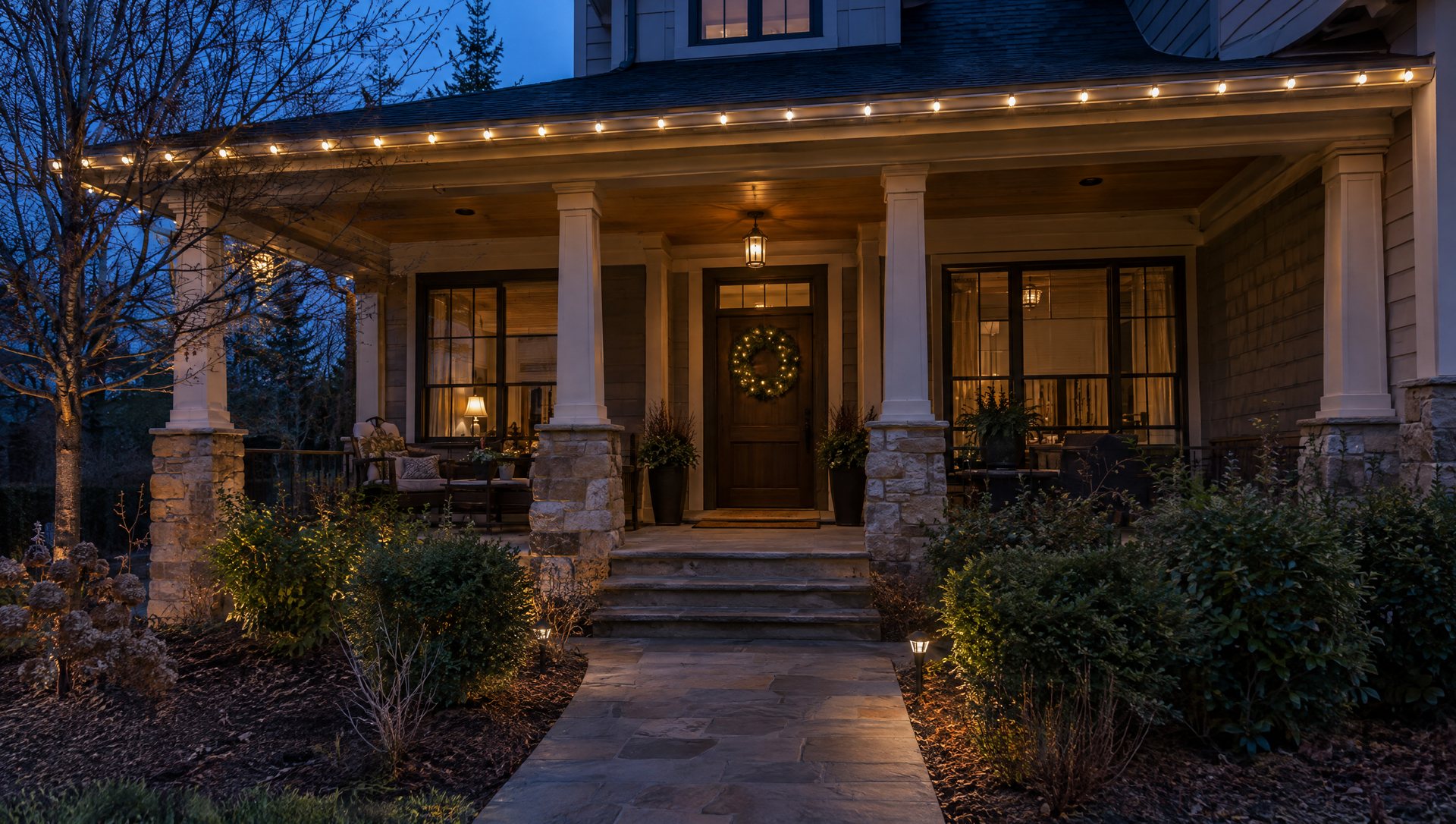
Plan 1: the small stoop
What you have: a concrete or stone landing, maybe 4 by 6 feet, with no roof or a small overhang, and two or three steps down to the walk. Common on newer tract homes and townhouses.
The plan: wreath and garland frame, one lit planter on the side with room, and a cluster of three lanterns on the landing beside the door. Stop there.
Why one planter, not two: two planters on a small stoop pinch the landing to a single-person path, and someone carrying grocery bags has to turn sideways. One larger planter on the open side, with the other side left clear, looks intentional and keeps the stoop usable. Fill it with evergreen tips and tuck mini lights deep inside so the glow comes from within the greenery, not from bulbs sitting on top.
The lantern cluster: three lanterns of different heights with flameless candles. Most battery candles have a six-hour timer, so switch them on once at dusk and they keep the same schedule. Keep the cluster on the landing, never on the steps.
The mistake to skip: a pair of tall lit trees flanking a narrow door. On a small stoop they make the entry look like a bottleneck, and they block the light from your porch fixture.
Plan 2: the deep bungalow porch
What you have: a covered porch 8 feet or deeper, a door set well back, often a beam across the front supported by tapered or square columns. This is the porch on a lot of older Austin bungalows and their newer imitations.
The problem: the door is in shadow. From the street, the wreath disappears no matter how good it is.
The plan: move the street-facing light to the front edge. Run lit garland or a line of warm white mini lights along the outer beam, wrap the two front columns, and let the wreath and garland frame handle the close-up view at the door. Add a seating vignette (a lantern on a side table, a small wreath on the wall behind the bench) for the person sitting there.
The ceiling is free display space. A deep porch has a ceiling, and the ceiling is the one surface visible both from the street and from the chair. Hang two or three lit star lanterns at staggered heights from existing hooks or from the beam. Moravian-style stars are the classic choice. Keep the lowest one at least a foot above head height of the tallest person who walks under it.
Keep the beam softer than the door. If the outer edge is brighter than the wreath, the eye stops at the edge and the door goes even darker. Use the same warm white throughout, and if anything, put the denser lights at the door.
Plan 3: the long ranch porch
What you have: a narrow porch, 5 or 6 feet deep, running much of the width of a one-story house. Several windows open onto it, there might be a bench, and the roofline is low enough that the porch edge and the eave are almost the same line.
The problem: one wreath on a 30-foot porch looks lost, and lights on every surface turn it into a carnival.
The plan: repetition. Pick one element and repeat it at even intervals: a matching wreath in each front window, or a lit planter at each column, or window candles in every front window. Then run garland along the railing or the porch edge to tie the repeats together. The house reads as one design because the same object shows up three or four times at the same height.
Use the windows. Window candles cost almost nothing to run, need no ladder and extend the porch across the whole facade. If you have window boxes, lit greenery in each one does the same job.
Mind the bench. A long porch usually has seating. Keep the brightest lights off eye level for anyone sitting there, and leave enough of the bench clear to actually sit on.
Plan 4: columns and a tall entry
What you have: a two-story entry, or a porch with prominent columns, often stone-clad, on a newer home in the suburbs around Austin.
The plan: wrap every column the same way, same material, same spacing, same top height, then frame the door. On a tall entry, the columns carry the street view and the door carries the close-up view. Add a large wreath above the door on the wall or transom if the space is two stories tall; a normal door wreath looks undersized against that much wall.
Consistency is the whole trick. Four columns wrapped at four slightly different spacings look worse than four columns left bare. Mark the start point with a small piece of painter’s tape at the same height on each column and count your wraps.
Mind the paint. Painted columns mark easily. Use soft ties or clips designed for the purpose, and never wrap tightly enough to scuff paint as the wind moves the garland.
What about a wide two-story entry with no columns? Put the light into the frame of the door and the window above it, and accept that the street-level view will come from the roofline and the trees, not the porch.
Keep the porch usable
Take a daytime photo of the porch and mark the door swing, the steps, the chairs and the route people actually walk. Decorate only the space left over.
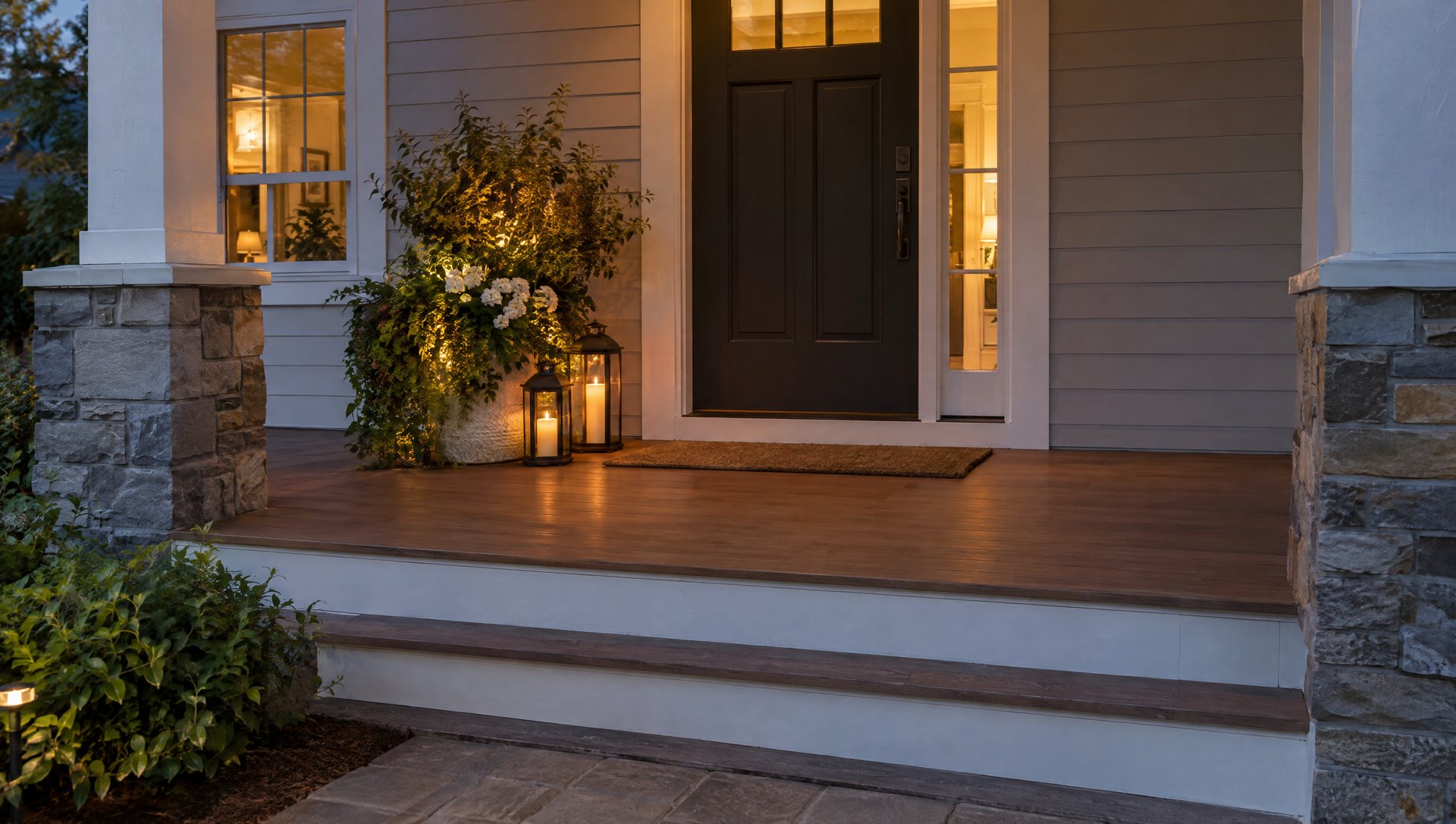
- Leave a clear spot by the door for packages and grocery bags. Delivery drivers will put the box wherever there’s room, and that is usually on your lantern cluster.
- Don’t cover the house number or the doorbell camera’s view.
- Keep decorations off the walking part of the steps and off the part of the handrail people grip.
- Never run a cord under the door or pinch it in the latch side.
- Keep the regular porch and step lights working. Decorative lights are for looks, not for seeing the steps.
Match your whites before anything goes up
A pre-lit wreath, a pre-lit garland and a lit planter can each say “warm white” on the box and still look three different colors side by side. On a porch, where everything is within a few feet of everything else, the mismatch is obvious.
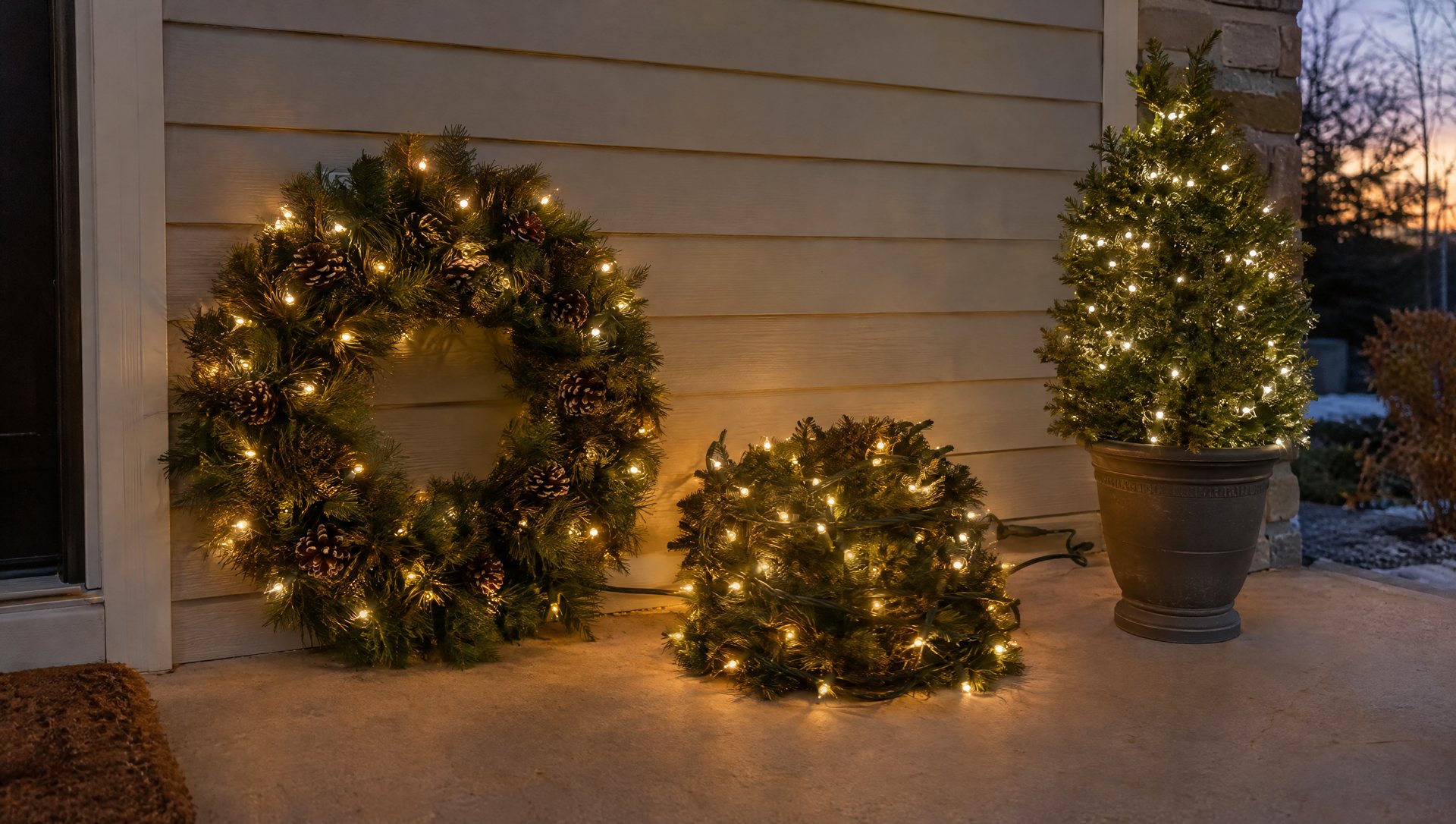
Plug every lit piece in together on the porch floor at dusk before you hang anything. If one piece is noticeably bluer or yellower, put it somewhere separate (a planter at the bottom of the steps, a window) or return it. The same goes for matching the porch to the roofline: if the roof is warm white, cool white on the porch looks like a mistake from the street. Our colored vs white guide covers the bigger palette decision.
Fresh or faux greenery in an Austin December
December afternoons in Austin can be warm and sunny, and fresh garland on a south- or west-facing porch can dry out and drop needles well before Christmas. That’s not a reason to give up on fresh; it’s a reason to place it carefully.
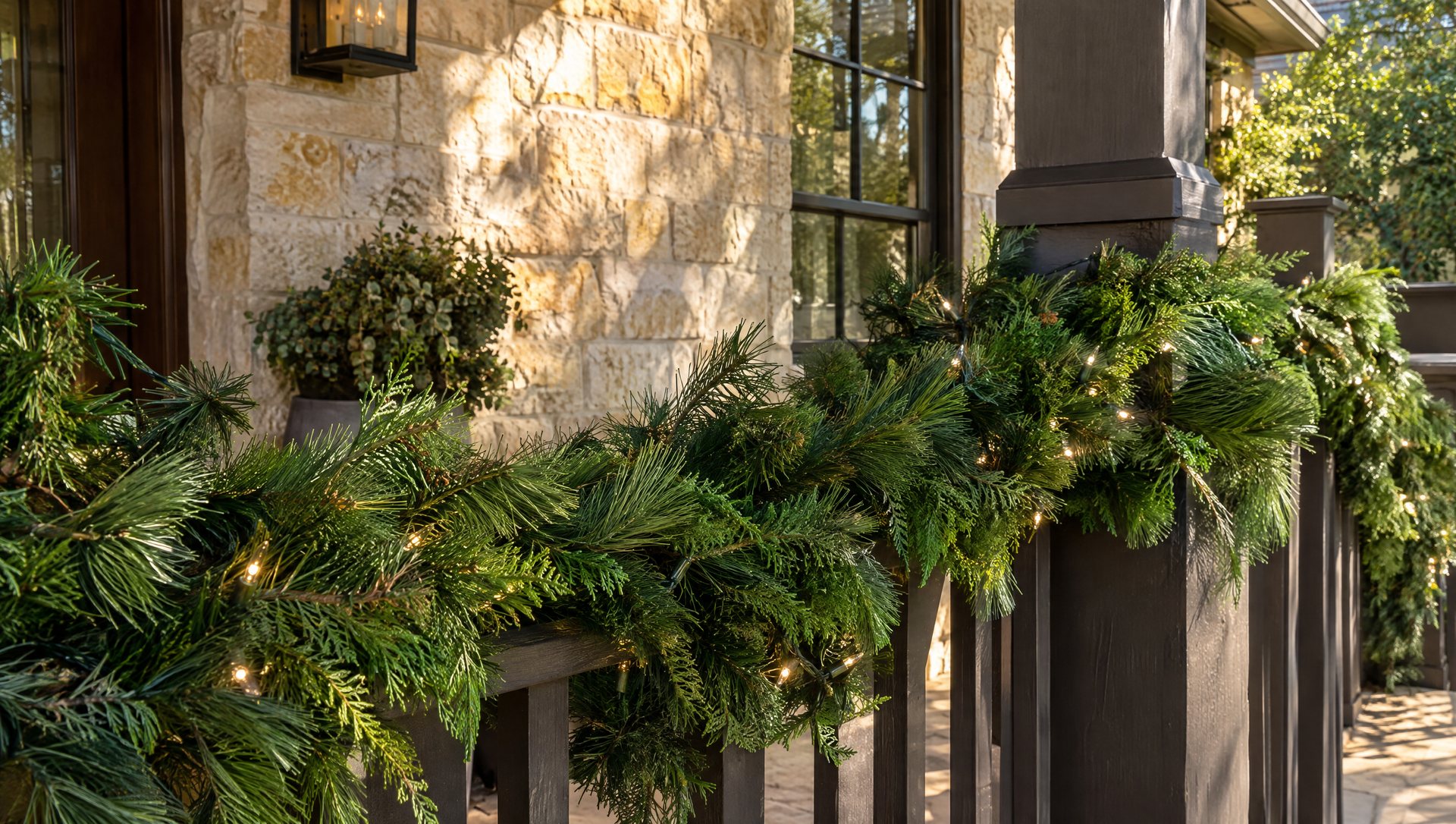
- Fresh works best on a shaded, north- or east-facing porch, kept away from any light that runs warm. Mist it on dry, windy days.
- Faux with built-in lights lasts the season, comes back next year and holds its shape. On a sunny porch, it’s the better buy.
- The blend many porches end up with: faux garland as the base, with a few fresh cedar or magnolia stems tucked in at the door where people get close enough to notice the smell and texture.
Hanging it on limestone, brick and stucco
Austin porches are rarely smooth painted wood all the way around, and the wall material decides how you hang things.
Smooth, sealed surfaces (painted trim, finished wood, glass) take adhesive outdoor clips and hooks. 3M’s outdoor light clip guidance is written for these surfaces, and that’s where adhesive works.
Brick usually has recessed mortar joints, and spring-style brick clips grip the face of a brick without any drilling. They work well for a garland frame or wreath on a brick wall.
Rough limestone and textured stucco are where adhesive fails. The bond grabs the high points of the texture and lets go in the first warm afternoon. Look for existing hooks, use the door trim and beam instead of the wall, or use a wreath hanger over the door. We’d avoid drilling into stucco for a seasonal decoration: every hole is a place for water to get behind the finish.
Heavy garland always needs its own supports. A 9-foot lit faux garland is heavier than it looks. Hook it every 18 to 24 inches and never use the light string as the hanger.
Power for a porch: one outlet, one timer
Most porches have one outdoor outlet, often at one end. Plan the whole porch from that point: wreath frame first, then the nearest columns or rail, and battery pieces for anything that would need a cord across the walking route.
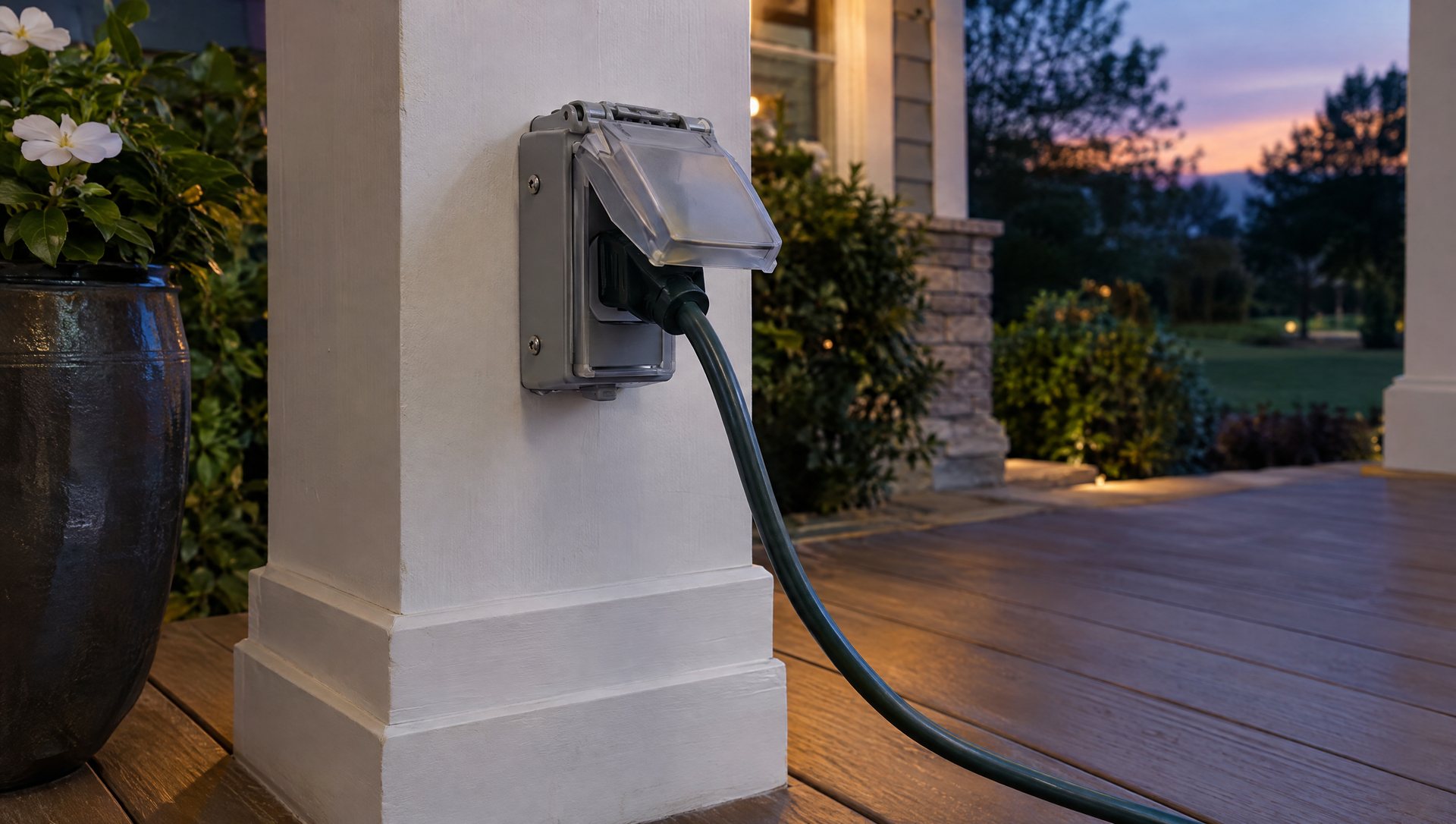
Put everything plug-in on one outdoor-rated timer so the porch comes on at dusk and goes off at bedtime without anyone touching it. Use outdoor-rated lights and cords, keep connections off the porch floor where water collects, and follow the “connect up to” limit printed on each light set’s tag. NFPA’s winter holiday guidance is a good one-page checklist.
No outlet at all? Battery wreaths, lanterns and timer candles can fill in on a small porch until there is an outlet to plug into; our battery-operated outdoor lights guide has the runtime math. Keep battery boxes where you can reach them without taking the decoration down. If you need a new outdoor outlet, that’s a job for a licensed electrician; Sapien’s seasonal work is plug-in only.
What we’d skip on a porch
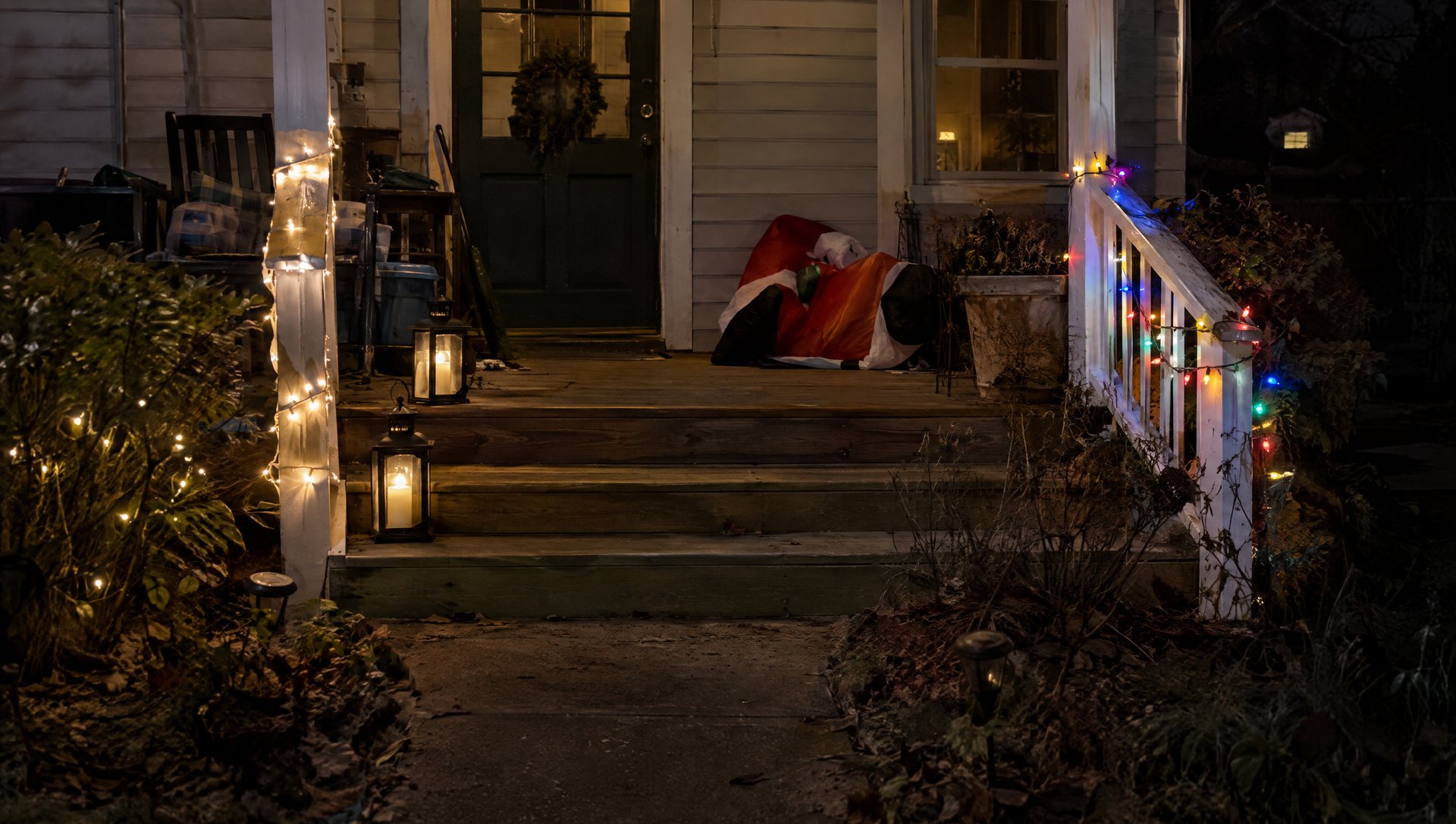
- Inflatables on the porch. They block the door, fall over in wind, and hum all night under your window.
- Projectors aimed at the porch. A pattern scattered across columns, windows and a front door rarely reads as anything. Our projector guide covers where they work.
- Mixing three kinds of lights. Twinkle on the wreath, chasing on the rail and steady on the columns looks like three different houses.
- Garland stapled to painted trim. It comes down in January with paint attached.
- Anything on the steps. Every year someone puts lanterns on the steps, and every year someone kicks one.
If you want a second opinion on your porch, text a daytime photo of the front of the house, taken from the street, to (737) 777-9099 or use our contact page.
Sources
About the author. Rick Safeman owns Sapien Lighting & Installation in Austin, Texas.