


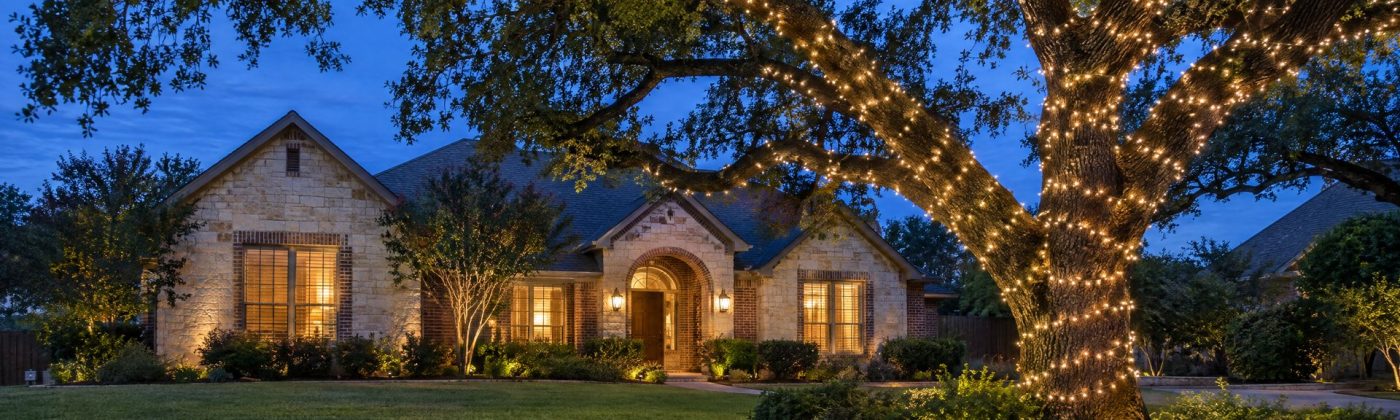
How Much Does It Cost to Wrap a Tree in Christmas Lights? (Austin, 2026)
Published cost guides such as Thumbtack and HomeAdvisor put tree wrapping at about $60 to $1,500 or more per tree, as of October 2026. Sapien Lighting & Installation’s typical 2026 Austin prices are $150 to $250 to wrap the trunk of a small or medium tree (from $100 for a very small one), $500 to $1,000 for a large oak’s trunk or a large live oak’s trunk plus some limbs, $1,500 to $3,000 for a very large oak with several branches wrapped, and up to about $5,000 for a maximum wrap or a very tall oak that needs a boom lift. Each price is confirmed from photos of your tree. Trunk thickness, how many limbs get wrapped and the gap between wraps move the price more than height does.
| Question | Answer |
|---|---|
| What does Sapien charge for a small or medium tree, trunk only? | $150 to $250 per tree, typical 2026 price; a very small tree from $100 |
| What does Sapien charge for a large oak? | $500 to $1,000 for the trunk only, or for a large live oak’s trunk plus some limbs (typical 2026 price) |
| What does a very large oak with several branches cost? | $1,500 to $3,000 per tree, typical 2026 price |
| What about small trees with the leafy canopy lit? | About $150 to $300 per tree for a light wrap through the leaves |
| What does a maximum wrap cost? | Up to about $5,000 for every branch lit as high as the tree allows, or a very tall oak; these usually need a boom lift |
| How are prices confirmed? | From photos of your tree. Prices vary by tree. |
| What is the smallest job? | $500, so a single small tree on its own is billed at the job minimum |
| What do national guides publish per tree? | About $60 to $1,500 or more, depending on the guide and the tree (Thumbtack, HomeAdvisor; checked October 2026) |
| What drives the price? | Trunk thickness, how many limbs are wrapped and how far, the gap between wraps, and whether the work needs a tall ladder or a lift |
| How many feet of lights does a large live oak take? | Example: about 250 feet for a 36-inch trunk wrapped 6 feet high. Add five 12-inch limbs wrapped 8 feet each and it comes to about 525 feet at a 6-inch gap on the limbs, or 800 feet at a 3-inch gap (10% extra included). |
| What lights are used to wrap trees? | Usually 5mm wide-angle LED mini lights |
| Do lights hurt the tree? | Not if the wrap comes off after every season. A Davey Tree arborist says a wrap left on starts to girdle a tree in two to three years. |
This guide is for Austin homeowners, HOA boards and business owners who want trees on a lighting quote, or who have a quote in hand and want to check it. If the trees are one part of a bigger job, start with what a whole-house install costs in Austin and come back here for the tree line.
- Cost per tree
- Trunk wrap, trunk-and-limb wrap, canopy lighting
- Trunk only or full canopy
- What drives the price
- How many feet of lights a tree takes
- Live oak, crape myrtle, cedar elm, pecan, palm
- Per tree, per strand, per foot
- Why trees are quoted apart from the roofline
- What other sources publish
- Doing it yourself
- What the price should include
- Tree health rules
- Trees we would skip
- Power and running cost
- What to send for a quote
- Frequently asked questions
How much does it cost to wrap a tree in Christmas lights?
Sapien’s typical 2026 prices in the Austin area depend on the tree and how much of it gets lit:
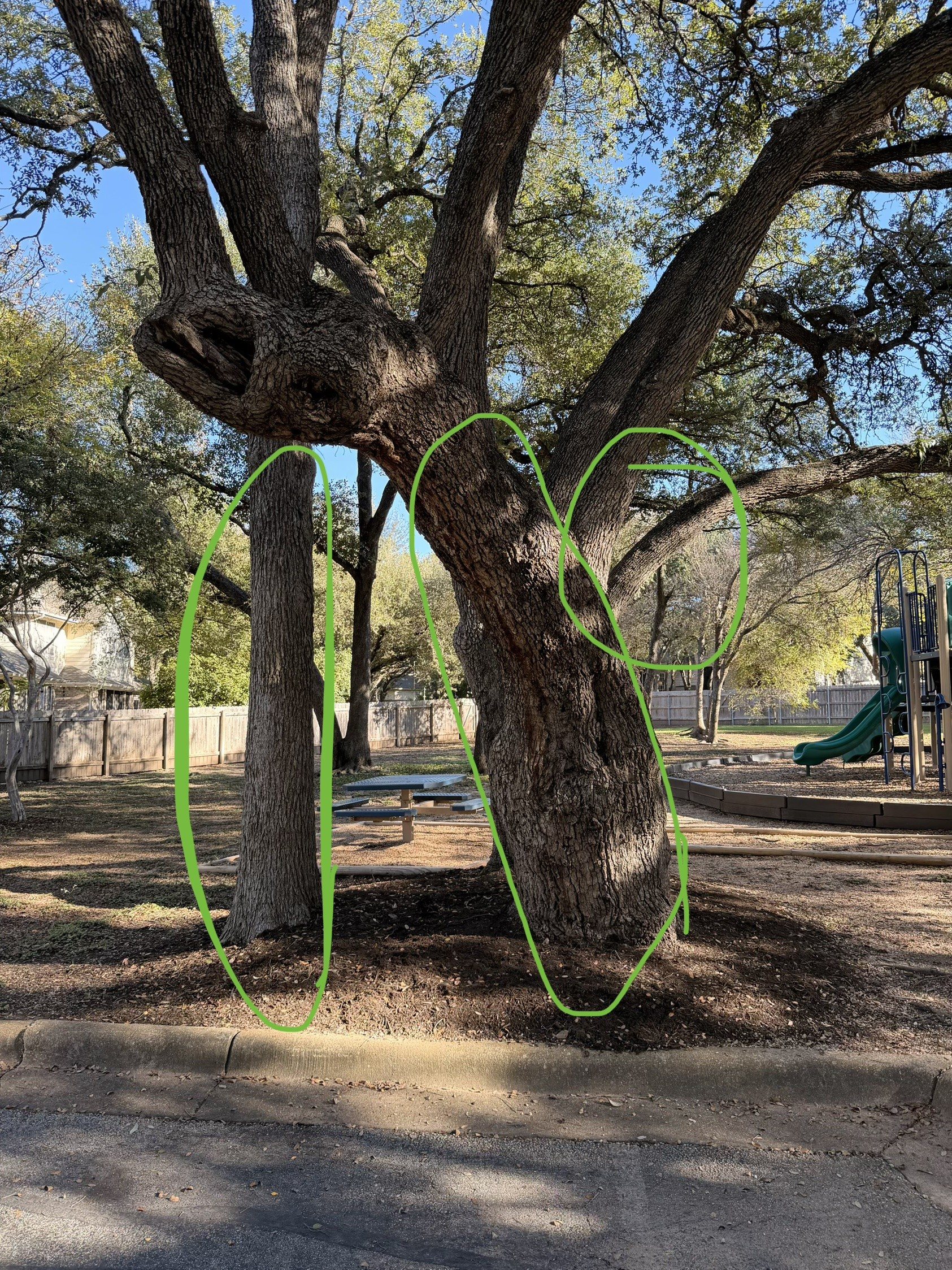
| Tree and coverage | Sapien typical 2026 price per tree |
|---|---|
| Very small tree, trunk only | From $100 (our tree minimum) |
| Small or medium tree, trunk only | $150 to $250 |
| Small tree, leafy canopy wrapped lightly | About $150 to $300 |
| Large oak, trunk only | $500 to $1,000 |
| Large live oak, trunk plus some limbs (not a full wrap) | $500 to $1,000 |
| Very large oak, trunk and multiple branches | $1,500 to $3,000 |
| Maximum wrap (every branch as high as the tree allows, C7 bulbs dangled through the leaves) or a very tall oak | Up to about $5,000; these usually need a boom lift |
Prices vary by tree, so we confirm each one from photos of your tree: how thick the trunk is, how many limbs get wrapped and how far along each one the wrap runs all change the work. Jobs start at $500, so a single small tree on its own is billed at that minimum.
National cost guides publish a wider spread, from about $60 to $1,500 or more per tree. The table of published prices lists each source, its unit and its date.
Those guides sort trees by height. Height is the wrong yardstick for most Austin trees. A live oak is short and thick, with limbs that reach far sideways. A crape myrtle and a young oak of the same height can need very different amounts of string, because one has five thin trunks and the other has one thick one. The lights go on bark, so the price follows how much bark gets covered and how hard it is to reach. The footage examples below show how far apart those trees really are.
Trees are usually one line on a bigger quote for Christmas light installation in Austin. For a number on your own trees, text photos to (737) 777-9099. What to send is listed near the end of this page.
Trunk wrap, trunk-and-limb wrap and canopy lighting defined
Tree lighting comes in three coverage levels: a trunk wrap lights the trunk to the first fork, a trunk-and-limb wrap continues out the main limbs, and canopy lighting reaches the smaller branches and crown. Installers use the terms loosely, so here is how this page uses them.
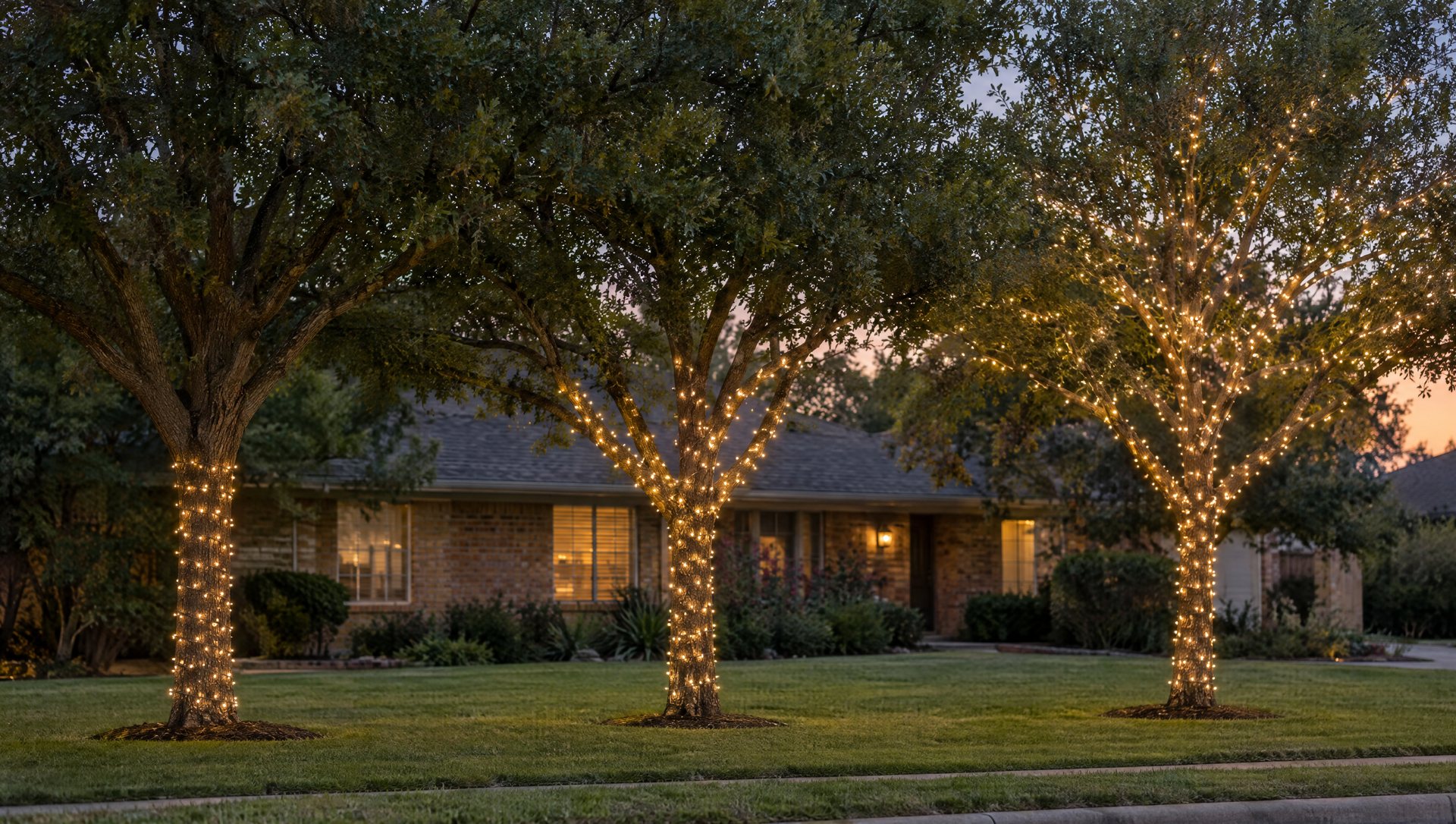
Trunk wrap. One light string spiraled up the trunk from the ground to the first fork, with an even gap between wraps. Stores also sell “trunk wrap lights”, a net that stretches around a trunk. That is a different product from the spiral wrap priced here.
Trunk-and-limb wrap. The spiral carries on past the fork and out along the main limbs. The retailer Christmas Lights Etc says in its tree-wrapping guide that most outdoor trees are wrapped the length of the trunk and about 3 to 4 feet up the main branches, and that not every branch needs wrapping. On a big live oak, the limbs can be wrapped much farther than that.
Canopy lighting. Canopy lighting has no fixed trade definition. On this page it means lighting the tree above the main limbs: wrapping secondary branches out toward the tips, or draping strings through the crown. It takes the most climbing and the most lights, and its footage cannot be worked out from a formula.
Trunk wrap vs full canopy: which is worth the money?
For most Austin front yards we’d light one tree’s trunk and limbs before we’d wrap three trunks.
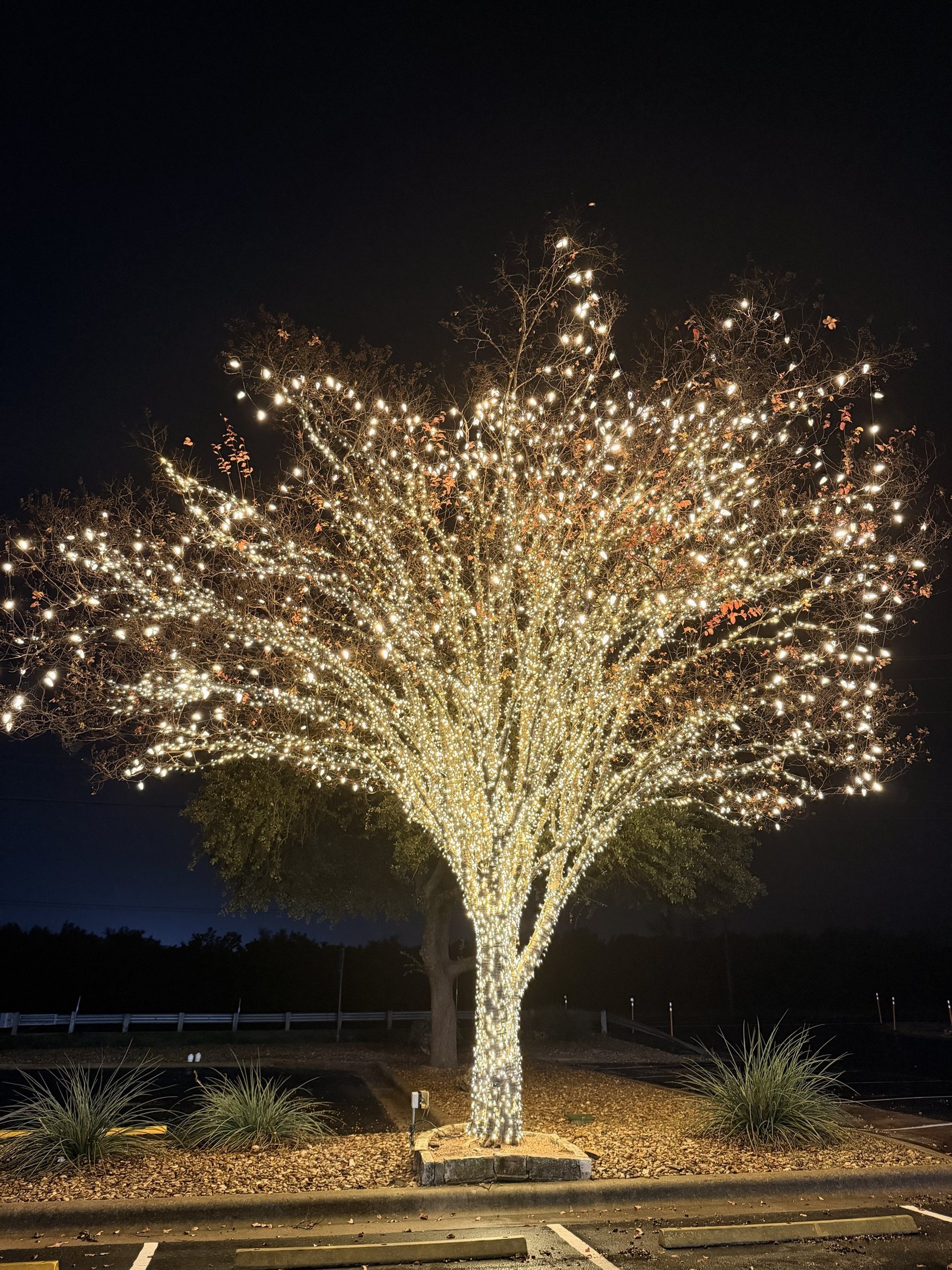
A trunk-only wrap is the cheapest way to light a tree. It reads as a lit column, and it works well in a row, such as trunks lining a driveway or an entry.
A trunk-and-limb wrap shows the shape of the tree. On a spreading oak the limbs are the shape. The cost jump is real, though. The Christmas Light Emporium, a lighting retailer, suggests adding 50% to 100% to the trunk footage once branches are included. In our large-oak example below, the five limbs take about as many lights as the trunk at a 6-inch gap, and more than twice as many at a 3-inch gap.
Limbs also cost time out of proportion to their footage. Each limb is a dead end. Christmas Lights Etc describes wrapping up a branch with gaps, back down to fill them, then crossing to the next branch at its base. That is why limb work adds crew time faster than it adds feet.
Full canopy lighting costs the most per tree because the crew is working high and far from the trunk. On a live oak it also pays back the least. Live oaks keep their leaves through the holidays, so lights out in the crown sit inside foliage. A bare crape myrtle or cedar elm shows canopy lights much better once its leaves are down.
What drives the price of a tree wrap?
Footage and crew time set the price. Items 1 to 4 below set the footage; items 5 to 8 set the time.
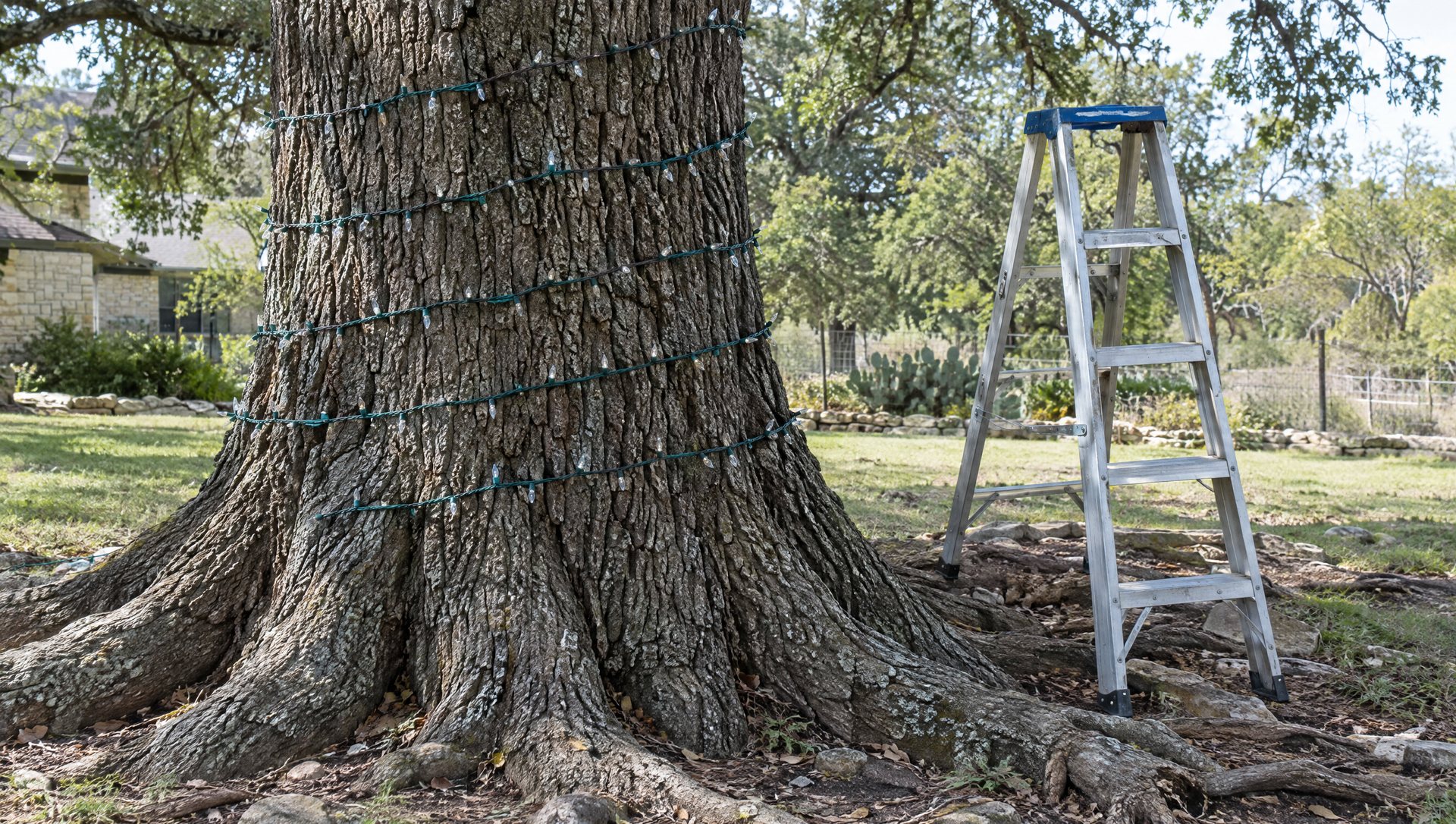
- Trunk thickness. Each wrap is one trip around the trunk. A trunk twice as thick takes twice the string for the same height.
- Wrapped height. Trunk footage rises in step with the height from the ground to the fork.
- Limb count and length. Each wrapped limb is another small trunk. Five limbs at 8 feet each is 40 more feet of wood to wrap.
- Wrap spacing. Davey Tree’s wrapping guide and several suppliers put the usual gap at 2 to 3 inches. Going from a 3-inch gap to a 6-inch gap halves the lights. The Christmas Light Emporium suggests 6 to 8 inches on branches, which cuts the limb footage by half or more.
- Access. A trunk wrapped from the ground or a short ladder is quick. Limbs 20 feet up need a tall ladder or a lift. A 36-foot towable boom lift was listed at $478 a day in Austin on the Dozr rental marketplace as of October 2026, before delivery fees. Ask any installer whether your trees need a lift and whether it is in the price. Sapien uses a boom lift on large trees that need one. Maximum wraps and very tall oaks usually do, which is why they run up to about $5,000.
- Bark and shape. Rough, furrowed bark and a flared base use more string than the formula predicts. Smooth bark lets a string slide, so it takes more care to keep the spacing even.
- Distance to power. A tree 80 feet from the nearest outdoor outlet needs a cord run hidden across the yard.
- How many trees in one visit. Setup and travel are shared when several trees are done together, so ask how the quote treats a second or third tree.
How many feet of lights does a tree take?
The standard formula is: divide the wrapped height by the gap between wraps, then multiply by the distance around the trunk. Davey Tree and several lighting suppliers, including Christmas Lights Etc on its light calculator page, publish the same equation. Keep height and gap in the same unit. The answer comes out in the unit you used for the distance around.
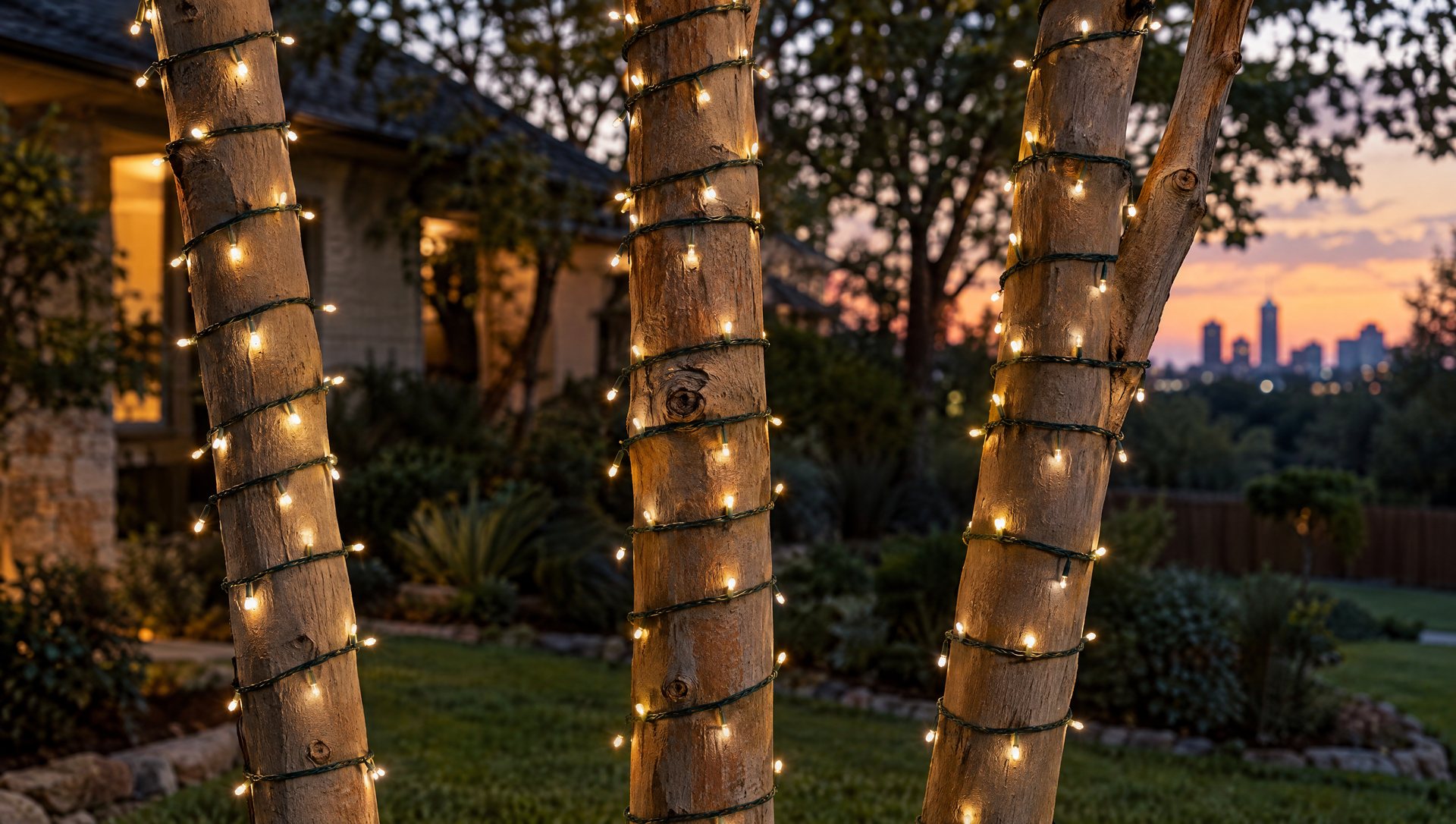
Example: a trunk 3 feet around, wrapped 8 feet high with a 3-inch gap. Eight feet is 96 inches. 96 divided by 3 is 32 wraps. 32 wraps times 3 feet is 96 feet of lights.
Feet of lights per foot of trunk height
This table is our arithmetic from that formula: 3.14 times trunk diameter in inches, divided by the gap in inches. No supplier publishes it. Multiply the figure by the height you want wrapped.
| Trunk diameter | 2 in gap (ft) | 3 in gap (ft) | 4 in gap (ft) | 6 in gap (ft) |
|---|---|---|---|---|
| 6 in | 9.4 | 6.3 | 4.7 | 3.1 |
| 8 in | 12.6 | 8.4 | 6.3 | 4.2 |
| 12 in | 18.8 | 12.6 | 9.4 | 6.3 |
| 18 in | 28.3 | 18.8 | 14.1 | 9.4 |
| 24 in | 37.7 | 25.1 | 18.8 | 12.6 |
| 36 in | 56.5 | 37.7 | 28.3 | 18.8 |
Read across the 3-inch column. A 24-inch trunk takes 25.1 feet of lights per foot of height. A 6-inch trunk takes 6.3 feet. That is four times the string for the same height.
Worked examples for common Austin trees
Each row below is an example with stated inputs, a 3-inch gap unless noted, and 10% added. The 10% follows the supplier Christmas Light Source’s advice to add 10% or one extra string. String counts assume a 70-light string with 23.3 feet of lit length. Trunk sizes are diameters measured about 4.5 feet up. Full canopy has no row, because its footage depends on branch count and no formula gives it.
| Example tree | Inputs | Formula (ft) | With 10% (ft) | Strings |
|---|---|---|---|---|
| Crape myrtle, trunks only | 3 trunks, 5 in diameter, 6 ft each | 94 | 104 | 5 |
| Small tree, trunk only | 6 in diameter, 6 ft | 38 | 41 | 2 |
| Small tree, trunk + limbs | Add 3 limbs, 3 in diameter, 3 ft each | 66 | 73 | 4 |
| Medium tree, trunk only | 12 in diameter, 8 ft | 101 | 111 | 5 |
| Medium tree, trunk + limbs | Add 4 limbs, 6 in diameter, 4 ft each | 201 | 221 | 10 |
| Large live oak, trunk only | 36 in diameter, 6 ft | 226 | 249 | 11 |
| Large live oak, trunk + limbs, 6 in gap on limbs | Add 5 limbs, 12 in diameter, 8 ft each | 478 | 525 | 23 |
| Large live oak, trunk + limbs, 3 in gap on limbs | Same 5 limbs | 729 | 802 | 35 |
| Windmill palm, trunk | 10 in diameter, 8 ft | 84 | 92 | 4 |
For a crape myrtle’s trunks plus main limbs, a retailer’s rule of thumb is 1.5 to 2 times the trunk footage, or about 155 to 210 feet for the example above.
The large-oak examples come to 23 or 35 strings, or about 1,610 to 2,450 lights at 70 per string. One Dallas-Fort Worth installer’s page (checked October 2026) says a typical 30- to 40-foot mature oak takes 800 to 2,500 lights, depending on canopy spread. Both examples sit inside that range.
Real trunks take more string than the formula says, because bark texture, the flare at the base and uneven spacing all add length. Christmas Light Source wound a cord around an 18-inch pecan at about a 6-inch gap and measured 11 feet per foot of height. The formula gives 9.4.
Cost notes by tree: live oak, crape myrtle, cedar elm, pecan and palm
Species changes the price through trunk count, trunk thickness, bark and how high the first limbs start.
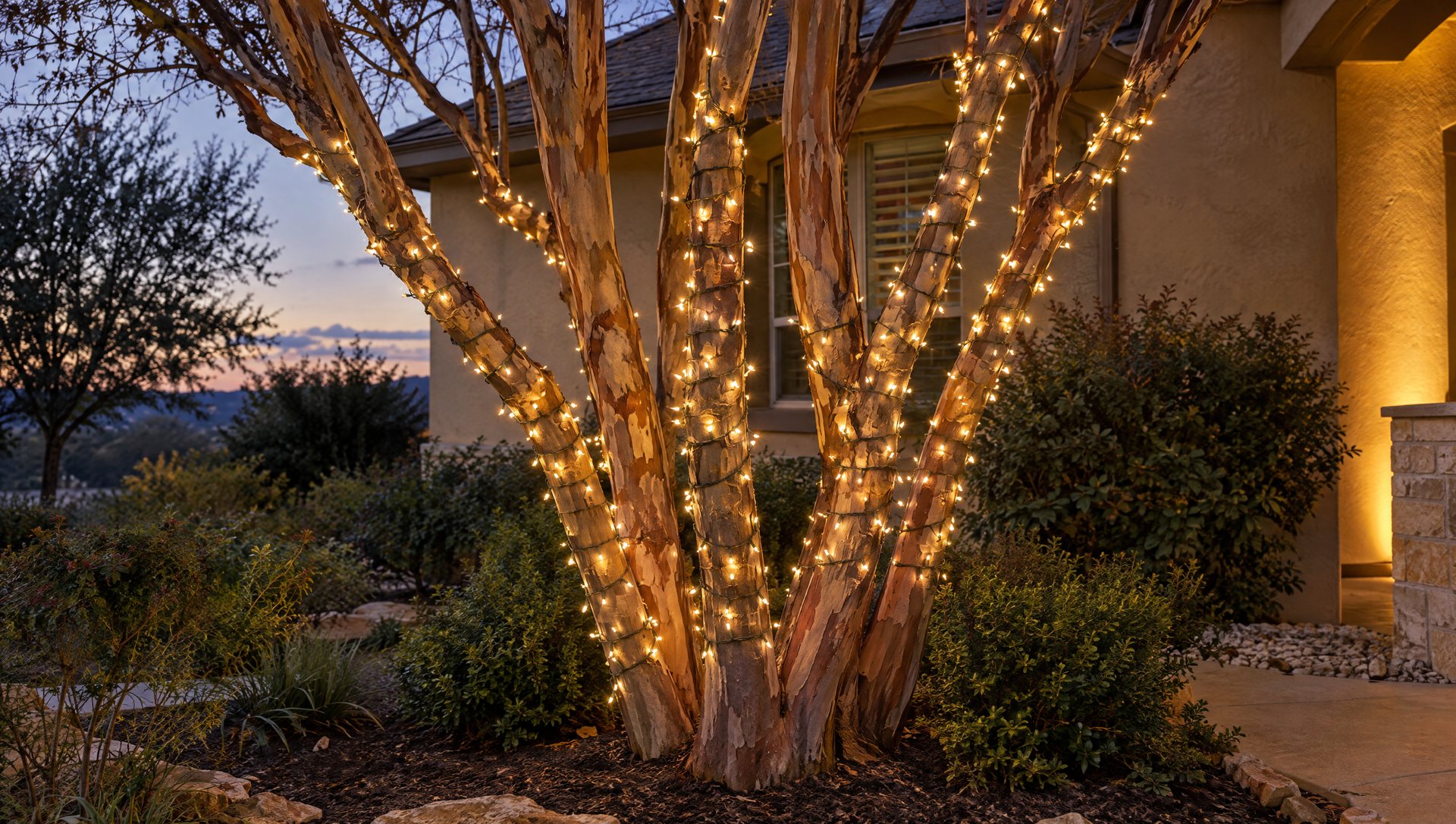
Christmas lights on live oak trees
A live oak costs the most to wrap because of girth and limb length, not height. Texas A&M Forest Service describes the live oak as commonly up to 50 feet tall, with a short, stout trunk 4 feet or more in diameter that splits into several large limbs. The crown can spread more than 100 feet. The Hill Country form, escarpment live oak, is smaller at 20 to 40 feet, according to the Wildflower Center, and is often multi-trunked, according to Texas A&M Forest Service.
That shape means a short trunk wrap with a lot of string in it, then long, thick limbs that can each take as much as a medium tree’s trunk. The bark is rough and deeply furrowed, which adds string. Live oaks hold their leaves through the holidays and swap them in late February or March, so we’d put the money into the trunk and limbs and leave the crown dark. For design, ladder and oak-wilt specifics, see our guide to lighting live oaks for Christmas.
Christmas lights on crape myrtles (also spelled crepe myrtle)
A crape myrtle takes little string per trunk, but the trunks add up. Texas A&M Forest Service lists the crapemyrtle as usually multi-trunked, to 20 feet tall, with mature trunks 4 to 12 inches in diameter and smooth bark. Our three-trunk example needs about as many feet as a medium tree’s trunk. Low forks and crossing stems also make limb work slow, so in our experience its price sits closer to a medium tree than its height suggests. It is deciduous, so once the leaves drop, wrapped limbs show cleanly.
Cedar elm
A cedar elm has a tall, straight trunk, so a trunk wrap can run higher than on an oak before it reaches a fork. Texas A&M Forest Service gives the cedar elm a height to 75 feet and a trunk 2 to 3 feet in diameter. The bark breaks into thin, loose, flaky scales. The crown is narrow and upright, so limb wraps climb instead of spreading, and that means more ladder height for each foot of limb.
Pecan
A mature pecan can be the tallest tree in an Austin yard. Texas A&M Forest Service lists the pecan to 120 feet with a trunk to 4 feet in diameter. On a big pecan the first limbs can start high above the ground, so a trunk-only wrap is often the sensible scope. Its limbs are often out of ladder reach, so ask whether the quote includes a lift.
Palms
A palm is a trunk wrap and nothing else, so its price is the simplest to estimate. A Texas sabal palm has a trunk to 2 feet in diameter, according to Texas A&M Forest Service. A windmill palm trunk is usually under 10 inches and covered in brown fiber, according to NC State Extension. We found no arborist source on whether wraps harm palms, so we make no claim either way. Our guide to Christmas lights on palm trees covers wrap styles.
Deciduous trees in Austin may still carry leaves at Thanksgiving. Texas A&M Forest Service says Texas fall color peaks among the latest in the nation. If you want canopy lights on a cedar elm or pecan, ask how the plan changes if the leaves are still up on install day.
How installers price trees: per tree, per strand or per foot
Tree quotes come in four different units, and two quotes only compare once you know which unit each one uses. For the rest of the page, see what a complete Christmas light quote includes.
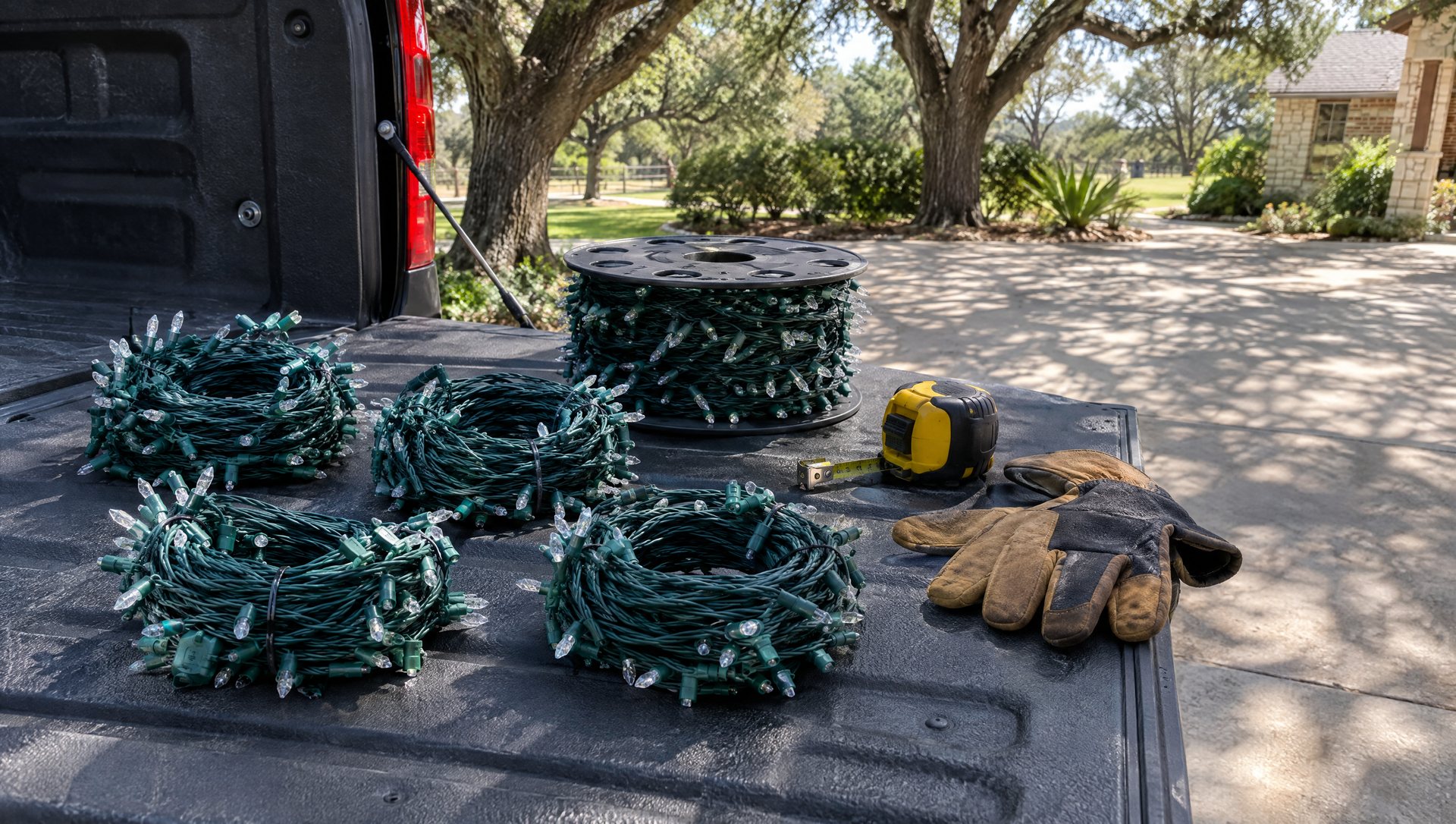
- Per tree, by size. This is the format most cost guides use. The tiers are usually by height. Ask which coverage the tier assumes: trunk only, or trunk and limbs.
- Per strand. The price is a rate times the number of strings used. One Austin installer’s site says it charges trees this way without giving the rate. Ask for the strand count and the lit length of one strand.
- Per foot of trunk. A San Antonio installer’s published list (checked October 2026) charges $5 per foot of trunk for labor only, or $15 per foot with LED lights supplied. The foot is a foot of trunk height, not a foot of lights. An 8-foot trunk at $15 per foot is $120 on that list as published; the list does not mention girth.
- Per foot of light string. The quote lists total feet of lights and a rate. This unit tracks the real work most closely, and you can check the footage against the tables above.
To compare two quotes, turn both into the same terms: which parts of which trees, at what gap, with how many feet of lights. Roofline pricing works differently; see how roofline pricing works in Austin.
Why are tall trees quoted separately from the roofline?
A roofline is priced by its length. A tree is priced by its surface. Those are different jobs, so a careful quote lists them on separate lines.
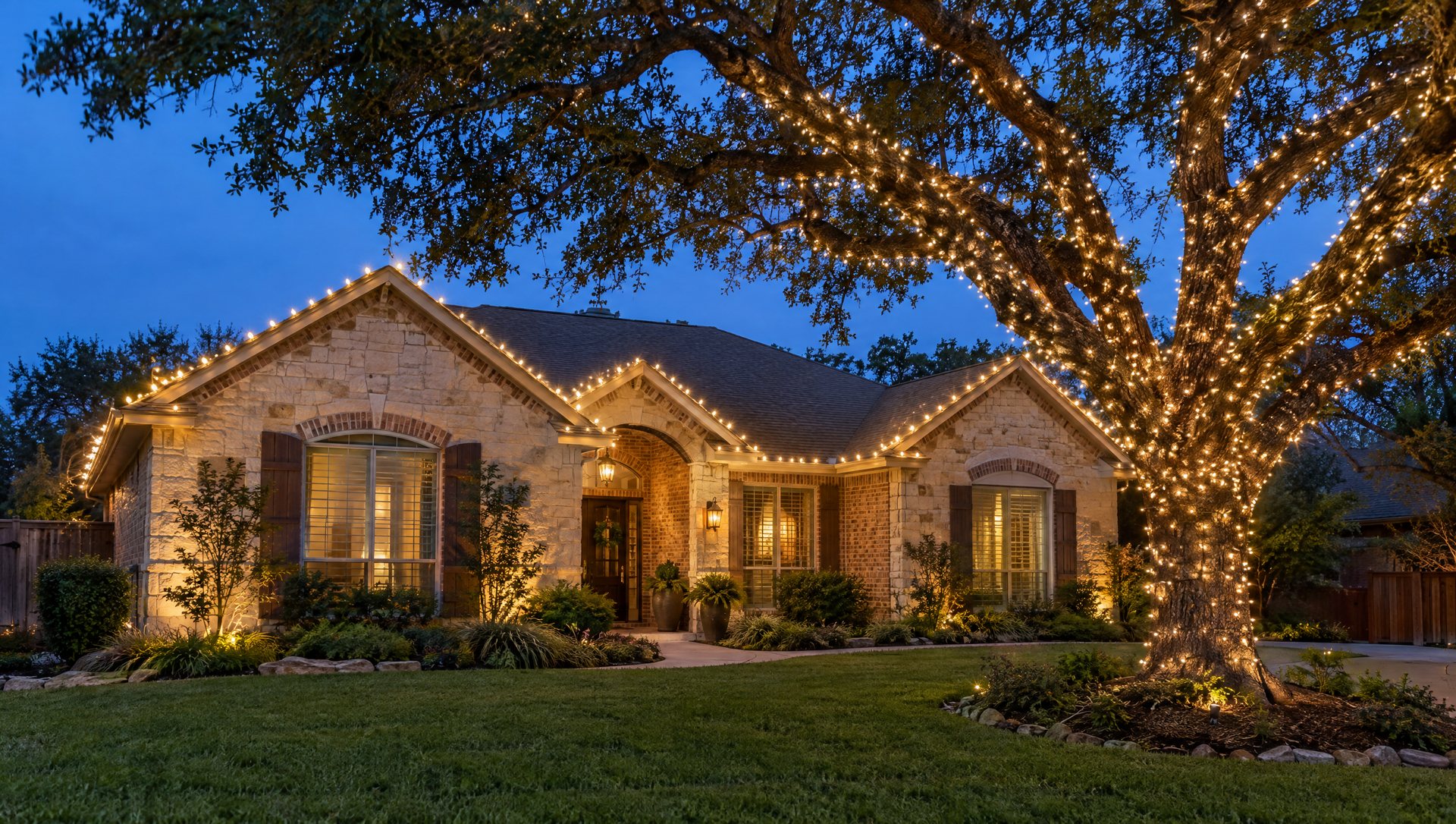
One linear foot of roofline takes about one foot of lights, clipped along the eave from a ladder. One foot of trunk height can take about 6 to 38 feet of lights at a 3-inch gap, for trunks 6 to 36 inches thick. Tree work is slower per foot, and above the first fork it needs different equipment.
A separate tree line lets you drop a tree, add one or change the coverage without redoing the whole quote. If a package rolls trees in, ask how many trees and what coverage it assumes.
For scale, the Christmas Lights HQ pricing guide for installers (dated March 2026, checked October 2026) lists a roofline plus two to four trees at $1,100 to $3,000. Sapien prices each tree as its own line: typically $150 to $250 for a small or medium trunk, $500 to $1,000 for a large oak’s trunk, $1,500 to $3,000 for a very large oak with several branches, and up to about $5,000 for a maximum wrap that needs a boom lift, with a $500 minimum for the whole job.
What do other sources publish for tree wrapping?
These are third-party numbers, shown with their unit and the date on the page. All were checked in October 2026. None is an Austin installer’s price, and none is Sapien’s.
| Source and page date (checked October 2026) | Unit | Published figure | What to know |
|---|---|---|---|
| Thumbtack (no year shown) | Per tree | $60 small tree to $1,200 large tree | National. Notes that open-branched trees take more than cone-shaped evergreens. |
| HomeAdvisor (June 2026) | Per tree | $75 to $200 small; $1,500 or more at 30 ft and up | National. Says to plan on 5 to 10 strands per tree. |
| Angi, Austin page (November 2025) | Per tree | $51 to $1,020 | Not Austin installer data. See the note below. |
| Christmas Lights HQ trade guide (March 2026) | Per tree, by height | Under 10 ft $100 to $250; 10 to 20 ft $250 to $500; over 20 ft $500 to $1,500 | Advice to installers on what to charge, not a survey of what homeowners paid. |
| Bob Vila (2022) and Fixr (2025) | Per tree, by height, labor only | About 6 ft $75 to $125; 12 to 18 ft $125 to $250; about 28 ft $300 to $1,500 | Lights are extra. Fixr adds $400 to $700 for a one-day lift rental. |
| A Dallas-Fort Worth installer’s list (2026 season) | Per tree, by height | 8 to 15 ft $150 to $250; 15 to 30 ft $250 to $400; large oak 30 to 60 ft $400 to $800 | Includes takedown and storage. Says multi-tree packages save up to 25% and most single-tree wraps take 30 to 90 minutes. |
| A San Antonio installer’s list | Per foot of trunk height | $5 labor only; $15 with LED lights | Canopy is priced per foot of canopy diameter. |
The Angi Austin figure equals the national range times 0.68 ($75 x 0.68 = $51; $1,500 x 0.68 = $1,020). That is our arithmetic. It reads as a modeled adjustment, not a survey of Austin installers, and Angi and HomeAdvisor share data. No Austin installer page we opened in October 2026 published a dollar price per tree.
What does it cost to wrap a tree yourself?
For a trunk you can reach from the ground or a short ladder, the lights are the main cost. The hanging steps are in our guide to hanging Christmas lights outside. A 70-light 5mm wide-angle LED string with 23.3 feet of lit length listed at $19.95 regular and $13.97 on sale at one online supplier, as of October 2026. Retail prices move after Black Friday.
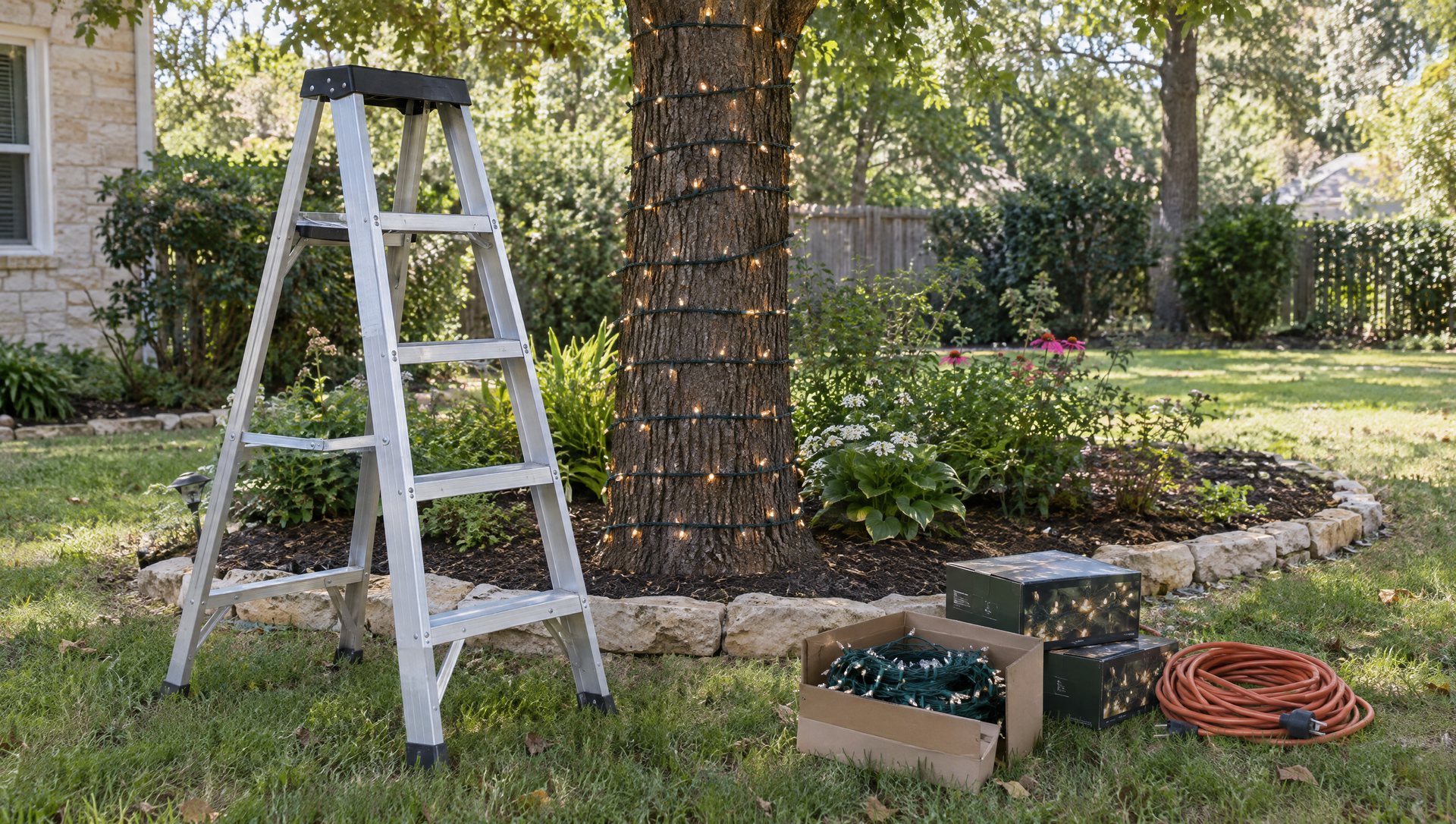
Examples at the $19.95 regular price, using the string counts above:
- Crape myrtle, three trunks: 5 strings, about $100.
- Medium tree, trunk only: 5 strings, about $100.
- Medium tree, trunk and four limbs: 10 strings, about $200.
- Large live oak, trunk only: 11 strings, about $219.
- Large live oak, trunk and five limbs: 23 to 35 strings, about $459 to $698.
Add outdoor-rated extension cords, a timer and a ladder if you do not own them, plus your time for the install and the takedown. A professional price adds labor, height work and usually takedown, so compare it against the string cost plus your own time. Our DIY vs professional cost comparison runs those numbers for a whole house.
Stop and call a professional if any of these is true:
- A limb you want lit is within 10 feet of a power line. Austin Energy’s home safety guidance says to keep ladders and tools at least 10 feet from power lines and to look for the service drop, where the line meets the house.
- The wrap needs you to climb into the tree or lean out past the ladder’s side rails. The American Ladder Institute says to keep your belt buckle between the rails.
- The ground under the tree is sloped, soft or covered in roots, so a ladder will not sit firm and level.
- The lights you have are not marked for outdoor use.
More ladder and cord rules are in our light installation safety guide.
What should a tree-wrap price include?
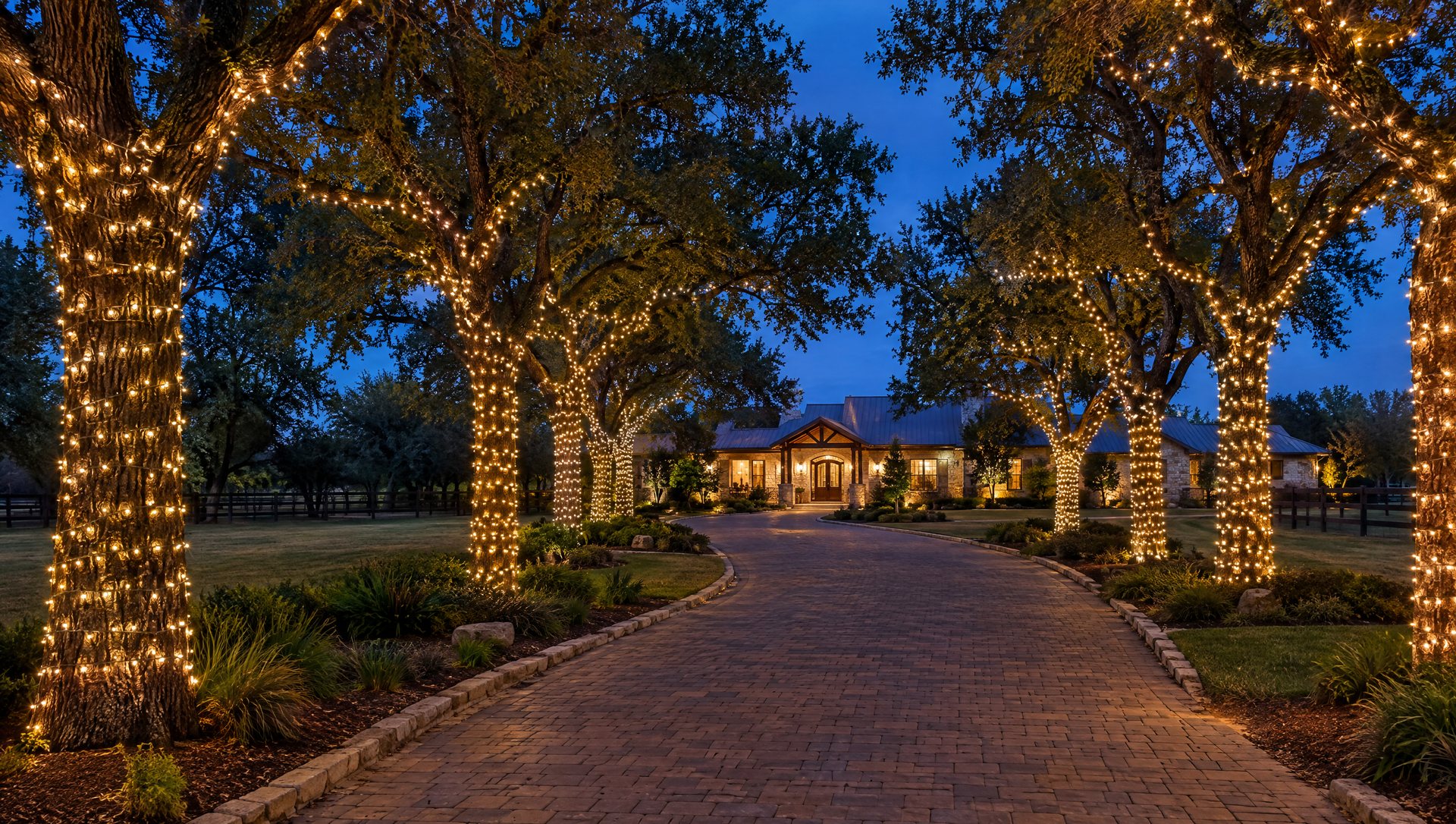
A tree-wrap price should state the coverage, the lights, the takedown and who owns the strings afterward. Ask any installer, including us, these questions before comparing numbers:
- Which trees, and how far up each one: trunk only, or which limbs?
- What gap between wraps, and about how many feet or strands?
- Are the lights included, and who keeps them after the season?
- Is takedown included, and when does it happen?
- What happens if a section goes dark in December?
- Is a lift needed, and is it in the price?
- Does a second or third tree on the same visit cost less?
- Is sales tax included in the quote?
- What does the same tree cost next year?
Who supplies the lights varies a lot between companies; our guide to whether installers provide the lights explains the common setups.
How Sapien handles this. Every install includes a custom design, commercial-grade lights and clips, installation and takedown. On trees we use 5mm wide-angle LED mini lights; the supplier Christmas Designers says most professional installers pick them for tree wraps because the small bulbs follow the shape of the tree, and the wire comes in green, brown or white to blend with the bark. Takedown happens January 2 to January 15. We re-quote every season, so a returning customer’s price reflects that year’s scope. Whether your trees need a lift, and how several trees on one visit are priced, comes back with the quote from your photos.
For the full list of what happens on site, see what install day includes.
Will Christmas lights hurt the tree?
Seasonal lights that come off after the holidays are not the main thing arborists warn about. The main harm they describe, girdling, comes from a wrap left on. Trees that look bare in November and December already carry next spring’s buds, so the Morton Arboretum also warns against breaking twigs or knocking buds off. A wrap should be snug enough to stay put for one season, not cinched, and off again every year.
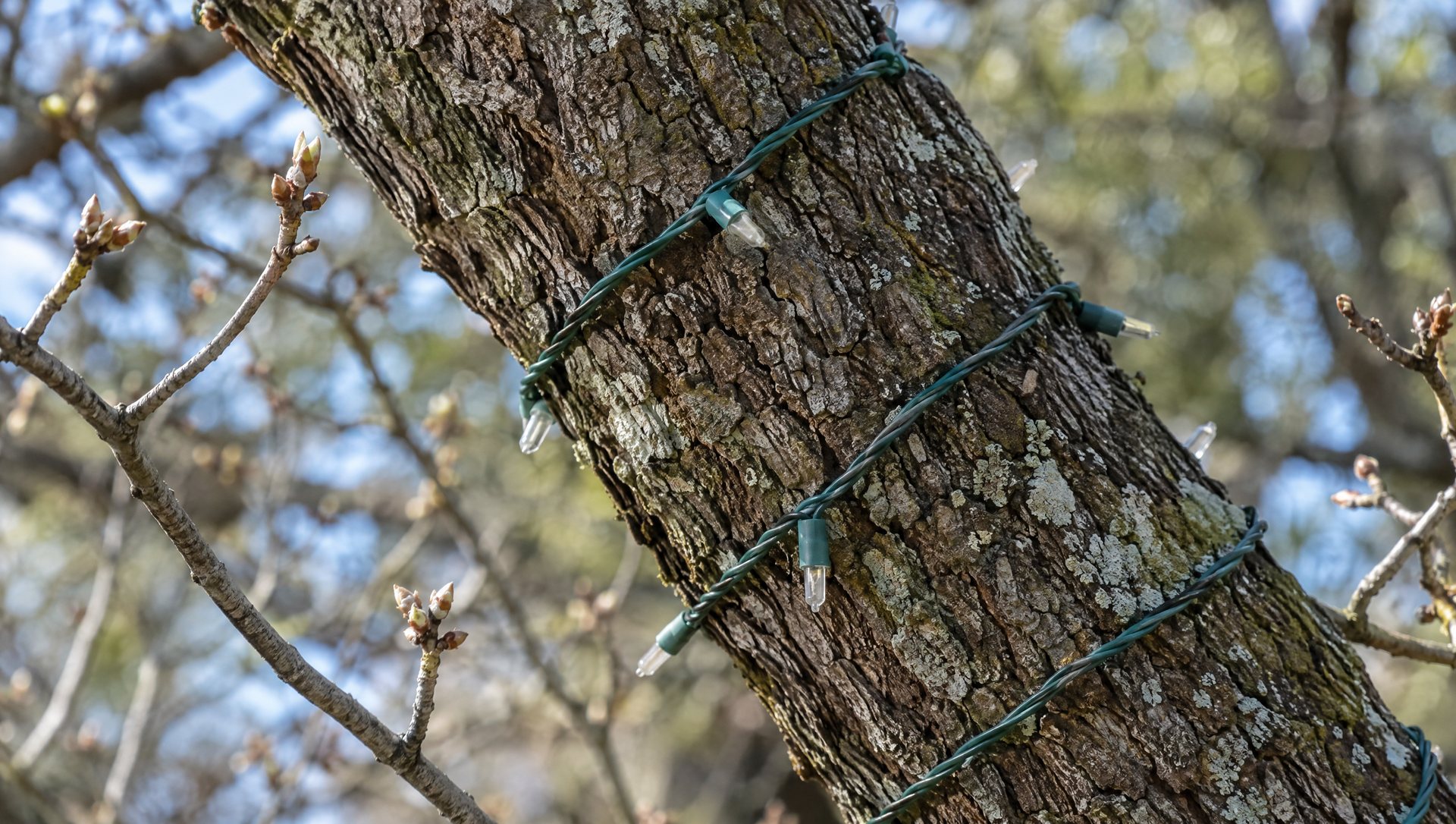
Take the wrap off every year
Wire left around a trunk or limb cuts in as the wood thickens. The Morton Arboretum’s plant clinic explains that forgotten wires sever the vessels under the bark, which can kill the branch or the tree. A Davey Tree arborist said on the company’s podcast that a wrap left in place starts to girdle a tree two to three years on. Davey also says a spiral wrap will eventually girdle branches, while lights laid over the top of branches can be acceptable. No source we found gives a safe number of months.
The practical rule: wraps come off after the season and before spring growth. In Austin, live oaks push new leaves in late February or March. Cool-running LED strings do not change this. The harm comes from the wire, not from heat. If you want someone else to handle it, see our Christmas light removal service guide; for timing, see when to take the lights down.
No nails, screws or staples
Some crews, ours included, anchor a tree wrap with small removable staples where it would otherwise slip, and take them out in January. If you would rather have nothing driven into your trees, tell us and we will wrap without staples. On oaks, weigh that choice against the Forest Service’s advice: Texas A&M Forest Service’s oak wilt guidelines say to paint all wounds on oaks right away, in every season, and to avoid wounding oaks from February 1 through June 30. The guidelines do not mention light fasteners; treating a staple hole as a small wound is our reading of them.
The same rule covers accidents. If an oak limb is cracked or gouged during install or takedown, the Forest Service rule is to paint it right away, and any paint works. Ask any installer whether the crew carries paint for that.
No cutting to make room
We would not cut a limb to make room for lights. The wrap follows the tree as it is. Cutting limbs on a large tree can fall under the City Arborist’s rules on removal and heavy pruning. A tree in the street right-of-way may be a public tree, so ask the City before lighting one. The City Arborist’s office decides questions about a specific tree.
Trees we would skip or light differently
Some trees should not be wrapped, and some are better lit another way.
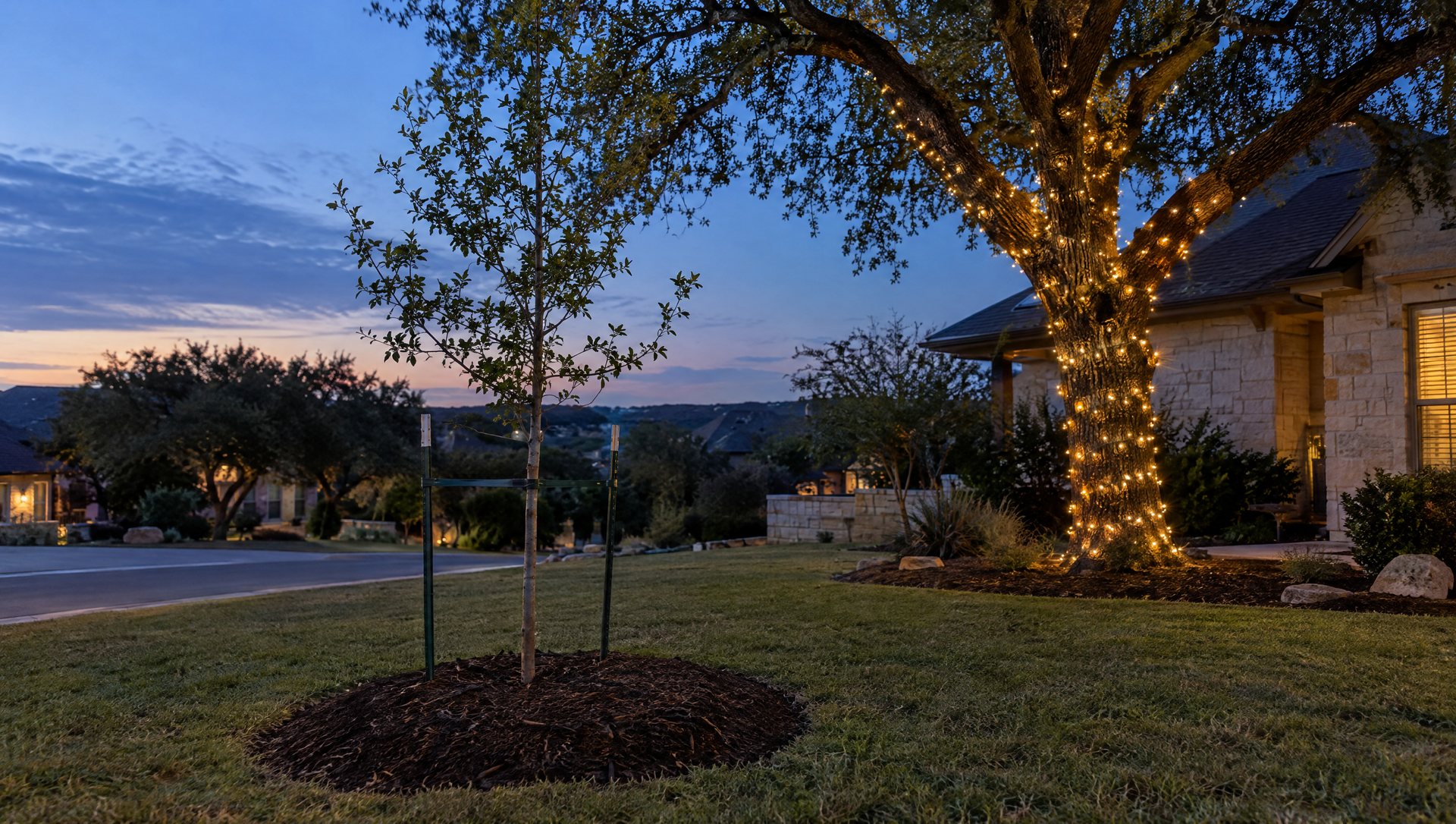
- Young or newly planted trees. Davey Tree says not to put lights on a young or newly planted tree, or on one that is weak or damaged. We agree. Light something else this year.
- Trees with limbs near power lines. Austin Energy says not to trim a limb within 10 feet of a power line yourself. We keep lights and ladders out of that zone too, and wrap only the parts of the tree that stay more than 10 feet from the line.
- A tree nobody sees. A wrapped oak in the side yard costs the same as one by the street. Pick the tree that faces the road or the front door.
- Very thin trunks. Under about 3 inches, a spiral wrap looks like a lit stick. A few strings draped through the branches can look better and cost less.
- Too many trees, lightly done. One tree wrapped well, trunk and limbs, usually beats five wrapped thinly. If the budget is fixed, cut trees before you widen the gap.
How much power does a wrapped tree need, and what does it cost to run?
A wrapped tree on LED mini lights draws very little power, and a single outdoor outlet usually covers it. The 70-light string in our examples is listed at 4.8 watts. The 35-string large-oak example totals 168 watts, which is 1.4 amps at 120 volts. Our LED vs incandescent comparison shows how different that would be with older bulbs.
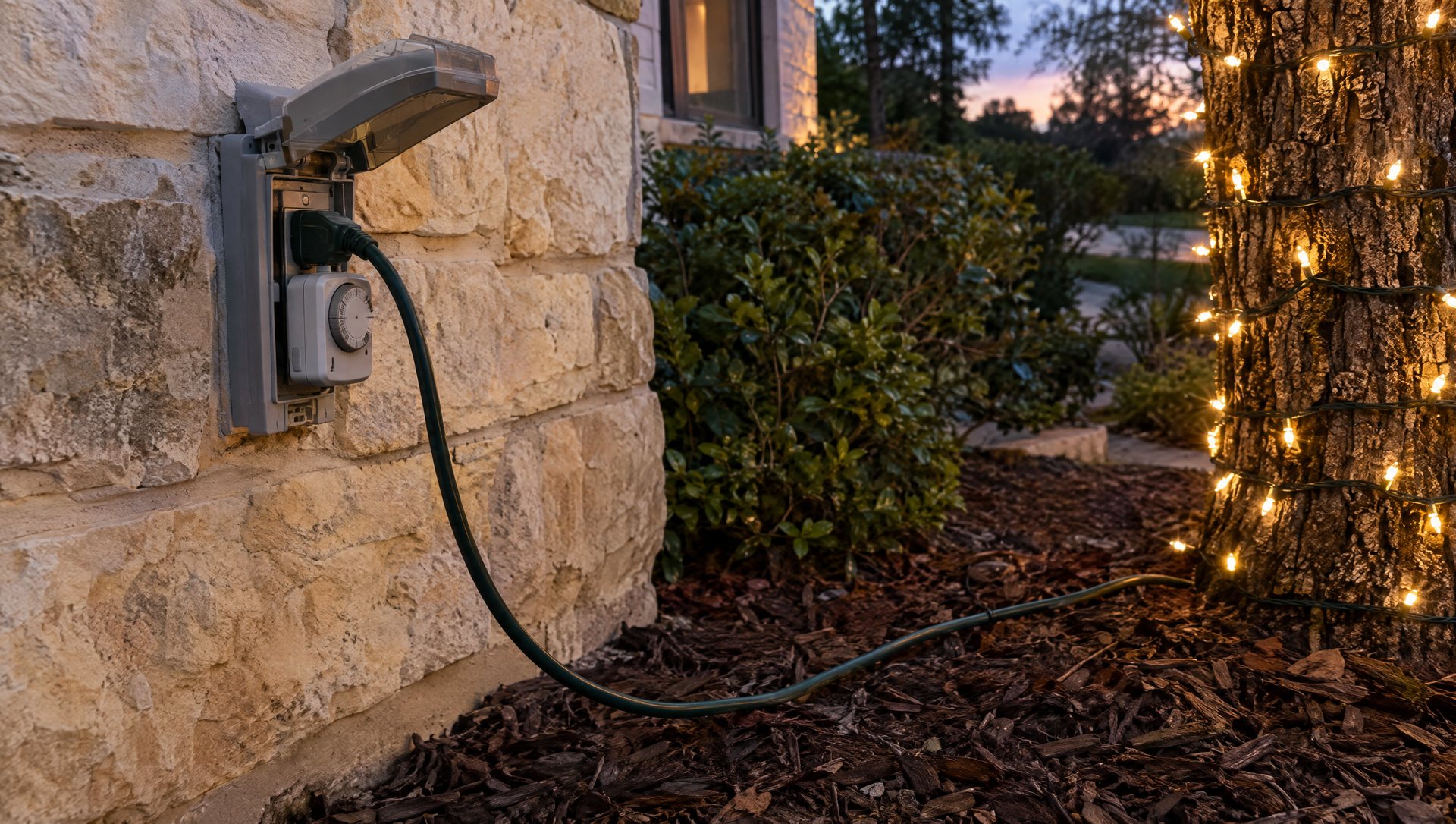
Example running cost: that 168-watt wrap, run 6 hours a night for 45 nights, uses about 45 kWh. On Austin Energy’s fiscal 2027 residential rates, an extra kWh works out to about 12 to 15 cents inside the city (our arithmetic on the posted charges, checked October 2026). That puts the tree at about $5.50 to $7 for the season. If another utility serves you, check the per-kWh charges on your own bill. A timer keeps the hours in check; see whether to leave Christmas lights on all night.
The limit that matters is how many strings connect end to end from one plug. That string’s listing allows up to 43 sets in one run. Christmas Lights Etc gives about 210 watts as the usual end-to-end limit for standard sets. Read the “maximum sets connected” line on your string’s tag and stay under it. Do not bypass or upsize a plug fuse to get around it; our guide to Christmas light fuses explains why.
The Electrical Safety Foundation International says to use lights marked for outdoor use, plug them into a GFCI-protected outlet, and keep connections out of standing water.
Sapien installs plug-in seasonal lighting only. If no outdoor outlet is within reach of a cord, the options are a longer outdoor-rated cord or a new outlet. A new outlet or circuit is work for a licensed electrician; Texas licenses them through the Texas Department of Licensing and Regulation under Occupations Code chapter 1305.
What to send for an accurate tree quote
A tree can be quoted from photos if the photos show its size. Send these:
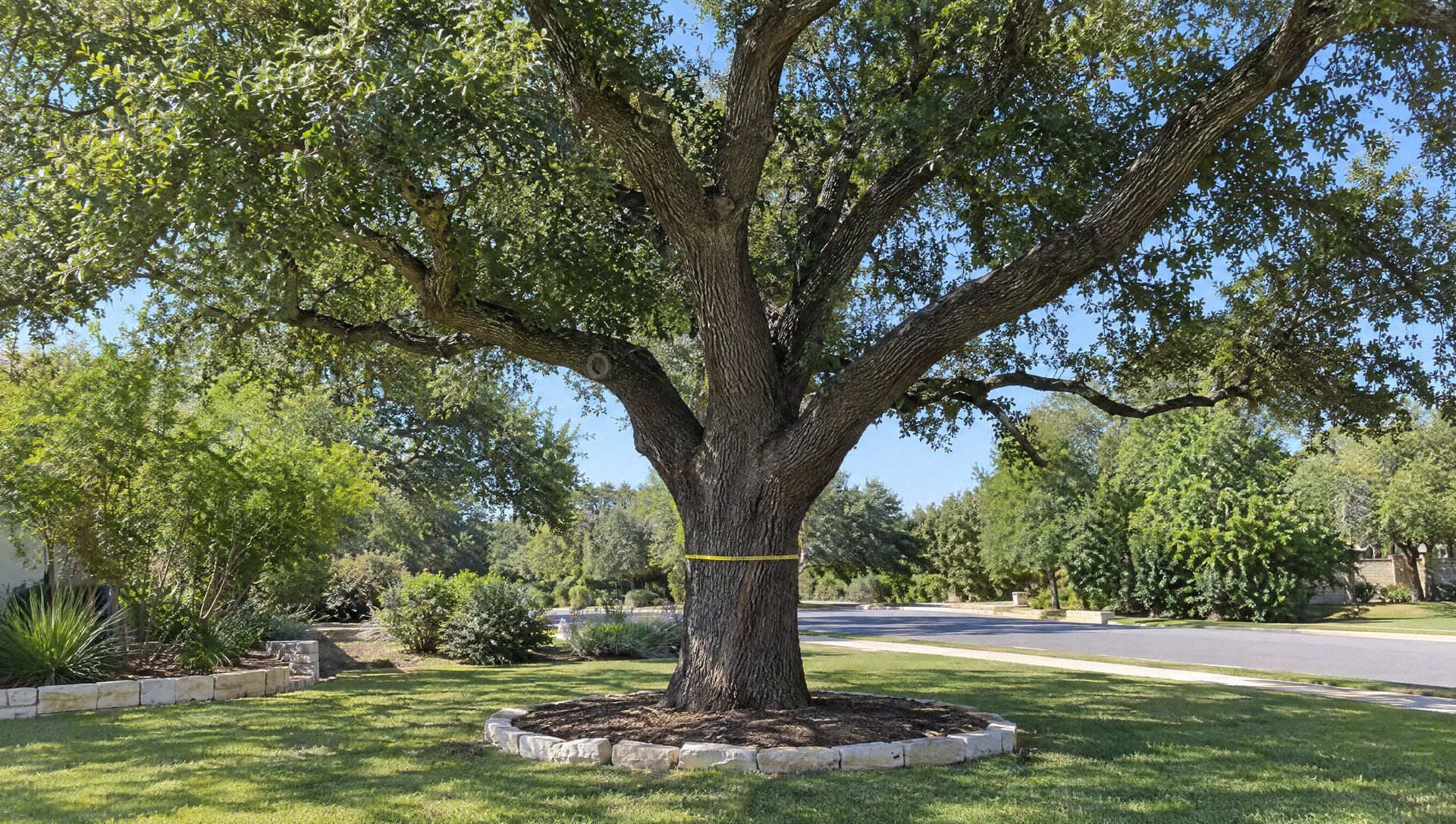
- One photo of each whole tree, taken in daylight from far enough back to see the top.
- One photo of each trunk with something for scale, such as a person, a gate or a tape measure.
- The distance around the trunk about 4.5 feet up, if you can measure it. A piece of string and a tape measure will do.
- How high the trunk goes before it splits into limbs. A photo with a person standing beside it works.
- How many main limbs you want lit.
- How far up you want lights: trunk only, trunk and main limbs, or more.
- Where the tree is seen from: the street, the driveway, the front door, the back patio.
- Where the nearest outdoor outlet is.
The steps for the whole house are in our guide to getting a quote from photos. Tree wrapping is usually the slowest part of an install, so settle the tree plan before you pick a date. Our Austin holiday lighting timeline covers when to book.
Ready for a tree-lighting plan? Text daytime photos of your trees to (737) 777-9099, or use the contact page. Tell us which trees, trunk only or trunk and limbs, and where they are seen from, and we’ll come back with a price. Jobs start at $500.
Frequently asked questions
How long does it take to wrap a tree in lights?
One Dallas-Fort Worth installer’s page (checked October 2026) says most single-tree wraps take 30 to 90 minutes. A large live oak with long limbs, wrapped from a tall ladder or lift, takes longer.
Do I need a permit to put lights on a protected or heritage tree in Austin?
We found no City of Austin rule about hanging lights on a tree in a private yard. The city’s tree rules cover removal and heavy pruning of trees 19 inches or more in diameter, measured 4.5 feet above the ground. The City Arborist’s office is the authority for your tree.
Can I use net lights on a tree trunk?
You can. Net-style trunk wraps are made to stretch around a trunk and give a uniform grid. One retailer says they usually do not suit very small branches. We’d skip them on any tree you see up close, because the grid does not follow the limbs.
Sources
- Thumbtack: Christmas light installation prices (per-tree range of $60 to $1,200; checked October 2026)
- HomeAdvisor: cost to install holiday lighting (small tree $75 to $200; 30 ft and up $1,500 or more; 5 to 10 strands; updated June 2026, checked October 2026)
- Angi: Christmas light installation cost in Austin ($51 to $1,020 per tree; November 2025, checked October 2026)
- Christmas Lights HQ: pricing guide for installers (per-tree height tiers; roofline plus two to four trees; March 2026)
- Bob Vila: Christmas light installation cost (labor-only height tiers; 2022)
- Fixr: Christmas light installation cost (labor-only height tiers; lift rental $400 to $700; 2025)
- A Dallas-Fort Worth installer’s tree-wrapping page (per-tree tiers, multi-tree saving, light counts for a 30 to 40 ft mature oak, time per tree; checked October 2026)
- A San Antonio installer’s price list (per-foot trunk and canopy pricing; checked October 2026)
- Davey Tree: wrapping trees with Christmas lights, the dos and don’ts (wrapping formula; 2 to 3 inch spacing; trees to skip)
- Christmas Lights Etc: Christmas tree light calculator (the same wrapping formula)
- Christmas Lights Etc: wrapping trees with lights (how far up branches to wrap; up-and-back branch wrapping; net-style trunk wraps)
- The Christmas Light Emporium: how to wrap trees guide (add 50% to 100% for branches; 6 to 8 inch gap on branches)
- Christmas Light Source: how many light strings to wrap a tree (10% allowance; measured pecan example)
- Christmas Designers: 70-light 5mm wide-angle LED string (string length, watts, sets connected, price as of October 2026)
- Christmas Designers: how to wrap a tree in Christmas lights (5mm lights for tree wraps)
- Dozr: towable boom lift rental in Austin (36 ft lift at $478 per day; checked October 2026)
- Texas A&M Forest Service, Trees of Texas: live oak (size, trunk and bark; escarpment form often multi-trunked)
- Texas A&M Forest Service, Trees of Texas: crapemyrtle (multi-trunk form, height, trunk size, bark)
- Texas A&M Forest Service, Trees of Texas: cedar elm (height, trunk size, bark)
- Texas A&M Forest Service, Trees of Texas: pecan (height and trunk size)
- Texas A&M Forest Service, Trees of Texas: Rio Grande palmetto (Texas sabal palm) (trunk size)
- Texas A&M Forest Service: the magic and chemistry of fall foliage color (late Texas fall color; November 5, 2025)
- Lady Bird Johnson Wildflower Center: Quercus fusiformis (escarpment live oak size; leaf drop in late February or March)
- NC State Extension: windmill palm (trunk diameter and fiber)
- The Morton Arboretum: caring for trees and shrubs as you light your landscape (girdling; buds already formed in late fall)
- Davey Tree, Talking Trees podcast, November 30, 2023 (girdling after two to three years; tightness)
- Davey Tree: is it OK to keep outdoor tree lights on year round? (wrapped lights girdle branches)
- Texas A&M Forest Service: pruning guidelines for prevention of oak wilt (paint oak wounds in every season, any paint; February 1 to June 30 window)
- City of Austin: City Arborist (protected tree size; removal and pruning rules)
- Austin Energy: safety at home (ladders and tools 10 feet from power lines)
- Austin Energy: tree trimming FAQs (limbs within 10 feet of a power line)
- Austin Energy: residential rates, fiscal 2027 (charges behind the 12 to 15 cents per kWh estimate)
- American Ladder Institute: basic ladder safety (stay between the side rails; firm, level footing)
- Electrical Safety Foundation International: outdoor decoration safety tips (outdoor-rated lights, GFCI outlets, connections out of standing water)
- Christmas Lights Etc: UL standards for Christmas light strings (about 210 watts end to end)
- Texas Occupations Code chapter 1305 (electrician licensing)
About the author. Rick Safeman owns Sapien Lighting & Installation in Austin, Texas.