


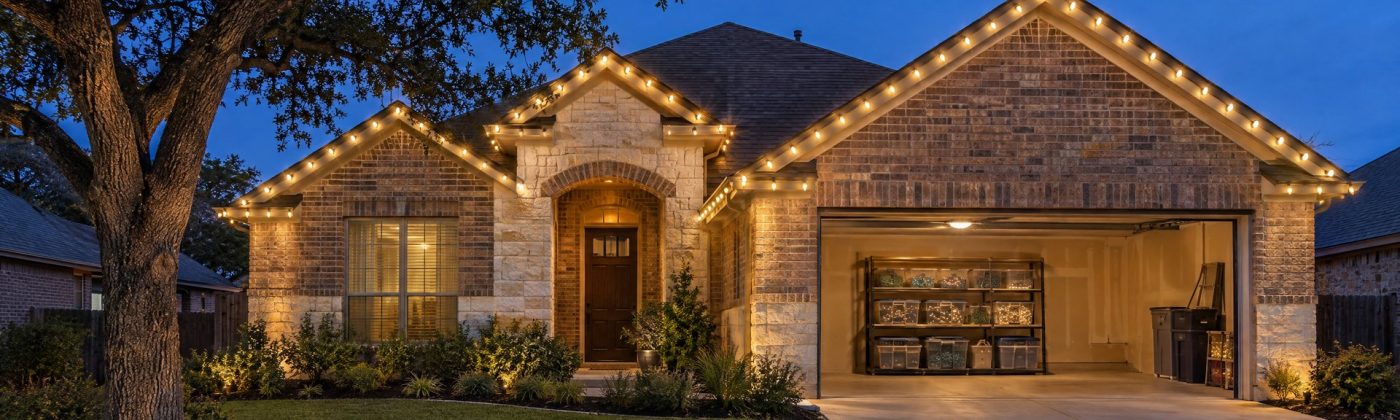
Do Christmas Light Installers Provide the Lights, or Do I Buy Them?
Usually, yes. Most full-service Christmas light installers supply the lights as part of a seasonal service, take them down after the holidays and keep them. Some sell you the lights instead, and some will hang lights you already own for a labor-only price. Every Austin-area installer we found publishing prices in October 2026 supplied the lights and included takedown and storage. Before you pay a deposit, get in writing who owns the lights in January.
| Question | Short answer |
|---|---|
| Do Christmas light installers provide the lights? | Most full-service installers do, and the lights are part of the seasonal price. All five Austin-area installers we found publishing prices did, checked October 4, 2026. |
| Who owns the lights after takedown? | Whoever the contract says. When the installer supplies and leases them, the installer keeps them. When you buy them, they are yours. |
| What does install-only cost? | $1.25 to $3 per linear foot with your own lights (Thumbtack and Angi, checked October 2026). |
| How much do installer-supplied lights add? | $0.50 to $2 per linear foot on top of install-only labor (Thumbtack, checked October 2026). |
| Is takedown included? | In every Austin-area published package we checked. Where it is not, removal-only runs $100 to $400 per job in national cost guides (HomeAdvisor and HomeGuide, checked October 2026). |
| Will an installer hang lights I already own? | Some will and some won’t. Outdoor-rated sets in good condition are the most likely to be accepted. Ask before you plan around them. |
| Who replaces a strand that dies mid-season? | Usually whoever owns the lights, unless the contract says otherwise. |
| Is buying the lights cheaper? | Not clearly. In our example for a 150-foot roofline, owning cost $521.50 to $784 the first season and $187.50 to $450 each later season if you take the lights down yourself. Installer-supplied lights cost $262.50 to $750 a season on Thumbtack’s figures and $750 to $1,800 on HomeGuide’s. |
| How does Sapien handle it? | Every Sapien install includes commercial-grade lights, clips, in-season repairs and takedown January 2 to 15. Lights you already own: yes, if they are pro-grade and working; we test them first. |
This guide is for anyone who can’t tell whether an installation quote buys lights, rents them, or only pays for labor, or who has a garage full of strands already. If you are still at the price stage, start with what Christmas light installation costs in Austin.
- Three ways installers handle the lights
- Who owns the lights after the season?
- How much cheaper is install-only?
- Lease or buy: is it cheaper to own your Christmas lights?
- Will an installer hang lights I already own?
- Does Christmas light installation include takedown?
- Who replaces lights that fail mid-season?
- Ten questions to settle in writing
- How Sapien handles this
Three ways installers handle the lights
Christmas light installers handle the lights in one of three ways. They supply the lights and keep them, they sell the lights to you, or they hang lights you supply. The model decides who owns the lights in January, who stores them, who pays when a strand fails, and what year two costs.
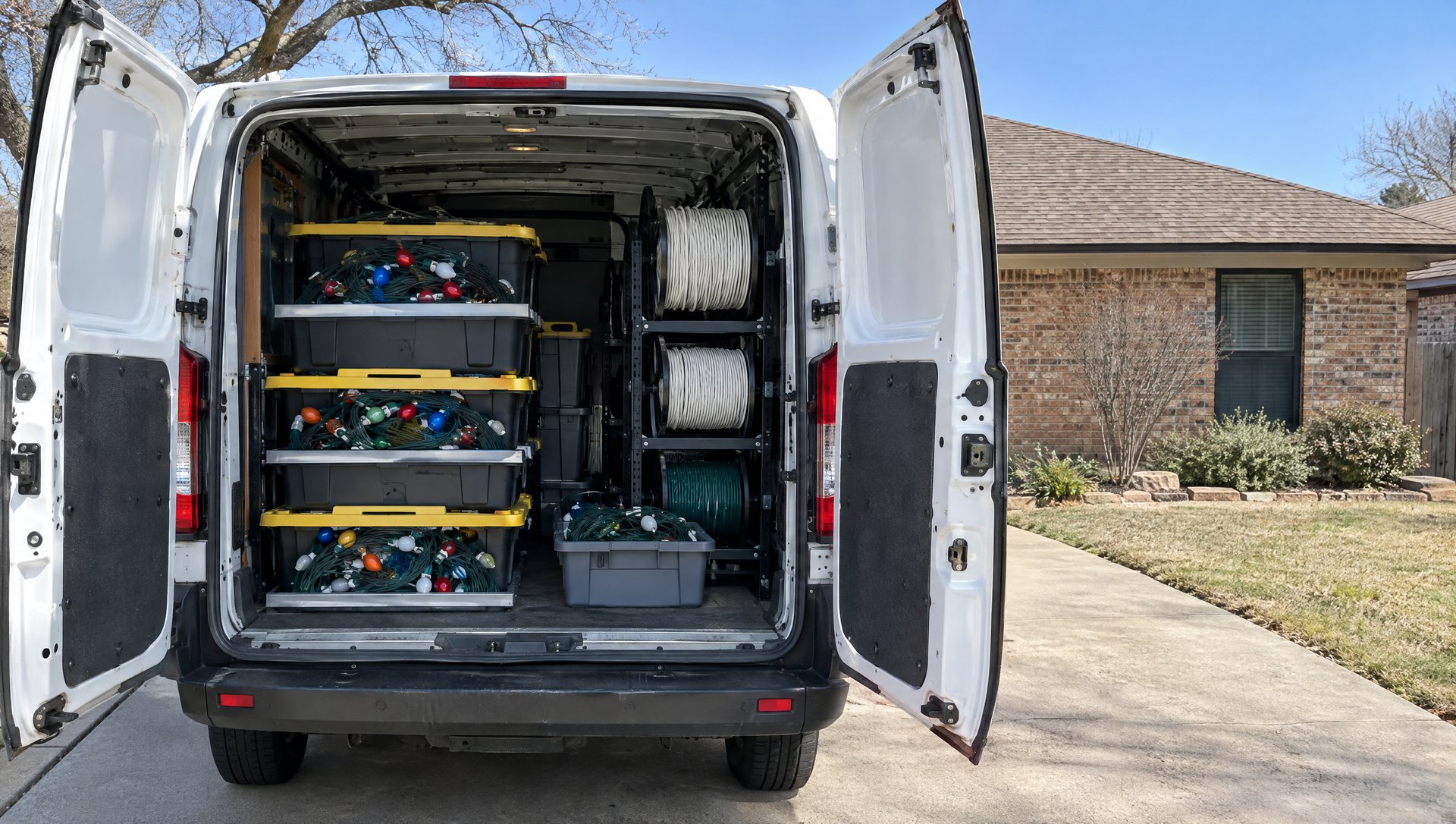
The installer supplies and keeps the lights (leasing)
The installer brings its own lights, hangs them, fixes them during the season, takes them down and keeps them, all for one seasonal price. Installers usually call this leasing or renting; one Austin-area installer calls it a rental outright. An installer marketplace, Curbstead’s lease-vs-buy guide, describes it the same way, with the installer owning the strands. This is the model behind most published Austin prices.
You buy the lights from the installer
The installer sells you lights, usually cut to fit your roofline, and you own them. The first year costs more because you pay for the product. Later years cost less because you pay mostly for labor. You also carry storage and failures, unless the contract shifts them to the installer.
A variant is the buy-out. One North Texas installer publishes terms where you commit to three years, pay about 30% more than its lease price in year one and about 10% less in years two and three, and own the lights after year three. Storage and bulb replacement are included for those three years. After that, it charges $200 per service trip.
You supply the lights and the installer hangs them
You buy the lights and pay the installer for labor, usually called install-only. The lights, their storage and their failures are yours from day one. Not every installer offers it, and those that do may set rules on what they will hang.
| Model | Who owns the lights in January | Who stores them | Who pays when a strand fails | Cost over the years |
|---|---|---|---|---|
| Installer supplies and keeps (leasing) | Installer | Installer | Installer, if in-season service is included | Same kind of price each season |
| You buy from the installer | You | You, unless storage is in the contract | You, after any warranty | High first year, lower later years |
| Buy-out after set years (one published example) | Installer, then you | Installer during the term | Installer during the term | Higher first year, lower later years, then labor only |
| You supply, they install | You | You | You | Your lights once, then labor each season |
Who owns the lights after the season?
The contract decides who owns the lights after the season. Words like “service”, “rental” or “lights included” do not settle it by themselves: “lights included” can mean the lights are rented for the season or sold to you. Only a line saying who owns the lights after takedown settles it.
If the quote does not say, ask before you pay anything, and get the answer in the quote or contract, not a text message. How to choose a Christmas light installer lists the other lines a written quote should carry.
Why do most installers keep the lights?
Most installers keep the lights for two reasons. Leasing brings the same customers back each year, and runs cut to one house are easy to rehang on that house.
A lighting supplier writing for installers, Thunder Lighting Supply (August 2025), says leasing brings recurring revenue but lower first-year profit, while selling brings higher first-year margins and leaves the customer to store the lights. A pricing guide written for installers, Christmas Lights HQ (March 2026), says its recommended full-service rates include lights, clips, installation, takedown and storage, with the installer keeping the materials.
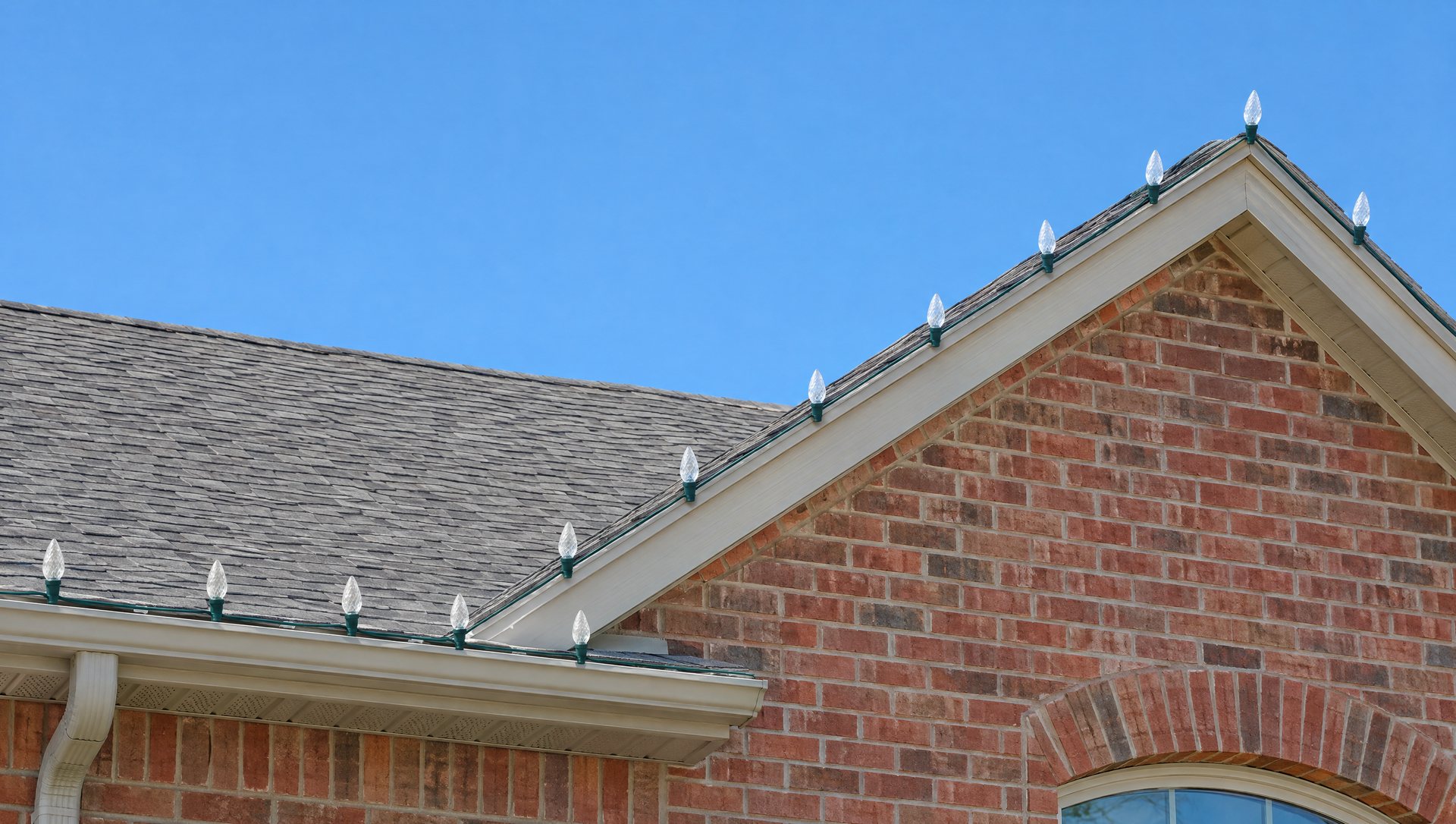
Professional roofline lights are often cut to length for each run of the roof, with plugs added where needed, per Christmas Lights Etc’s commercial LED page. A run cut for your gutter line fits your gutter line. An installer who keeps the runs can label them, test them and bring them back. The C9 Christmas lights guide explains the bulb most rooflines use.
Installers also prefer to maintain sets they know. On mini and 5mm LED strings, commercial-grade sets are one-piece, with the bulb sealed into the socket, and retail sets are usually two-piece with removable bulbs, per Christmas Designers’ comparison of retail and commercial lights. Large C7 and C9 bulbs screw into their sockets on retail and pro sets alike.
How much cheaper is install-only?
Install-only costs less each season because you supply the lights. Thumbtack (checked October 2026) puts installer-supplied lights at $0.50 to $2 per linear foot on top of labor. Full service, with takedown, storage and in-season repairs, costs more than that. None of the figures below is Sapien’s price.
| What the price covers | Published figure | Source, checked October 2026 |
|---|---|---|
| Labor only, your lights | $1.25 to $3 per linear foot | Thumbtack’s national price page; Angi’s hire-a-pro guide |
| Installer-supplied lights, added | $0.50 to $2 per linear foot | Thumbtack |
| Lights, setup and removal | $2.50 to $7 per linear foot | HomeAdvisor |
| Installed, national | $5 to $12 per linear foot | HomeGuide |
The clearest side-by-side we found is a San Antonio installer’s published price list (undated, opened October 2026). For the front roofline of a 2,000 to 2,999 square foot home, it lists $329 to $429 to hang the customer’s lights and $829 to $929 with LED C9 lights supplied. Each range runs from one-story to two-story. Supplying the lights adds $500. The same company publishes a separate takedown list, so with any installer, ask whether takedown is in the install price.
Angi’s Austin cost page (as of October 2026) lists $170 to $408 to rent lights from an installer and $0.27 to $1.36 per foot for lights bought through one. Those are Angi’s national figures scaled down (its national rental range of $250 to $600 becomes $170 to $408), not a survey of Austin installers. The Austin-area installers that publish prices set full-service minimums of $450 to $500 as of October 2026. Sapien’s minimum job is $500.
Lease or buy: is it cheaper to own your Christmas lights?
Buying your own Christmas lights can cost less each season after the first, but only when the lights last and someone handles takedown and storage. The cost guides price one season at a time, and the example below does the same. No third-party source we found tracks year-two pricing, so the example holds the full-service price flat. It is an example, not a quote.
| Example: 150-ft one-story roofline | Year 1 | Each later year |
|---|---|---|
| A. Installer’s lights, HomeGuide rate | $750 to $1,800 | $750 to $1,800 |
| A2. Installer’s lights, Thumbtack rates | $262.50 to $750 | $262.50 to $750 |
| B. Your lights, install-only, you take them down | $521.50 to $784 | $187.50 to $450 |
| C. B plus paid removal | $621.50 to $1,184 | $287.50 to $850 |
This table compares one season at a time; DIY vs professional Christmas lights cost runs the full three-year math.
Example inputs, before tax and shipping:
- Materials, about $334 once, from an online pro-lighting supplier’s regular prices on October 4, 2026: 150 feet of C9 socket wire (about $64, prorated from a 1,000-foot spool), 150 warm white C9 LED bulbs ($188.40), two 100-packs of clips ($39.90) and a timer ($20.95). Plus a 50-foot 16-gauge extension cord ($19.99 at a Texas building-supply chain; buy one marked for outdoor use).
- Row A: HomeGuide’s installed rate, $5 to $12 per foot.
- Row A2: Thumbtack’s install-only rate plus its $0.50 to $2 per foot for supplied lights. It does not say whether takedown or storage is included.
- Rows B and C: Thumbtack’s install-only rate, $1.25 to $3 per foot. Row C adds removal-only at $100 to $400 per job (HomeAdvisor and HomeGuide).
All third-party rates were checked October 2026. The materials figure runs low. A homeowner usually buys a full spool, and someone still has to cut the wire to each run and add plugs. The example also leaves out replacement bulbs, storage space, sales tax and your time. Row B assumes you do the January takedown yourself, which is ladder and roof work, and that an installer will hang lights you bought.
The example shows two things. First, the answer depends on whose numbers you use. On HomeGuide’s rate, owning looks far cheaper. On Thumbtack’s own figures (row A2), the two models land in the same range. HomeAdvisor’s rate for lights, setup and removal ($2.50 to $7 per foot) puts a season at $375 to $1,050, in the same range as row C. Austin-area full-service packages also include storage, and four of the five we checked list in-season maintenance; rows B and C leave both to you. Those installers’ published minimums of $450 to $500 a season mean a 150-foot Austin roofline won’t price at the low end of row A2.
Second, a buy-out costs slightly more over the first three years. On the North Texas installer’s percentages, three years cost about 1.3 + 0.9 + 0.9 = 3.1 times its lease price, against 3.0 for leasing. Example: at $1,000 a season, the buy-out totals $3,100 against $3,000, and then you own the lights.
How lon