


How Much Does Christmas Light Installation Cost in Austin? (2026 Prices)
Christmas light installation in Austin costs $500 to $1,500 for a front roofline and $800 to $3,500 for a typical full-service job with lights, takedown and storage. Those are the prices on five Austin-area installers’ own pages as of October 2026 (one page dates from 2024). Their minimums run $450 to $500. Angi’s national average of $444 (checked October 2026) is lower because it blends in small, labor-only jobs. Sapien Lighting & Installation charges from $500 for a single-story roofline in 2026.
| Question | Answer |
|---|---|
| What do Austin installers publish for a roofline? | $500 to $1,500, with lights, takedown and storage included (five Austin-area price pages, checked October 4, 2026) |
| What is the usual minimum in Austin? | $450 to $500 at the installers that publish one. Sapien’s 2026 minimum: $500 |
| What does a two-story roofline cost? | From $1,100 at Sapien in 2026. Thumbtack says most installers charge about twice as much for a second story (checked October 2026) |
| What is the price per foot? | $5 to $12 per linear foot for full service (HomeGuide, October 2025 page, checked October 2026) |
| Why do cost sites say about $300 for Austin? | Angi’s Austin figures work out to its national figures times 0.68 (our arithmetic, shown below). That points to a modeled number, not a survey of Austin installers |
| What should the price include? | Design, lights, clips, timer, installation, in-season service, takedown and storage |
| How do I get an exact number? | A photo quote. Linear feet, height and tree count set the price, and all three show in photos |
This guide is for Austin-area homeowners pricing a first professional install, or checking a quote they already have. It covers price only. For what the service itself looks like, see our Christmas light installation in Austin page.
- Austin prices in 2026
- Why cost sites say $300
- What Sapien charges
- Cost per foot
- Minimum charges
- Trees and add-ons
- What is included and what is extra
- What doing it yourself costs
- How to compare quotes
- Frequently asked questions
What does Christmas light installation cost in Austin in 2026?
Five Austin-area installers put prices on their websites. We opened all five pages on October 4, 2026. Together they show minimums of $450 to $500, front rooflines from about $500 to $1,500, and typical jobs of roughly $800 to $3,500.
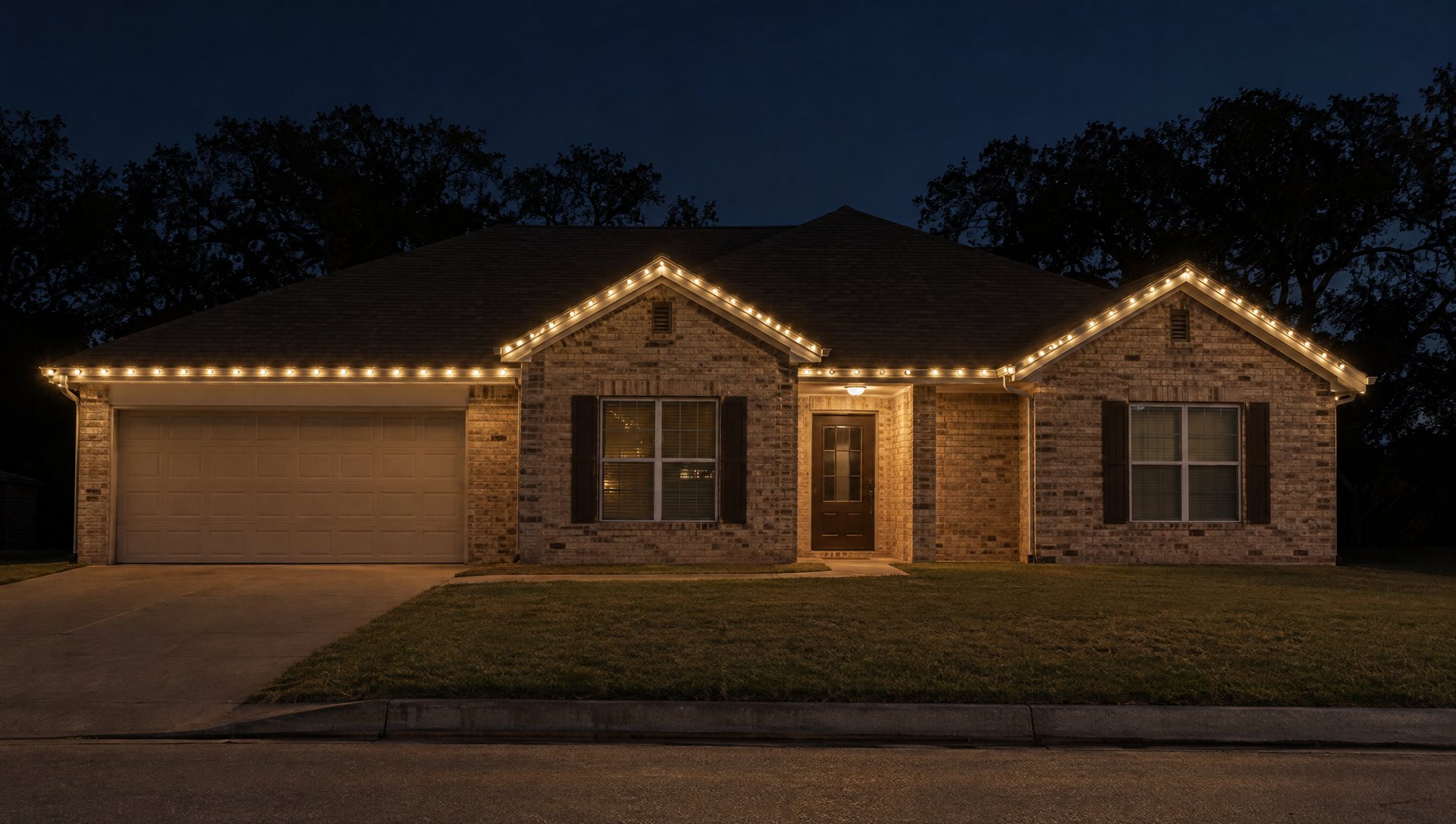
These are other companies’ published prices, not Sapien’s. We don’t name or link other installers, so they appear here by number. All five describe full service: the installer supplies the lights, takes them down and stores them.
| Installer | Published price (checked October 4, 2026) | Notes |
|---|---|---|
| Installer 1 (Austin, undated page) | $500 minimum. Front roofline on a standard home $500 to $800. Most customers spend about $800 to $2,000 | Roofline priced per foot, trees per strand |
| Installer 2 (Austin, undated page) | Three packages: $500 to $1,200, $900 to $2,500, and $1,500 to $3,500 | Described as a rental service, timers included |
| Installer 3 (Austin, post dated November 2024) | Roofline only $900 to $1,500. Complete display $1,800 to $3,500. Estate homes $3,500 to $8,000 and up | Complete display includes 2 to 4 wrapped trees, garland, wreaths and pathway lights |
| Installer 4 (Austin area, undated page) | From $4.50 per linear foot, with a $450 minimum | Page lists installation, removal and storage |
| Installer 5 (Austin, post dated June 2025) | A standard install averages around $1,000. Roofline starts at $800 | Page lists maintenance, takedown and storage |
Two cautions. Installer 3’s numbers are two seasons old, and the $1,500 top of the roofline range comes from that page. Installers also revise these pages each fall, so treat the table as a snapshot from early October 2026.
Why do cost guides say $300 when Austin installers publish $500 and up?
Cost guides and installers are pricing different jobs. The guides average every kind of job, including small ones where the customer already owns the lights. The Austin installers above price full service. Both numbers are real; they describe different work.
The national average mixes job types
Angi’s national cost guide (updated May 2026, checked October 2026) puts the average at $444, with most homeowners spending $220 to $684. Angi says the figures come from surveys of its customers plus outside research. That pool mixes small labor-only jobs with full-service ones. HomeAdvisor shows the same average, range and methodology wording, so we count the two as one source.
The “Austin average” looks like a multiplier, not a survey
Angi’s Austin page (updated November 2025, checked October 2026) lists an average around $301 and a usual range of $179 to $438. We compared its line items with the national ones. They match the national figures times 0.68. This is our arithmetic, not Angi’s statement, so check it yourself:
- Average: $444 x 0.68 = $302. The Austin page says about $301.
- Per foot with lights and removal: $2.50 to $7 x 0.68 = $1.70 to $4.76. The Austin page says $1.70 to $4.75.
The per-tree and removal-only lines match the same way. So the $301 figure looks like a local multiplier applied to a national blend, not a survey of Austin installers. The local published prices in the table above run roughly two to ten times higher. Thumbtack’s Austin page (undated, checked October 2026) gives $200 to $400, with no scope stated.
Install-only and full service are different products
Install-only means you own the lights and someone hangs them. Full service means the installer brings the lights, hangs them, fixes them during the season, takes them down and stores them. Published per-foot rates differ by a factor of four between the two; the per-foot section has the numbers.
Our advice: budget from the local installer prices, not the cost-site average, and make sure each quote you get states which product it is. If the gap between bids still surprises you, our piece on why Christmas light installation is expensive breaks down where the money goes.
What does Sapien charge in 2026?
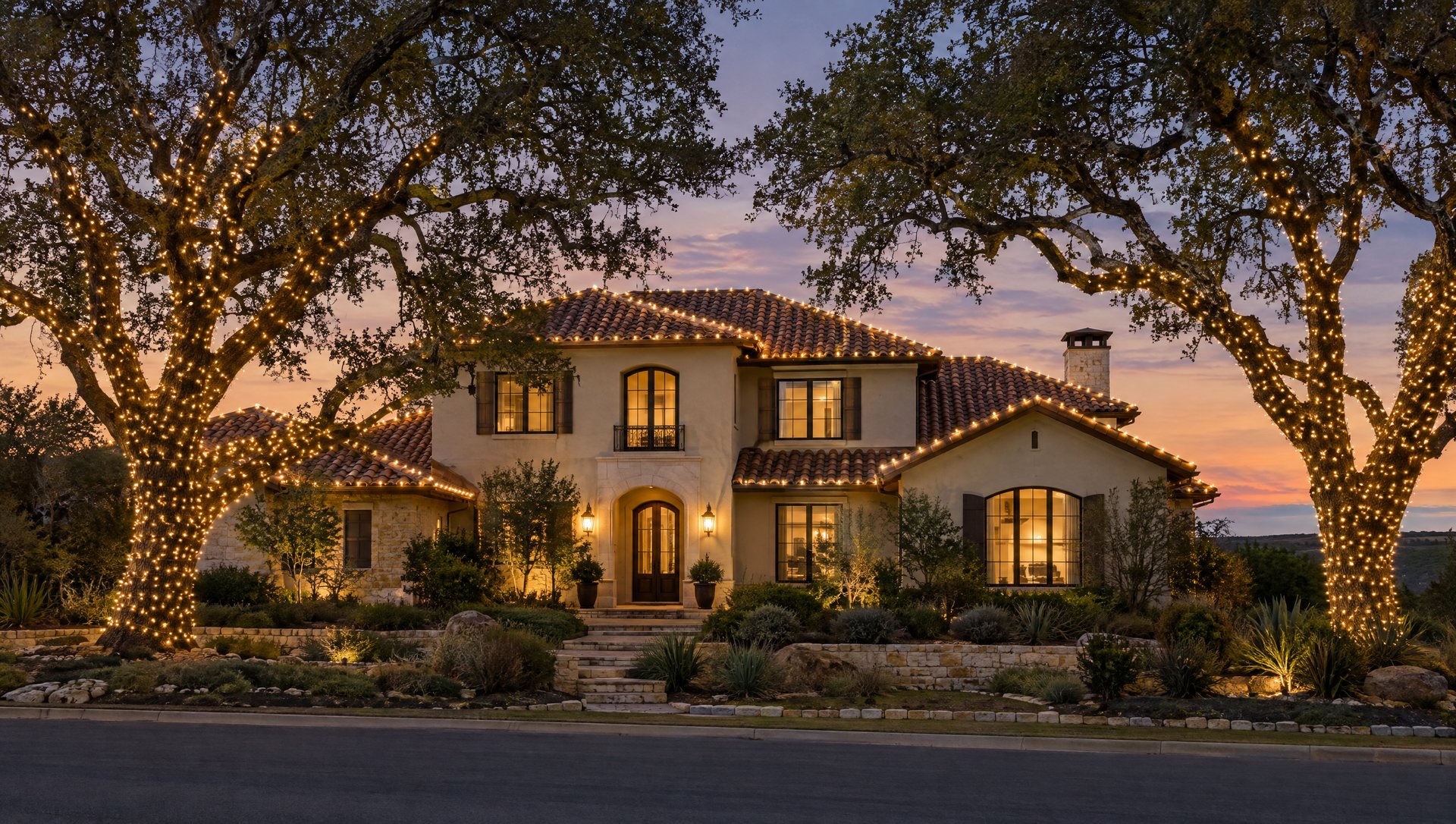
Sapien’s prices below are for the Austin area as of October 2026. Each is a typical starting point for that scope, front of house. Your quote depends on linear feet, height and tree count.
| Scope | Sapien 2026 typical range |
|---|---|
| Single-story roofline, front of house | From $500 |
| Two-story roofline, front of house | From $1,100 |
| Roofline plus one wrapped tree | The roofline price plus the tree as its own line: typically $150 to $250 for a small or medium tree, trunk only (see per-tree prices) |
| Full front: roofline, trees, bushes, wreath or garland | From $1,800 |
| Minimum job | $500 |
What is in the price: a custom design, commercial-grade lights and clips, installation and takedown between January 2 and 15. Sapien supplies the lights and does plug-in work only: if your plan needs a new outlet or circuit, that is a job for a licensed electrician first.
For a number on your house, text a few daytime photos of the front to (737) 777-9099. Typical photo-quote turnaround: the same day. Here is how a Christmas light quote from photos works.
How much does it cost by home size and stories?
National cost guides list $200 to $450 for a small one-story home and $1,000 to $2,500 for an estate (Angi, May 2026 page, checked October 2026). Austin installers’ published roofline prices run higher, as the first table shows.
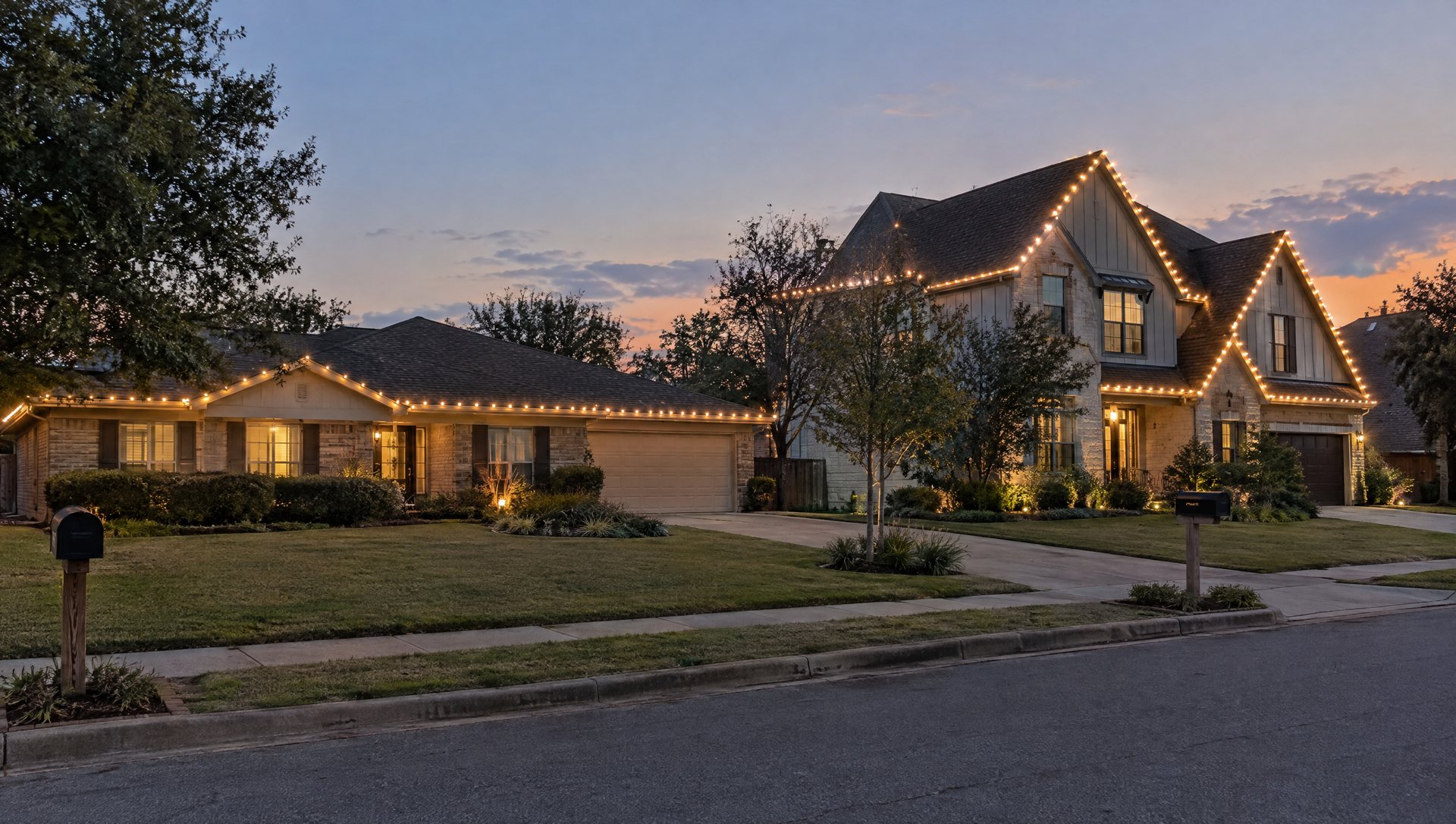
Bigger and taller homes cost more, but square footage is a weak guide. What an installer measures is linear feet of roofline and how high it sits. Two homes of the same square footage can differ by 100 feet of roofline once you count gables and returns. A simple 3,000-square-foot ranch can cost less than a 2,200-square-foot two-story with six gables.
The ranges below are national, not Austin data, and they are wide because each source counts different jobs. Use the table for the pattern (more feet and more height cost more), not for a budget.
| Angi home type | Angi linear feet | Angi national range (May 2026, checked October 2026) | HomeGuide, same number of stories (October 2025, checked October 2026) |
|---|---|---|---|
| Small, one story | 100 to 150 | $200 to $450 | $250 to $2,400 |
| Medium, two stories | 150 to 250 | $350 to $800 | $500 to $3,600 |
| Large, three stories | 250 to 400 | $700 to $1,500 | $750 to $5,000 |
| Estate or custom | 400 and up | $1,000 to $2,500 | Not listed |
HomeGuide’s ranges are by stories only, not by these footages. The two columns differ because Angi’s blend includes labor-only jobs and HomeGuide’s cost guide prices full service.
How much does Christmas light installation cost per foot?
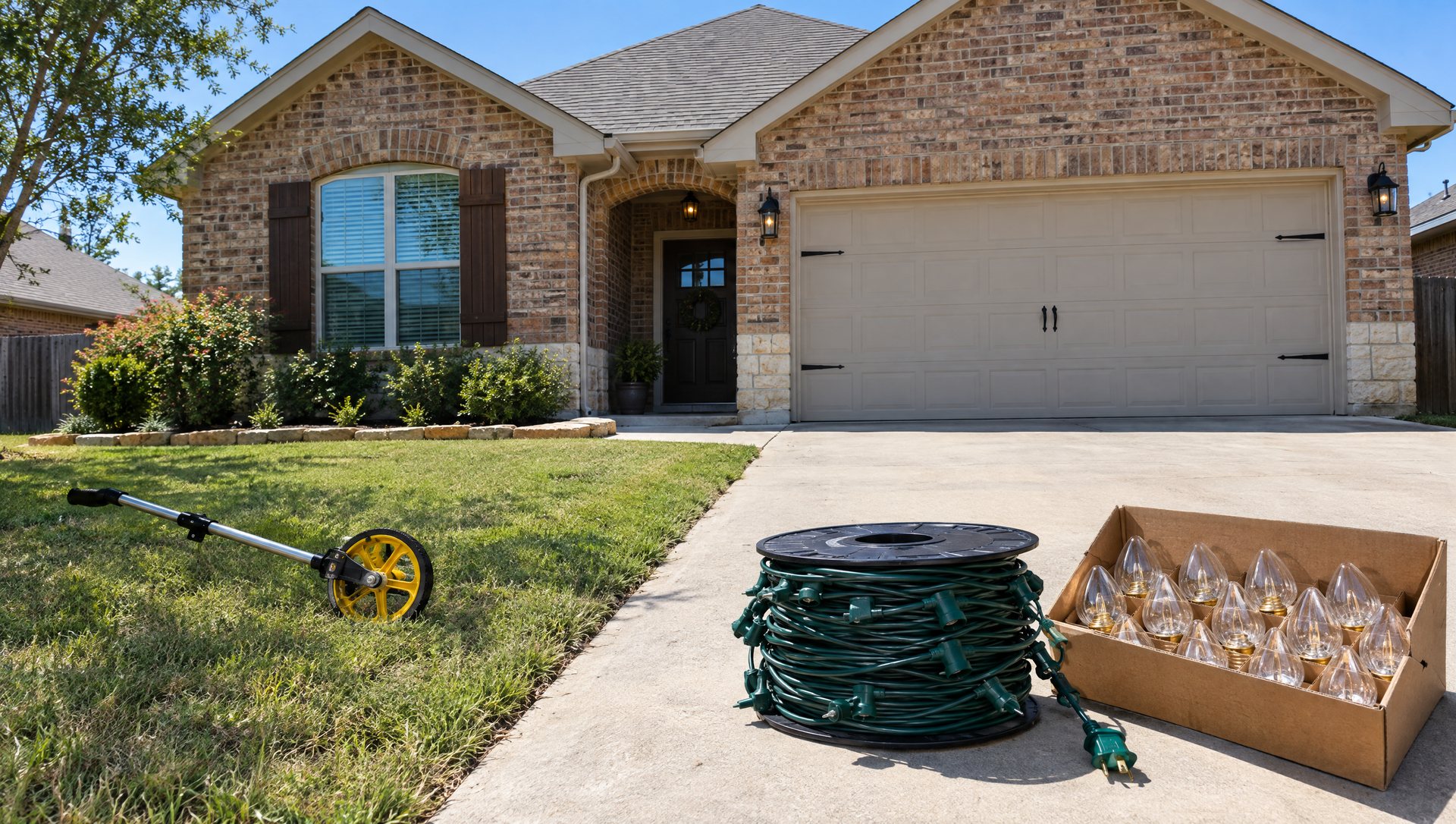
Published per-foot prices for Christmas light installation run from $1.25 to $12 in the sources below, all checked October 2026. The low end is labor only. The high end includes lights, takedown and storage.
| What the rate covers | Price per linear foot | Source and date |
|---|---|---|
| Install-only. You supply the lights. No takedown implied | $1.25 to $3 | Thumbtack, April 2026 |
| Lights, setup and removal | $2.50 to $7 | HomeAdvisor, June 2026 |
| Full service, installed | $5 to $12 | HomeGuide, October 2025 |
| What installers are advised to charge: lights, clips, install, takedown, storage | $8 to $12 | Trade pricing guide, March 2026 |
| Installer 4 (Austin area): installation, removal, storage | From $4.50 | Its own page |
The install-only rate comes from Thumbtack’s national price page. The middle rate is from HomeAdvisor’s cost guide. The trade figure is from a pricing guide written for installers by Christmas Lights HQ; it is advice to contractors on what to charge, not a survey of what homeowners paid.
Example: a 150-foot roofline at HomeGuide’s $5 to $12 per foot comes to $750 to $1,800 for the season. That is a third-party range, not a Sapien price. Sapien quotes the whole job from photos rather than publishing a per-foot rate.
A rough way to measure your own roofline
Pace the front eaves from the ground. One long step is about 3 feet. Add both sloped sides of every gable you want lit. Multiply the total by the per-foot rate that matches the service you want. This is a rough estimate: an installer’s measurement will differ, and trees are priced separately.
Is there a minimum charge?
Most Christmas light installers have a minimum charge. The Austin-area installers that publish a minimum set it at $450 to $500 as of October 2026. Angi’s national guide (checked October 2026) says most companies have a minimum of $150 to $300. The trade guide advises installers to set a 100-foot minimum, which at its rates is $800 to $1,200. Sapien’s minimum job is $500.
Minimums exist because a small job costs nearly as much to serve as a medium one. A full-service job is at least two trips: one to install and one to take down, plus any service calls in between. The same trade guide puts a typical home at 3 to 4 hours for a two-person crew, and wholesale materials at about $1.50 to $3 per foot of roofline. Forty feet of lights over a front door still takes a truck, a crew and two visits.
What drives the price up or down?
Seven things move a Christmas light installation quote. Footage and height matter most.
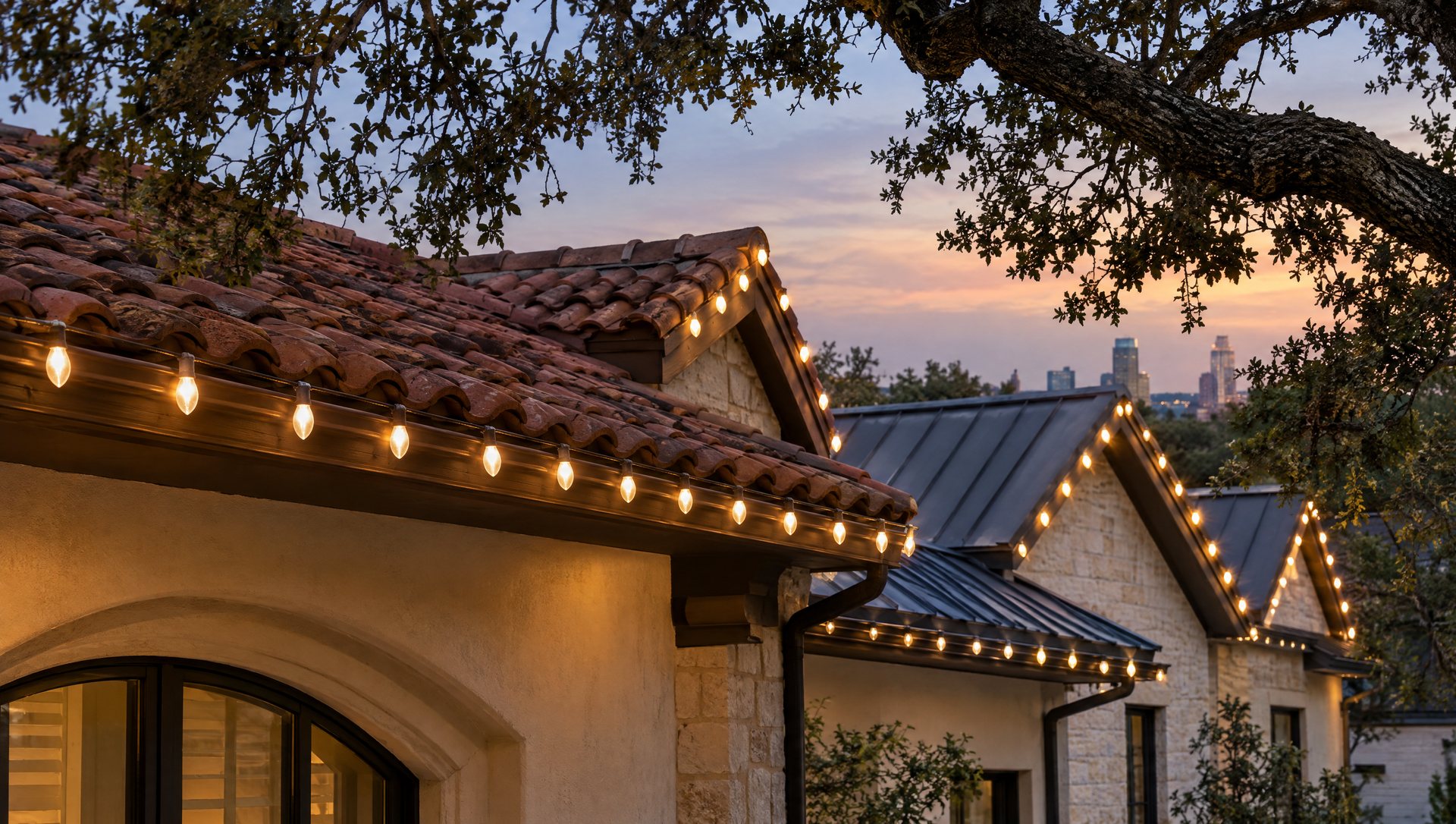
- Linear feet. Every lit edge is measured. Front only costs less than front plus sides.
- Stories and pitch. Thumbtack says most installers charge about twice as much for a second story. Thumbtack and HomeAdvisor both cite about 20% more for hard-to-reach roofs (both checked October 2026).
- Roof surface. Tile roofs, metal roofs and homes without gutters take longer. Each needs a different clip and more care, and Austin has plenty of all three.
- Peaks and returns. A straight 60-foot eave is fast. Six gables with short returns take longer per foot: every peak and return means moving the ladder again, and often a cut and a jumper.
- Distance to power. A long run from the nearest outdoor outlet means more cord and more planning.
- Bulb type. C9 bulbs on the roofline are the standard. Color-changing or animated displays cost more: Angi’s national range for custom animated displays is $1,000 to $8,000 (checked October 2026).
- Tree count. Wrapping is slow hand work. One large tree can cost more than the roofline.
How much do wrapped trees, bushes and wreaths add?
A wrapped tree adds roughly $60 to $1,500 or more to a quote in the national guides (Thumbtack, April 2026; HomeAdvisor, June 2026; both checked October 2026). The spread comes from the tree’s size and how much of it is wrapped. Trees are priced apart from the roofline because they take different lights and far more labor per foot.
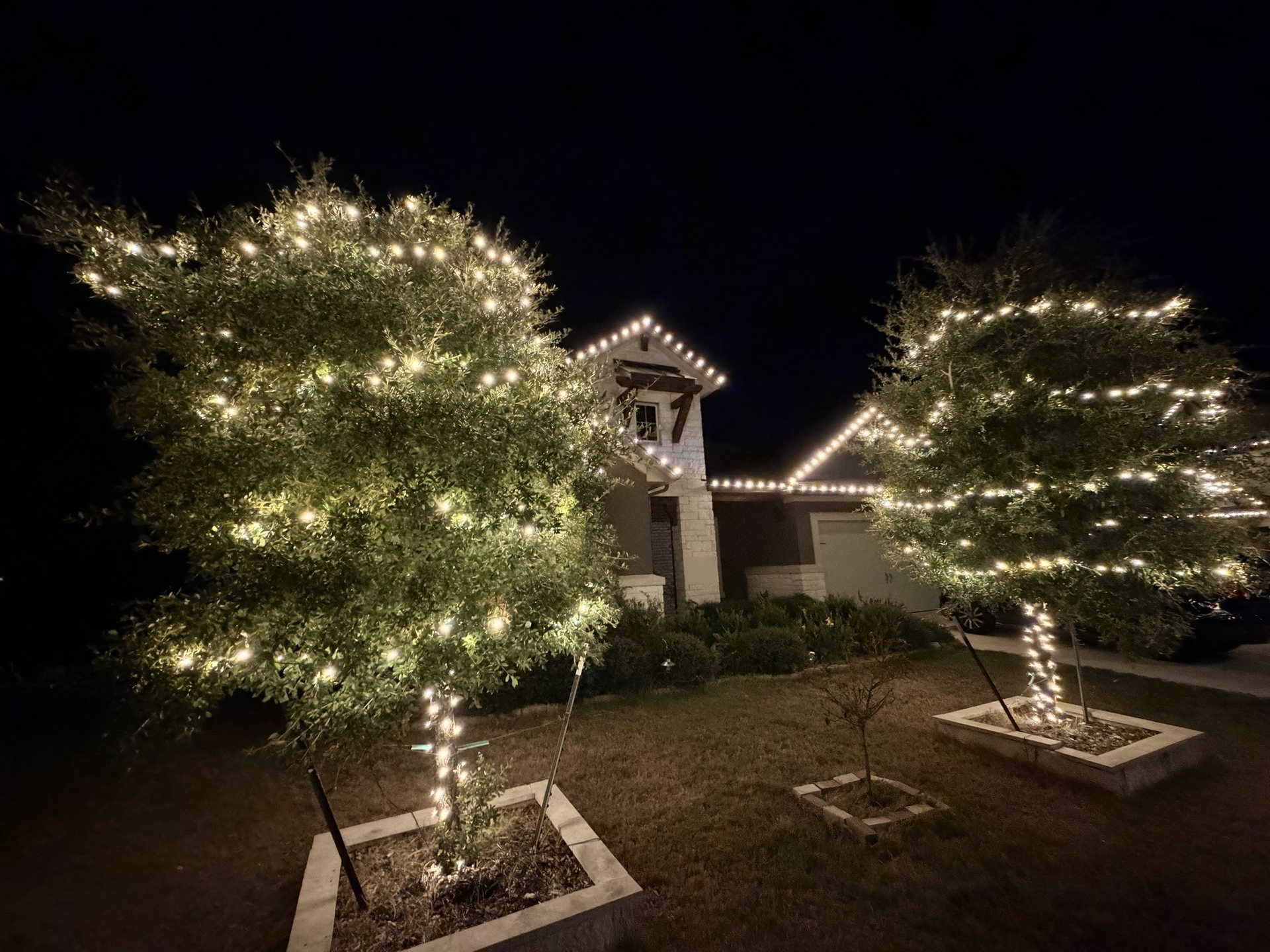
Three terms come first, because the price depends on which one you mean.
- Trunk wrap: lights spiraled around the trunk only, from the ground to the first fork.
- Trunk-and-limb wrap: the trunk plus the main limbs, wrapped out as far as you choose.
- Canopy lighting: lights draped or strung through the outer branches and leaves.
What third parties publish per tree
As of October 4, 2026, no Austin installer page we opened publishes a dollar price per tree. One charges trees per strand without giving the rate. Another bundles 2 to 4 wrapped trees into a package. The per-tree figures that exist are national or from other Texas cities, and most tier by height. A San Antonio price list charges per foot of trunk height instead: $5 a foot for labor only, or $15 a foot with LED lights supplied.
| Source and date (all checked October 2026) | Small tree | Medium tree | Large tree |
|---|---|---|---|
| HomeAdvisor, June 2026 | $75 to $200 | Not listed | $1,500 or more at 30 ft and taller |
| Thumbtack, April 2026 | About $60 | Not listed | Up to $1,200 |
| Trade pricing guide, March 2026 | Under 10 ft: $100 to $250 | 10 to 20 ft: $250 to $500 | Over 20 ft: $500 to $1,500 |
| Dallas-Fort Worth installer | 8 to 15 ft: $150 to $250 | 15 to 30 ft: $250 to $400 | Large oak, 30 to 60 ft: $400 to $800 |
Why height tiers mislead on Austin trees
Height is what homeowners expect to be asked, but it is a poor measure of a wrap. The footage of lights depends on three things: how big around the trunk is, how many limbs get wrapped, and how tight the spacing is. A live oak 25 feet tall with a thick trunk and six long limbs can take several times the lights of a 25-foot cedar elm with one straight trunk.
Spacing alone can double the bill. A trunk wrapped with 3 inches between passes takes about twice the lights of the same trunk at 6 inches. Ask every installer for the spacing and how many feet up the wrap goes.
That is why Christmas lights on live oak trees price so differently from house to house. One mature live oak can cost more than the whole roofline. A crape myrtle (also spelled crepe myrtle) is the opposite case: several slim trunks, each a short wrap, and a lot of effect for far less light than an oak.
Sapien’s typical 2026 per-tree prices, by tree and coverage:
| Tree and coverage | Sapien typical 2026 price per tree |
|---|---|
| Very small tree, trunk only | From $100 (the tree minimum) |
| Small or medium tree, trunk only | $150 to $250 |
| Small tree, leafy canopy wrapped lightly | About $150 to $300 |
| Large oak, trunk only | $500 to $1,000 |
| Large live oak, trunk plus some limbs (not a full wrap) | $500 to $1,000 |
| Very large oak, trunk and multiple branches | $1,500 to $3,000 |
| Maximum wrap (every branch as high as the tree allows, C7 bulbs dangled through the leaves) or a very tall oak | Up to about $5,000; these usually need a boom lift |
Prices vary by tree, and we confirm each one from photos of your tree. The $500 job minimum still applies, so a single small tree on its own is billed at that minimum.
If you want one upgrade beyond the roofline, put it on the tree nearest the street; it is the first thing people see. Ask any installer to price each tree as its own line. Our full breakdown of what it costs to wrap a tree in Christmas lights goes tree by tree.
Bushes, wreaths and other add-ons
The trade pricing guide (March 2026, checked October 2026) puts a wrapped bush at $50 to $150 and a lit wreath at $75 to $200. The Dallas-Fort Worth installer’s page lists bushes at $50 to $120. Both are installer-side figures from outside Austin. For ideas on what to light beyond the roof, see Christmas lights on bushes.
What should the price include, and what is extra?
A full-service Christmas light installation price should cover seven things. If a quote leaves one out, it is not comparable to one that includes it.
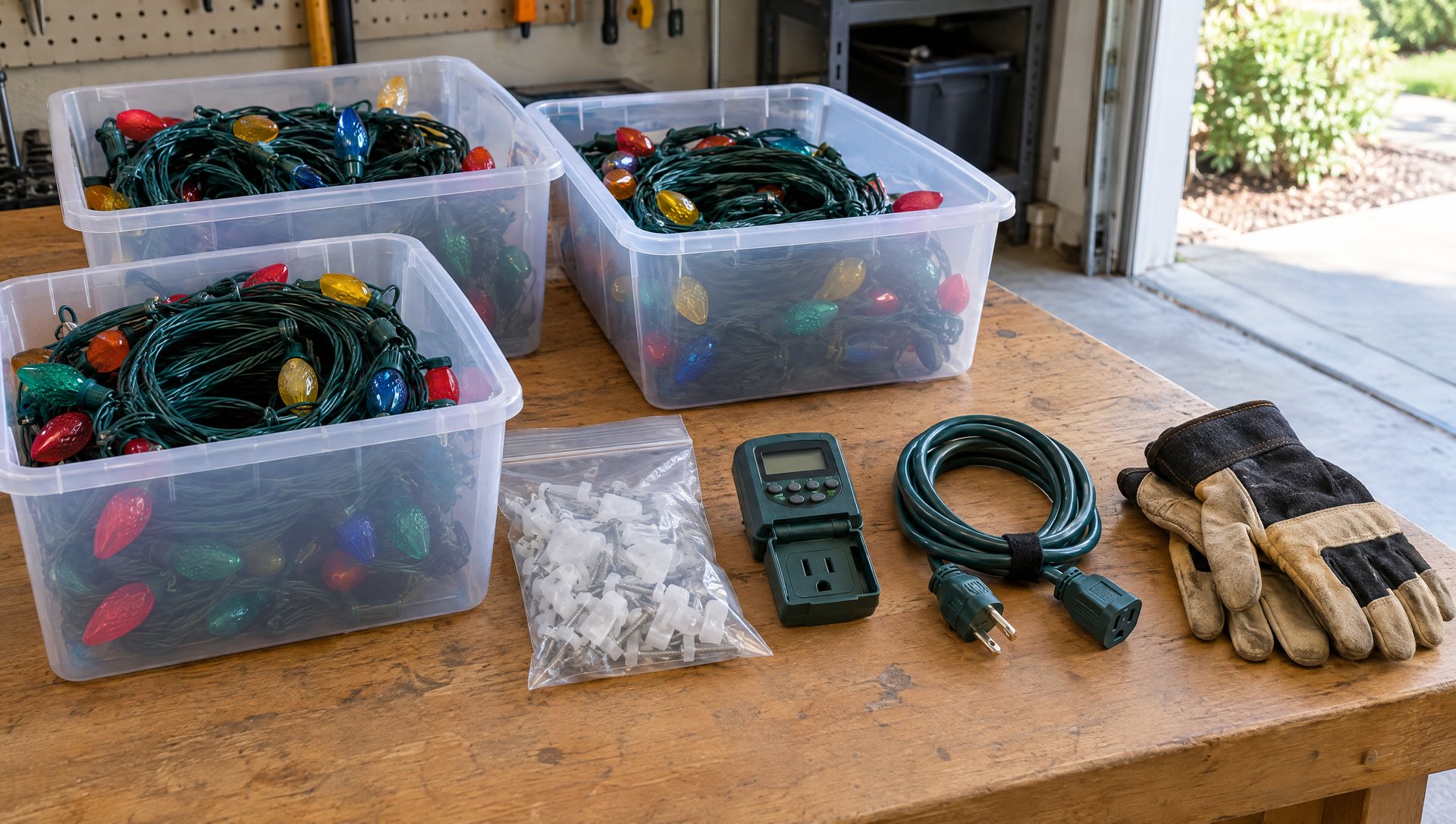
- A design or plan for which edges and trees get lit
- The lights, wire and bulbs
- Clips and attachment hardware
- A timer
- Installation
- Service during the season if something goes out
- Takedown after the season, and storage if the installer owns the lights
Common exclusions to ask about
- Back and sides. Many quotes cover only the front of the house unless you ask. Ask for them as separate lines so you can drop them if the total runs high.
- Takedown. Removal bought on its own runs $100 to $400 per job, or about $0.50 per linear foot, in the national guides (HomeAdvisor, June 2026; HomeGuide, October 2025; both checked October 2026). Sapien also takes down lights it did not install, whether you hung them or another company did. That usually runs around 20% of what the install would cost, but it varies widely, so we quote it from photos. Our guide to Christmas light removal service covers that case.
- Storage. All five Austin-area price pages we checked include it. Confirm it anyway.
- Mid-season service. Ask how fast, and whether a visit costs extra. Ask too whether weather and animal damage are covered or billed.
- The timer. Small, but ask.
- Sales tax. Ask whether tax is included in the quoted total.
- New outlets. Not part of a light install. Adding an outdoor outlet is work for a licensed electrician; Texas licenses electricians through the Texas Department of Licensing and Regulation. Angi’s Austin page lists $154 to $373 for an outdoor outlet (November 2025 page, checked October 2026).
Install-only versus full service: which costs less?
Install-only costs less per visit, and you take on the rest. You buy the lights, store them, replace what fails, and either take them down or pay again for removal.
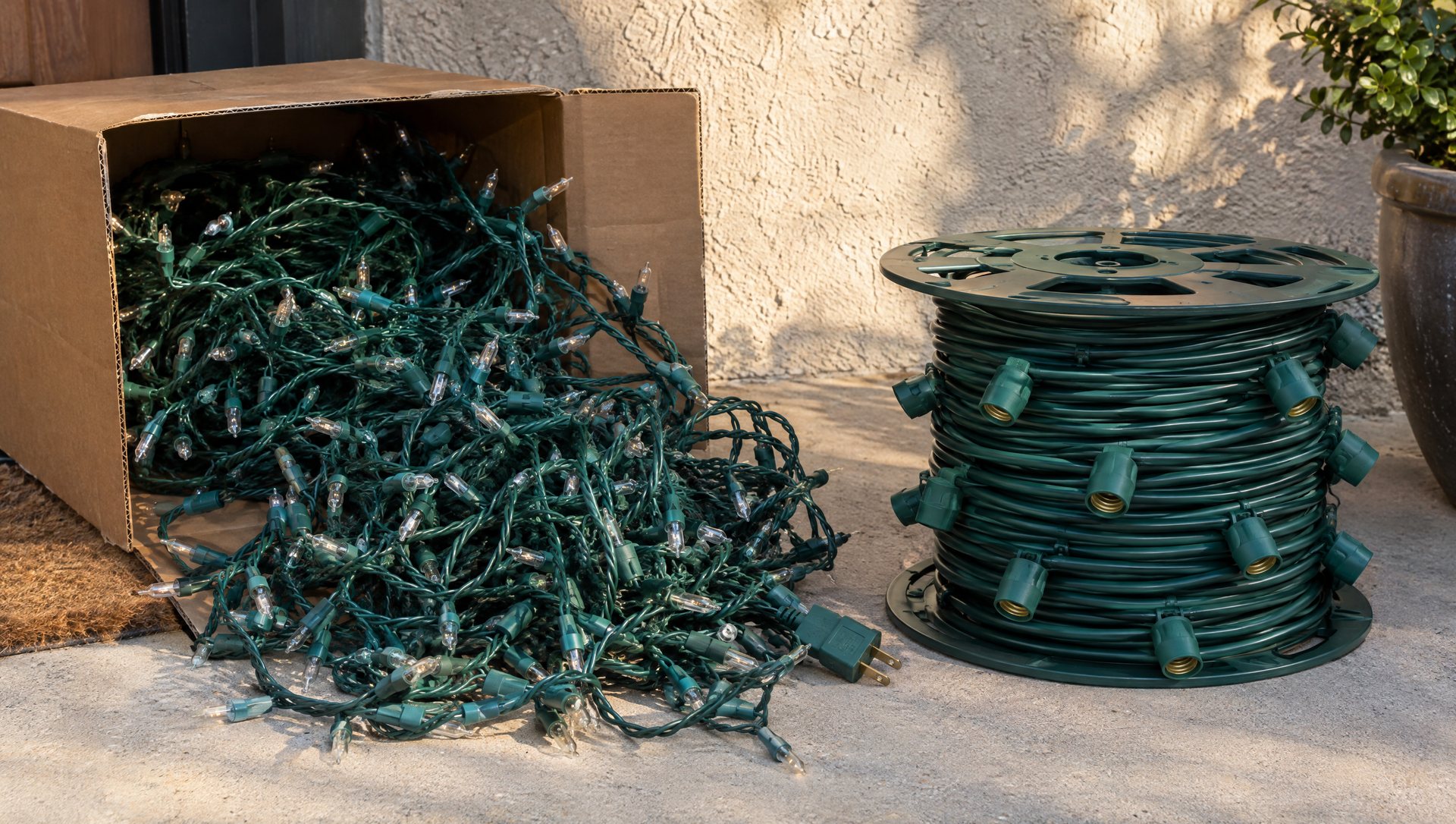
The clearest published comparison we found is a San Antonio installer’s price list (undated, checked October 2026). For a front roofline on a home of 1,000 to 1,999 square feet, it charges $229 to $329 to install the customer’s own lights and $599 to $699 with LED C9 lights supplied. The $370 gap is what that installer charges to supply the lights.
Install-only makes sense if you already own good lights that fit your roofline. It makes less sense with retail strings, which come in fixed lengths and rarely fit an eave exactly. Ask too whether the installer will service lights it did not supply.
Sapien will install lights you already own if they are pro-grade and working. We test them first, and sets that are dead or retail-grade get replaced or declined. More on that in do Christmas light installers provide the lights?
Does it cost less the second year?
Whether Christmas light installation costs less the second year depends on who owns the lights. No cost guide we opened publishes renewal pricing.
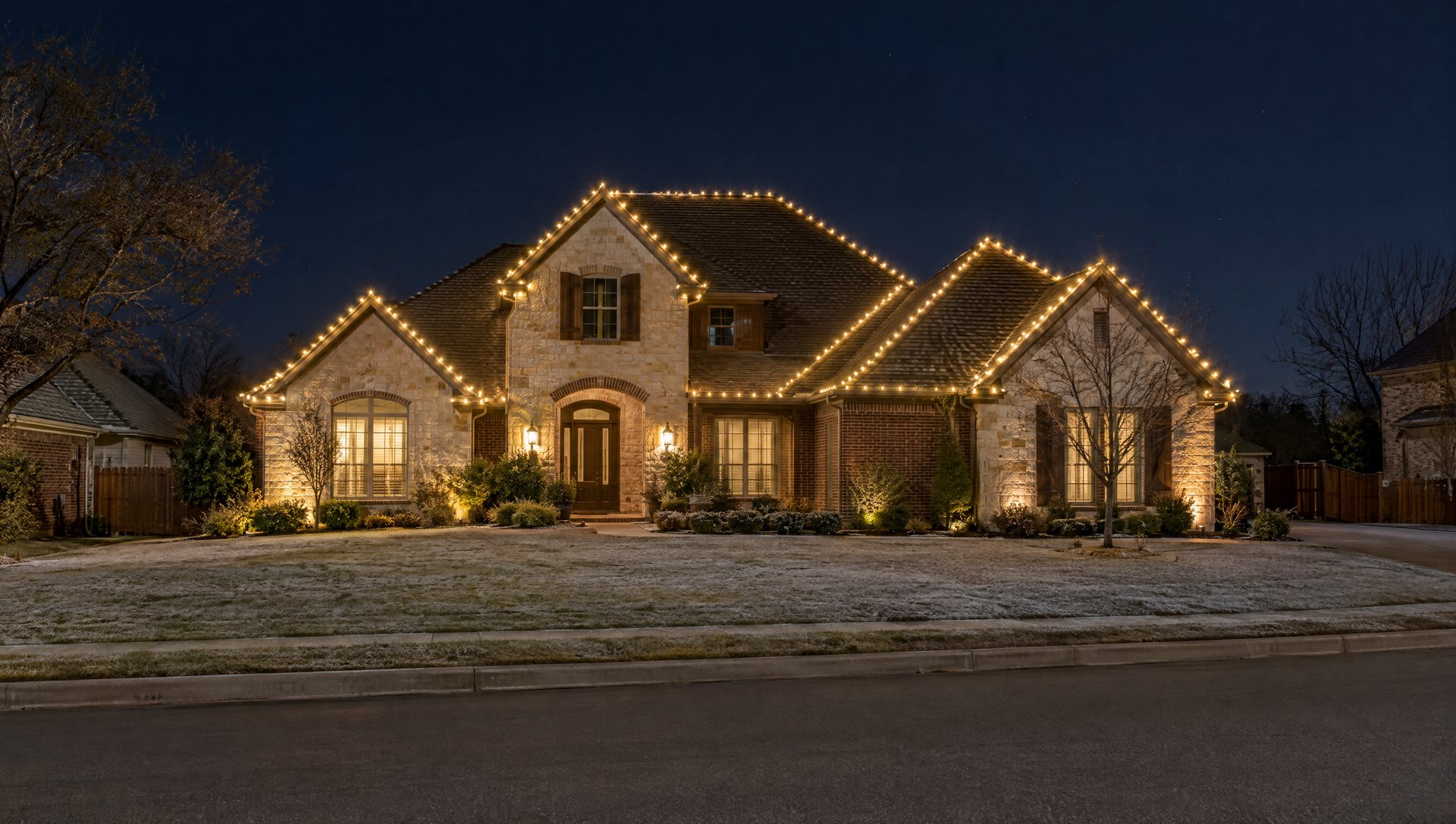
In the first year, the installer cuts wire to fit your roofline and builds the set. In later years that set already exists. Some installers pass the saving on. Some charge the same each year and treat the lights as a rental. Ask every installer directly: what will this exact display cost next year?
Sapien re-quotes every season, so a returning customer’s price reflects that year’s scope.
Does booking early cost less?
Booking Christmas light installation early can cost less. As of early October 2026, two Austin-area installers advertised early-booking discounts of 15% and up to 20%, one with an October 31 deadline. Promotions like these change week to week, so check the date on any offer.
The trade pricing guide coaches installers to give 5% to 10% off in September and October and to add 10% to 20% in early December, so late bookings rarely get the low end.
Thanksgiving is November 26, 2026, and Thanksgiving weekend is the usual lights-on target in Austin. The Austin holiday lighting timeline lays out what to do in each week before then, and Christmas lights before Thanksgiving covers the early-install question.
What about deposits, sales tax and tipping?
Deposits
A deposit is normal. The Texas Attorney General’s guidance on home improvement contractors says to expect to pay part of the cost before work begins, and not to pay in full until the work is complete and you have inspected it. The Federal Trade Commission’s guidance (July 2022) says the same and adds: be wary of anyone who takes only cash. This is general information, not legal advice; your written contract governs your job.
At Sapien, a 50% deposit books your install date, and the balance is due after the lights are up.
Sales tax
Ask any installer whether tax is included in the quoted price. Two quotes that look far apart may be closer once both include tax.
Tipping
Tipping a light crew is optional. Thumbtack’s Austin page says some people tip $20 to $50 and others about 20%. Angi’s guide to hiring a light installer (July 2026) says 10% to 20% is appreciated but not expected. Both checked October 2026.
What does it cost to do it yourself?
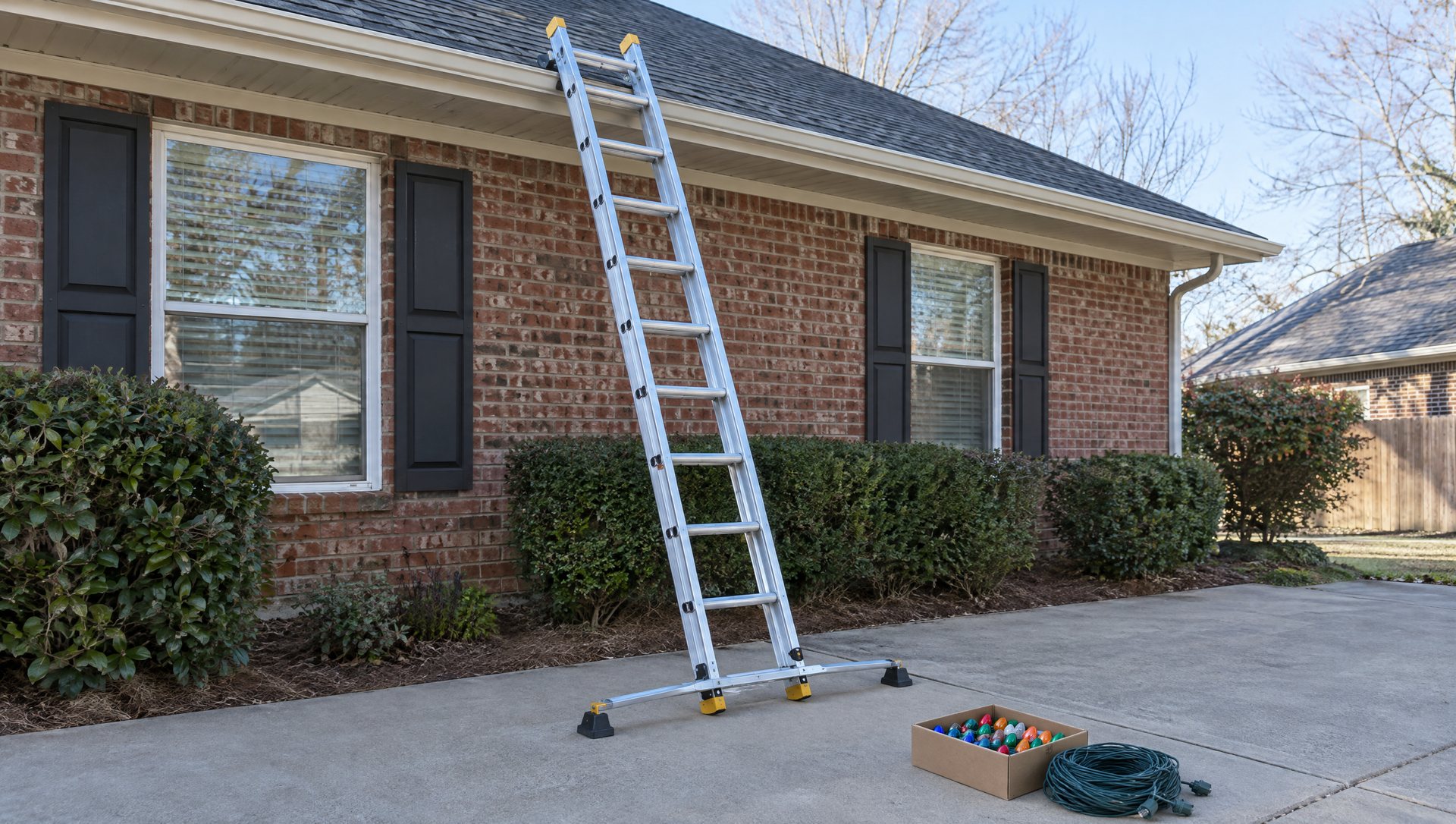
Doing a one-story roofline yourself costs about $334 in pro-grade materials for 150 feet, and about $814 in the first year if you also need a ladder. This example uses retail prices we checked in early October 2026.
| Example item (150 ft, one story) | Math | Cost |
|---|---|---|
| C9 socket wire, 12-inch spacing | 150 ft at $0.43 per ft | About $64 |
| C9 LED bulbs, warm white | 6 packs of 25 at $31.40 | $188.40 |
| Clips | 2 packs of 100 at $19.95 | $39.90 |
| Outdoor digital timer | 1 at $20.95 | $20.95 |
| 50-foot extension cord | 1 at $19.99 | $19.99 |
| Materials | Before tax and shipping | About $334 |
| 24-foot extension ladder and stabilizer | $389.99 + $90.05 | $480.04 |
| First year, if you own no ladder | About $814 |
Notes on the example:
- The wire price is the per-foot rate of a 1,000-foot spool. Shorter spools cost more per foot.
- Spool wire needs a slide-on plug at each end. Plugs add a few dollars and are not in the total.
- Light and timer prices are from an online pro-lighting supplier; the cord and ladder prices are from a Texas building-supply chain. Confirm the cord you buy is rated for outdoor use.
- A low single-story eave may need only a shorter ladder you already own. The gable peaks are what call for the extension ladder. A two-story roofline needs a longer one.
In years two and three you pay only for replacements. Over three seasons the do-it-yourself math wins on cash: about $814 once, against $2,250 to $5,400 if HomeGuide’s full-service rate stayed flat (150 feet x $5 to $12 x 3 seasons).
What the table leaves out is your time, twice a year, and the ladder work. We found no measured figure for how long a first-time install takes. Angi says several hours and sometimes a whole weekend, and that does not count takedown. The full DIY versus professional Christmas lights cost comparison runs the numbers further, and how to hang Christmas lights outside covers the method.
If you go this route, read our light installation safety guide first. Stop and call a professional if the job needs you on the roof itself, if you cannot set the ladder on firm, level ground, or if you, the ladder or the light strings cannot stay 10 feet from an overhead power line (the distance in Austin Energy’s job-site safety guidance).
How do I compare two quotes?
To compare two Christmas light quotes, put both on the same scope before you look at the totals. Most price gaps between bids are scope gaps. Check these ten lines on each quote:
- Linear feet of roofline, and which sides of the house
- Bulb type and spacing (for example, C9 LED at 12 inches)
- Which trees, trunk wrap or trunk-and-limb wrap, the spacing between passes, and how high the wrap goes
- Who owns the lights at the end of the season
- Whether in-season service is included, and how fast
- Whether takedown is included, and when
- Whether storage is included
- Whether tax is in the total
- Deposit amount and when the balance is due
- What the same display costs next year
The Texas Attorney General’s guidance says to get written bids from more than one contractor, look for detail on exactly what will be done, and be wary of a bid far below the others. With lights, a low bid is usually a different product: install-only, retail strings, or no takedown. That can be the right choice, as long as the quote says so.
For the questions to ask beyond price, see how to choose a Christmas light installer. Our list of common lighting mistakes covers what goes wrong after the quote is signed.
When is hiring an installer not worth it?
Hiring a Christmas light installer is not worth it in three cases.
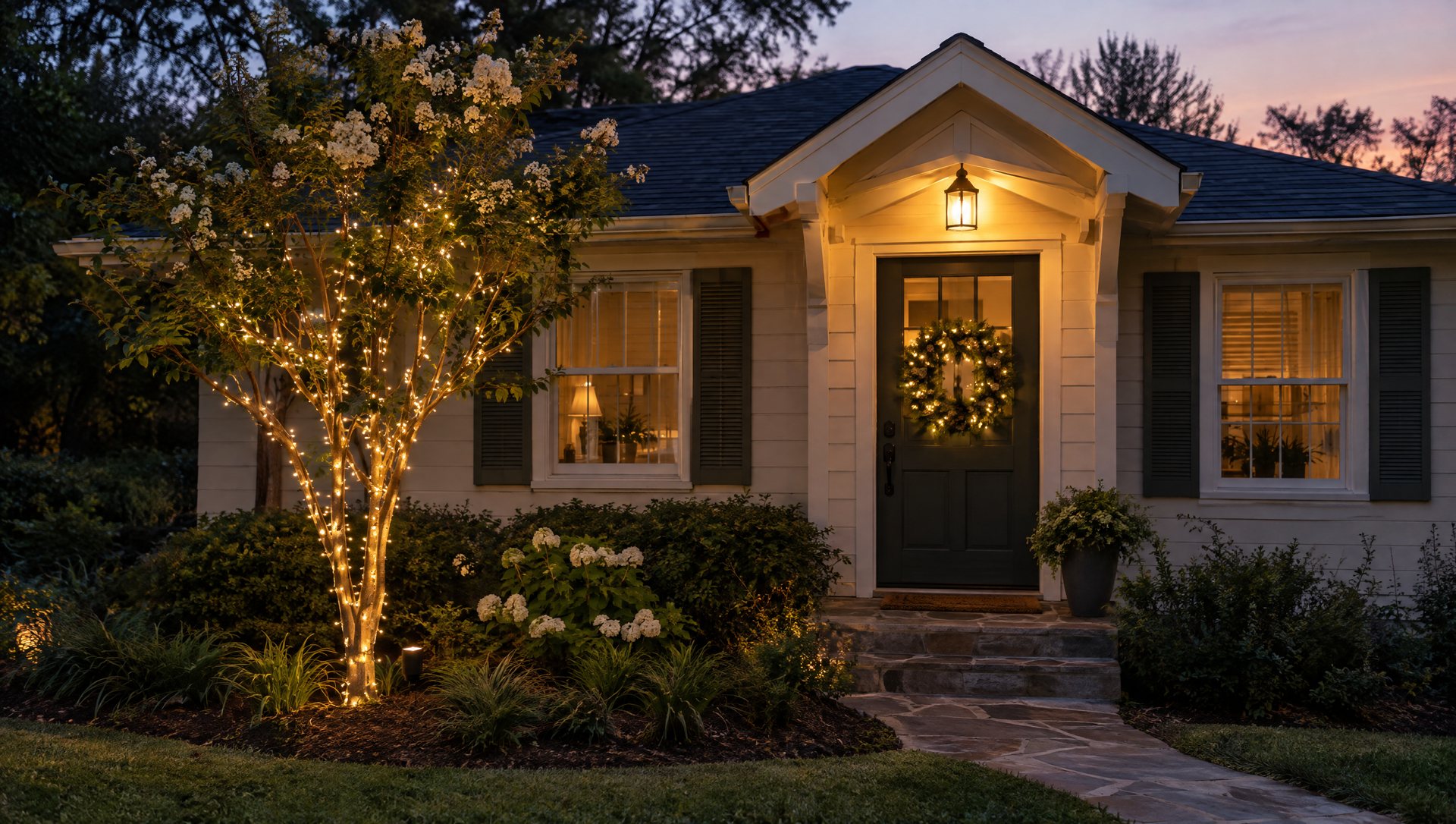
- A short, single-story eave and a homeowner at ease on a ladder. Forty feet over a porch is a small job. An installer’s minimum will likely cost more than the lights.
- A budget under the local minimum. Light the entry and one small tree yourself. A wrapped crape myrtle and a lit doorway look finished. A third of a roofline does not.
- A job that is really electrical work. If the plan depends on a new outlet, a new circuit or hardwired fixtures, call a licensed electrician first. A light installer comes after.
We’d also steer you away from paying for a roofline you cannot see from the street. Put that money into the front trees.
If your house is past those cases, get a real number: text a few daytime photos of the front to (737) 777-9099 or use the contact page. Say which edges you want lit and which trees you’d like wrapped, and we’ll price each part as its own line.
Frequently asked questions
How much do Christmas light installers charge per hour?
Angi’s national guide lists $60 to $100 per hour for labor (May 2026 page, checked October 2026). The Austin price pages we checked quote by the foot, the strand or the package, not by the hour, so ask for a total for the whole scope.
How much do professionally installed lights add to my electric bill?
Very little with LEDs. Example: 150 LED C9 bulbs at about 1 watt each (the high end for LED C9 bulbs), on 6 hours a night for 40 nights, use 36 kilowatt-hours. At roughly 12.3 cents per kilowatt-hour, a typical marginal rate computed from Austin Energy’s residential rates, that is about $4.40 for the season. More in LED vs. incandescent Christmas lights.
Can I get a price without someone coming to my house?
Yes, for most homes. Daytime photos of the front show the roofline length, the height and the trees, which is what sets the price. Large properties and commercial sites usually need a visit.
What does commercial or HOA entrance lighting cost?
One Austin installer’s 2024 post put commercial quotes at $2,500 and up, with large properties at $8,000 to $25,000 or more. We found no published price for HOA entrances. Sapien quotes commercial and HOA work per property. See commercial Christmas light installation in Austin and HOA entrance Christmas lights.
Are permanent lights cheaper in the long run?
Permanent lights cost more up front: $20 to $40 per linear foot installed, or $2,000 to $8,000 for 100 to 200 feet, per HomeGuide’s permanent lights guide (September 2024 page, checked October 2026). Track systems go on the roofline, so trees still need seasonal wrapping. Our guide to what permanent Christmas lights cost has the detail.
Sources
- Angi: How much does Christmas light installation cost? (national average, home-size table, minimum fee, hourly rate, animated display range; updated May 3, 2026)
- Angi: Christmas light installation cost in Austin (Austin average and line items, outlet cost; updated November 19, 2025)
- Angi: Hire someone to put up outdoor Christmas lights (tipping; updated July 9, 2026)
- HomeAdvisor: Cost to install holiday lighting (per-foot rate with lights and removal, tree and removal-only ranges; updated June 19, 2026)
- HomeGuide: Christmas light installation cost (full-service per-foot rate, cost by stories; October 1, 2025)
- HomeGuide: Permanent Christmas lights cost (permanent lighting per-foot and total ranges; September 17, 2024)
- Thumbtack: Christmas light installation prices (install-only rate, per-tree range, second-story and hard-to-reach surcharges; updated April 13, year not shown, weekday matches 2026)
- Thumbtack: Holiday lighting installation in Austin (Austin range, tipping; undated, opened October 4, 2026)
- Christmas Lights HQ: Christmas light installation pricing guide (advice to installers: per-foot rates, minimums, tree tiers, add-ons, crew time, materials cost, seasonal pricing; March 30, 2026)
- Texas Attorney General: How to avoid home improvement scams (deposits, written bids, low bids; undated, read October 4, 2026)
- Federal Trade Commission: How to avoid a home improvement scam (payment guidance; July 2022)
- Austin Energy: Residential rates (rate used in the electricity example)
- Austin Energy: Safety on the job (10-foot distance from overhead power lines)
- Five Austin-area installers’ own price pages, a San Antonio installer’s price list and a Dallas-Fort Worth installer’s tree-wrapping page, all opened October 4, 2026. We do not name or link other installers. Retail prices in the do-it-yourself example come from an online pro-lighting supplier and a Texas building-supply chain, seen the same day.
About the author. Rick Safeman owns Sapien Lighting & Installation in Austin, Texas.