


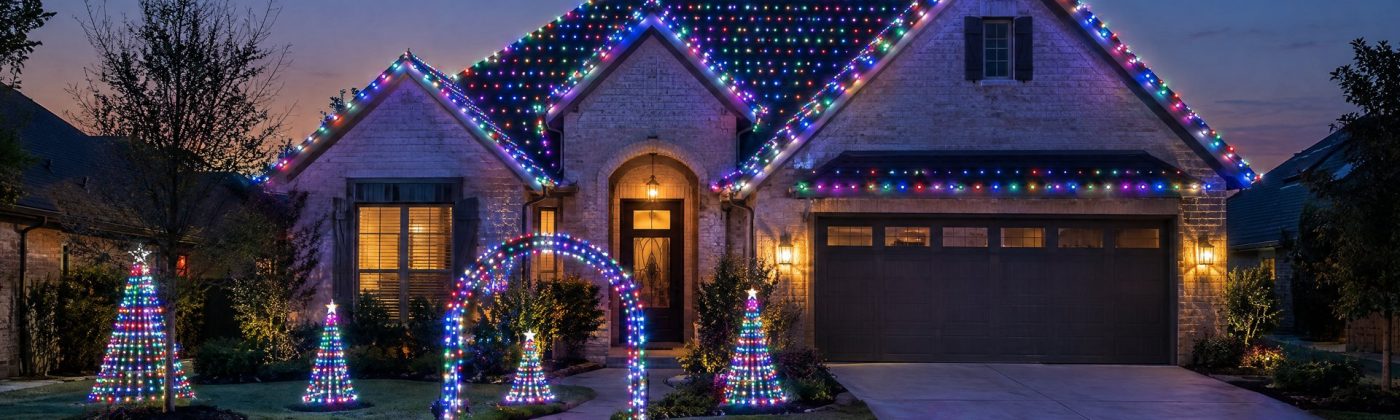
Christmas Light Show to Music: What It Really Takes
A Christmas light show to music takes four things: lights you can control individually or by string, a controller that drives them, sequencing software (most hobbyists use free xLights), and a player that runs the show and its soundtrack on a schedule, usually broadcast on a low-power FM transmitter that visitors tune to in their cars. The hardware is the easy half. The programming is where the hours go, so the smart first show is one song and three or four elements, not the house from the viral video.
This guide walks through a first show the way you would actually build it: what kind of show to choose, how many pixels you are really buying, which controller and power supply that implies, how the software and playback fit together, and the legal limits on the FM transmitter and the music. There is a worked parts list with real prices near the end.
First decide: reacting or choreographed?
There are two very different products sold as “lights that sync to music.”
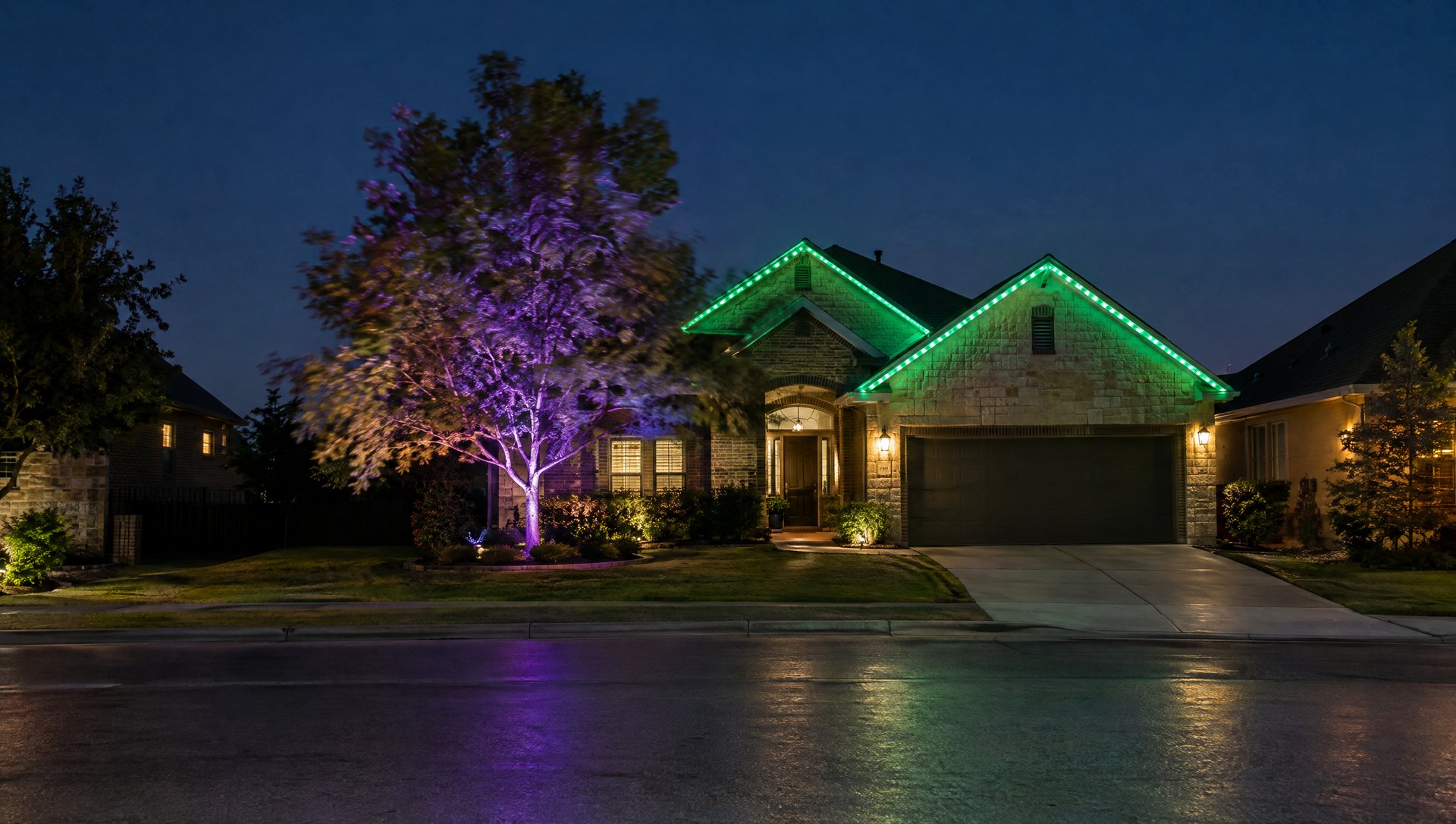
Sound-reactive lights listen through a microphone or the app and pulse with whatever is playing. Any song works, setup takes minutes, and nothing is choreographed. The tree flashes on loud beats; it does not know a chorus is coming. Many app-controlled strings have a music mode.
A sequenced show is programmed against one specific recording. The roofline sweeps left to right on a drum fill, the arches pop in on the second verse, everything goes dark on the last note. That is what people mean by a “light show house,” and it is what the rest of this guide is about.
If you want music in the yard for one party, buy sound-reactive. If you want cars stopping on your street every night in December, you are signing up for a sequenced show and the winter project that comes with it.
Pick three or four elements and give each a job
Before buying anything, decide what lights up and what each piece does in the music. Experienced sequencers think in roles:
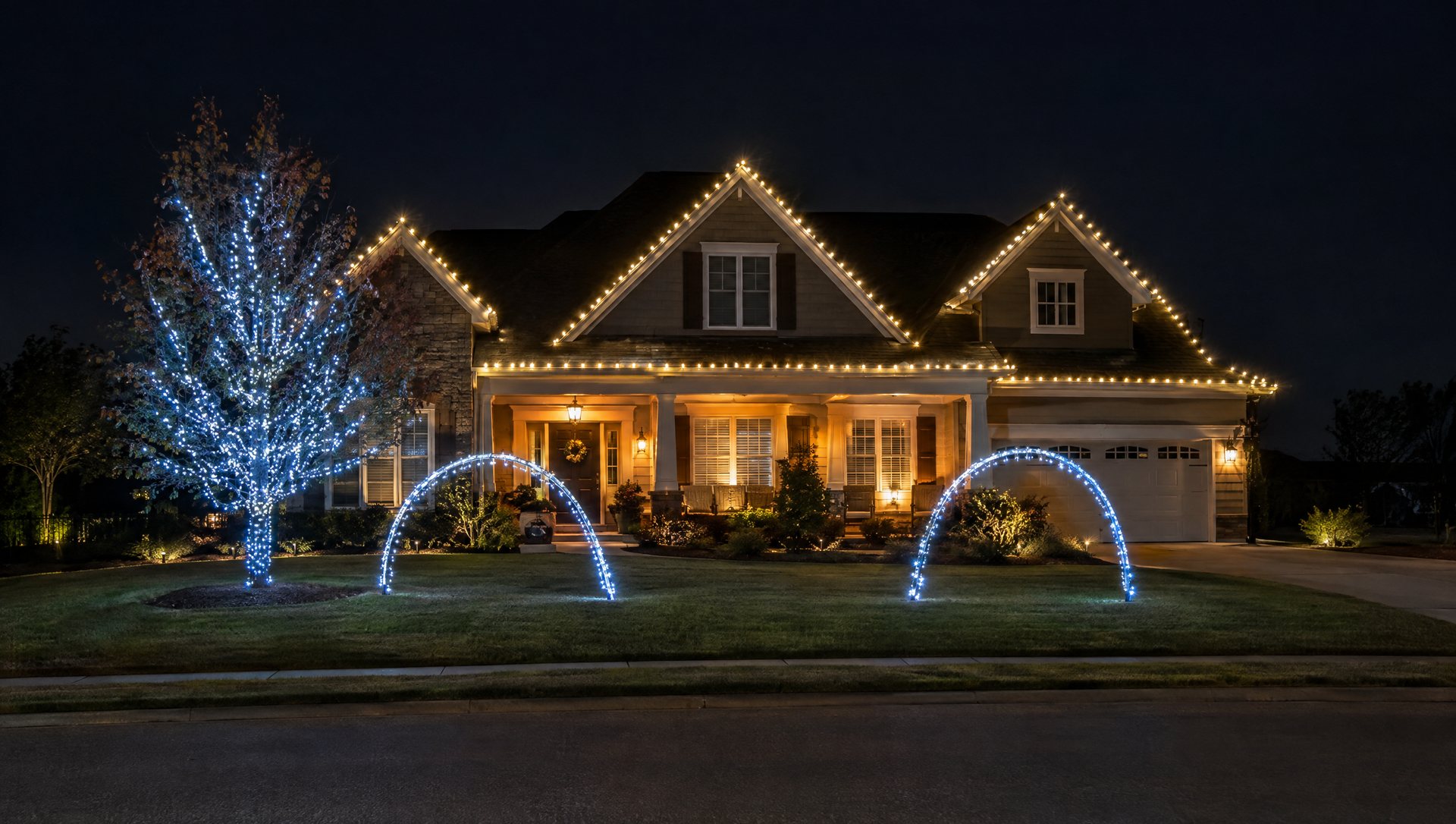
- The frame. Usually the roofline. It holds a steady color through most of the song so the house reads as a house.
- The rhythm section. Arches, mini trees or window outlines that answer the beat.
- The feature. One element saved for the big moments: a mega tree, a star, a matrix, or a wrapped yard tree.
Three or four elements with clear roles look better than twelve that all do the same thing. Leave room for stillness. If every beat triggers every light, nothing stands out, and the show looks like a sound-reactive string with more wiring.
Draw your house from the street, number each element left to right as a viewer sees it, and keep that drawing. You will need it when you build the model in the software. Get “left” wrong once and every sweep in the show becomes a jump.
Channels or pixels: what are you really buying?
There are two families of show lights, and the choice drives everything downstream.
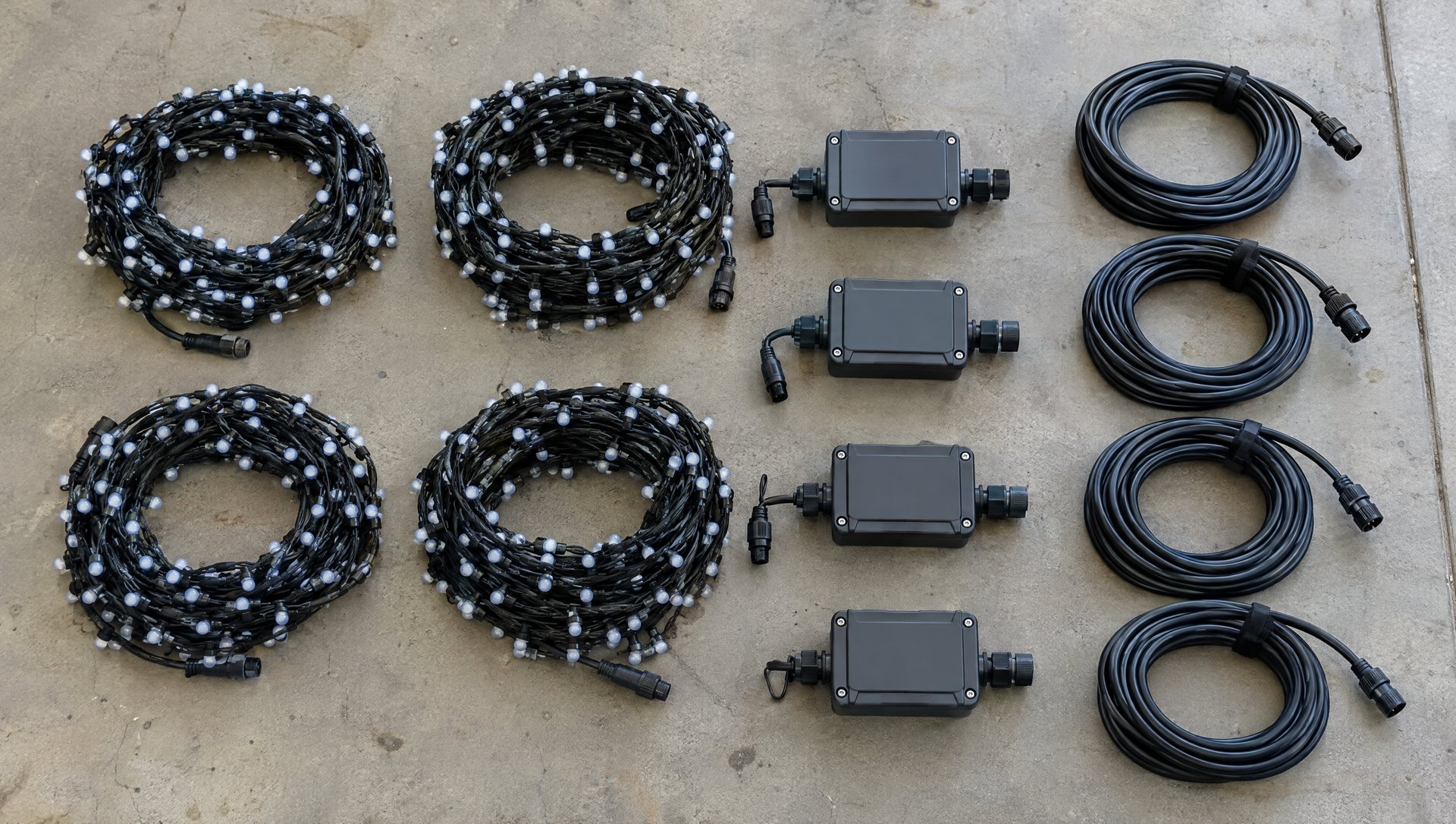
Channel-based shows control whole strings. Each string plugs into one channel of a controller and can be on, off or dimmed. Ordinary light strings work. Light-O-Rama’s 16-channel AC controllers are the classic route. This is cheaper per element and easy to understand, but each string is one color doing one thing at a time.
Pixel shows use RGB pixels: each bulb has its own chip and can be any color at any moment. Chases, color waves and text all need pixels. Most new hobby shows are pixel-based. For residential runs, 12-volt pixels are the common choice because they handle longer runs with less voltage drop than 5-volt pixels.
Count pixels before you count money. Pixel strings are sold by count and spacing. Light-O-Rama’s 12-volt 50-count bullet string has pixels at 6-inch spacing, so one string covers about 25 feet. A 100-foot roofline at that spacing is four strings, 200 pixels. Measure each element in feet, divide by the spacing, and you have your pixel count. That number sizes the controller, the power supplies and even the software license.
Choose a controller that matches the pixels
The controller turns show data from the computer or player into the signal the pixels need. On the pixel side, the Falcon F16V5 is a common hobby choice: $280, 16 pixel outputs (32 with SmartReceiver expansion boards), up to 1,024 pixels per output, 5 to 13 volt pixel power, and the E1.31, Art-Net and DDP network protocols. Light-O-Rama sells its own pixel controllers and the AC controllers for channel-based shows.
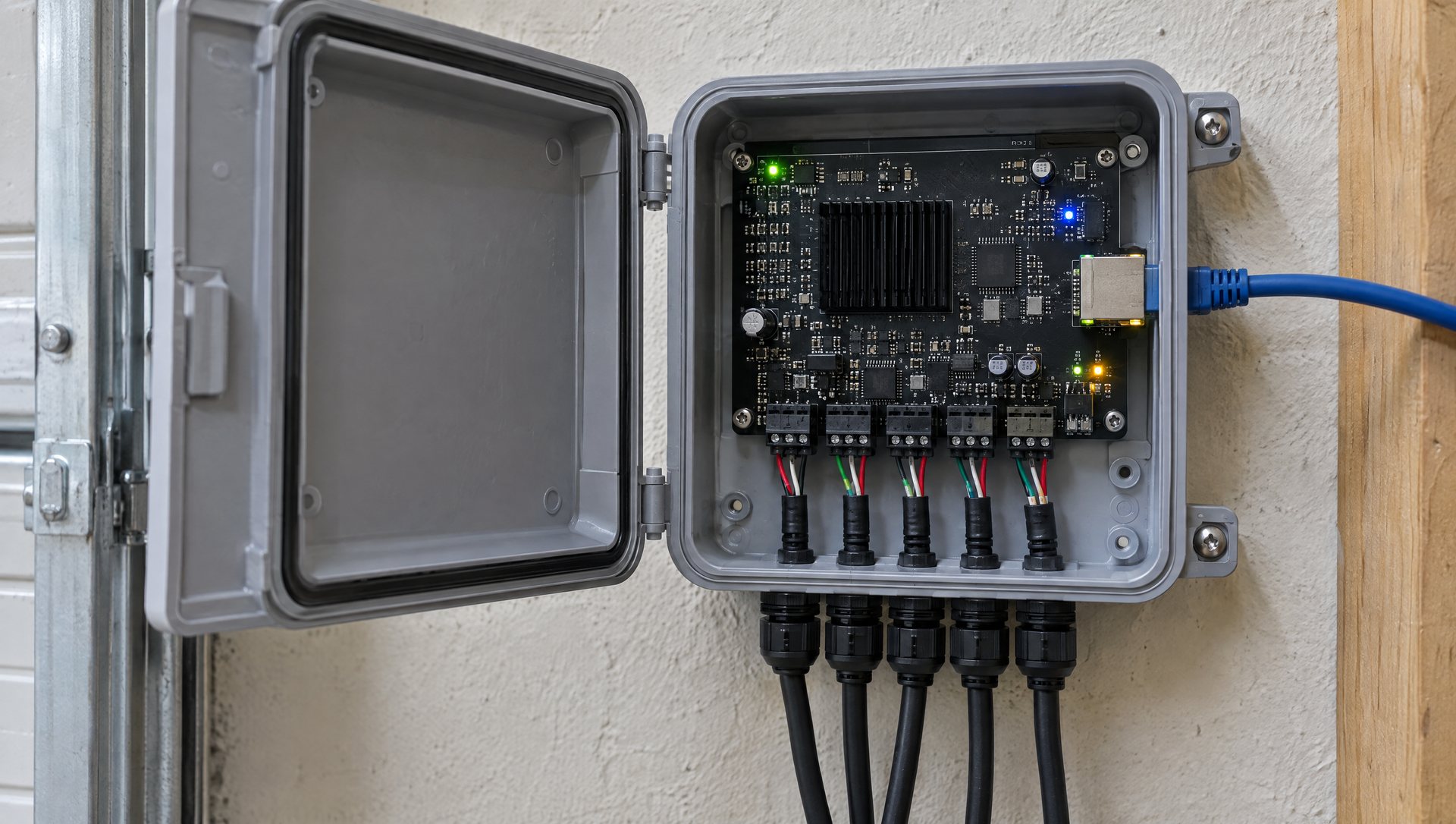
Before buying anything, match four things on paper: the pixel chip type, the pixel voltage, the controller’s supported protocols, and the connector. A plug that fits is not a compatibility check. A 5-volt pixel on a 12-volt output dies on the first power-up.
A practical rule: one output per element where you can. It keeps each element on its own fused output, so a squirrel-chewed arch doesn’t take the roofline down with it.
Do the power math at full white
Size power for the worst case, every pixel at full white, even if your sequences rarely go there. The spec sheet tells you the number. Light-O-Rama rates its 50-count 12-volt bullet string at 15 watts, which works out to 0.3 watt per pixel; generic 12 mm WS2811 nodes are often listed at about 0.72 watt. Use the sheet for the pixels you actually buy.
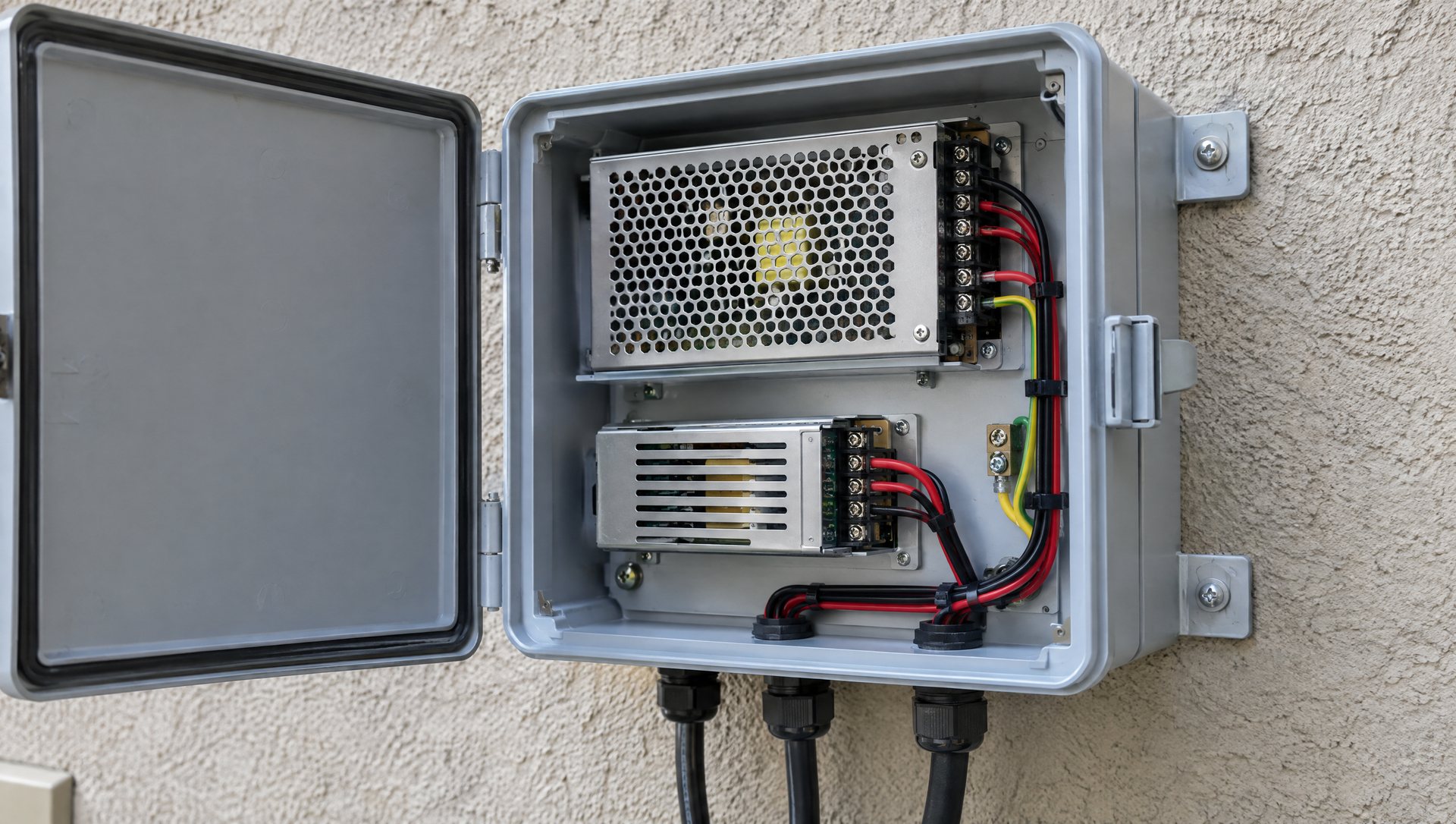
Worked example. 500 Light-O-Rama pixels at 0.3 watt is 150 watts at full white. At 12 volts, that is 12.5 amps. A 12-volt, 350-watt-class supply such as the Mean Well LRS-350-12 (rated 29 amps, 348 watts) covers it with plenty of headroom. The same 500 pixels in 0.72-watt nodes would be 360 watts, 30 amps, and now one supply is not enough.
Three things people get wrong:
- Low voltage is not low current. Thirty amps at 12 volts needs properly sized wire and fusing. Thin wire on a long run gets warm and drops voltage.
- Long runs need power injection. Feed power in at intervals along a long run, or the far end runs dim and shifts toward orange-pink at full white.
- The 120-volt side still counts. The power supplies plug into ordinary outlets, which have the same limits as any display. Mains wiring, new outlets and circuits belong with a licensed electrician. Our light installation safety guide covers the outdoor basics.
Then weatherproof it. Austin Decembers bring rain fronts and the occasional hard freeze. Power supplies and controllers live in a ventilated, drip-proof enclosure, off the ground, with the cable entries at the bottom so water can’t run in.
Sequence it: xLights or Light-O-Rama
Sequencing is where you tell every element what to do at every moment of the song. The two main options:
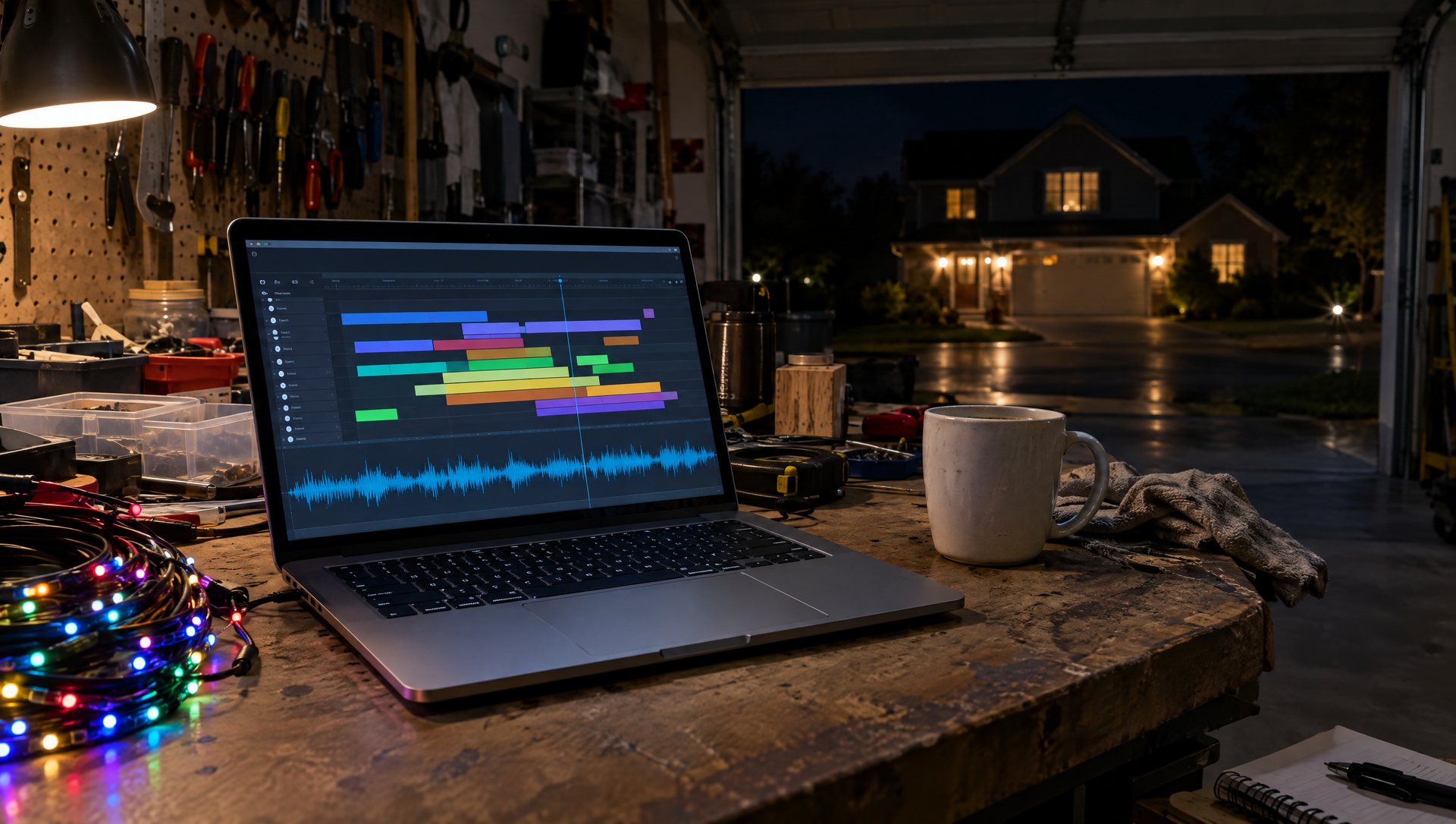
- xLights is free and open source, runs on Windows, Mac and Linux, and works with Falcon controllers, Falcon Player, Light-O-Rama hardware and many others. It is the most widely used hobby option.
- Light-O-Rama S6 has a free Basic license that handles one LOR network with four unit IDs, one DMX universe and up to 680 smart pixels. Paid tiers are one-time: Advanced at $139.95 and Pro at $189.95.
The process is the same in both. You build a model of your house that matches your drawing, load the song, mark timing tracks for beats, phrases and lyrics, and paint effects onto each element along the timeline. Budget real time. The first minute of your first song will take longer than you think, mostly in learning the tool; the second song goes faster.
Pre-made sequences can save weeks. Check what one assumes before you buy: the models and prop counts, the software version and the exact audio recording. You will still map it to your house, and a sequence built for six arches needs rework for three.
Play it back every night on a schedule
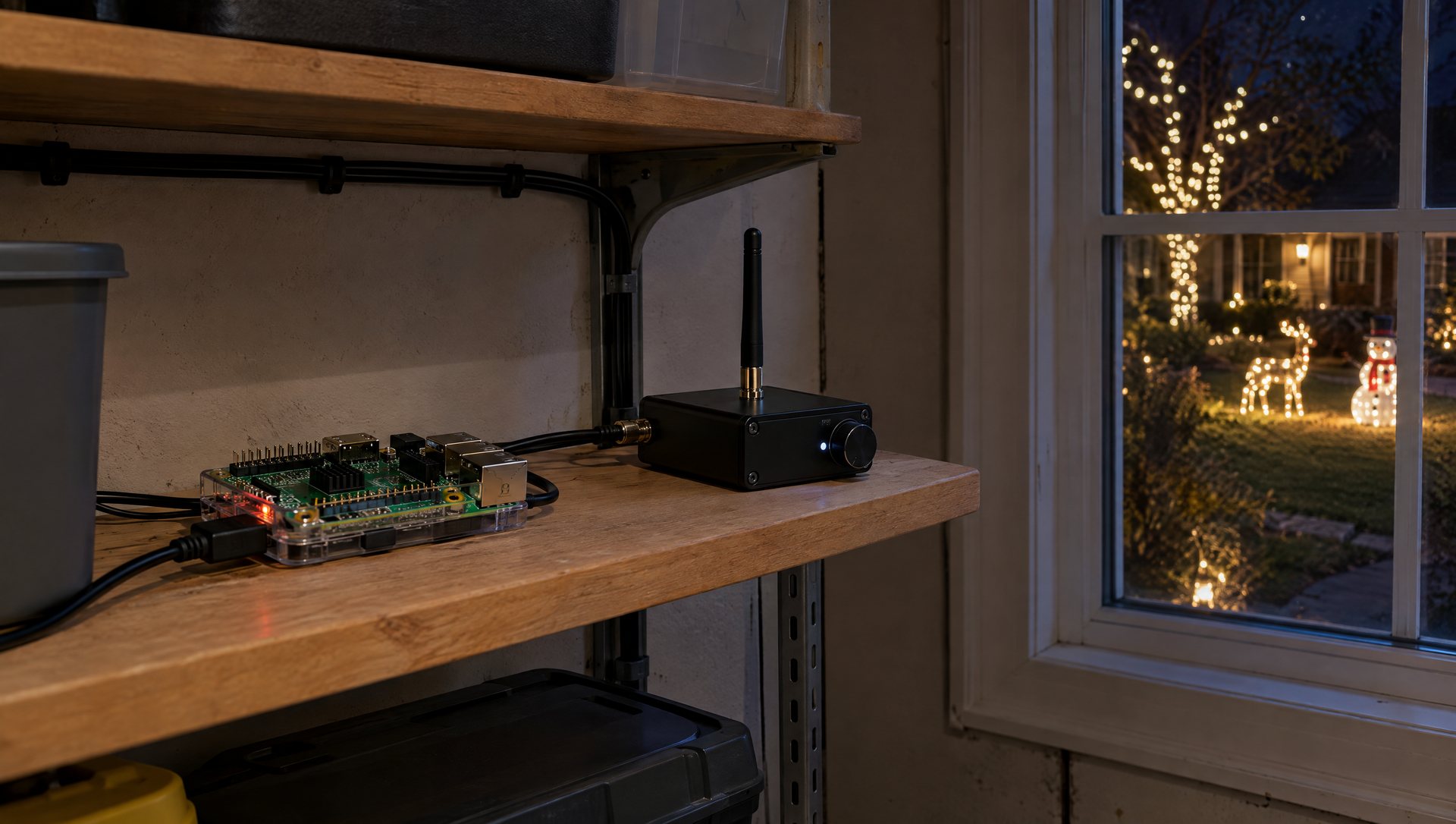
Something has to run the show without you. The common answer is Falcon Player (FPP), free software that runs on a Raspberry Pi or BeagleBone. It plays xLights sequences and the audio on a schedule and can drive controllers over the network. The F16V5 can also store sequences on a microSD card and play them in sync with an FPP master. A laptop running the sequencing software works, but a dedicated player is more reliable through a month of December nights.
Set the schedule with the neighbors in mind. A pattern that works on most streets:
- Shows start after full dark, roughly 6 p.m. in December in Austin.
- The playlist runs a few times an hour, with a calm static scene, not darkness, between runs so the house still looks finished.
- Everything ends by 10 p.m. on weeknights, a little later on Fridays and Saturdays.
- The same schedule every night, posted on a small yard sign, so people know when to come.
Avoid rapid full-house strobing. It is hard on neighbors and on viewers sensitive to flashing light.
Broadcast the audio legally
Most residential shows broadcast the soundtrack on FM so visitors listen in their cars and the street stays quiet. The rules for an unlicensed transmitter are FCC Part 15. Under 47 CFR 15.239, you may operate between 88 and 108 MHz, within a 200 kHz bandwidth, with a field strength of no more than 250 microvolts per meter measured 3 meters away. The FCC describes a compliant Part 15 FM transmitter’s coverage as roughly 200 feet. That reaches a street of parked cars, not the neighborhood.
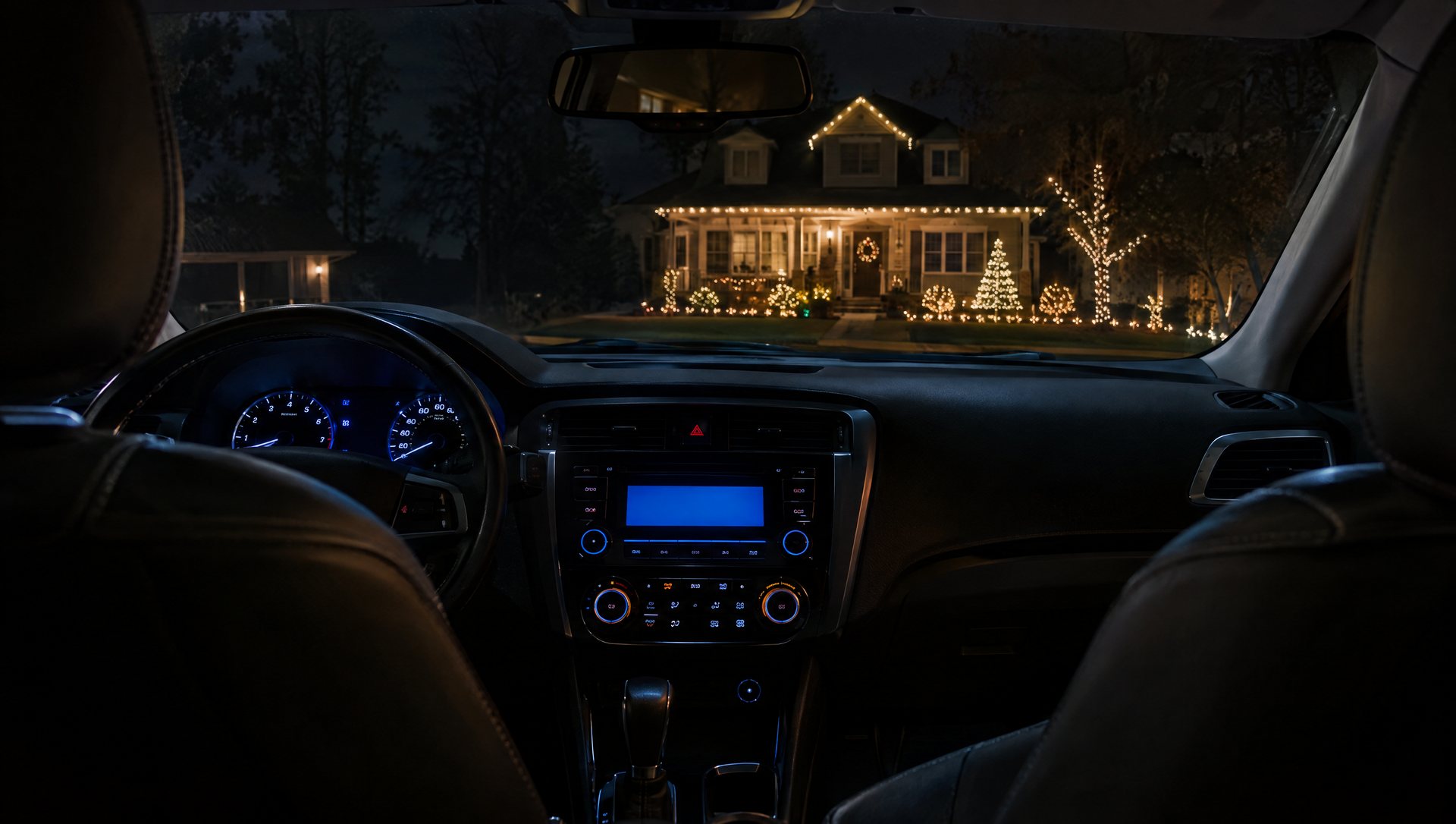
What that means in practice:
- Buy an FCC-certified transmitter sold for light shows or low-power use.
- Pick an empty frequency. Austin’s FM dial is crowded. Drive the street with the car radio and find a channel with nothing on it, including faint distant stations, before you commit.
- Don’t add amplifiers or bigger antennas to reach farther. That turns a light show into unlicensed broadcasting. Under the PIRATE Act the FCC can fine up to $100,000 per day, up to $2 million, and 47 CFR 15.5 requires Part 15 devices to stop if they cause harmful interference.
Outdoor speakers work for a small, supervised gathering, kept low and short. A silent show timed to its own rhythm is also a legitimate choice, and your neighbors will like it.
Check the music rights before you sequence
A streaming subscription or a purchased download is a license to listen, not to perform the song publicly or post a video of your show. The U.S. Copyright Office explains that a song’s composition and a particular recording of it carry separate rights. An old carol may be in the public domain as a composition, but a modern recording of it is not.
For a private show on your own street, most hobbyists don’t think about this. For a fundraiser, a business, or a show you plan to post on YouTube or social media, sort out the rights before you spend thirty hours sequencing a song. Platforms will flag or mute a video with a copyrighted recording, and that is a bad way to find out.
Plan for the cars
A good show draws drivers, and drivers stop where they shouldn’t. Before opening night:
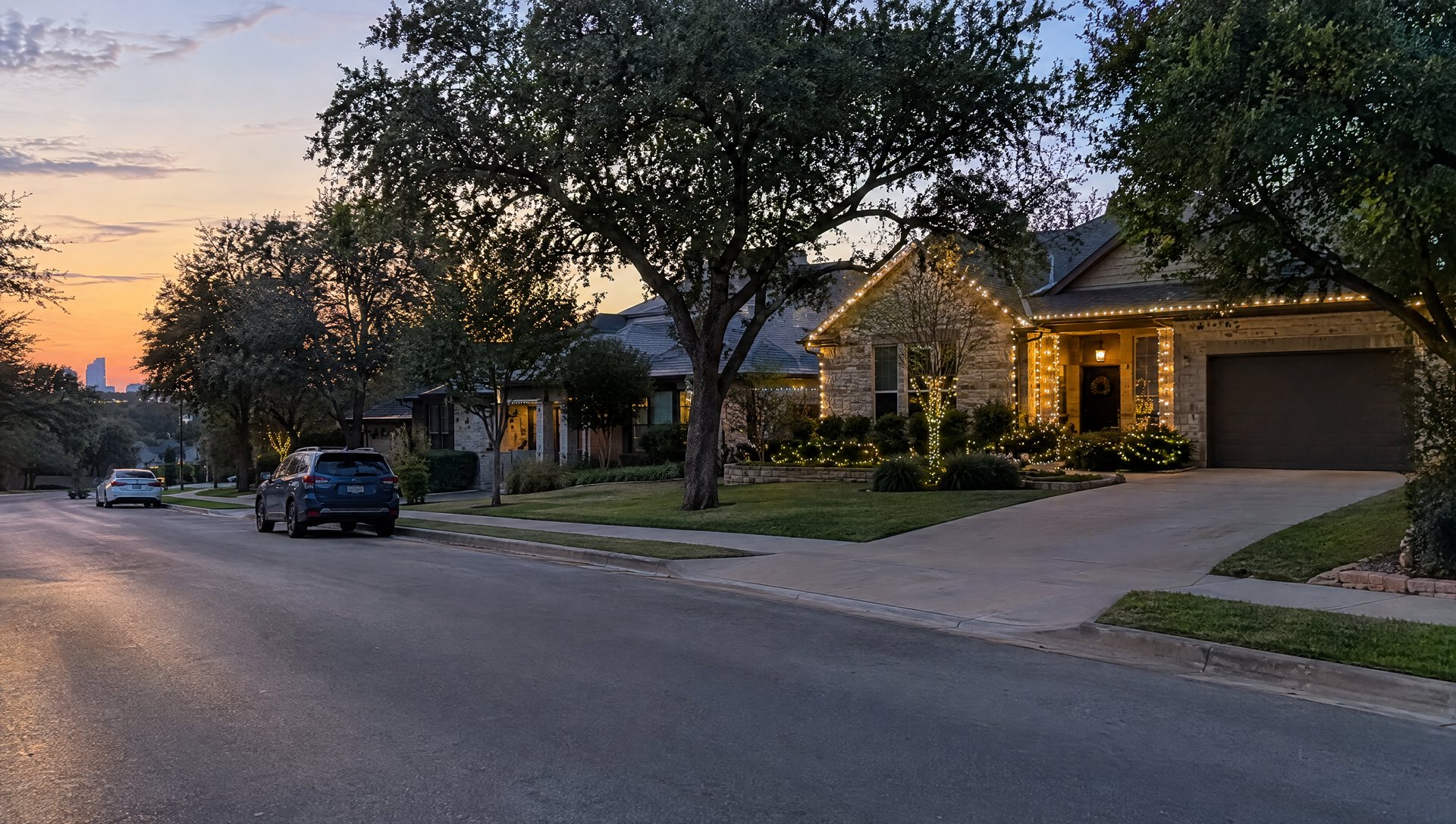
- Walk your street at 7 p.m. and decide where cars can safely park and listen. Most residential streets have room for a handful.
- Keep driveways, the sidewalk and any fire hydrant clear.
- Put the frequency and the schedule on a sign readable from a car window, so people don’t stop in the travel lane to read it.
- Tell the immediate neighbors the schedule and give them your number before they have a reason to want it.
If your street becomes a stop on people’s Austin Christmas lights driving tour, the parking plan matters more than the sequence.
What a first show really costs
Here is a worked first-show parts list for a modest pixel display: a 100-foot roofline, front-window outlines and two arches, using Light-O-Rama’s 50-count 12-volt bullet strings at list price.
| Item | Quantity | Cost |
|---|---|---|
| 12 V 50-count pixel strings ($23.95 each): roofline 4, windows 4, arches 2 | 10 strings, 500 pixels | $239.50 |
| Falcon F16V5 controller | 1 | $280.00 |
| xLights sequencing software | — | Free |
| Falcon Player software | — | Free |
| Subtotal from the list above | $519.50 |
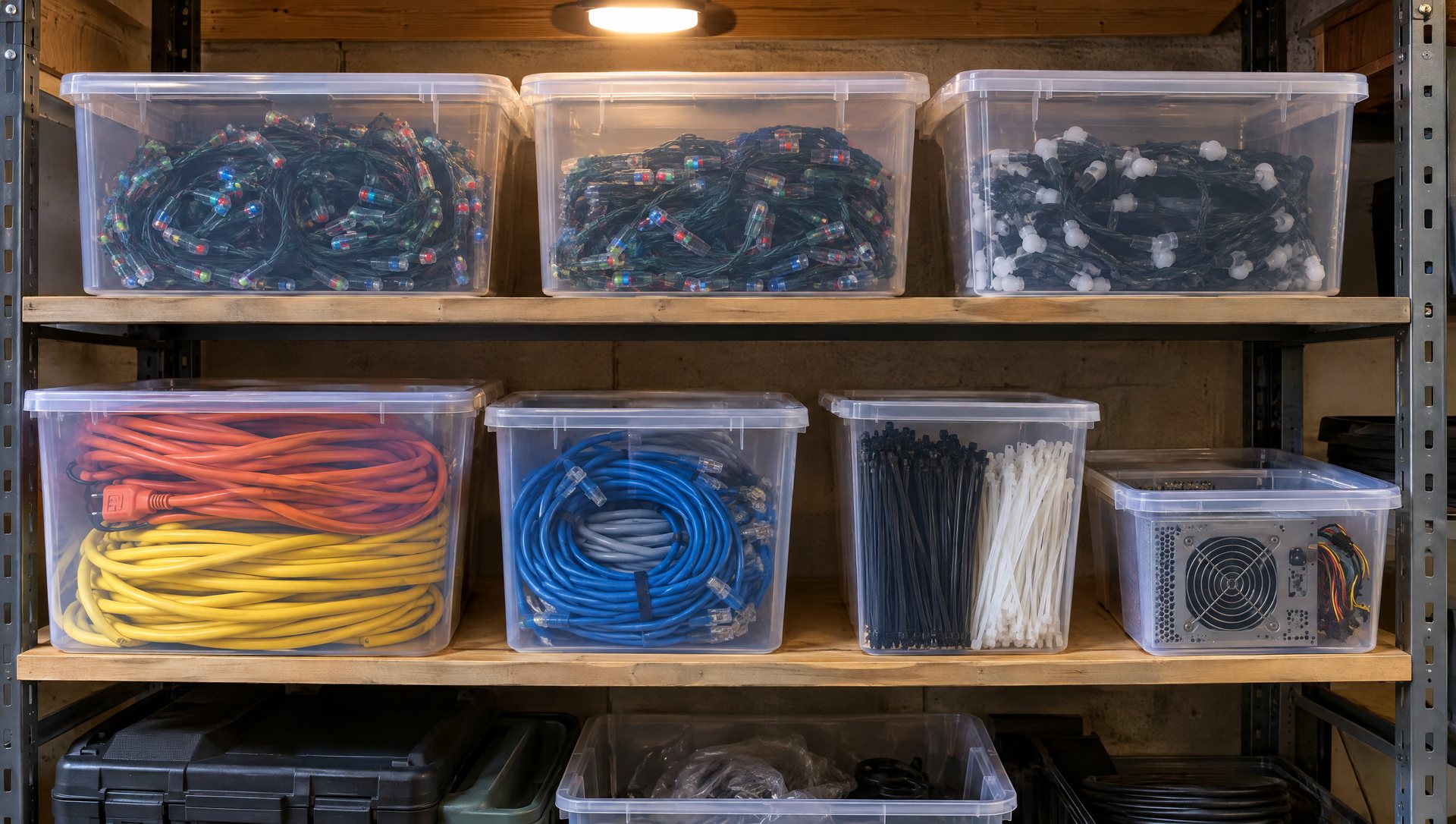
Not in that subtotal, and not small: the 12-volt power supply, a weatherproof enclosure, network and extension cable, fuses, mounting for the arches and the window outlines, a Raspberry Pi to run Falcon Player, an FCC-certified FM transmitter, spare pixels and shipping. Prices on those vary enough that we would rather you price your own than trust a number from us.
The bigger cost is time. Setup, model building, sequencing and the inevitable mid-December troubleshooting when a pixel string goes dark in the rain. A custom show can’t be priced by the roofline foot, because most of the work is control, programming and integration, not hanging lights.
If you hire anyone for a show, ask four questions: who designs it, who programs it, who supplies and owns the controllers, and who fixes it on December 18 at 7 p.m.?
Where a steady display fits
Many of the best show houses are built on a calm base: a steady roofline, wrapped trees and a lit entry, with the animated elements layered on top. That base makes the house look finished between shows and during the day after Thanksgiving when the sequences aren’t ready yet.