


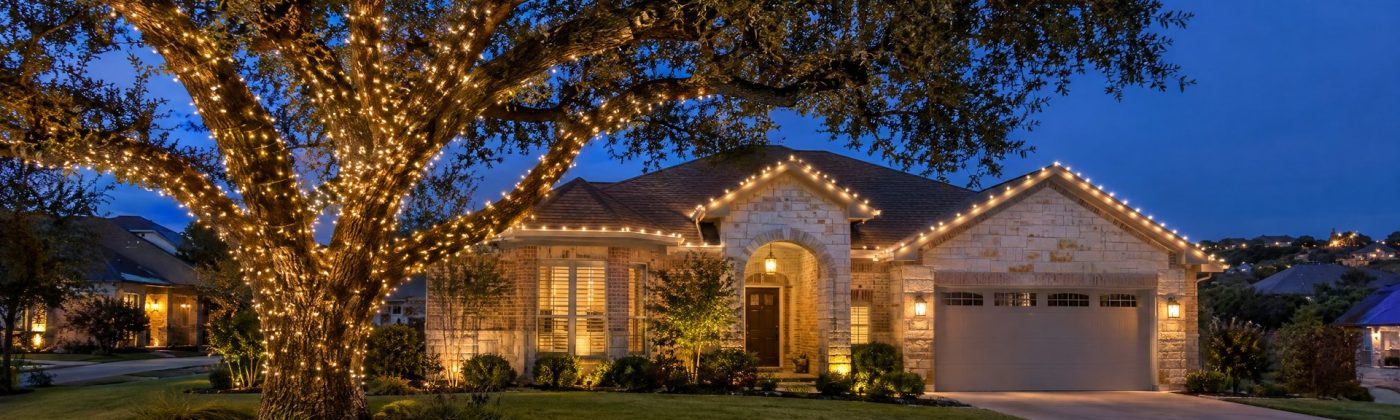
The top Christmas light trends for 2026, by the supplier and installer trend lists we read, are a warm white LED base, minimalist designs built around one focal point (often a wrapped tree), app or timer control, color-changing RGB accents and permanent track lighting. Americans who decorate still lean colored: 59% preferred colored lights and 22% white in a 2023 Today’s Homeowner survey. In Austin, a wrapped live oak makes a natural focal point wherever a yard has one.
| 2026 trend | What the evidence says | Fit for Austin (our judgment) | Plug-in seasonal? |
|---|---|---|---|
| Warm white base | Suppliers call it the leader. No sales data published. | Strong. Suits brick, limestone and stucco, and is less likely to read as glare. | Yes |
| Colored lights | Surveys favor color with households. | Good when it is one color or one pattern, not a mix. | Yes |
| Minimalist, one focal point | On several 2026 lists, also called “architectural.” | Strong. Fits HOA glare wording. | Yes |
| Wrapped trees | A 2026 supplier list calls tree wrap “a core part” of many commercial programs. | Good wherever there is a large front-yard tree. | Yes |
| Big C9 bulbs | A 2026 supplier list says C7 and C9 are “still in demand.” | Good on most rooflines seen from the street. | Yes |
| App control and timers | On most lists we read. | Useful: lights on at dusk without anyone remembering. | Yes, with a plug-in timer or smart plug |
| RGB color change | On most lists. No household adoption figures found. | A taste call. | Simple sets, yes. Animated pixels need a controller |
| Permanent track lighting | High on installer lists. HomeGuide: $2,000 to $8,000 for 100 to 200 ft installed (checked October 2026). | An alternative to seasonal lights, at a higher price. | No, permanent hardware |
| Solar strings | Called “sustainable.” In one hands-on test, the solar set was the dimmest. | Weak as the main display. Fine as a small accent. | Yes, no outlet needed |
The last two columns are installer judgment. Nobody publishes data on which trends Austin homes actually install. The survey and supplier figures are linked and dated in the sections below.
This guide is for Austin homeowners who are starting to see lit houses and wondering what is current, what is hype, and what would work on their own house. If you want to change something this season, skip to trying a look now or next year.
Where do the 2026 Christmas light trends come from?
Most 2026 Christmas light trend lists are written by companies that sell lights, design software or installations. The ones we read name four to ten trends each, and none cites an outside survey or sales data. That does not make them wrong. It means a “trend” usually describes what professionals are designing and selling, not what most households put up.
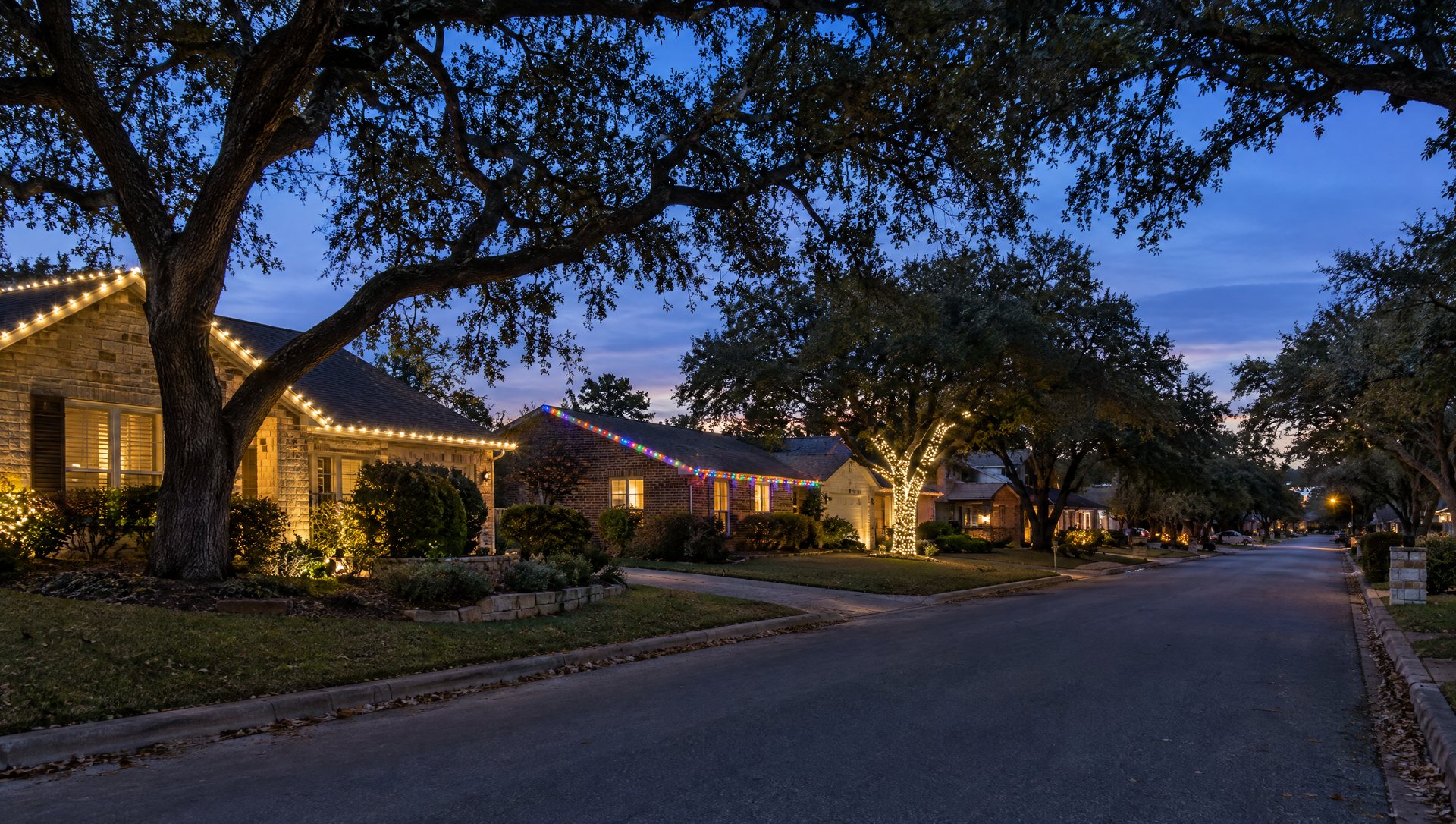
The only measured data we found is consumer surveys, which record what people prefer or plan, not what they install. Where the two disagree, we say so below.
Are colored Christmas lights back in style for 2026?
Colored Christmas lights are in style with households: in the surveys we found, most people who decorate prefer them. Suppliers say warm white leads on professionally designed displays. The two don’t conflict. Pros design for one look, and households pick what they like.
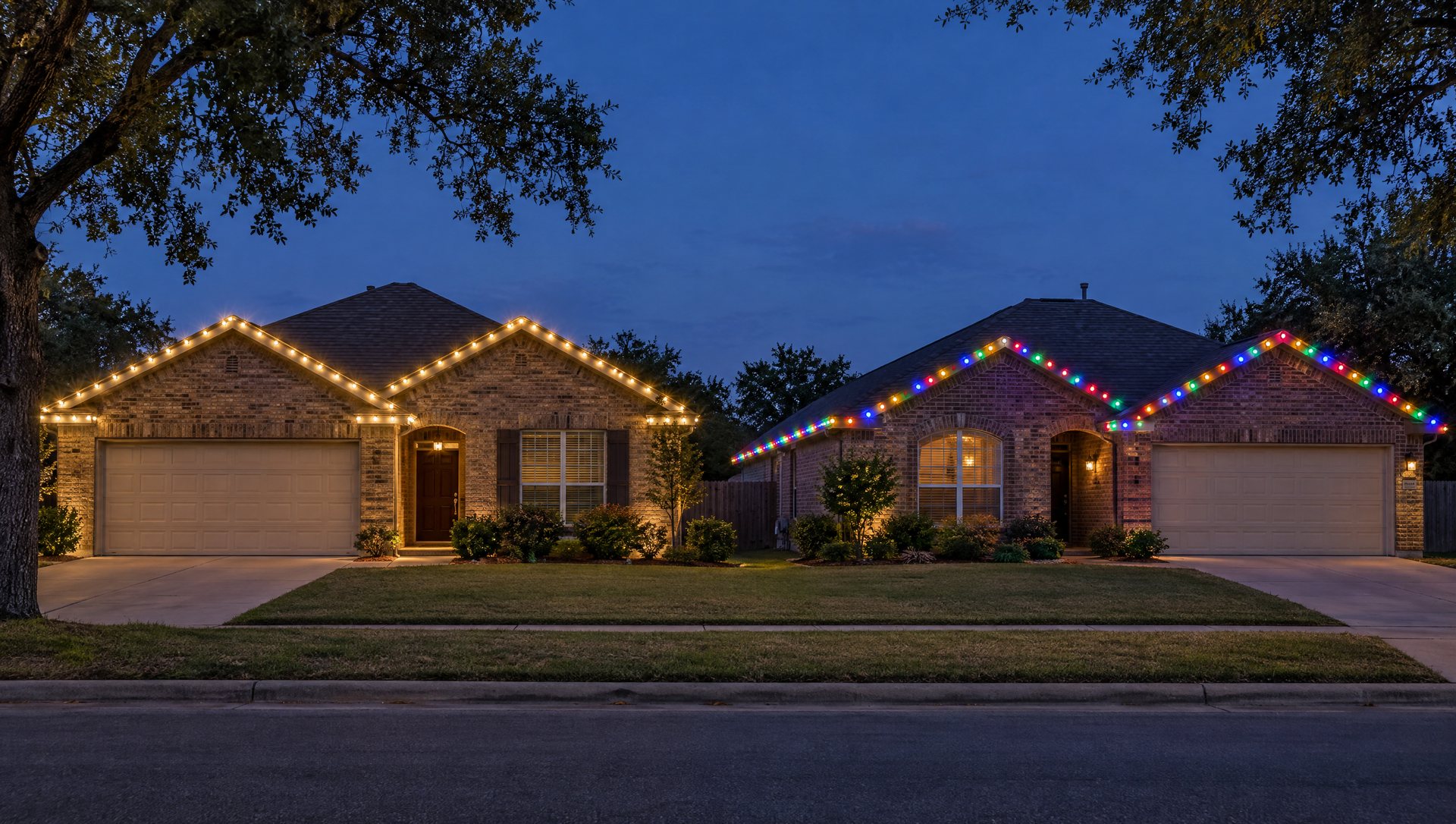
On the supplier side, Christmas Light Source’s 2024 article on popular colors calls warm white the “undisputed king” and says pure white is gaining. It cites no data. St Nick’s Christmas Lighting’s 2026 trend list, written for commercial buyers and updated in July 2026, says warm white and minimalist displays “remain strong.” The same list says bold color is growing.
The surveys lean toward color.
- 59% preferred colored lights
- 22% preferred white
- 19% had no preference
A YouGov poll from December 2025 found that 57% of Americans planning a Christmas tree would put colored lights on it and 36% white. That figure is about the indoor tree, so treat it as a hint about taste, not about rooflines.
Our reading: if you want the look most installers are designing right now, use warm white. If your household loves color, color is not out of style. It reads as deliberate when it is one color, or one repeating pattern, across the whole house. We weigh the two in colored vs white Christmas lights.
Whichever you pick, use one white in each area, and the same white across the whole roofline. Warm white runs from about 2600 K to 3000 K depending on the brand. The Christmas Light Emporium sets its warm white at 3000 K, while Minleon sells a 2600 K “Sun Warm White,” per a Christmas Designers product page. Two brands’ “warm white” side by side can look mismatched, and older LEDs drift slightly in color as they age. For the full comparison, see warm white or cool white for your house.
Is minimalist Christmas lighting in for 2026?
Yes. Minimalist Christmas lighting is on several 2026 trend lists, sometimes under the name “architectural” lighting. It means lighting the shape of the house and one feature, and leaving the rest dark. A clean roofline plus one lit tree is the classic version. On a house without a feature tree, a large wreath or garland at the front entry can be the focal point instead (our judgment, not a trend-list finding).
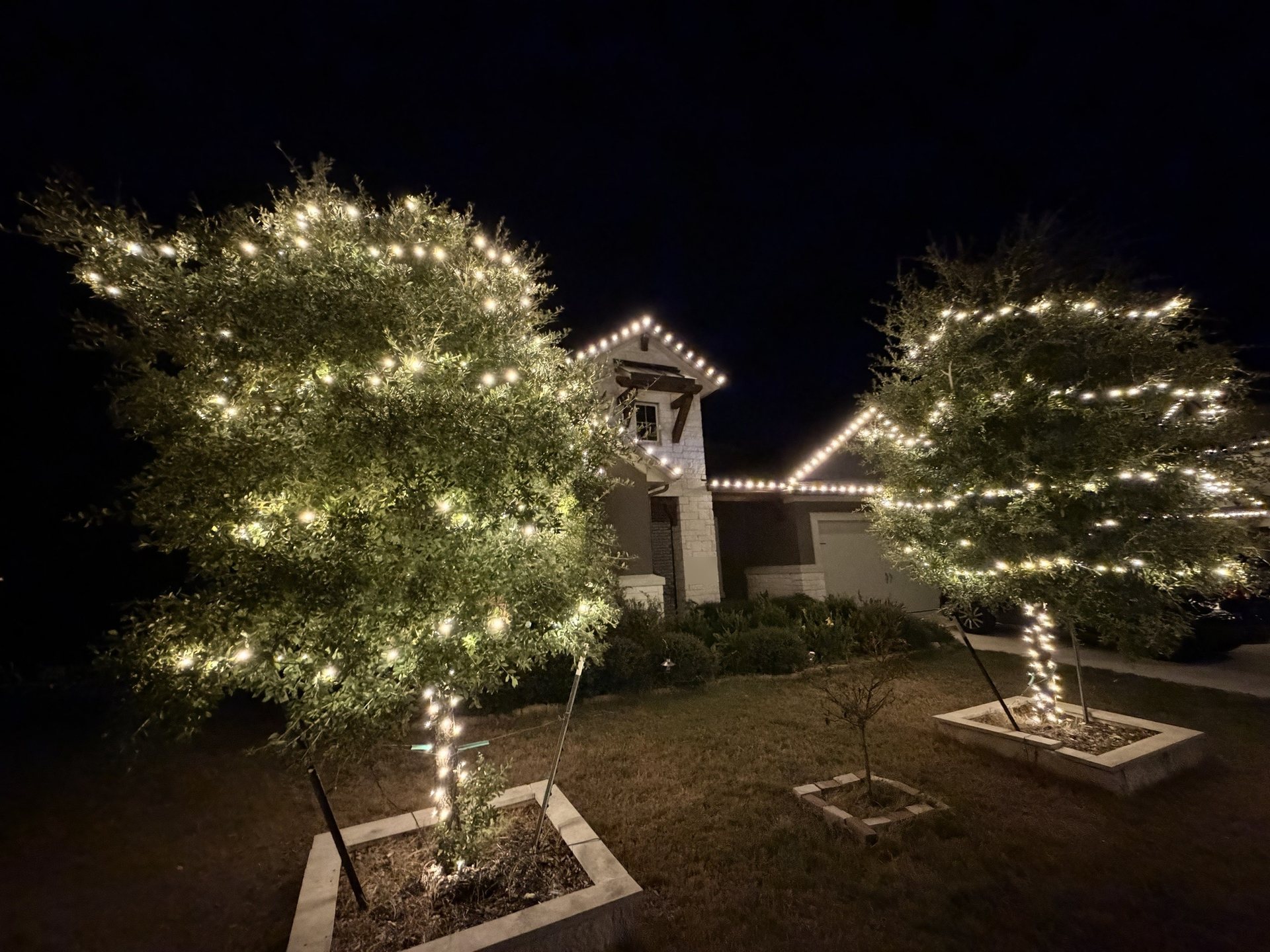
With fewer lights, every flaw shows. A sag, a dark section or one odd-colored strand stands out on a simple house. We cover how to keep it clean in the simple, elegant look.
Is wrapping trees in lights a trend?
Yes. Wrapped trees appear on several 2026 trend lists as a centerpiece, and St Nick’s 2026 list says tree wrap and trunk lighting are now “a core part” of many commercial holiday programs. In Central Texas, lit oaks are an old tradition.
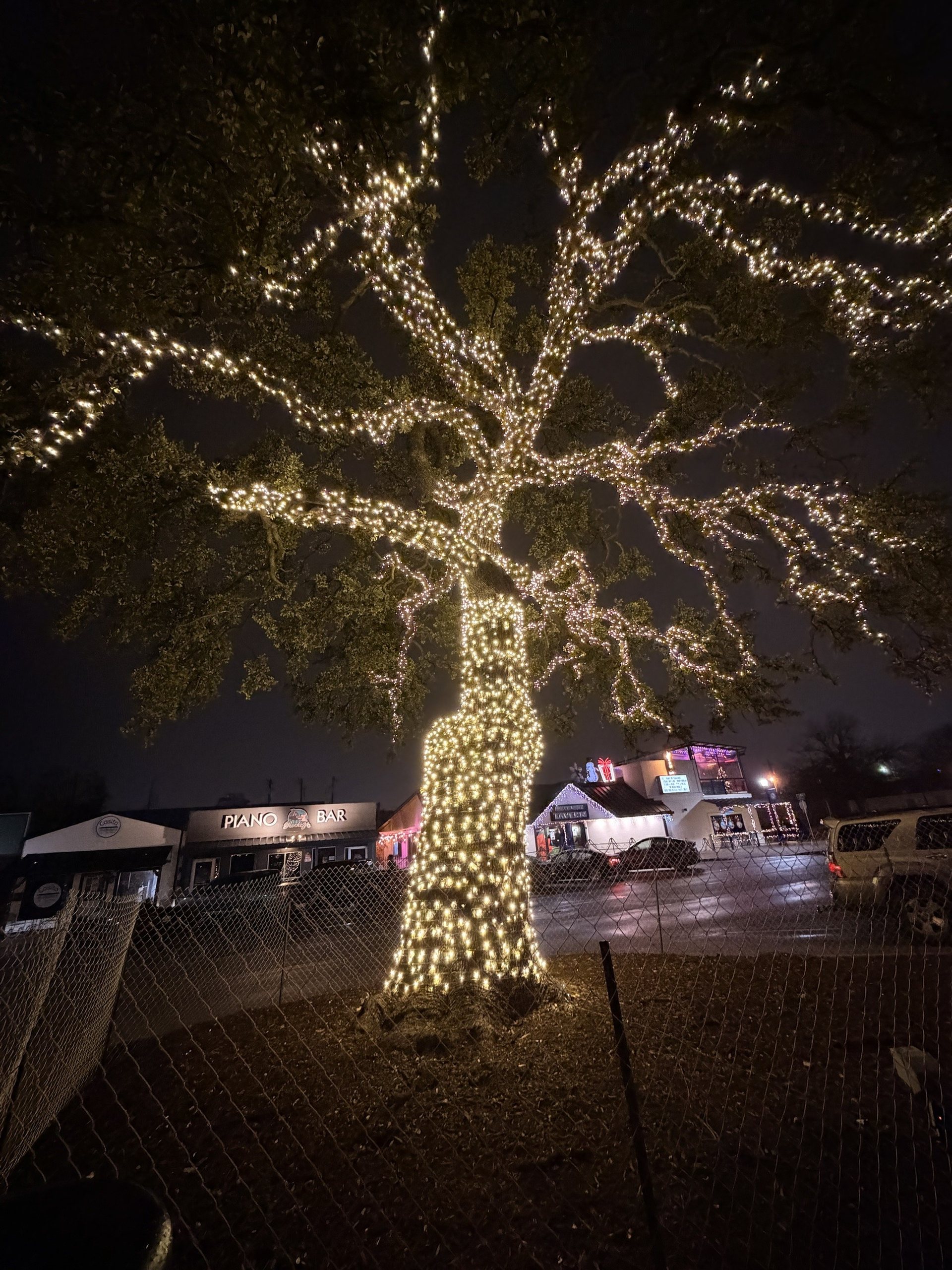
Pedernales Electric Cooperative says that from November 27, 2026, through January 3, 2027, visitors to its Johnson City headquarters can walk under oaks carrying more than 1.6 million LED lights, a tradition of more than 30 years. The City of Cedar Park says it lights what it calls its largest live oak with more than 30,000 lights. The 2026 Trail of Lights is billed by its organizer at 96 lit trees, running December 10 to 23 in Zilker Park; our Trail of Lights guide has the visiting details.
Two terms matter before you copy the look:
- Trunk wrap: a light string spiraled up the trunk from the base.
- Trunk-and-limb wrap: the spiral continues out along the main limbs.
Christmas Lights Etc, a retailer, says most outdoor trees are wrapped the length of the trunk and about 3 to 4 feet along the main branches. On a spreading live oak, how far out the limbs are wrapped is the biggest choice in the job, and it is what moves the price. Christmas Designers says most professional installers use 5mm wide-angle LED minis, because the small bulbs follow the tree’s shape.
For scale, here is what we charge in Austin in 2026, confirmed from photos of the tree. Every job has a $500 minimum.
- $195 to $275 Small or medium tree, trunk only
- About $195 to $450 Each small tree with the leafy canopy wrapped lightly
- $450 to $950 A large oak’s trunk, or a large live oak’s trunk plus some limbs
- $1,750 to $3,000 A very large oak with several branches
- $2.75 per foot A very tall oak or a maximum wrap, per foot of light string, $1,750 minimum; a lift, if needed, is extra
One rule comes with the trend: wraps come off every year. The Morton Arboretum explains that wire left around a trunk or branch cuts into the bark as the wood thickens, which can kill the branch. For the details, see what it costs to wrap a tree and lighting a live oak for Christmas.
Are big C9 bulbs in style?
Yes. Large C7 and C9 bulbs are on the 2026 lists as a “vintage” look, and St Nick’s says they are “still in demand.” Big bulbs read clearly from the street.
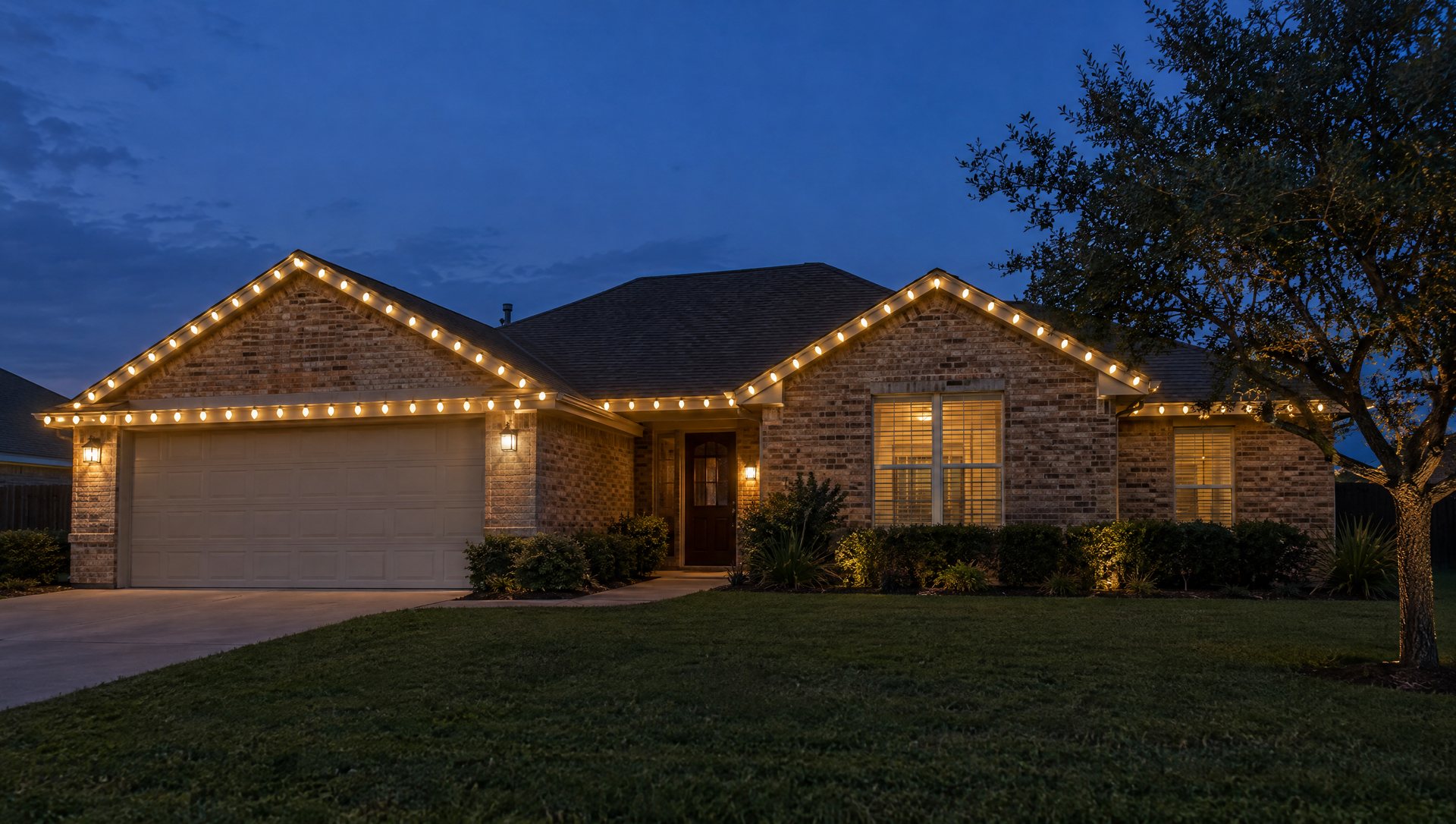
The retro part is the shape and a warm white tone, not the old power draw. In Christmas Lights Etc’s wattage example, 300 LED C9 bulbs total about 29 watts, against about 2,100 watts for 300 incandescent C9s.
In our judgment, C9s suit most rooflines seen from the street, one-story or two. C7s suit a small house or a line seen up close, like a porch rail. More on sizes in our C9 Christmas lights guide.
Are smart and color-changing Christmas lights worth it?
Smart scheduling is worth it on most seasonal displays, and color-changing lights are a taste call. App control and RGB lights appear on most of the 2026 trend lists we read, but they are two different things.
RGB LEDs mix red, green and blue diodes to make thousands of colors, per Christmas Lights Etc’s glossary. When each LED can be controlled on its own, the lights are commonly called pixels. That is what makes chasing color waves and animated patterns possible, and it takes a controller. We look at app-controlled sets in Twinkly and other smart Christmas lights.
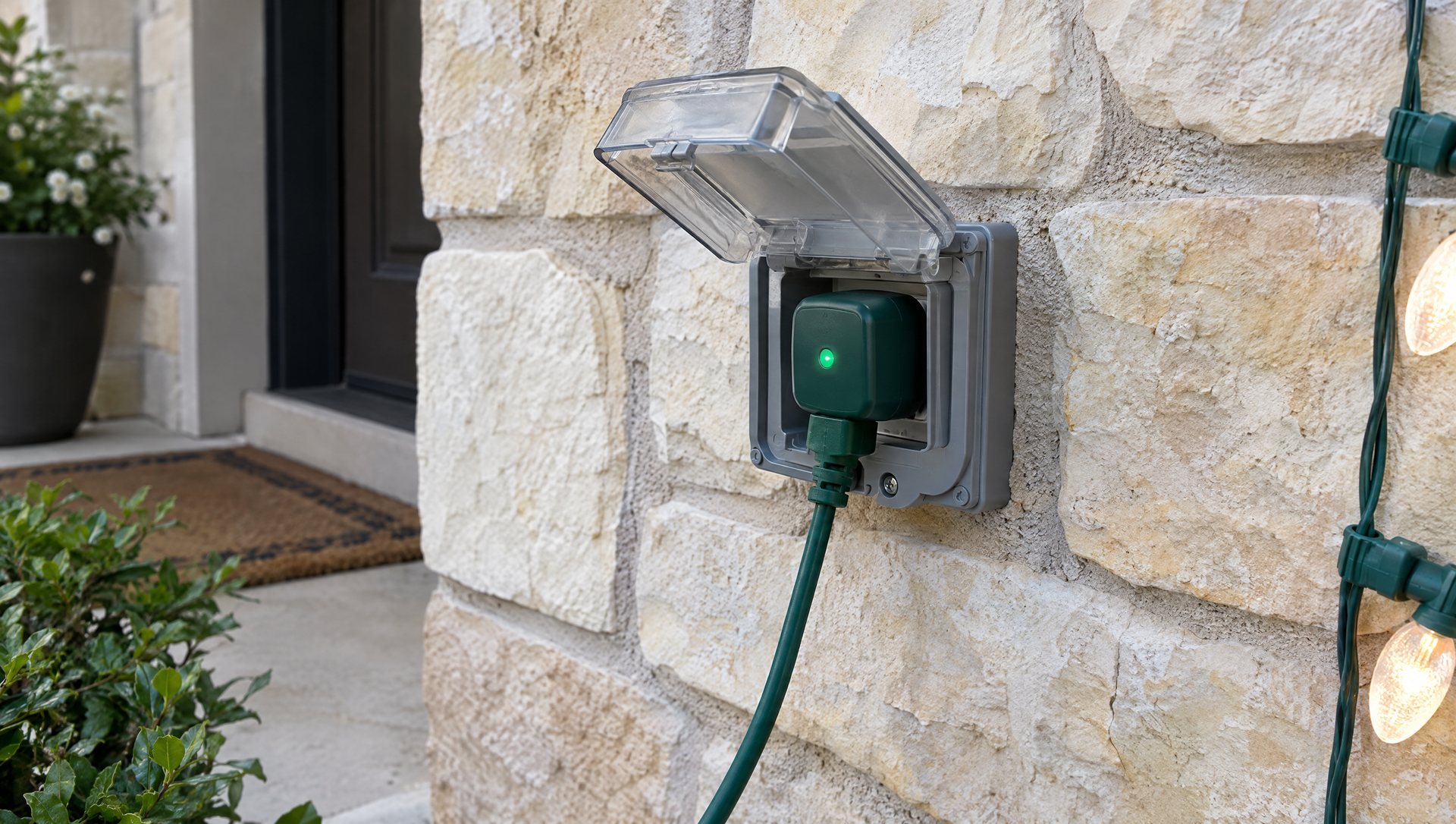
App control can be as simple as an outdoor smart plug. A timer without Wi-Fi does the main job too: an astronomic timer such as the Intermatic HB880R turns lights on at sunset by its built-in clock and adjusts for daylight saving time (specs checked October 2026).
In Austin the sun sets at about 5:30 p.m. from late November into early December, per NOAA’s solar calculator table for Austin. Lights that come on at dusk by themselves are the “smart” feature we’d want first. See setting an outdoor light timer for the options.
Sunset is earliest, about 5:30 p.m., in early December and moves later toward New Year, which is why a timer that follows sunset beats a fixed time.
Source: NOAA Global Monitoring Laboratory, solar calculator table for Austin, 2026
Show the numbers
| Sunset, minutes after 5 p.m. | |
|---|---|
| Nov 1 | 43 min |
| Nov 15 | 34 min |
| Dec 1 | 30 min |
| Dec 15 | 32 min |
| Dec 31 | 41 min |
Are permanent Christmas lights replacing seasonal ones?
Permanent track lighting sits near the top of installer trend lists, but it is a different product, not a style of seasonal lights. It stays mounted under the eaves all year and is switched on for each holiday. Some 2026 installer lists also push “landscape integration,” holiday lights tied into year-round path lights or uplights. That is the same decision: a year-round product, not a seasonal install.
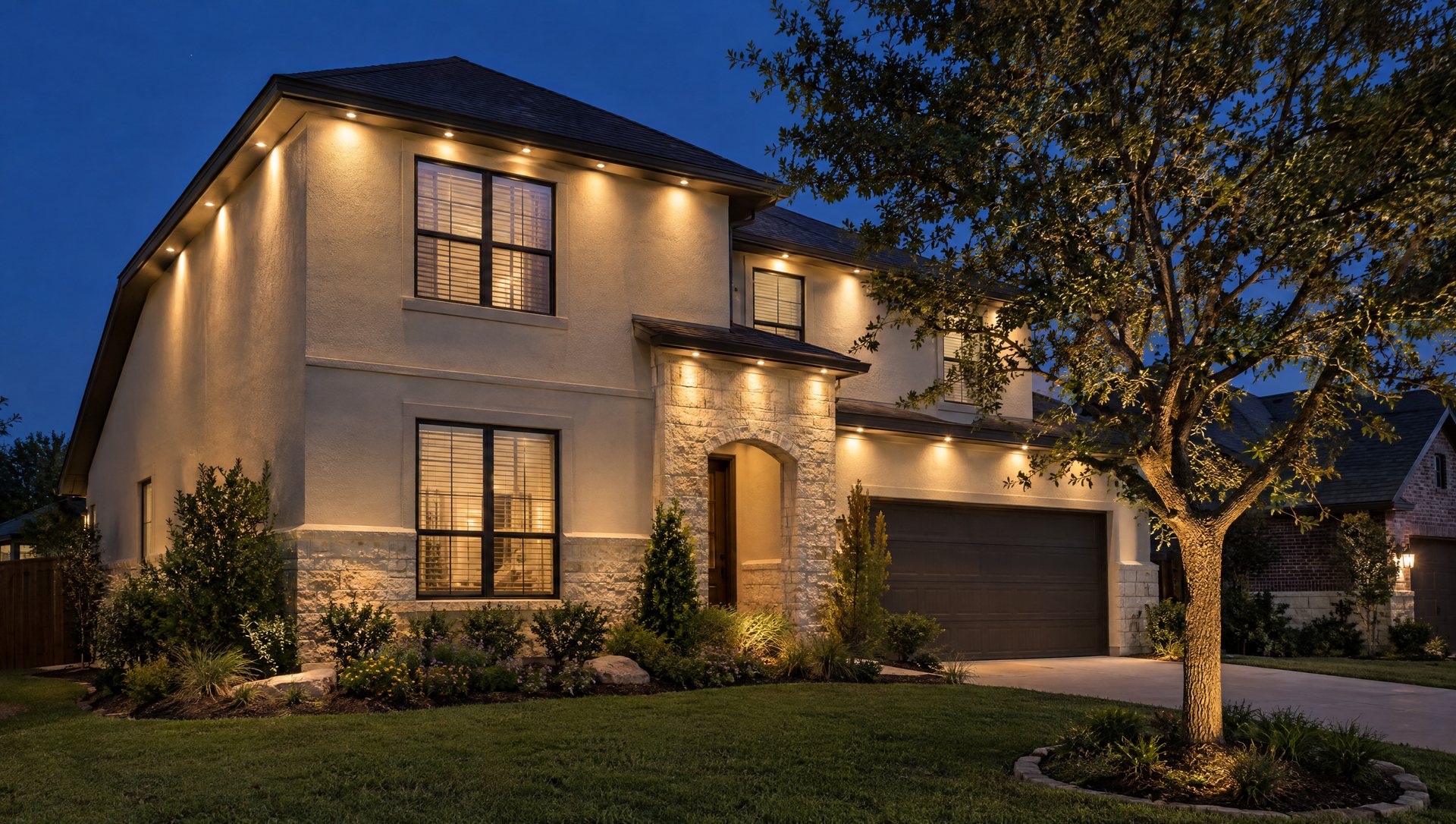
The price gap is the first thing to know. HomeGuide’s permanent lights guide lists $20 to $40 per linear foot installed, or $2,000 to $8,000 for 100 to 200 feet. Angi’s Austin page gives about $2,380, and HomeAdvisor a $3,500 average (all three checked October 2026). Those sources disagree on how long the systems last, so we would not count on any payback period.
For the full numbers, see