


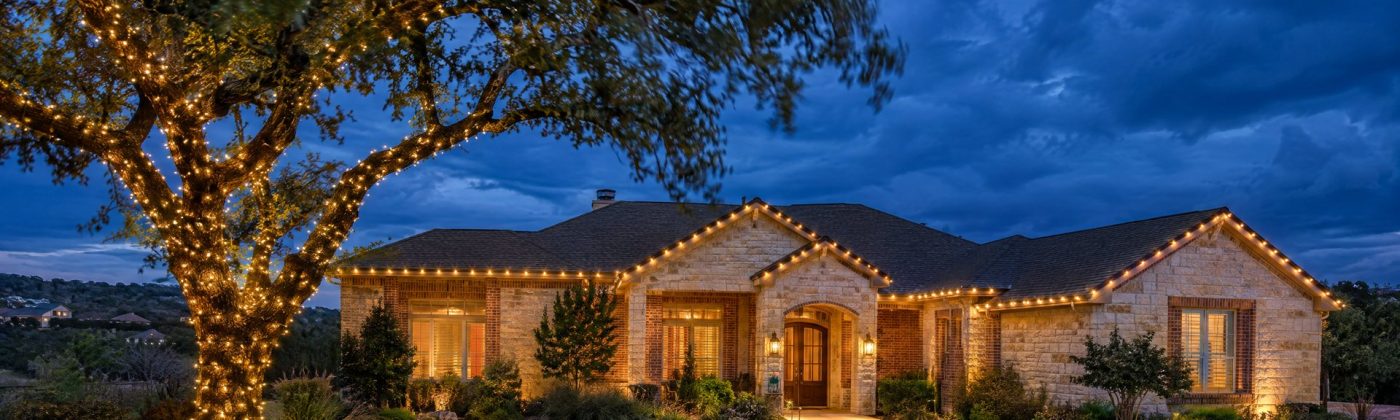
Usually, yes. Christmas lights clipped to a firm support at every bulb tend to ride out the gusty north winds behind Austin’s winter cold fronts. That is installer judgment, because no light, clip or magnet maker we checked publishes a wind rating. Wind works on what is loose: skipped or brittle clips, slack wire, a dangling tail, or a strand stretched between tree limbs. Check from the ground before a front, and stay off ladders until the wind drops.
| Part of the display | What wind does to it | How it is held |
|---|---|---|
| Roofline with skipped clips | Lifts the loose stretch, works clips off | A clip at every bulb |
| Slack wire | Swings, stretches, sags | Snug, not stretched |
| Loose tail at the end of a run | Pries at the last clips | Clipped or tucked |
| Lead down a corner | Flaps off the roofline | Clipped down the trim |
| Icicle drops | Swing and tangle | Clips 6 to 12 inches apart |
| Net lights on shrubs | Lift off the bush | Edges tucked, bottom staked |
| Tree trunk wrap | Moves little | Snug spiral |
| Strand spanning between limbs | Takes the most load | Avoid open spans |
| Cords and connections | Whip, rub, pull apart | Fastened down; connections raised |
This guide is for Austin homeowners with a cold front in the forecast, or a run that came loose after one.
How much wind can Christmas lights take?
We found no published wind rating for Christmas lights. None of the light, clip and magnet makers’ pages we read in October 2026 gives one, so a claim that lights hold to a given speed has no test behind it. We’d expect a well-fastened display to ride out ordinary gusts.
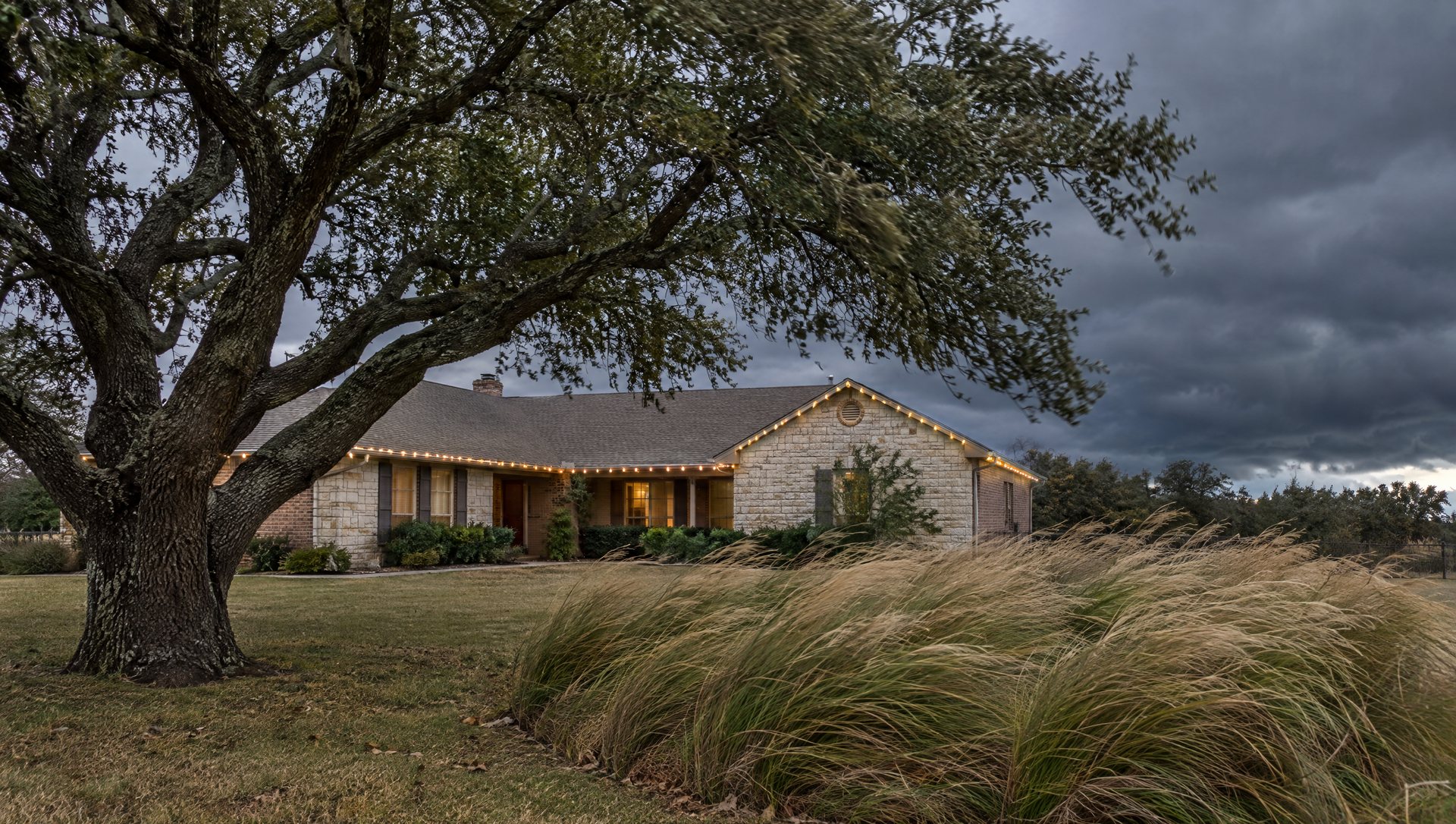
The National Weather Service’s Beaufort wind scale gives a feel for the forces. At 25 to 31 mph, large branches move. At 32 to 38 mph, whole trees sway. At 39 to 46 mph, twigs break off.
The NWS generally issues a Wind Advisory for sustained winds of 30 to 39 mph, and a High Wind Warning for sustained winds of 40 mph or gusts of 58 mph. Local offices set their own criteria. Under a Wind Advisory, the NWS page on wind warnings and advisories says to secure outdoor objects.
Austin’s cold-front wind
In Austin, the winter test is cold-front wind, not snow. The NWS Austin climate summary says north winds are about as common as south winds in winter, and gusty north winds follow the fronts. That is exactly when lights are up.
Two December examples. Last season, the NWS Austin/San Antonio office issued a Wind Advisory for December 28 to 29, 2025, for Travis and Williamson counties. It forecast north winds of 20 to 30 mph with gusts up to 45 mph behind the front. Further back, the NWS Austin-area wind records table (1984 to January 2024, measured at the old Mueller airport) lists a 63 mph northwest gust on December 14, 1987.
The December 14, 1987 gust, from the northwest, is the only one of the five the NWS marks as non-thunderstorm wind.
Show the numbers
| Peak gust | |
|---|---|
| Sep 10, 1987 | 81 mph |
| May 27, 1997 | 71 mph |
| Jul 28, 1980 | 69 mph |
| Sep 7, 1995 | 64 mph |
| Dec 14, 1987 | 63 mph |
Wind with ice is worse. An Austin Energy winter storm release from January 2026 says the two together stress trees, power lines and poles. Our guide to Christmas lights in a freeze or ice storm covers that case.
What part of a light display fails first in wind?
In wind, the clips fail before the lights do. Some terms: a run is one continuous line of lights. The lead is the cord that carries power up to it. The tail is the loose end at the far side. Drops hang from icicle lights.
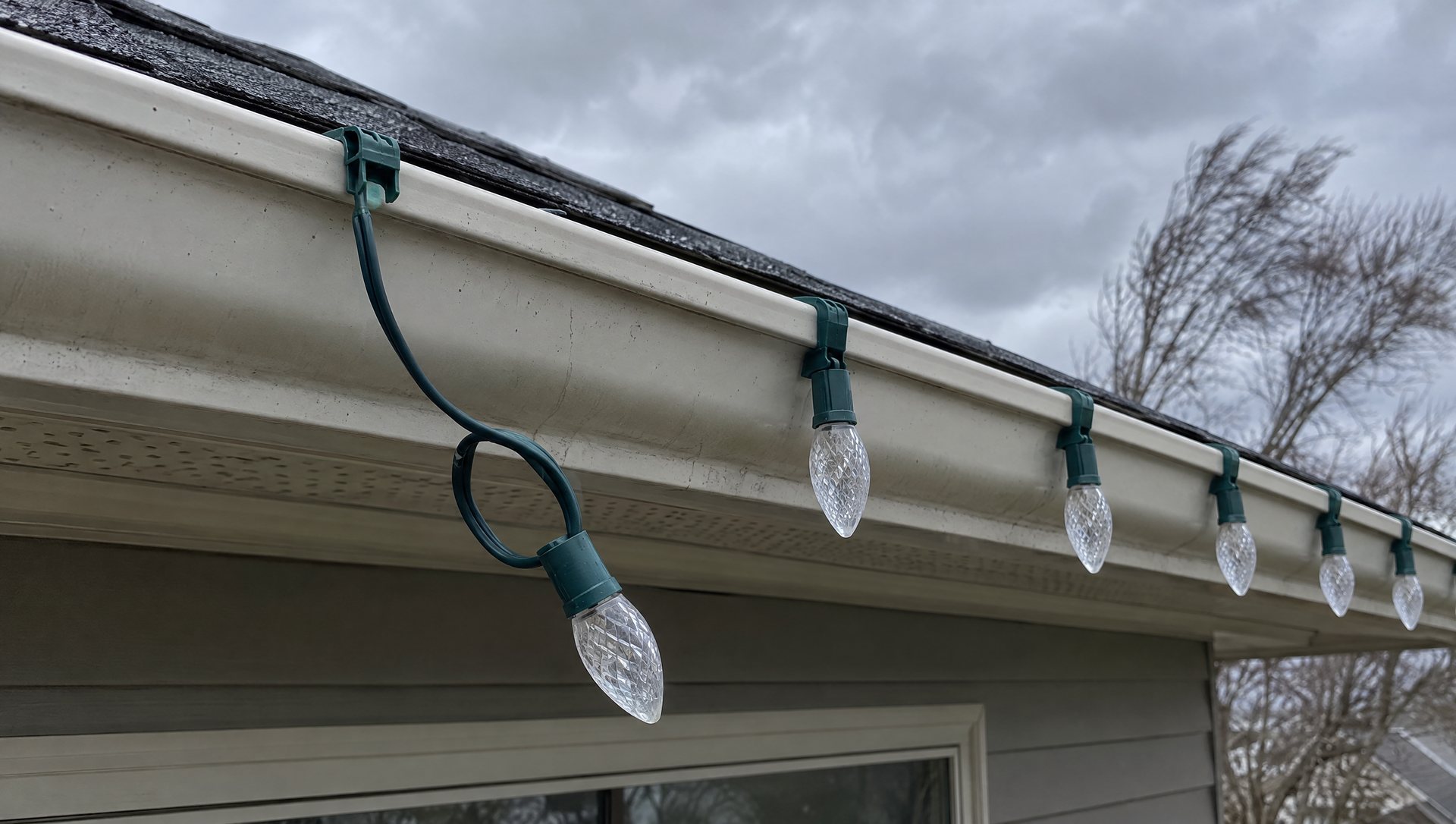
We think of every loose length as a lever on the clips at each end. Brite Supply, a pro supplier, lists wind damage in its roofline troubleshooting guide (updated March 2026): clips pulled off, tangled lines, broken bulbs, sections torn away, and wire stretched into a sag.
Which runs take the most wind in Austin?
Behind a front, Austin’s gusts come out of the north, per the NWS climate summary. In our judgment, the runs that move first are north-facing rooflines and rakes, outside corners, and anything on an open or hilltop lot. A run tucked under a south-side eave rarely moves.
How pros secure roofline lights against wind
Roofline lights hold in wind when the line is fastened to something firm at short, even intervals. The Electrical Safety Foundation International (ESFI) says to fasten outdoor lights securely to trees, the house or other firm supports to protect them from wind, without damaging the cord’s insulation. The National Fire Protection Association’s holiday tip sheet (NFPA) says to use clips, not nails.
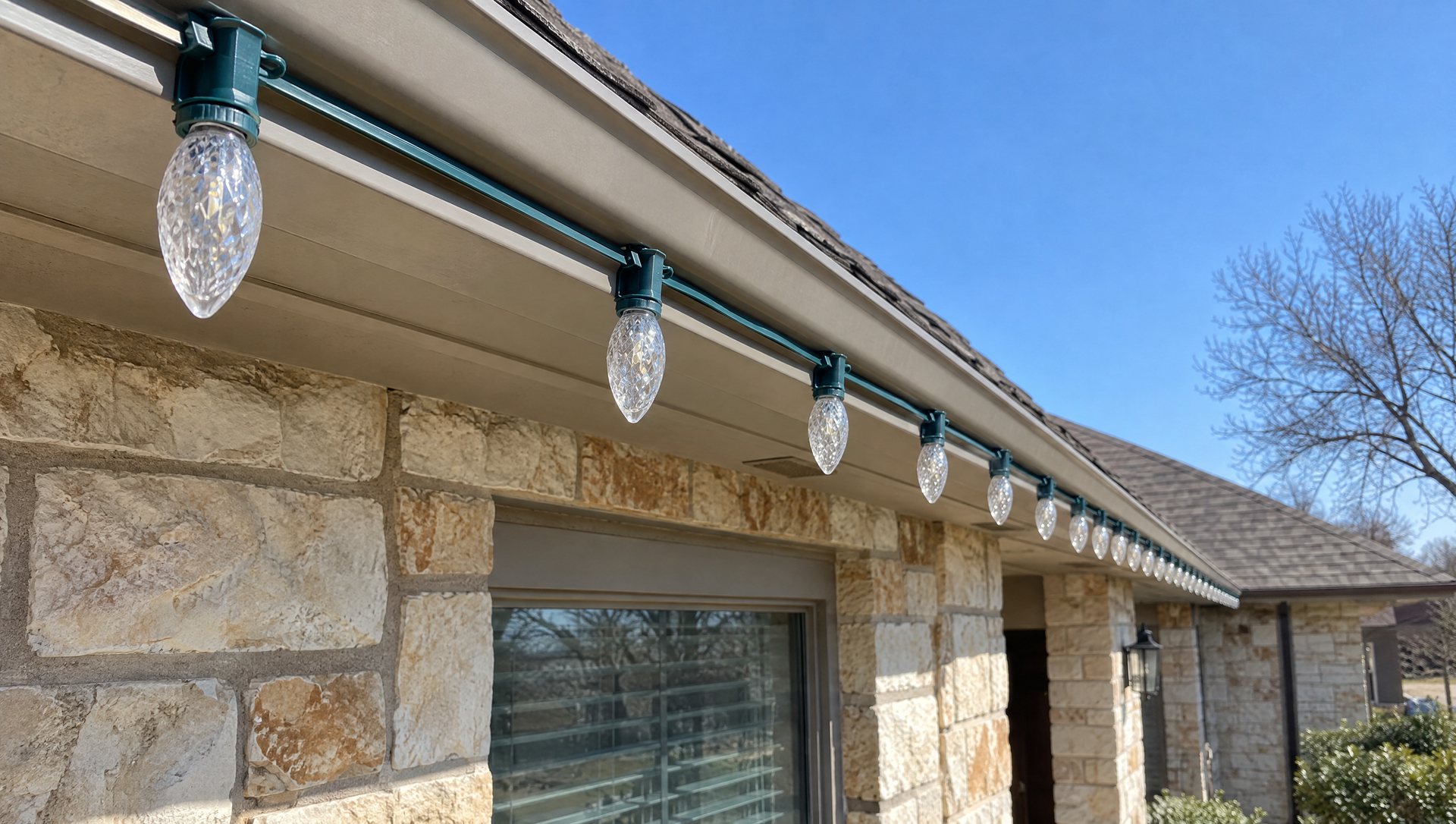
- Match the clip to the surface. Christmas Designers, a pro supplier, says the correct clip for the bulb and surface improves stability in wind. On stucco it says clips may not hold and can do damage; use outdoor-rated adhesive hooks or nearby trim.
- A clip at every bulb. We’d clip every socket on C7 and C9 lines. Skipped clips leave the loose stretches wind pulls on.
- Snug, not stretched. Drum-tight wire strains every clip; loose wire swings. Brite Supply’s fix for a dip is to add a clip and take up slack. Our guide to hanging Christmas lights outside shows how to keep a roofline straight without stretching it.
- Secure the tails. A loose tail at the end of a run catches wind and pries the last clips off. Clip it or tuck it behind the line.
- Add clips on exposed lots. Brite Supply suggests doubling clip density on wind-exposed sites such as hilltops.
- Adhesive clips and magnets need the right surface. 3M lists its Command outdoor light clips for sealed, smooth surfaces such as flat vinyl siding and soffits, not stone or brick (as of October 2026). Magnetic clips hold only on steel or iron, so test your gutter with a fridge magnet first.
Icicle lights, garland and wreaths in wind
Icicle lights are the roofline product we’d watch most in wind, because each drop hangs loose by design. Christmas Lights Etc’s icicle-light page suggests clips 6 to 12 inches apart on gutters. We’d keep long drops off exposed corners.
The Consumer Product Safety Commission’s holiday safety tips (CPSC) say to fasten lights to firm supports, and we’d treat wreaths and garland the same way. We’d hang a wreath from a hook that cannot lift off and tie the bottom so it cannot swing. We’d tie lit garland at short intervals without crushing the wire.
Do old clips make wind damage worse?
Yes, brittle clips let go sooner. Christmas Designers says good plastic clips typically last 24 to 36 months of continual outdoor use, and that sun, freeze-thaw cycles and stress make them brittle. When a clip cracks in a gust, it drops its bulb and loads the next clip. We’d replace faded, whitened or cracked clips rather than reuse them.
How to keep tree lights from blowing around
Trees are where wind matters most, because the support itself moves. How a tree is lit decides how much of that movement reaches the lights.
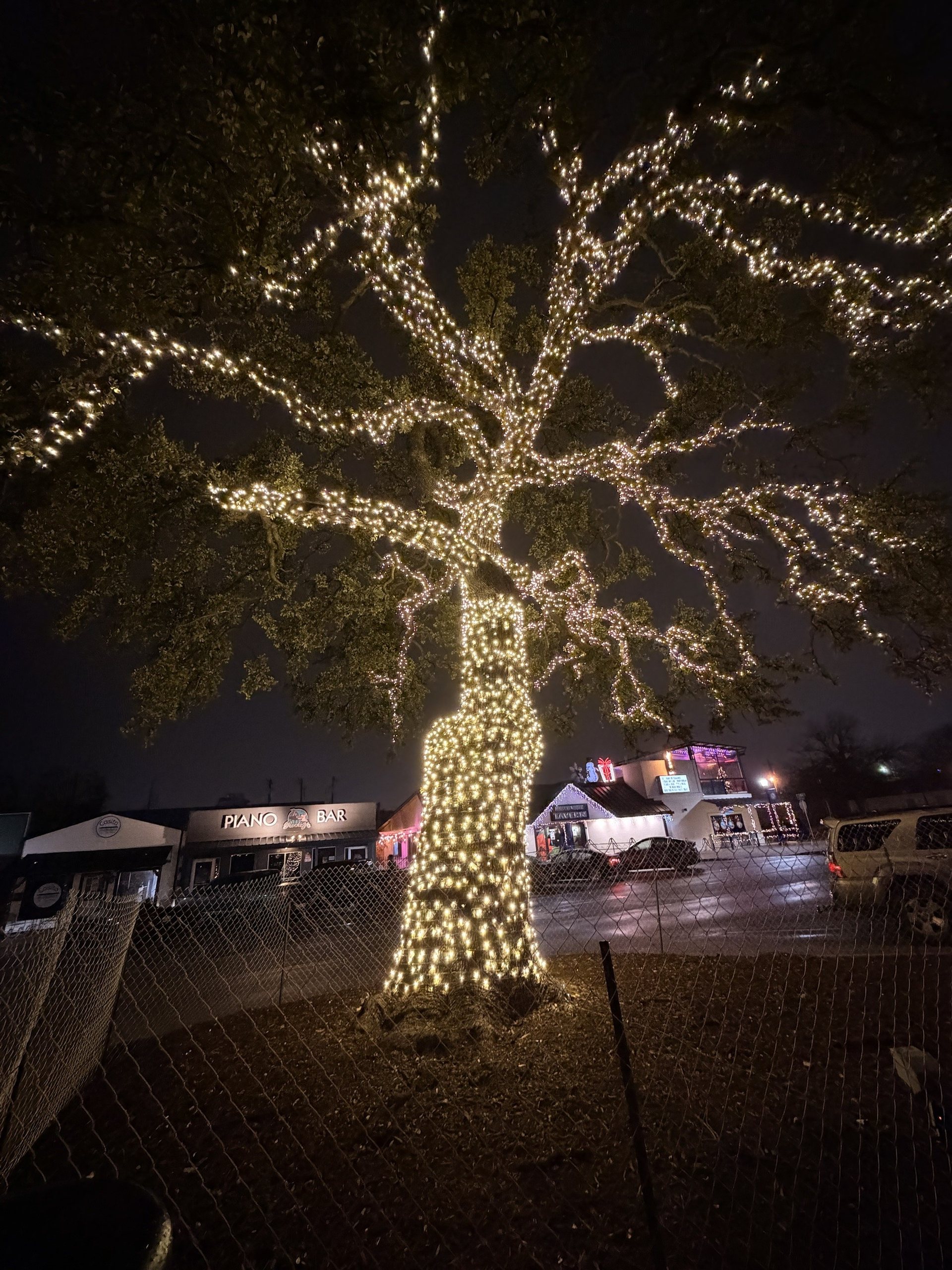
- Trunk wrap: lights spiraled up the trunk. In our judgment, a snug trunk wrap rarely shifts, because the trunk barely moves.
- Trunk-and-limb wrap: the spiral continues out the main limbs, and each strand moves with its limb. We’d make the jump from trunk to limb at the crotch, where movement is smallest, and stop before the limb gets thin and whippy.
- Canopy lighting: strands run out through the outer branches. A full canopy is the most striking way to light a tree, and it is where fastening matters most: we’d keep each strand on its own branch rather than bridging open air between two limbs that sway apart.
Suppliers say to wrap snugly so lights do not slide. Arborists warn against wrapping too tight. We’d wrap snug enough to stay put for one season, not cinched, and take it off every year.
Fasteners are where trees get hurt. The Morton Arboretum says not to use plastic cable ties or wire twist ties on a branch, because they rub or cut into the bark as the plant sways. Some suppliers suggest ties, so pros differ. Wind is exactly that swaying, so we’d rely on wrap tension. Sapien uses small removable staples selectively as anchors on tree wraps, set over the wire and never through it, and pulls them at takedown; on oaks, we recommend a staple-free wrap.
Live oaks catch more wind in December than bare trees, in our judgment. The Lady Bird Johnson Wildflower Center notes that live oaks drop old leaves only in late winter, so the canopy stays full all season. Crape myrtles (also spelled crepe myrtles), cedar elms and pecans are deciduous and lose their leaves over late fall and winter. On a live oak, whether it is a trunk wrap or a full canopy, we’d keep every strand on a branch and avoid long spans across open air. More in our guide to Christmas lights on live oak trees, and for what each style costs, see what tree wrapping costs.
Shrubs, net lights and ground stakes
Net lights and loose strands can lift off the top of a bush in a gust. We’d tuck net edges down into the shrub, pin the bottom edge with ground stakes, and push pathway-light stakes in to full depth.
How do you secure extension cords in wind?
A loose cord in wind rubs against edges until the insulation wears, and tugs on connections until they part. We’d run cords along a wall, fence or the ground and fasten them so they cannot whip.
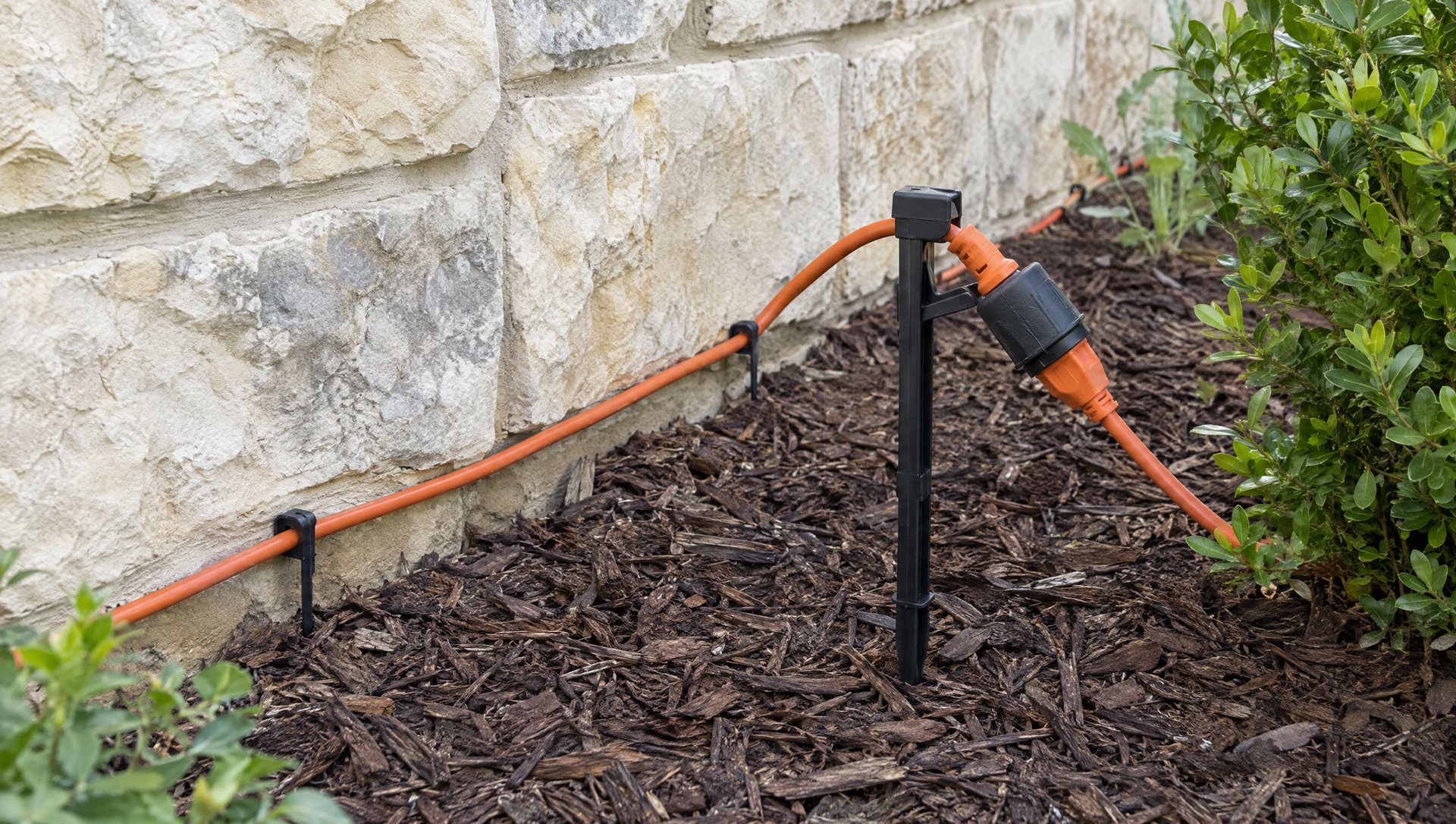
- Use cords and lights marked for outdoor use (ESFI, NFPA). Our outdoor extension cord guide covers ratings and gauge.
- Do not pinch cords in doors or windows, and keep them clear of standing water (ESFI).
- Keep plug connections off the ground on a hook or stake. Christmas Designers says they need airflow to stay dry. More on keeping connections dry.
We wouldn’t expect wind alone to trip a GFCI outlet, but rain blown into a connection can. See why Christmas lights trip the breaker or GFCI. Adding or changing outdoor outlets or circuits is electrician work, and Texas licenses electricians through TDLR.
Should you unplug or take lights down before a windstorm?
No safety body we found says to unplug lights because of wind, so this is our call: leave a fastened display up, and unplug any run already hanging loose. When a front is in the forecast:
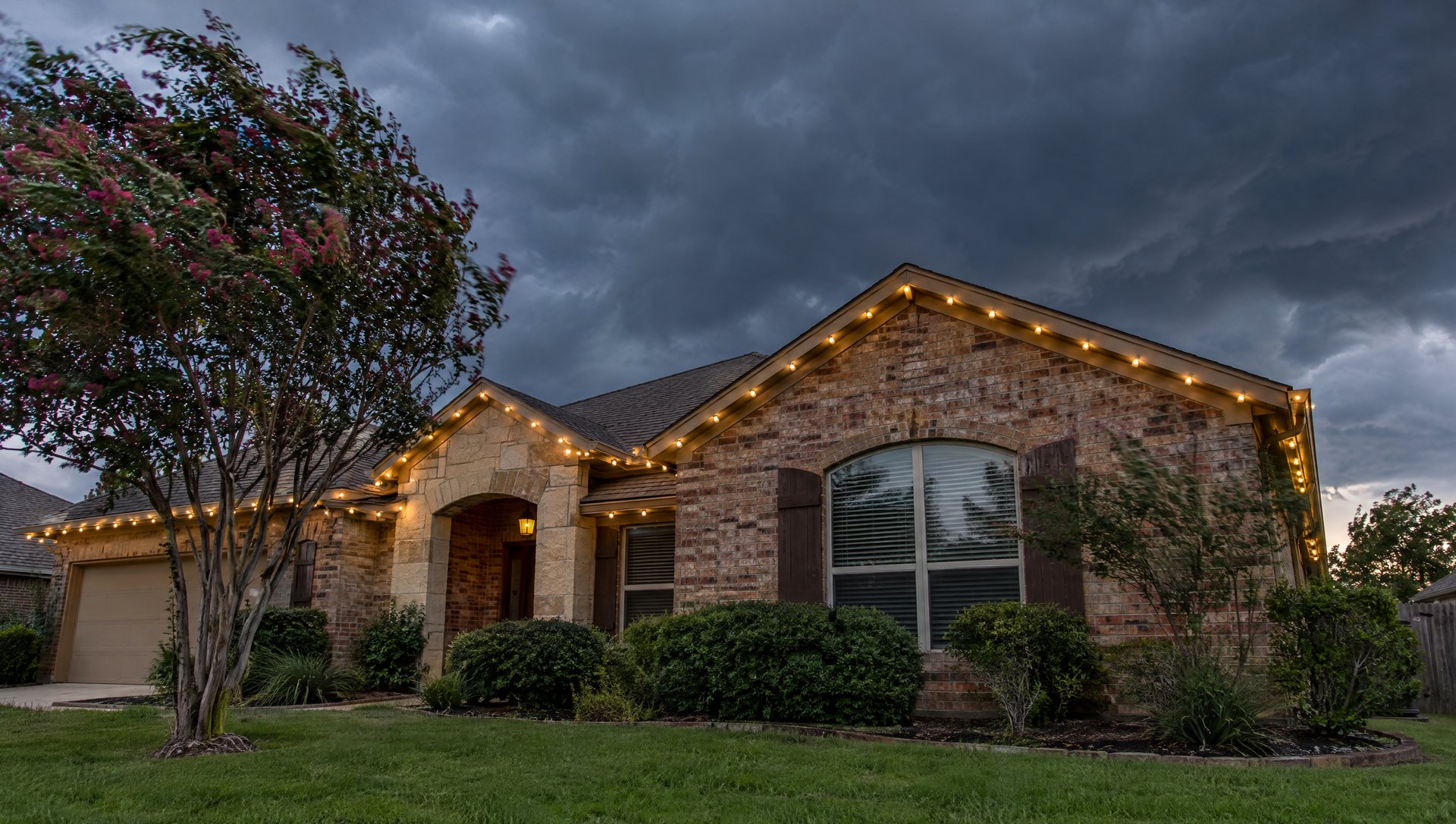
- Walk the property in daylight and look up, starting on the north side. Note any bulb out of its clip, any sag, any swinging tail or lead.
- Fix only what you can reach safely on a calm day. The American Ladder Institute says not to use ladders in high winds or storms.
- Fasten loose cords and yard pieces at ground level.
- Use a timer or turn lights off at bedtime and when you leave, as NFPA, ESFI and CPSC advise.
We’d rarely take a display down ahead of a front. Christmas Designers says lights usually get damaged during takedown, when strings are ripped down, and a rushed takedown invites exactly that.
After the wind: what to check from the ground
After a windy night, inspect from the ground and climb nothing until the wind drops and surfaces are dry. Work in this order:
- Look for power lines first. If a line is down, Austin Energy’s outage guidance says to stay at least 35 feet away, assume it is live and report it at 512-322-9100. Do not touch lights near a line. If the wind knocked out power, see what to do with Christmas lights in a power outage.
- Unplug any damaged or hanging run at the outlet before you handle it.
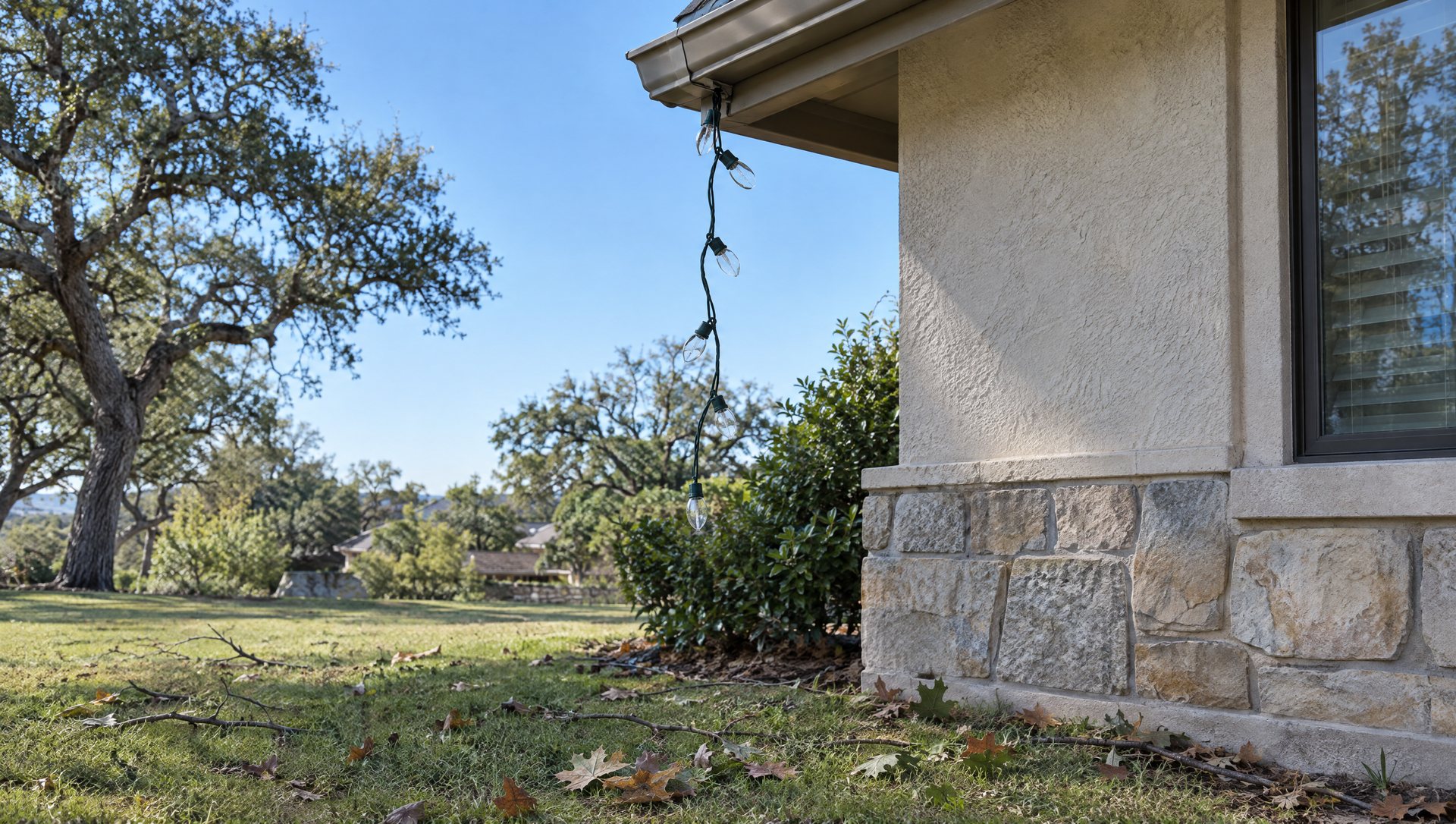
- Look for damage. CPSC says to discard sets with cracked sockets, frayed or bare wires or loose connections. That goes for a strand that blew onto the roof or lawn, too: inspect it before it goes back on the outlet.
- Do not yank a hanging section down. Unclip it, or leave it for someone who can reach it safely.
- Re-hang rather than patch. Brite Supply says patched wind damage rarely holds. Replace broken parts and re-clip the section.
- Leave broken limbs to an arborist. On oaks, the Texas A&M Forest Service says to paint every wound righ