


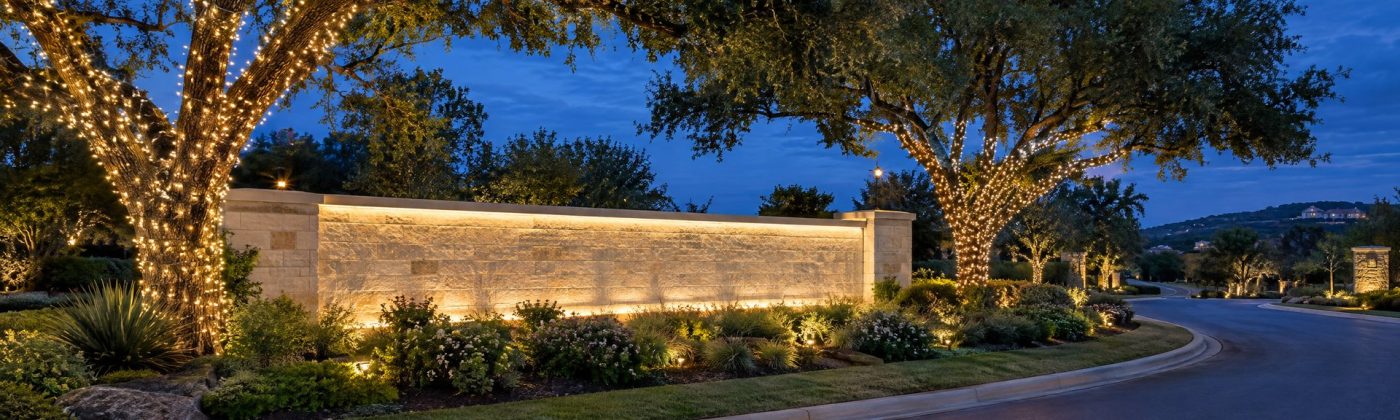
HOA Entrance Christmas Lights: A Texas Board’s Guide to Monuments, Power and Budget
HOA entrance Christmas lighting usually means the monument face, one or two flanking trees and the beds in front, run on a timer. Installer pages we checked in Dallas-Fort Worth, Dallas and Phoenix start single-entrance packages at about $3,000 to $3,500 (as of October 2026). Sapien Lighting & Installation quotes Austin-area HOA entrance work per property after a site walk. The final price depends on the number of zones, the size of the trees, and whether the monument has a usable outlet.
| Question | Answer |
|---|---|
| What do HOAs usually light at the entrance? | The monument face, the trees beside it and the beds in front. Larger communities add medians and gates |
| What does Sapien charge for an HOA entrance? | It is quoted per property after a site walk. The walk-through sets the real number |
| Who owns the lights after the season? | It depends on the contract: the installer (lease or full service), the HOA (buy and install), or whatever a multi-year agreement sets. Get it in writing |
| Can the light installer add an outlet? | No. A new outlet is work for a licensed electrician, and inside Austin it needs a permit |
| Does the board have to take bids? | Under state law, only for service contracts over $50,000, or at any amount if a board member or a relative’s company bids (Texas Property Code 209.0052). The $50,000 rule names no number of bids |
| Can the HOA keep religious displays off the entrance? | Yes, on property the association owns or maintains (Property Code 202.018). Religious displays at owners’ homes are protected, with six exceptions |
| What insurance proof should a board ask for? | A certificate of insurance, any additional-insured endorsement, and a separate written answer on how workers are covered |
| When should the lights be on? | We’d aim for Thanksgiving weekend (Thanksgiving is November 26, 2026). Put the timer’s off time in the contract |
| When do they come down? | Sapien removes entrance lights January 2 to January 15. All four Austin-area HOA documents we read end the resident window on January 15 |
This guide is for HOA board members, community managers and landscape committees in the Austin area deciding how to light an entrance this season. If you run a storefront or office instead, read the guide to commercial Christmas light installation in Austin.
- What to light at an HOA entrance
- What HOA entrance lighting costs
- What the price should include
- Power at the monument
- Lighting stone or brick without damage
- Lighting the entrance trees
- Medians, right of way and utility poles
- Design choices for a shared space
- Timers, hours and the electric bill
- Weather at an open entrance
- How a Texas board approves entrance lighting
- Vendor checklist for boards
- Timeline: from budget vote to takedown
- Can a Texas HOA restrict residents’ lights?
- Volunteer committee or hired crew
- What we’d decline at an entrance
What should an HOA light at the entrance?
An HOA entrance usually has five places that can take lights.
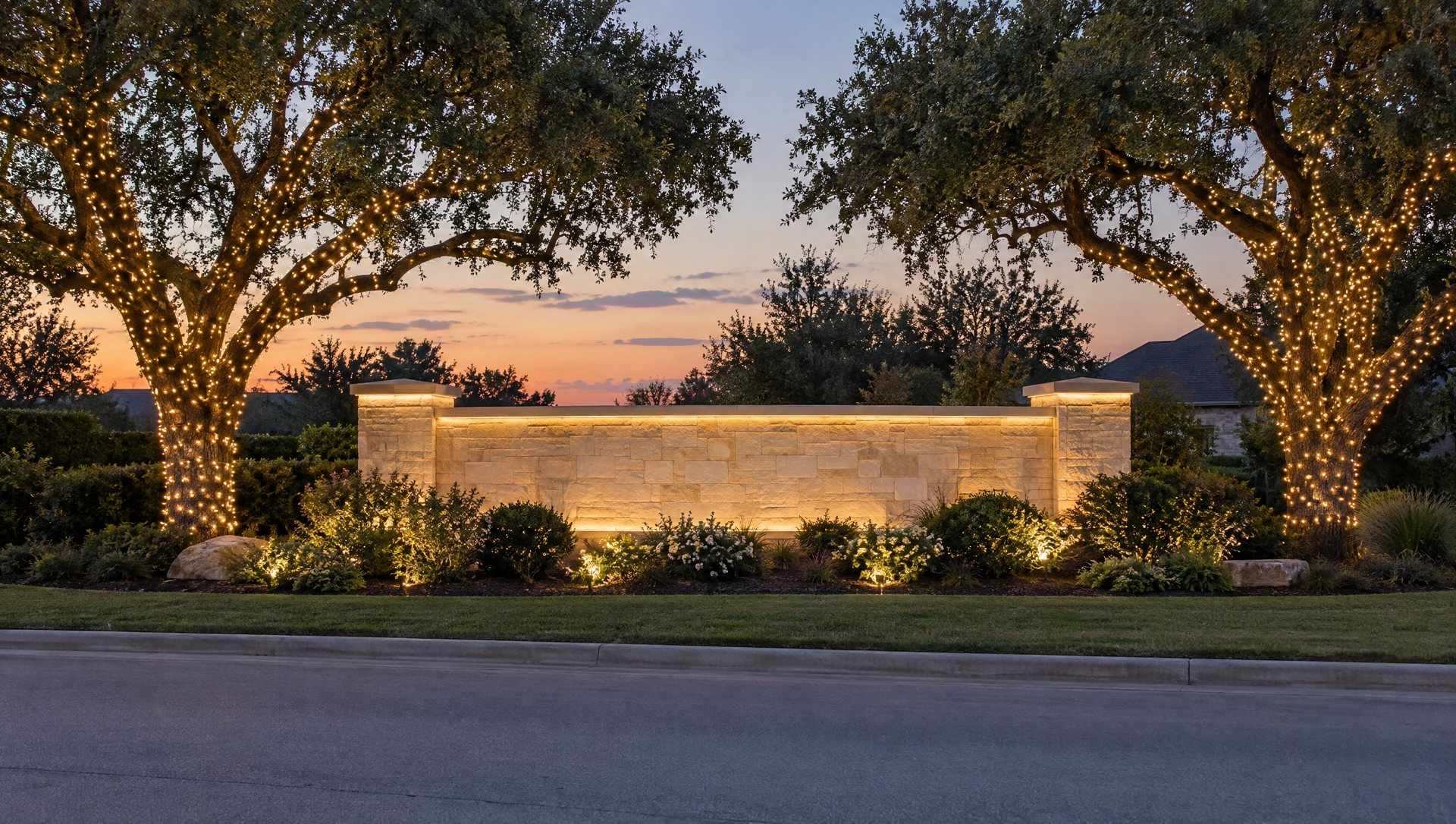
- The monument face. Lights frame the sign along its cap, edges or base, without crossing the letters or shining into drivers’ eyes.
- The flanking trees. Often live oaks or young trees planted with the monument. Wrapped trunks and limbs give an entrance the most visible light for the money.
- Shrubs and beds. Net lights or bulbs on ground stakes.
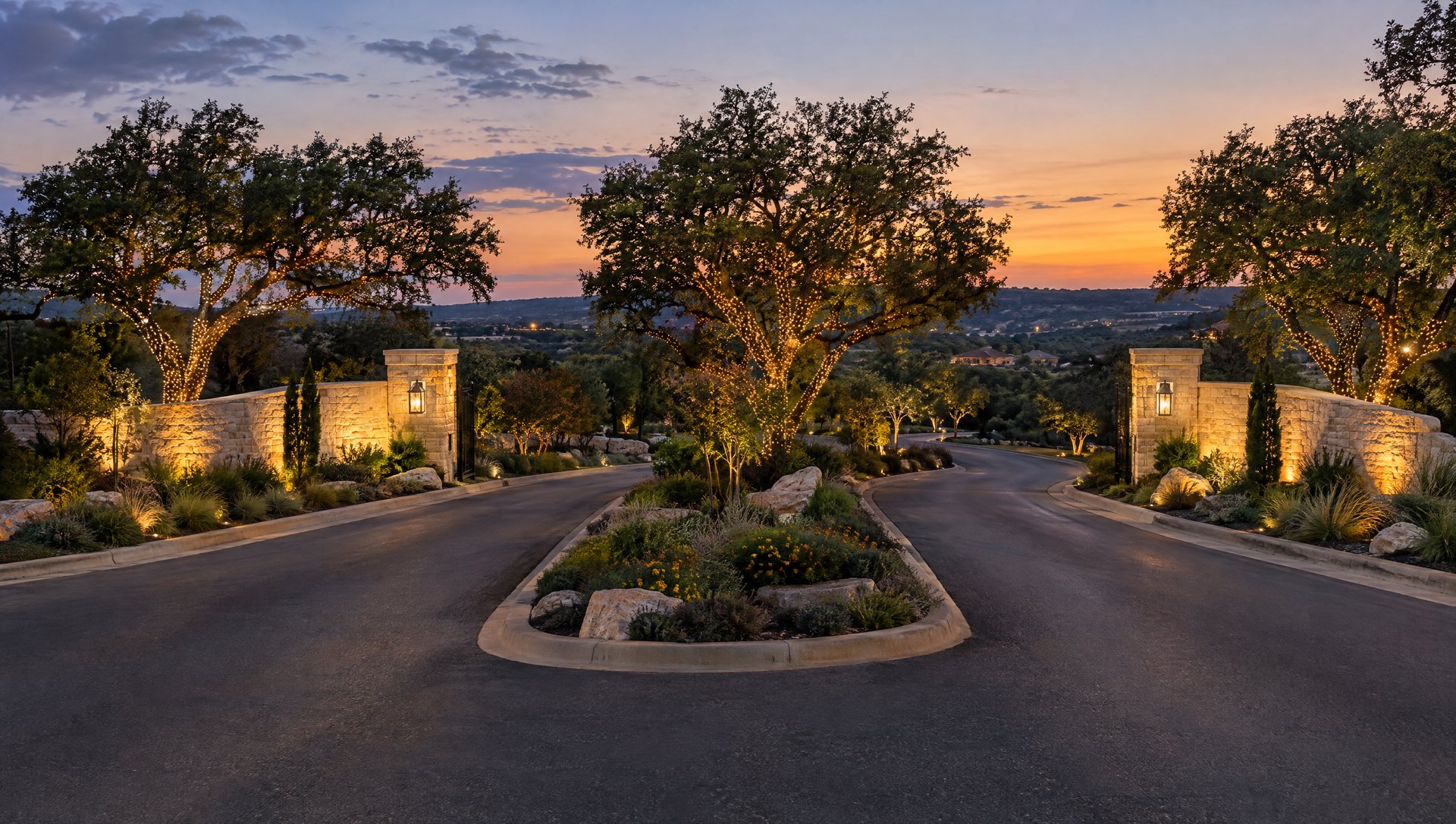
- Gates, fences and columns. Garland, wreaths or a line of C9 bulbs. On a gate that opens, keep lights off the moving leaf, the hinge side and the opener arm, and keep the gate’s safety sensors clear.
- Median trees. These may sit on public right of way, which changes who must approve them (see medians and right of way).
Our advice: light the monument and one focal tree well before spreading lights thin across every zone. A board can add zones in later years, once it knows the power, the bill and how residents react.
How much does HOA entrance lighting cost?
Single-entrance HOA lighting packages start at about $3,000 to $3,500 on the installer pages we found in Dallas-Fort Worth, Dallas and Phoenix (checked October 4, 2026). Multi-entrance and community-wide programs on those pages start between $8,500 and $30,000. These are other companies’ starting prices in other cities, not Sapien’s. No Austin-area installer we found publishes an HOA entrance price.
| Source (checked October 4, 2026) | Single entrance | Bigger programs | Page date |
|---|---|---|---|
| A Dallas-Fort Worth installer’s HOA page | $3,500 and up: gate and monument, C9 LED design, install, service calls, January takedown and storage | $8,500 and up (community); $20,000 and up (full community) | Updated May 21, 2026 |
| A Dallas installer’s HOA page | From $3,000: monument, entry gate and signage | From $10,000 (multiple entrances); from $30,000 (community-wide) | Not dated |
| A Phoenix installer’s HOA page | From $3,000 | $25,000 or more (master-planned) | Not dated |
Sapien’s HOA and commercial work is quoted per property after a site walk; our Christmas light installation in Austin page lists what we install. For how residential prices compare, see the Christmas light installation cost guide.
What moves the price:
- Entrances. A second entrance is close to a second job, with its own power and trees.
- Tree footage. Trunk girth, wrapped height, limb count and wrap spacing set the feet of lights.
- Power. How many outlets exist, how far they are from each zone, and whether an electrician must add one.
- Reach. Tall live oaks may be beyond a ladder. Ask each vendor how it will reach the upper limbs and what that adds.
An example scope to put in front of every vendor
Ask each vendor to price the same written scope, line by line, so the board can drop a zone instead of thinning the whole display. Ask whether sales tax is included. Example, with illustrative inputs:
- Monument: 80 feet of C9 bulbs on 12-inch spacing along the cap and base, so 80 bulbs.
- Trees: two oaks with 24-inch trunks, wrapped 10 feet up at 3-inch spacing, about 250 feet of lights each (math in the trees section).
- Beds and controls: four beds on ground stakes, and one timer with its on and off times written down.
What should the HOA budget line include?
An HOA holiday lighting budget line has four parts: the installed price for each zone, any electrician work to add an outlet, the season’s electricity, and takedown if it is priced separately. For an LED entrance, the electricity is a few dollars a season (see the example). Budget from the walk-through number, not a market starting price.
What the price should include, and who owns the lights
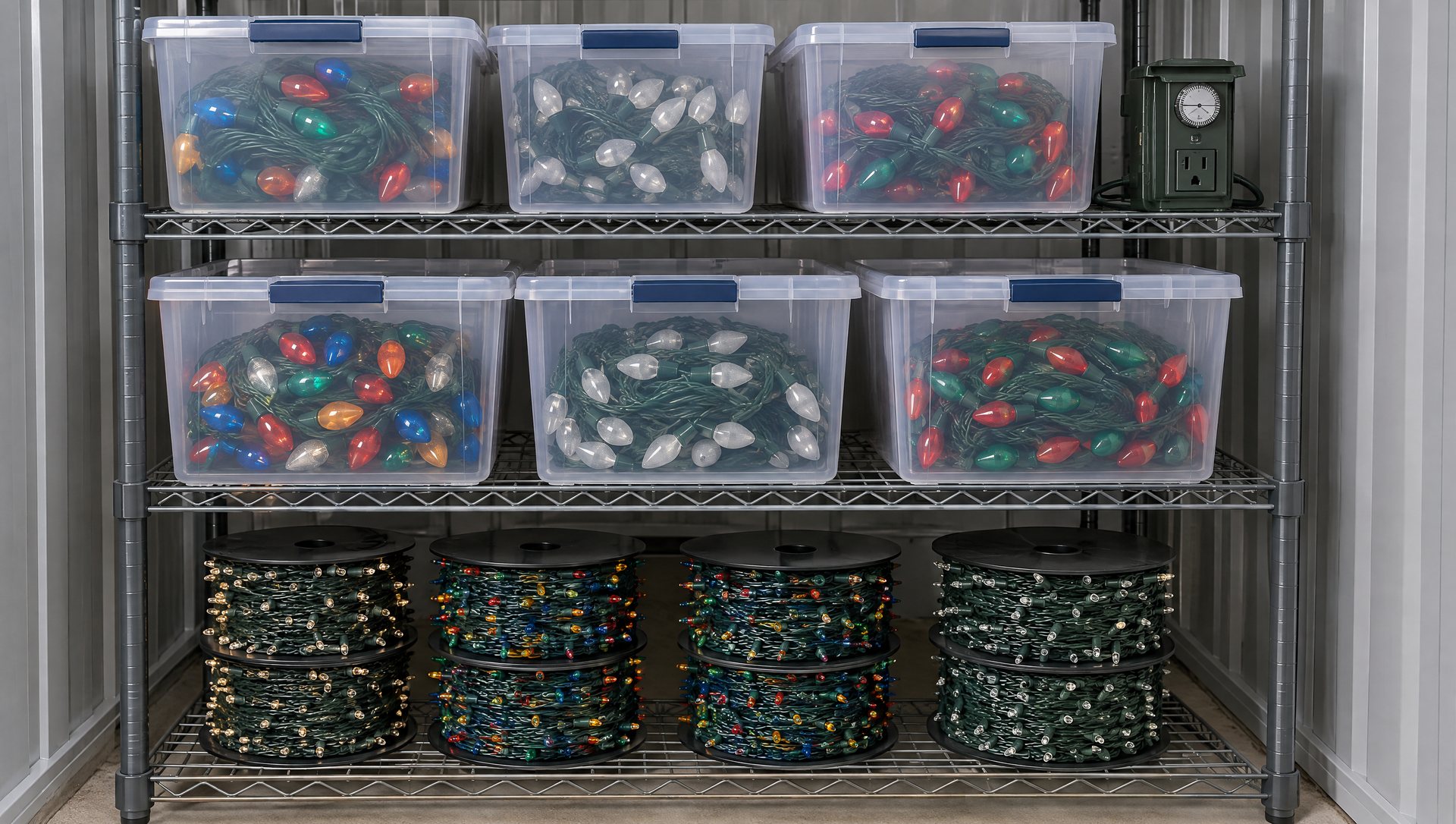
One Dallas-Fort Worth page lists design, installation, service calls, January takedown and storage in its entrance tier. Use that as a checklist. If a quote leaves an item out, ask whether it costs extra. The bigger question is who owns the lights.
| Setup | Who owns the lights | Year two | What to check |
|---|---|---|---|
| Lease or full service | The installer | Priced each season; ask how year two compares | What happens if the HOA changes vendors |
| Buy and install | The HOA | Usually an install-only price | Where the lights are stored, and who tests them |
| Multi-year agreement | Set by the contract | A locked price, for example 2 to 5 seasons on one Dallas page | How the board can exit, and whether the design can change |
The year-two column is our general read of the market, not a quoted price. Both Dallas-area pages offer multi-year terms with locked pricing. Whatever the setup, have the proposal say who owns the lights and what happens to them if the board changes vendors.
Is there power at the HOA monument?
Many entrance monuments have no plain outdoor outlet. Expect a low-voltage transformer for the sign uplights, an irrigation controller, or nothing.
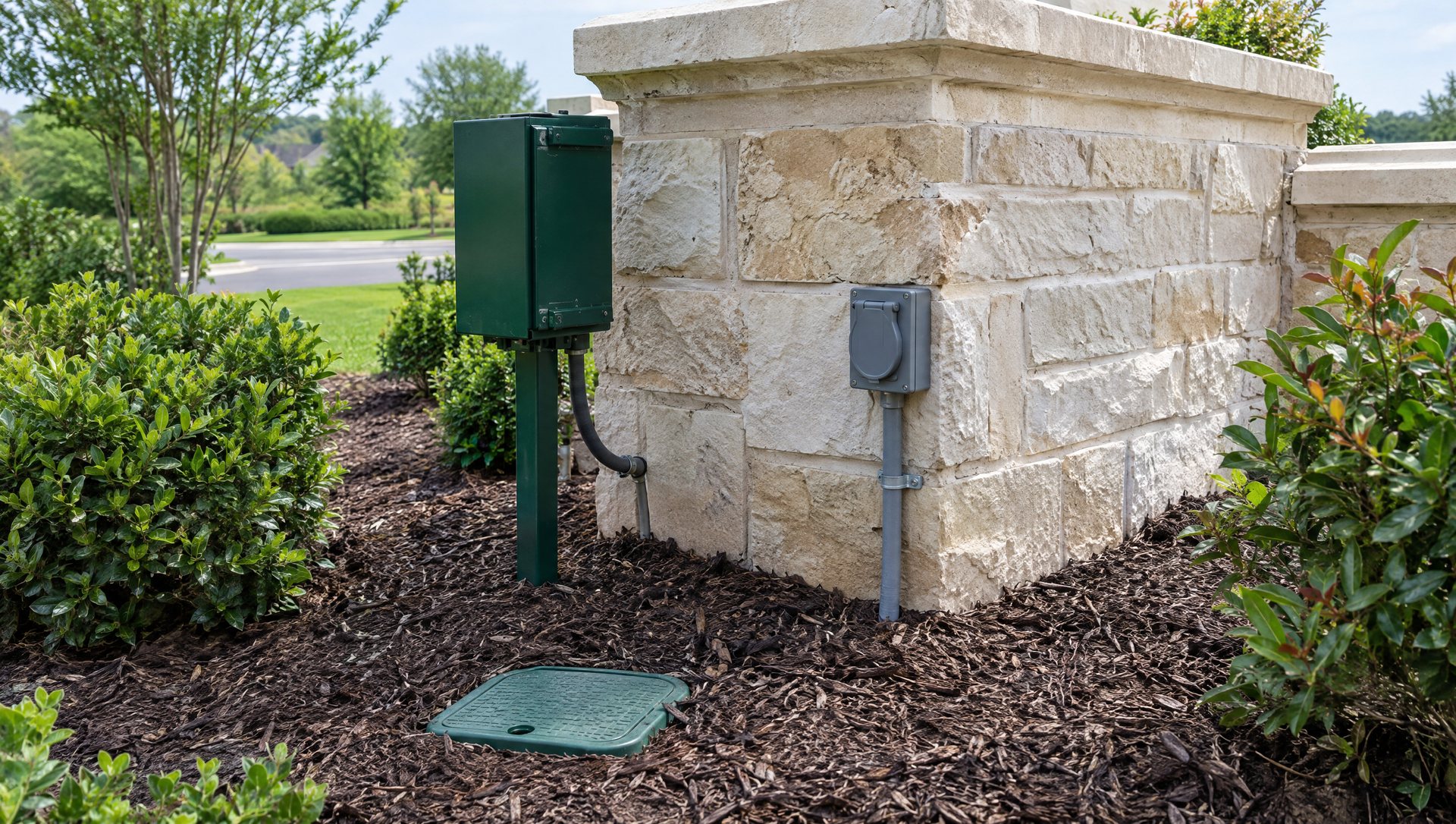
A landscape-lighting transformer turns household power into low voltage for the sign lights. Its low-voltage output does not run 120-volt holiday strings. If the transformer has its own 120-volt outlet or plugs into one, have someone confirm GFCI protection and what else is on that circuit.
Who can add an outlet
The Texas electrician-licensing law exempts landscapers installing holiday lighting, “excluding any required power source” (Texas Occupations Code 1305.003(a)(13)). The exemption stops at the power source. A new outlet or circuit is electrical work for an electrician licensed by the Texas Department of Licensing and Regulation.
Inside the City of Austin, temporary holiday decorative lighting is permit-exempt. A new receptacle or circuit is not, and an electrical contractor must pull the permit (Austin City Code 25-12-113). Georgetown, Round Rock and other nearby cities run their own permits.
Sapien installs plug-in seasonal lighting only. If the entrance needs an outlet, the electrician goes first and the lights follow.
What a usable outlet looks like
- GFCI protection. NFPA’s electrical specialist writes that all receptacles installed outdoors need ground-fault protection (NFPA, December 2025). Where an outlet has none, ESFI points to a portable outdoor GFCI (ESFI outdoor decoration tips).
- An in-use cover that closes over a plugged-in cord.
- Enough capacity. A 15-amp, 120-volt circuit is 1,800 watts. For lights that run for hours, the usual planning figure is 1,440 watts (12 of the 15 amps), minus anything else on that breaker. An LED entrance uses a small share.
- Safe cord routes: not across sidewalks or drive lanes, not through a gate, not in standing water.
Stop and call an electrician if a GFCI trips again and again, a cover is cracked, or an outlet is warm or scorched. Do not move the lights to an outlet without ground-fault protection.
Site details to settle before install day
This list is installer judgment, not a published standard.
- Test the outlet at night. Some monument outlets are switched by the sign’s photocell or timer, so they test dead in daylight.
- Get keys and codes early for the power pedestal, the irrigation controller and any locked box. The management company usually holds them.
- Tell the landscape crew. Trimmers and mowers cut cords at ground stakes, and blowers move loose garland.
- Box the connections. Put the timer and plugs in a lockable weatherproof box, and run cords inside the beds, not along the curb.
- Name a checker who looks at the display after a windy night and reports problems.
How do you light a stone or brick monument without damage?
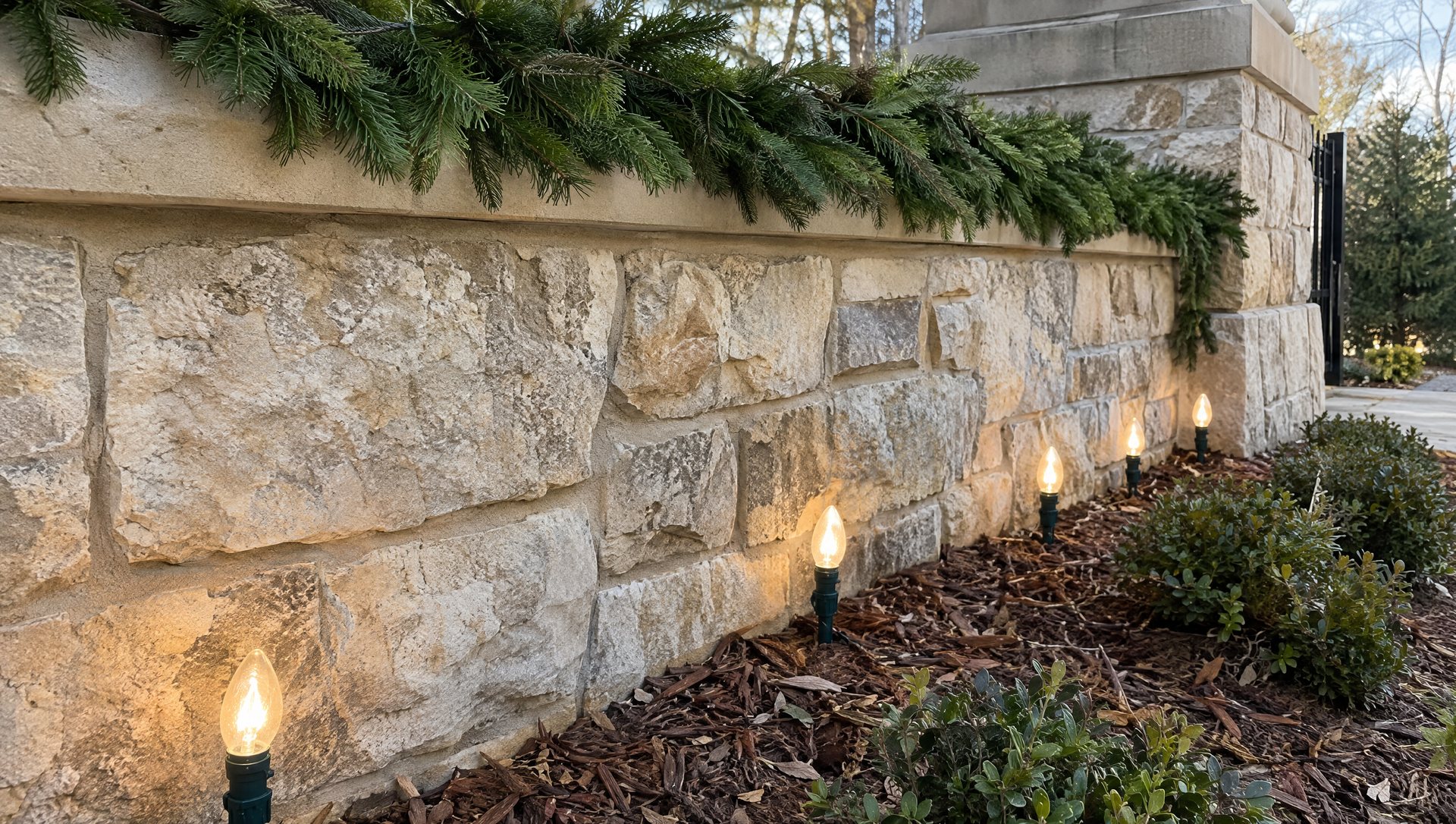
Do not drill, nail or screw into a monument for seasonal lights. The holes stay after the lights come down, and a pro lighting supplier warns that staples, nails and screws can damage the light string and create a fire or shock hazard.
- Brick. Pine Hall Brick, a brick maker, describes hot-gluing sockets to dry, unpainted brick and removing the glue later with rubbing alcohol, but not on stucco or stone. It says brick clips need mortar recessed at least 1/8 inch (Pine Hall Brick).
- Adhesive clips. 3M lists its outdoor light clips for sealed, smooth surfaces such as painted cinder block and tile (3M Command outdoor light clips). Rough limestone is neither.
- Stucco. One pro supplier recommends no clip on stucco and suggests nearby wood trim instead.
On most limestone monuments, we’d light from the ground and the cap instead of the face: garland on the cap ledge, bulbs on ground stakes along the base, and lit shrubs in front. It frames the sign with no fasteners in the stone. Anything on the cap has to be tied down or weighted, because an entrance takes the full force of a cold front.
Can you wrap the HOA entrance trees?
Yes, most HOA