


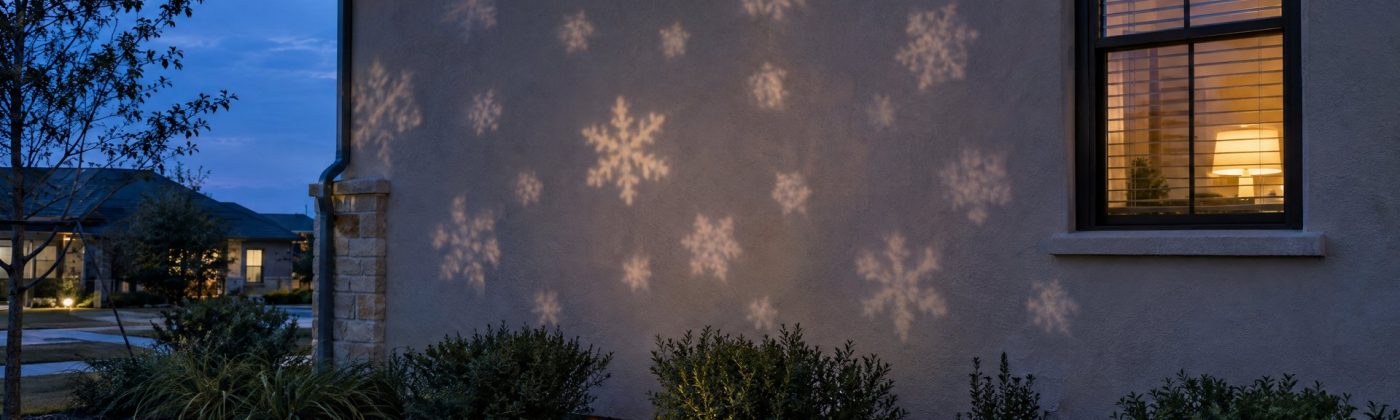
Christmas Light Projectors and Laser Lights: Worth It?
A Christmas light projector is worth it on one kind of house: one with a broad, smooth, light-colored wall that faces the street and has nothing in front of it. On that wall, one inexpensive box adds moving snowflakes in ten minutes, a fun accent beside a lit roofline and trees. On limestone, dark brick, a wall of windows, or a facade hidden behind a live oak, it gives you a smear, and no amount of fiddling with the stake fixes that.
So the useful question isn’t “are projectors good?” It’s “is my wall a screen?” This guide walks you through that test, the brightness math that explains why the box photo lies, the federal rule that applies the moment you buy a laser, and three common Austin houses with an honest verdict for each.
Score your wall before you buy anything
A projector borrows your house as a screen. Movie screens are flat, matte, white and in a dark room. Your house is none of those, so score how far it is from that ideal. Go out after dark with your normal porch and landscape lights on, stand where people will see the house from (usually the street or the sidewalk across from you), and check five things.
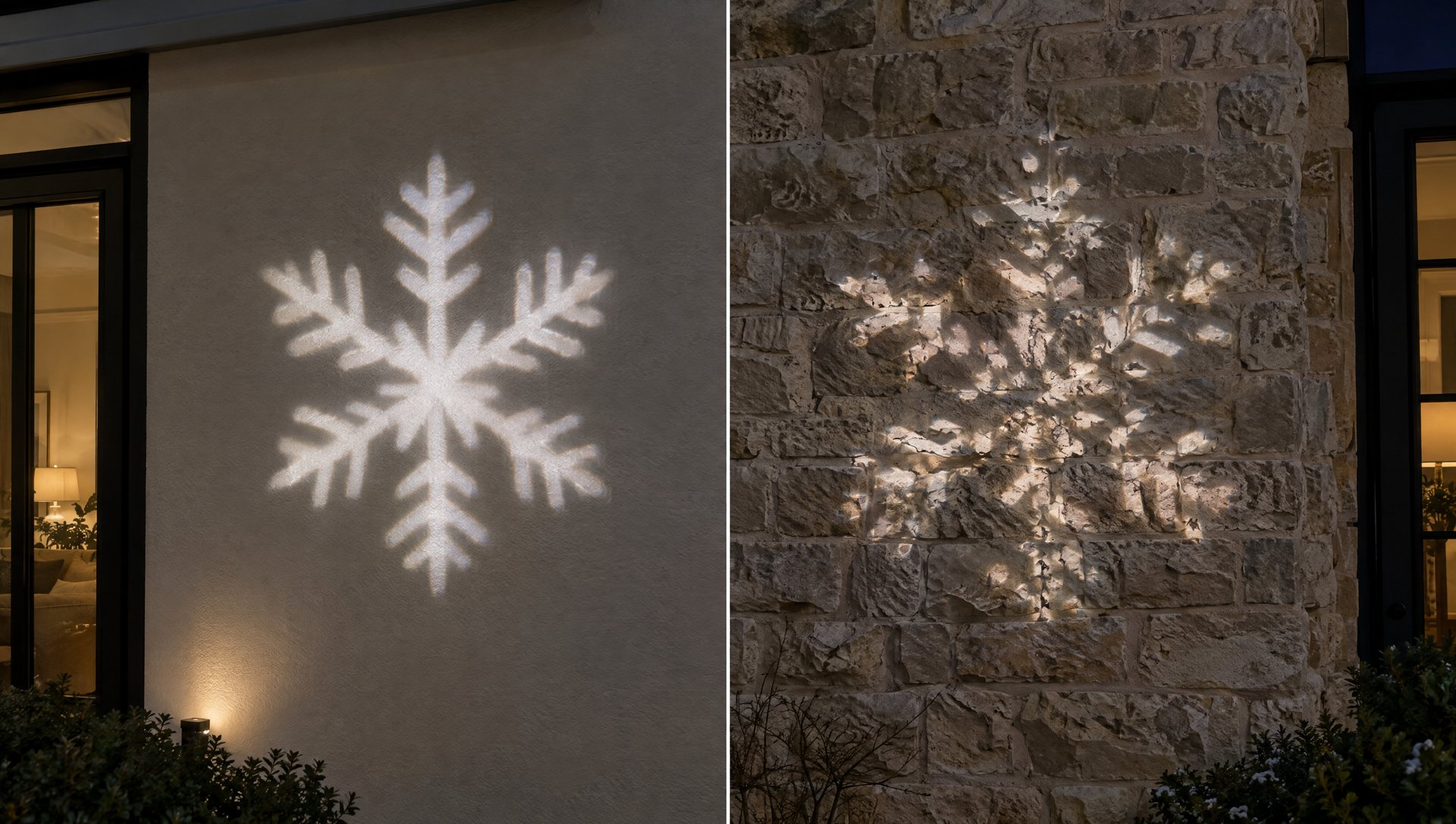
- Texture. Smooth stucco, painted siding and smooth fiber-cement panels hold a shape. Austin limestone, chopped stone, deep-relief brick and board-and-batten break a snowflake into confetti. The deeper the shadow lines in the surface, the worse it gets.
- Color. Pale cream, white and light gray reflect most of what hits them. Dark brick, charcoal paint and the dark accent walls on a lot of newer modern-farmhouse builds absorb it, and the image looks half as bright as you expected.
- Glass. Windows swallow projected light or bounce it inside. A wall that’s 40 percent window gives you a pattern with holes in it.
- Competing light. A streetlight, a pair of 60-watt coach lights or bright landscape uplights flatten a projection. You can switch off your own; you can’t switch off the streetlight.
- What’s in front. Shrubs, a crape myrtle or the canopy of a front-yard oak chop the image into pieces, and the pattern lands on leaves that move.
Pass all five and you have a good screen. Fail texture or color and the best you’ll get is “okay up close.” Fail on glass or what’s in front, and the projector probably belongs on a different wall or in the return box.
The quick test costs nothing: shine a strong flashlight at the wall from where the projector would sit. If the circle of light looks crisp and bright from the street, a projected pattern will too. If it looks blotchy or vanishes, so will the snowflakes.
The distance math the box skips
Every projector box shows a whole house covered in stars. Here’s why yours won’t look like that.
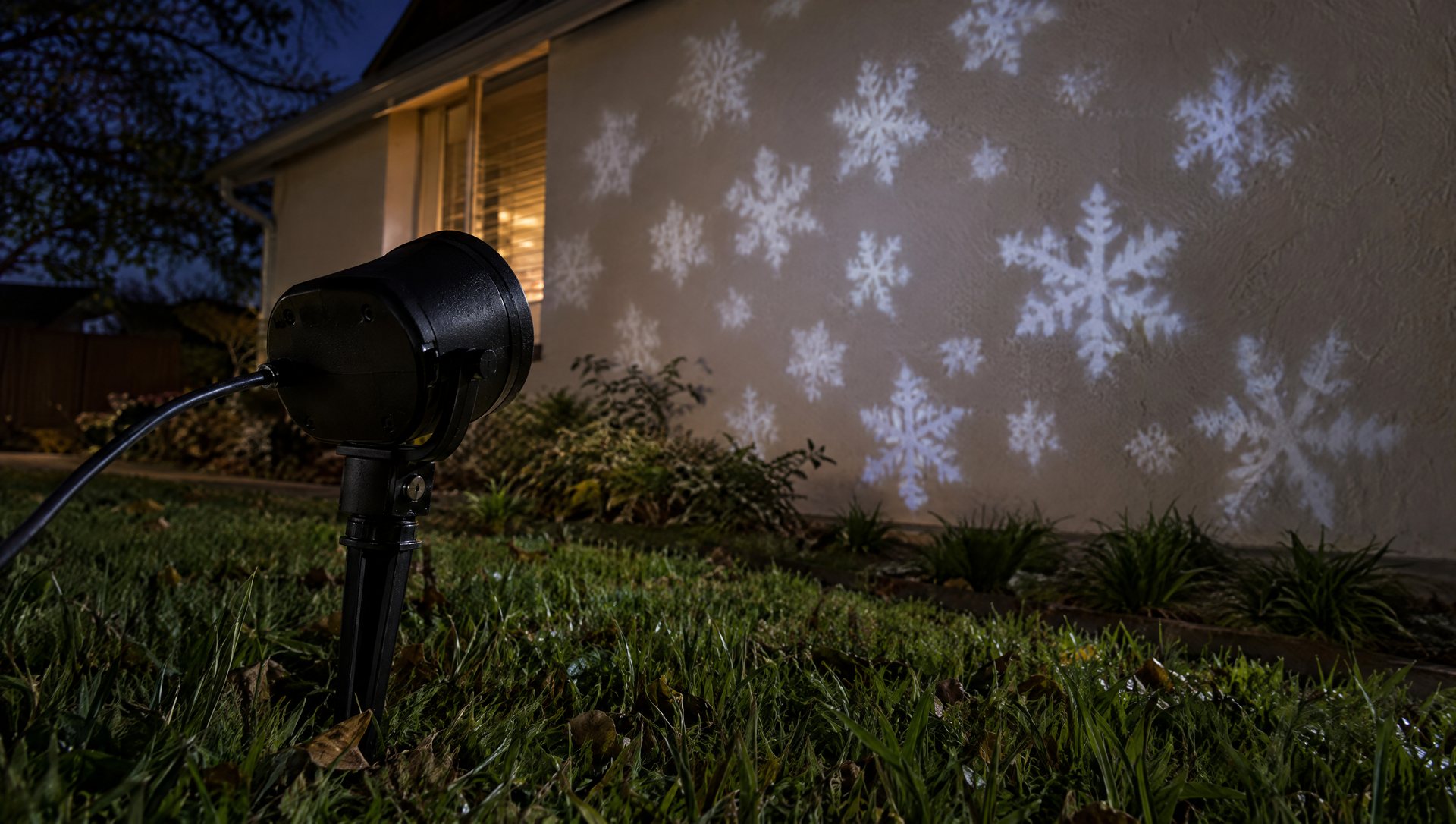
A projector throws a fixed amount of light into a cone. Move it farther from the wall and the image gets bigger, but the same light is spread over more area. The relationship is simple: double the distance, and the image is twice as wide, twice as tall, and covers four times the area. Each square foot gets about a quarter of the light.
A worked example. Say a unit throws a pattern 10 feet wide when it sits 12 feet from the wall. That’s roughly a 10 by 6 foot patch, about 60 square feet, and on a pale wall it looks good. Now pull it back to 24 feet to “cover the whole front.” The pattern is about 20 feet wide and 12 feet tall, roughly 240 square feet, and every part of it is about a quarter as bright. On a 50-foot-wide house front, you’ve still covered less than half the facade, and what you covered looks faint.
That’s the case for doing one wall well instead of the whole house badly. Start close, step back until the pattern fills the area you want, and stop the moment it looks washed out. On most houses that ends up between 10 and 20 feet from the wall, which is often the middle of a flower bed, not the middle of the lawn. Plan where you’ll stake it with that in mind.
The same math explains why a projector that looks great on a garage-sized wall disappears on a two-story gable. If you want to cover more, buy a second unit for a second wall. Don’t move one unit back.
LED pattern, laser or video projector: what each one does
Three kinds of products get sold as Christmas projectors, and they solve different problems.
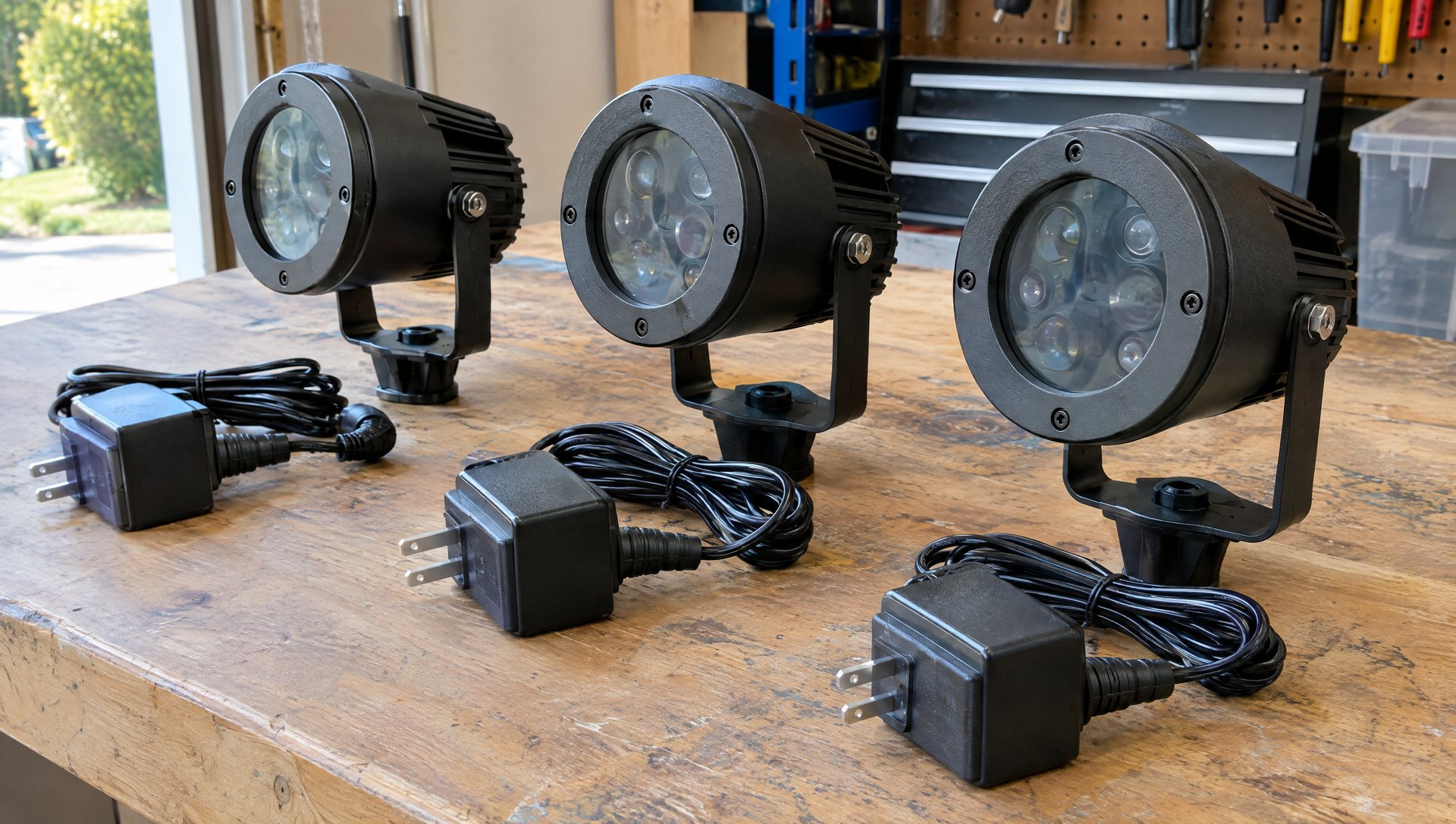
LED pattern projectors shine light through a rotating disc or slide, the same idea as an old slide projector. You get shapes, snowflakes, stars, trees, usually in slow rotation. They’re the safest choice and the most forgiving, and they’re also the dimmest. They need the best wall.
Laser projectors make sharp points of red, green and sometimes blue light that drift across the wall like a star field. Lasers stay bright at distance because the beam doesn’t spread like an LED’s does, so they work on a wider range of surfaces, including some textured ones. That same quality is why they come with legal rules: a stray beam doesn’t fade into nothing past your roof. More on that in the next section.
Video projectors play animated scenes, like Santa’s workshop in a window or a ghostly choir on a garage wall. They need a sheltered spot, a nightly setup or a weather enclosure, and a properly dark backdrop. They’re the most impressive when done well and the most work. For most families they belong in a front window, aimed at a sheet hung inside the glass, not out on the lawn.
If your goal is movement, a projector isn’t the only way to get it. App-controlled strings and pixel lights animate along a roofline instead of washing over a wall; our guide to syncing lights to music is the deep end of that pool.
Laser projectors and aircraft: the rule that isn’t optional
Holiday laser projectors sold in the U.S. are typically labeled Class IIIa (also written 3R), meaning under 5 milliwatts of output, according to laser-safety reporting on popular models. That’s weak enough to put dots on your wall and still strong enough to dazzle a pilot if beams escape upward.
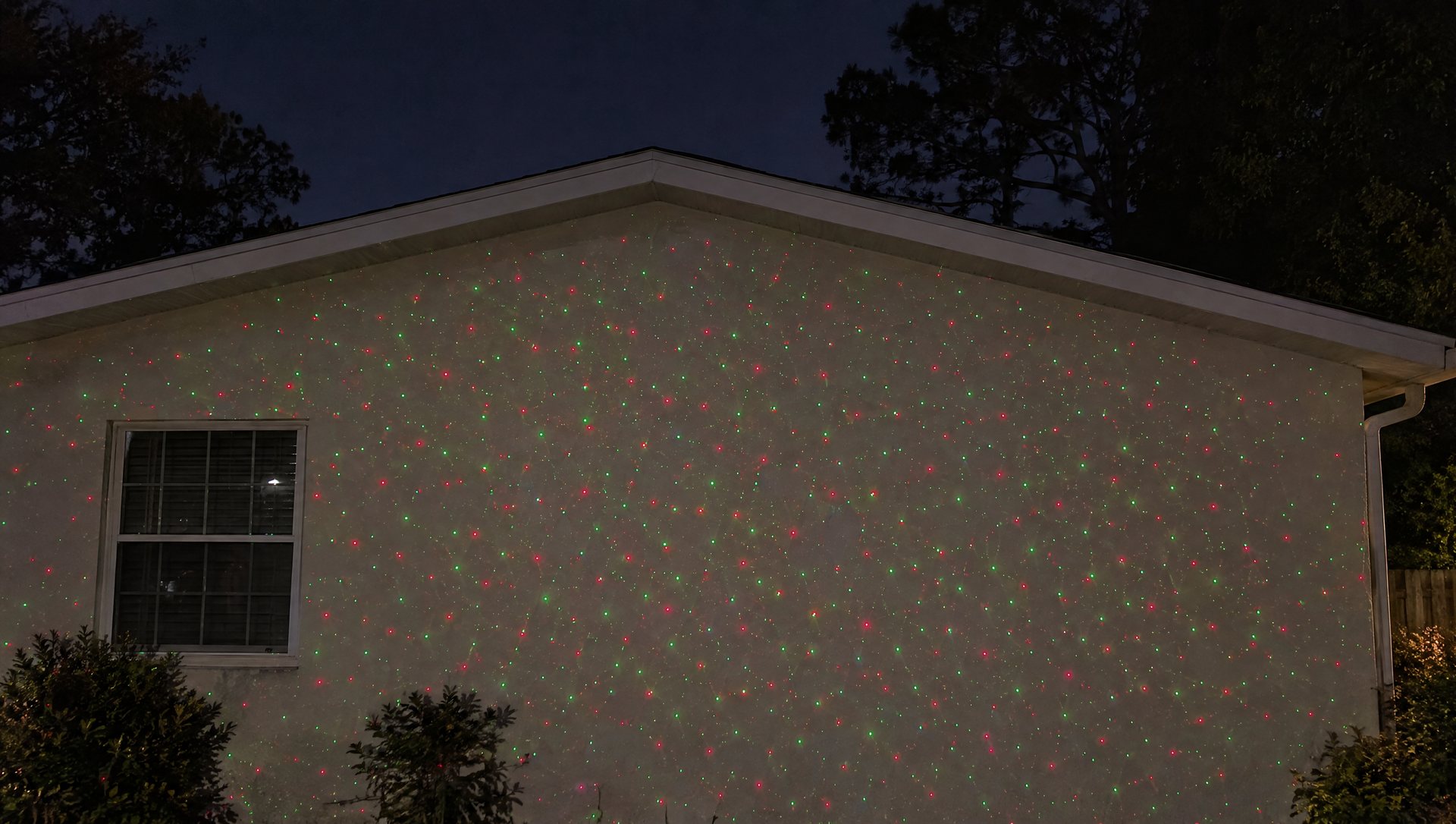
The FAA has warned that residential laser displays aimed even slightly high send beams past the roof and into the sky, and it asks owners whose displays affect pilots to adjust or turn them off. The agency can impose civil penalties of up to $11,000 per violation and up to $30,800 for multiple incidents, and aiming a laser at an aircraft is a federal crime.
That isn’t a theoretical risk here. A lot of Austin neighborhoods sit under the approach paths into Austin-Bergstrom, and medical and police helicopters fly low over the city at night. The beam that clears your roof by a few degrees is headed exactly where they are.
Four aiming rules cover almost every case:
- Keep the top edge of the pattern below the roofline, on solid wall. Check from the street, not from beside the projector.
- Never aim into trees. Gaps between oak leaves let beams straight through to the sky, and the leaves move in the wind, so the gaps change all night.
- Keep beams off windows, cars, the street and neighbors’ houses. A dot through a neighbor’s bedroom window is a quick way to meet the neighbor.
- Re-check the aim after wind, a bumped stake, a mowing crew, or any time the unit is moved. December fronts come through Austin with gusty north winds, and a stake in soft bed soil can lean overnight.
The garage door problem
In a lot of Austin subdivisions the biggest blank surface facing the street is the garage door. It’s flat, often pale, and has nothing in front of it. It’s also the one wall that moves.
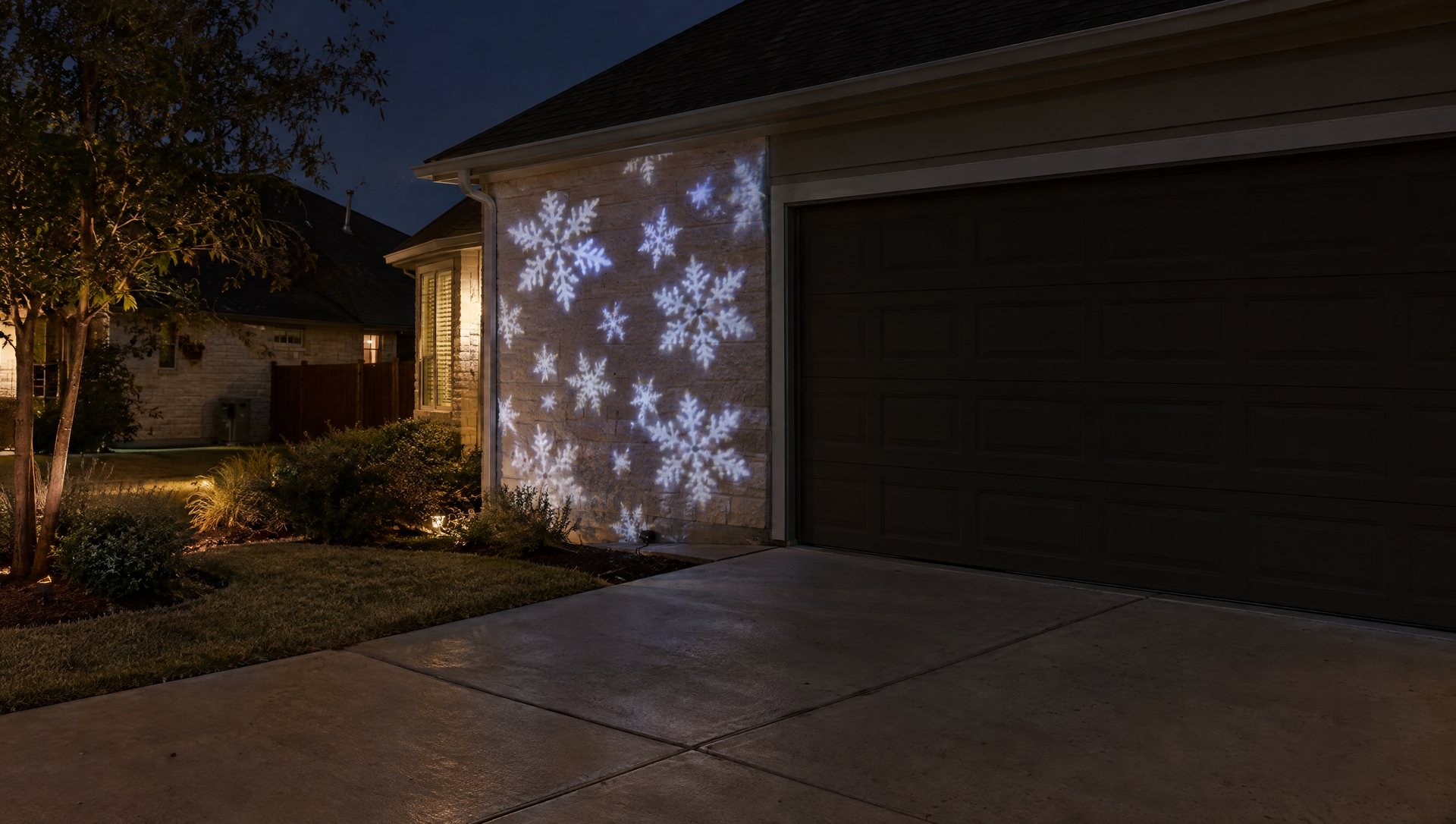
When the door goes up, a laser pattern that was safely on a door panel can shoot into the garage, across the driveway, or straight at the windshield of the car pulling in. With an LED pattern projector the worst case is a lost image. With a laser it’s beams where they shouldn’t be, aimed at someone’s eyes at eye level.
Aim at a fixed wall beside the garage instead, even if it’s smaller. If the door really is the only option, use a non-laser projector, and set its timer to end before the household’s usual coming and going, which for most families is earlier than the 10 or 11 p.m. shutoff they had in mind.
Three Austin houses, three verdicts
Here’s how the wall test plays out on house types we see all over the Austin area.
The stucco two-story in a newer subdivision. Pale stucco, a big side gable facing the street with one small window high up, a front-loading garage. This is the best case. Stake an LED pattern projector in the bed below the gable, about 12 to 15 feet back, and the slow snowfall fills the gable cleanly. Verdict: yes. Pair it with a warm-white roofline on the front eaves so the projected wall looks like part of a plan instead of an afterthought.
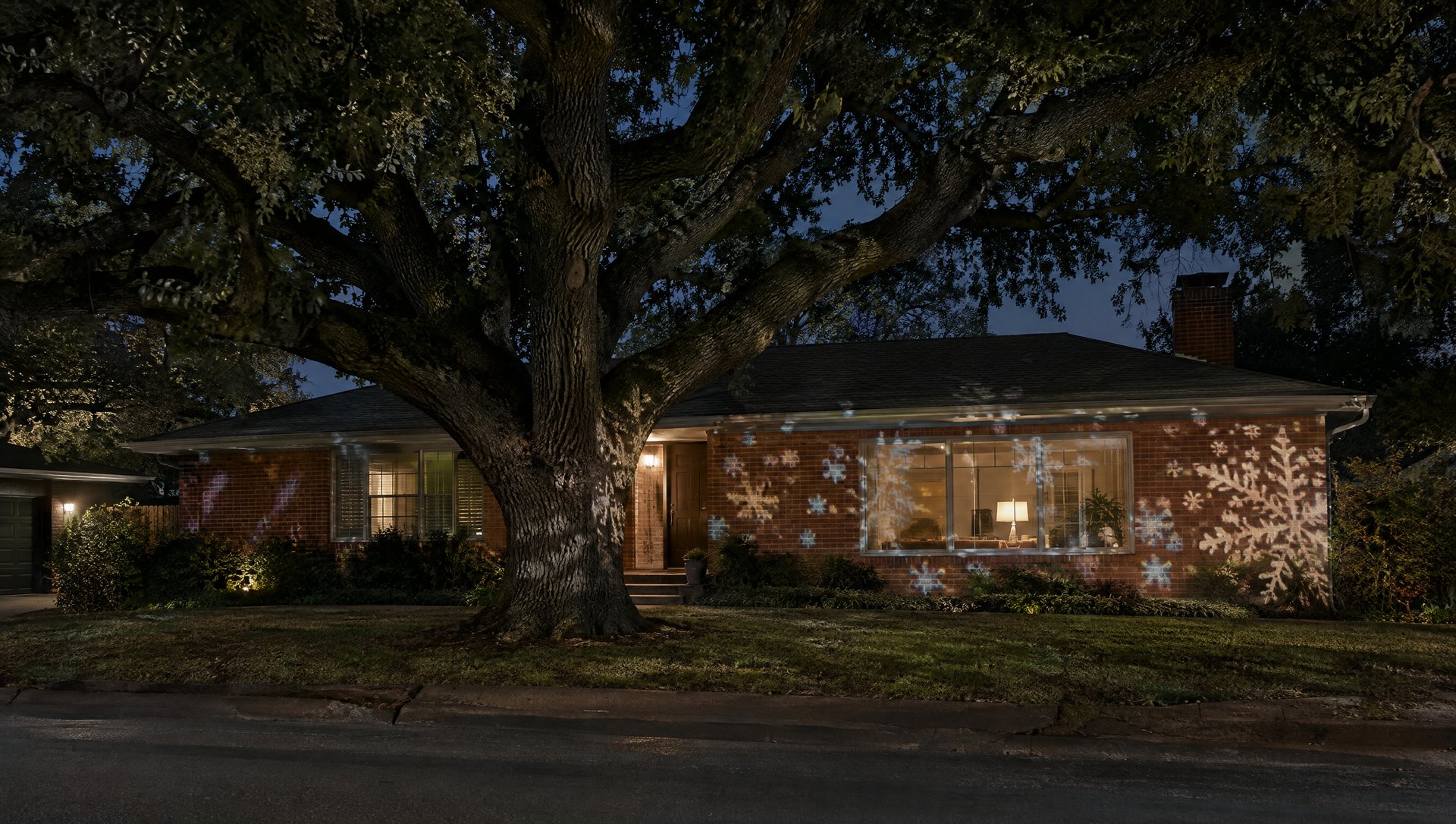
The 1950s or ’60s brick ranch in central Austin. Long and low, red or brown brick, a picture window in the middle, a big pecan or live oak in the yard. The brick is dark and textured, the only open stretches are between windows, and the tree is in front of half of it. A projector here gives you dim fragments. Verdict: no. Lights along the long, low eave show off the shape of a ranch far better, and wrapping that tree does more than any projector could.
The limestone house out west. Chopped Austin stone, deep mortar lines, lots of glass, sloped lot. The stone eats an LED pattern. A laser will show up, but on a sloped lot the “aim below the roofline” rule is harder than it sounds, because the street may be below the house and you’re aiming up. Verdict: probably not, unless there’s a smooth stucco or painted wing. If there is, project on that and nothing else.
Notice the pattern: projectors only suit houses with big plain walls, and they fail on houses with strong architecture, which is exactly what a lit roofline and wrapped trees show off best. That’s the most useful thing to know before you buy one.
Setting it up so it survives December
Most projector failures aren’t optical. They’re a unit that tipped over in the bed, filled with sprinkler water, or tripped the outlet after the first rain.
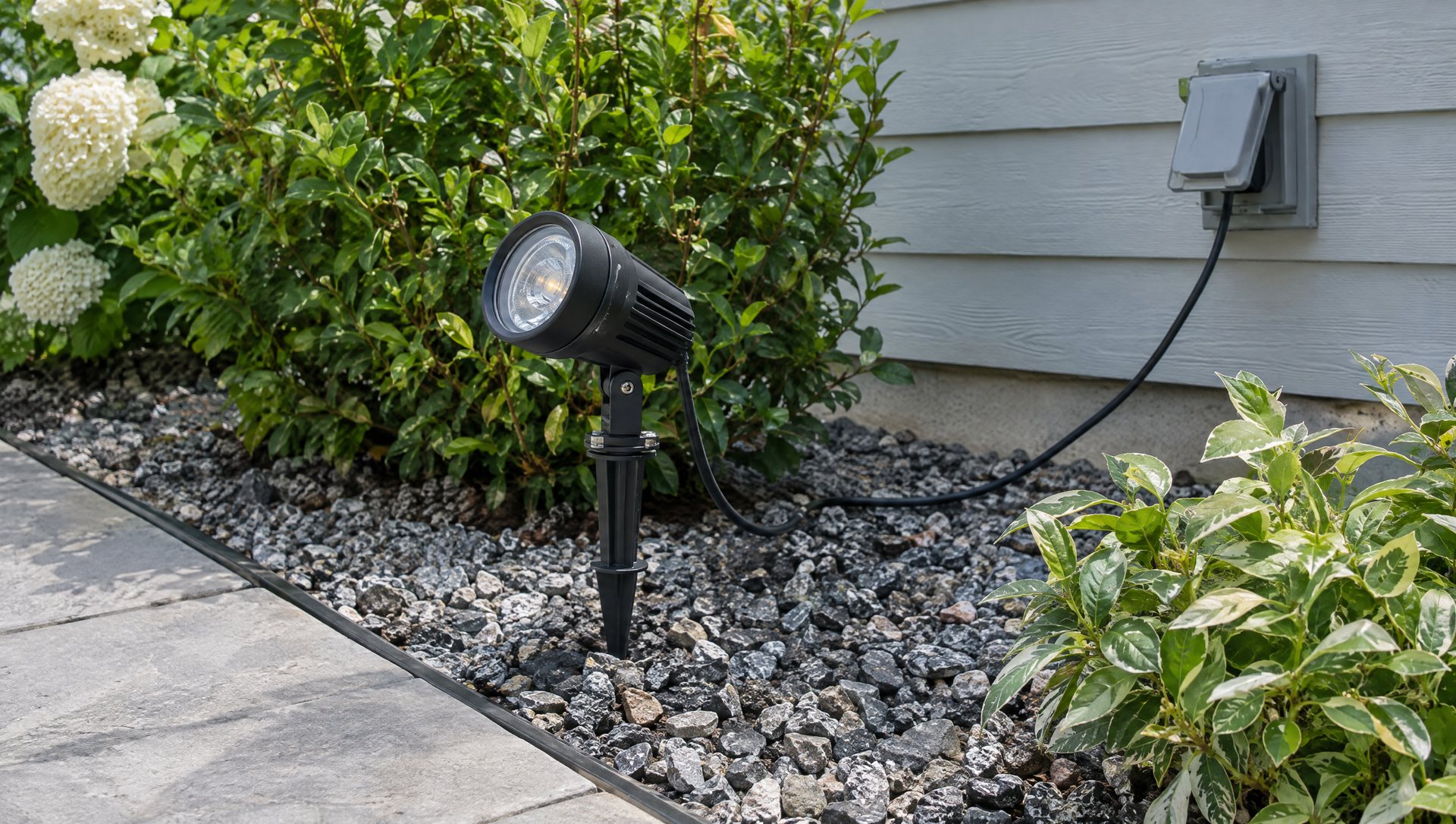
- Check the rating of every piece. The projector, its power adapter and every connection need to be outdoor-rated. Many projectors are fine in rain but not in standing water or a direct sprinkler hit. Our guide to IP ratings explains what those numbers on the label actually promise.
- Stake it high and dry. Pick a spot where water drains away, not the low corner of the bed. A couple of inches of gravel under the stake helps.
- Know your sprinkler day. Under the Conservation Stage rules Austin has had in effect since September 2025, automatic systems run one day a week, between midnight and 10 a.m. or 7 p.m. and midnight (City of Austin watering schedule). That evening window lands right in display hours. Walk the zone once with the system running and move the projector out of the spray.
- Use a GFCI-protected outdoor outlet, and keep the adapter off the ground. Don’t run a cord across a shared sidewalk.
- Keep it out of walking and mowing paths. A stake at shin height in the dark is how projectors get kicked off target, and how guests trip.
What to look for on the box, and what to ignore
Ignore the hero photo. It was taken on a white wall from close range, almost always with the camera exposure turned up. Read the specs and the manual instead.
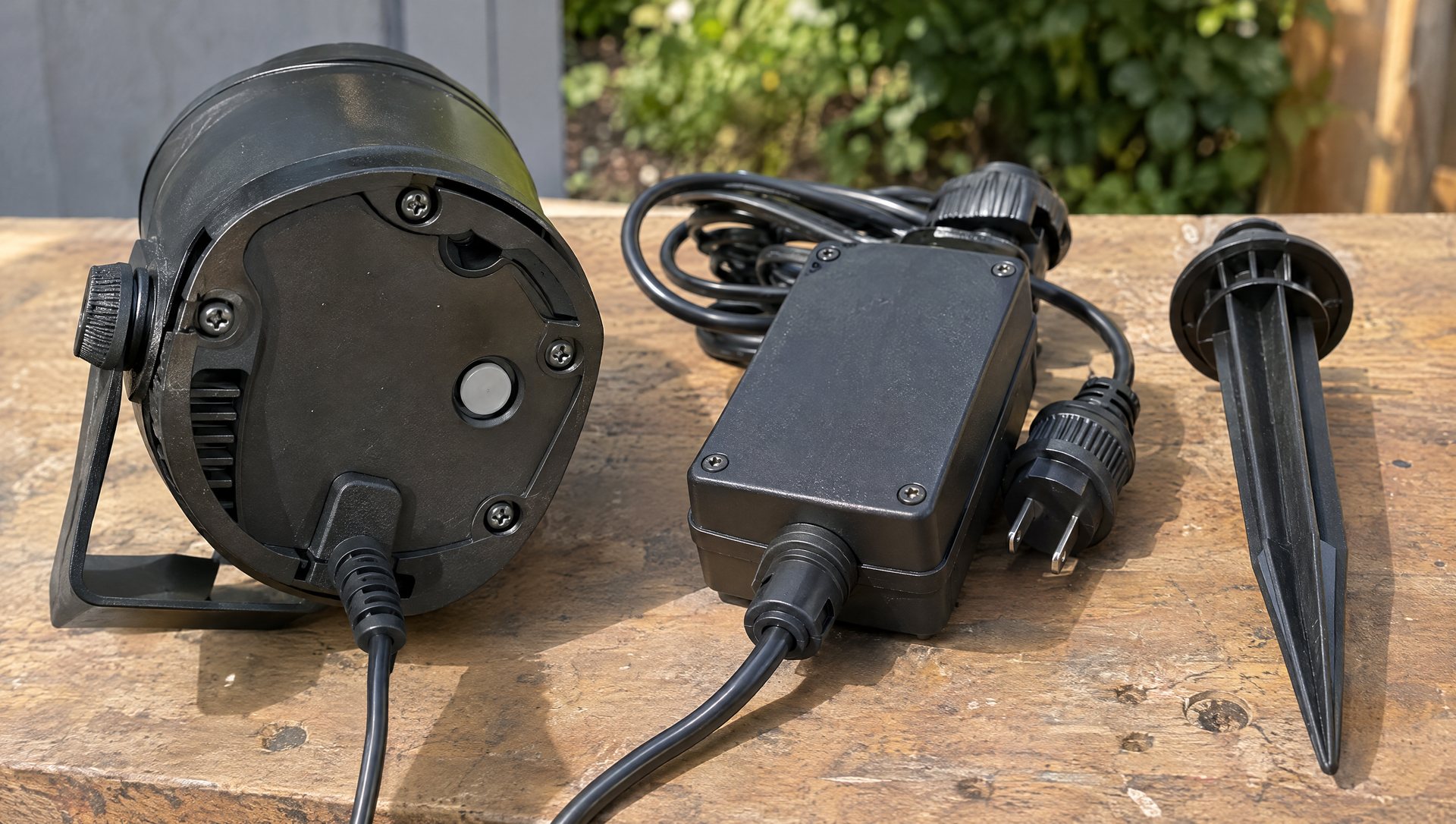
- Pattern choice and the ability to turn patterns off. A projector with twelve slides is worse than one with three if you can’t lock it to the one you like.
- Motion speed control. Slow almost always looks better. Fast rotation reads as a disco ball.
- Coverage stated at a stated distance. “Covers 600 square feet” means nothing without “at X feet.” If a listing doesn’t give both, assume the number came from the far end of the range, where the image is faint.
- A built-in timer that survives a power cut. Austin gets winter storms and brief outages. A unit that resets to “always on” or “off” after a blip is a nightly chore.
- Outdoor rating for the unit and the adapter, not just the unit.
- For lasers, the class label printed on the unit itself.
If a listing has dramatic photos and no clear outdoor or setup information, treat that as the answer.
Making one projector look designed
One moving element, surrounded by steady light, looks intentional. Projectors on three walls, plus flashing stakes, plus a chasing roofline, looks like a store aisle. The eye needs something still to compare the motion to.
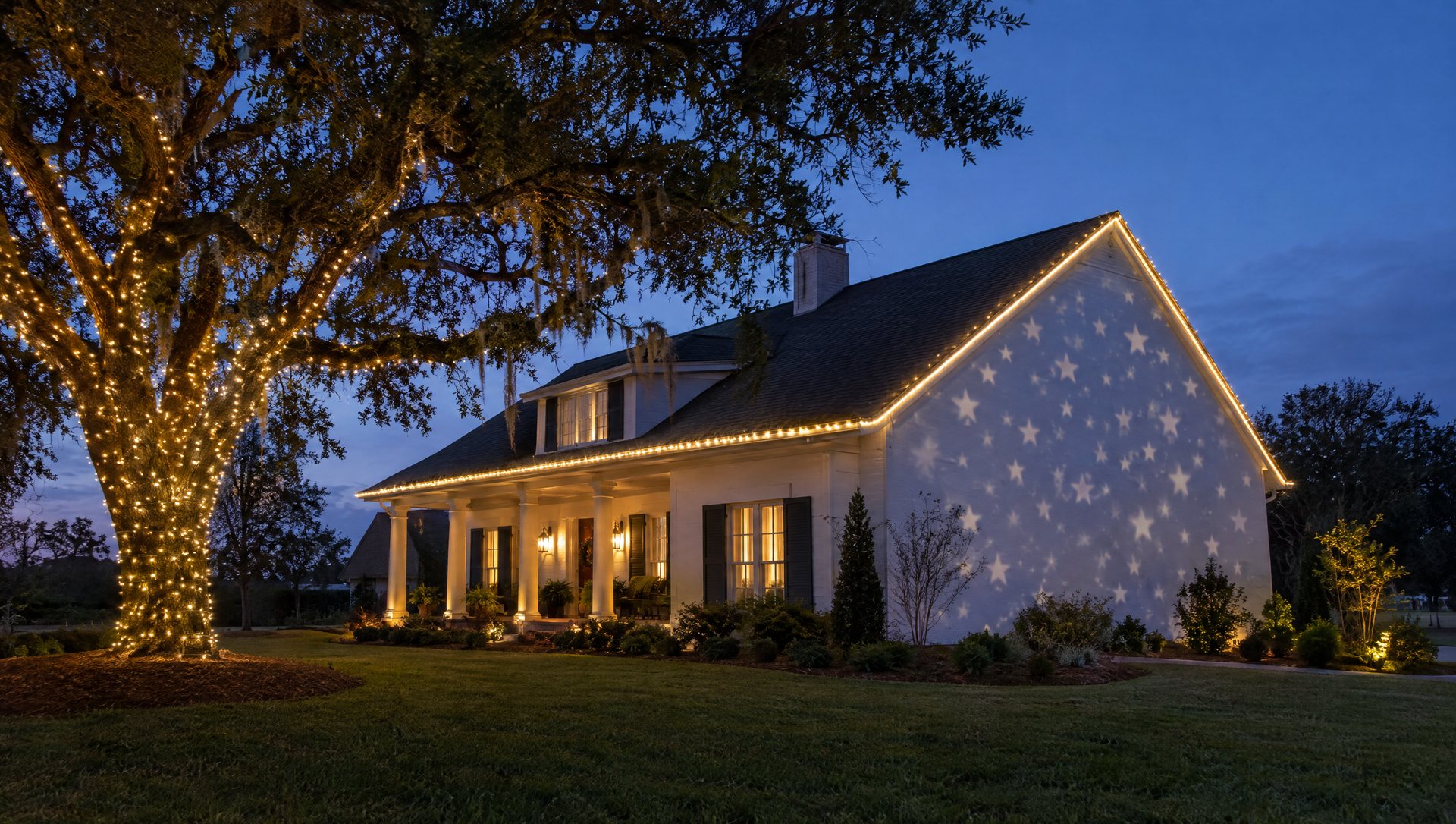
Two combinations that work on Austin houses:
- White stars on one plain side wall, warm-white trees in front. The contrast is shape, not color, and the projected wall reads as a backdrop for the trees.
- A single “picture window” of projected snow on the wall beside the front door, framed by a steadily lit porch. Small, deliberate, and it rewards people walking by.
Keep the projected color in the same family as everything else. Cool white snowflakes next to a warm-white roofline look like two different houses. If the rest of the display is warm white, choose a warm or gold pattern if the projector offers one. Our common lighting mistakes guide covers more of the color-mixing traps.
If you’ve already used a projector for Halloween, the lessons carry straight over; our outdoor Halloween lights guide covers the October version of the same wall.
When to spend the money on string lights instead
Skip the projector when the beam can’t stay on the wall, when the only place to stake it blocks a path or a driveway, when the facade is too broken up for an image to read, or when your neighbors across the street get more of the effect than you do.
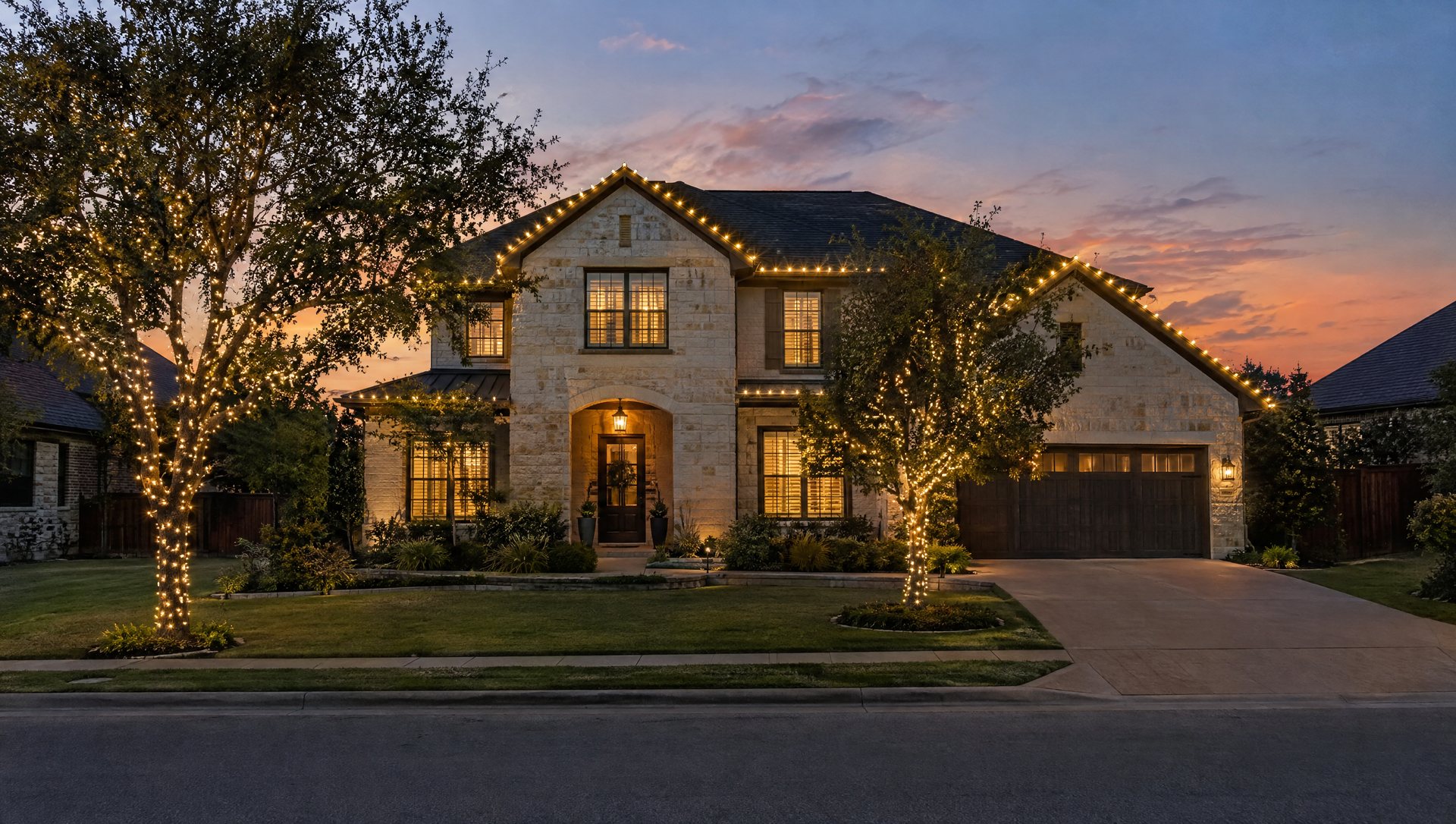
Two places a projector never wins:
- Trees. Projected patterns disappear into the leaves of a live oak. Wrapping the trunk and main limbs shows off the tree’s shape, which is the point of lighting it.
- Rooflines. A line of bulbs draws an actual edge. A projector can only wash a wall; it can’t outline a gable.
If the house you’ve just scored is a brick ranch or a limestone build, that’s where the money goes. Our Austin Christmas light installation service handles rooflines, trees and other physical lighting; a projector can still be a good accent on top of that on a house with the right wall.
Not sure which camp your house is in? Text one photo of the front, taken from the street after dark, to (737) 777-9099 or send it through our contact page, and we’ll tell you which wall, if any, is worth projecting on.
Frequently asked questions
Are laser Christmas lights safe for your eyes?
The dots on a wall aren’t a hazard, but don’t look into the aperture of a laser projecto