


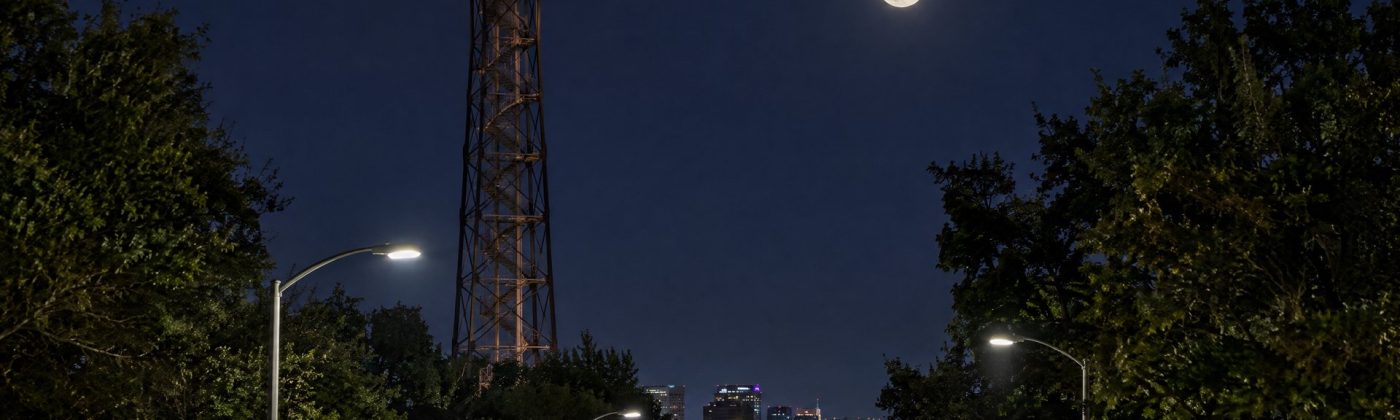
Austin is the only city in the world that still lights some of its streets from 165-foot iron towers built in the 1890s. It also runs tens of thousands of ordinary streetlights on wireless photocells, pays for them through a line on every in-city electric bill, and has spent more than a decade swapping old fixtures for LEDs. It still has intersections dark enough that the City Council approved a $1.7 million contract in late 2024 just to light fourteen of them.
That mix is why Austin street lights deserve an honest look. Here’s who runs them, how the system got here, what it does well, where it falls short, and what you can actually do about the light on your street.
Who runs Austin’s street lights, and how you pay for them
Inside the city limits, Austin Energy provides the streetlight system. Its lighting services page says the utility handles design, engineering, installation and maintenance, and that lights switch on automatically by photocell. Highways are a separate story: lights maintained by the Texas Department of Transportation are outside Austin Energy’s streetlight cost recovery, which is why the lighting on a TxDOT highway and the lighting on the neighborhood street that crosses it can look so different.
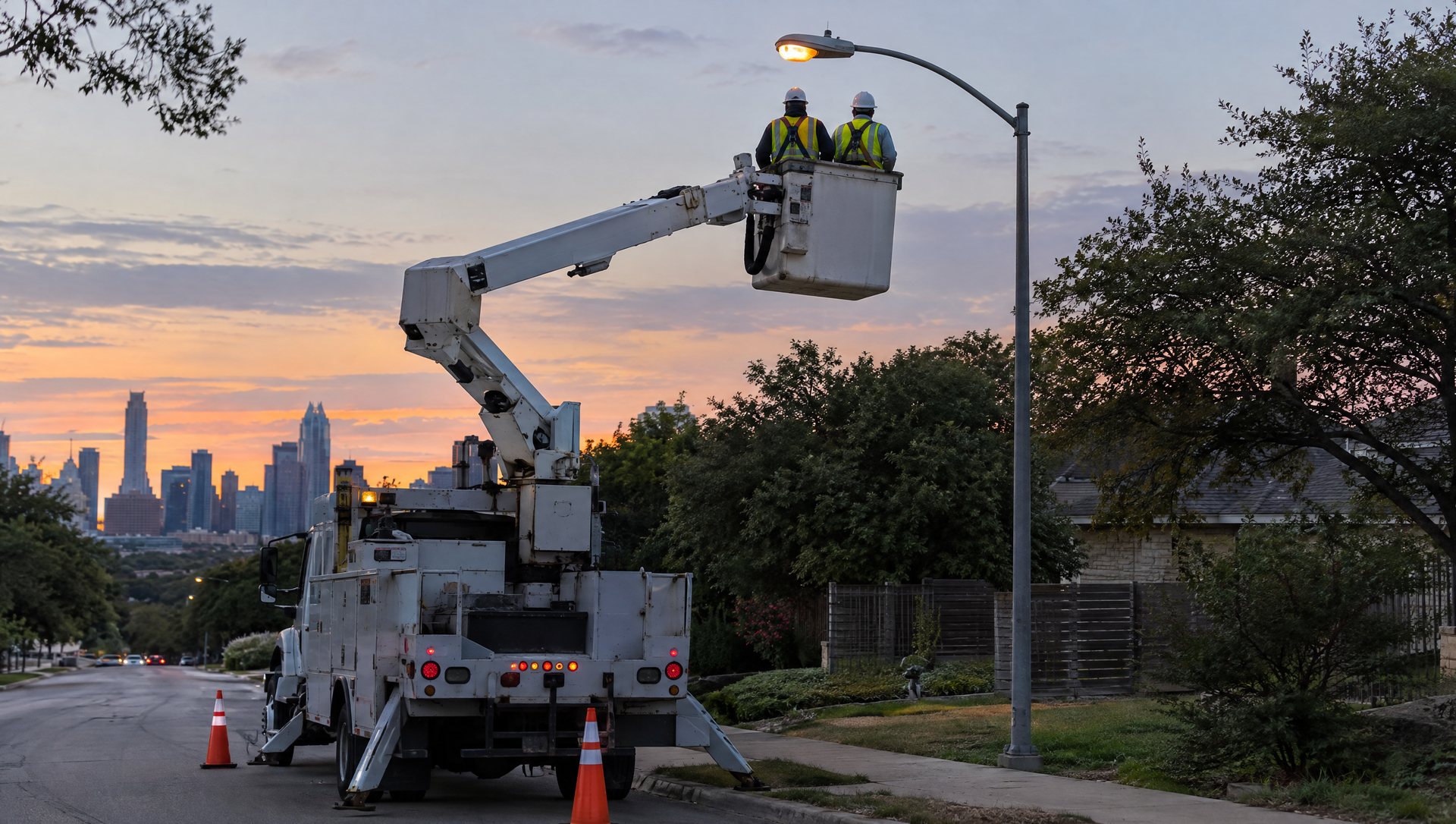
You pay for city streetlights through the Service Area Lighting charge, one of the “community benefit” charges on an Austin Energy bill. Austin Energy says it “recovers the costs of street lighting (except for those maintained by the Texas Department of Transportation)” and “the operation of traffic signals in the City of Austin.” Customers who live outside the city don’t pay it.
Austin Energy’s residential rate page (reviewed October 1, 2026) lists the Service Area Lighting charge at 0.272¢ per kWh. With the inputs shown:
- A home using 860 kWh in a month pays 860 × $0.00272 = $2.34 toward street lighting and traffic signals.
- A home using 1,500 kWh in a hot August pays 1,500 × $0.00272 = $4.08.
Austin Energy also offers pole-mounted private lights, which it calls Nightwatchman lights, to customers in its service area for a monthly charge. They go on existing utility poles, Austin Energy maintains them, and the charge shows up on the utility bill.
From moonlight towers to LEDs: a short timeline
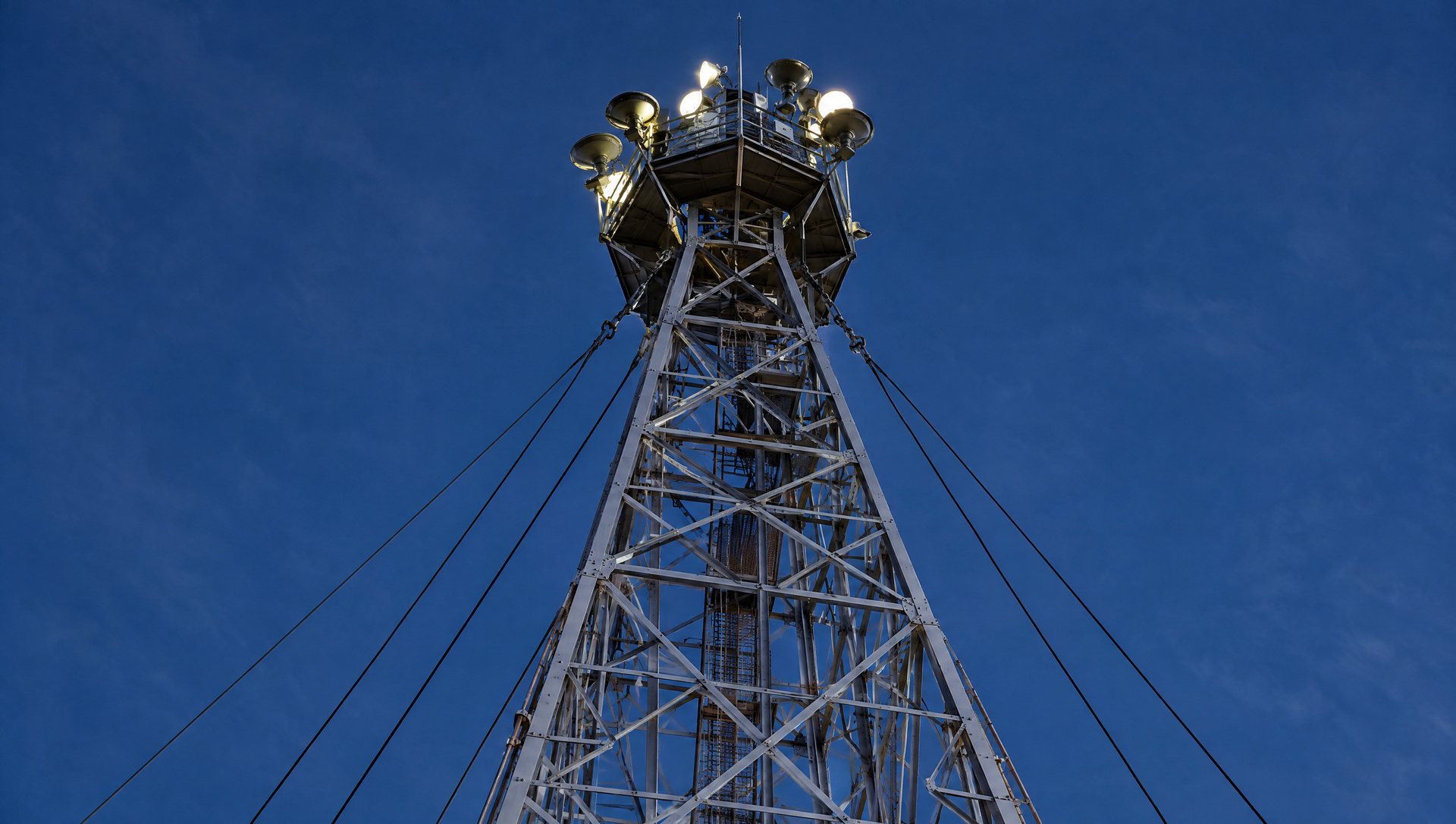
- The moonlight towers. Austin bought 31 lighting towers from the Fort Wayne Electric Company of Indiana. According to the towers’ 1976 National Register nomination, each is a triangular iron frame 150 feet tall on a 15-foot pedestal, for a total of 165 feet, held up by tension cables. The towers were first put into service on May 6, 1895, though Hyde Park developer Monroe Shipe lit the tower at 41st Street and Speedway in 1894 with his own generator, according to Community Impact. Each tower originally carried six carbon arc lamps, and Fort Wayne Electric guaranteed the light would let anyone read a watch without squinting or it would remove the towers at its own expense. The city got the towers and the dynamos to power them partly by trading away a city-owned narrow-gauge railroad used to build the old Austin Dam.
- New lamps. The arc lamps gave way to incandescent lighting in the 1920s, then mercury vapor lamps in the 1930s, according to the National Register nomination. Later the towers moved to metal halide.
- The Zilker replica. The city built a replacement tower in Zilker Park to stand in for a fallen one. That’s the tower strung with lights each December as the Zilker Holiday Tree. For more on how Austin’s light displays fit into the larger story, see our history of Christmas lights.
- Protected. The towers became state landmarks in April 1970 and were listed on the National Register of Historic Places in 1976. The 1976 nomination counted 21 towers still standing and called them “the only remaining examples” of the tower lighting systems once common in American cities. Today 17 survive.
- Austin’s lighting rules. The Land Development Code added exterior lighting standards (Ordinance 20060831-068, amended in 2013) requiring fully shielded or full cut-off fixtures for public street and pedestrian lighting, parking lots and other site lighting governed by Subchapter E.
- The LED vote. The City Council authorized up to $15 million to upgrade or replace roughly half of Austin’s streetlights, including about 35,000 LED fixtures, Grist reported at the time. The plan also removed the plastic domes that spread light sideways.
- Automated and flat glass. Austin Energy reported that all 56,000 of its streetlights had been automated with wireless photocells that report each light’s condition, and that all had been made Dark Sky compliant by replacing globe fixtures with flat-glass fixtures that direct light down. More than 13,000 had been converted to LED, which the utility said saved more than 4.3 million kWh a year.
- Restoring the towers. Austin Energy contracted Enertech Resources to restore all 17 remaining moonlight towers, at a pace of about three or four a year, KUT reported. The Zilker tower went to a shop in New Braunfels that spring for sandblasting and repainting.
- LED conversion under way. A September 2017 case study from Acuity Brands, the fixture supplier, described Austin Energy converting about 60,000 streetlights, with just over 30% done.
- West Campus. After a 2019 Austin Transportation Department lighting study, Austin Energy replaced about 600 West Campus streetlamps with LEDs by September 2022, added 15 new lights, and raised tree canopies, FOX 7 reported.
- The last moontower goes LED. The tower at Martin Luther King Jr. Boulevard and Chicon Street was the last to get LEDs, swapping 400-watt bulbs for 80-watt LEDs, FOX 7 reported. An Austin Energy supervisor said maintenance could drop from every five years to perhaps every twenty.
- Vision Zero lighting. City Council approved a $1.7 million contract for lighting upgrades at 14 crash-prone, poorly lit intersections under Austin Transportation and Public Works’ Vision Zero program, with work set to start at Pearce Lane in January 2025, FOX 7 reported at the time.
The good
The moonlight towers are still working. Austin kept a lighting system more than 130 years old running, landmarked it at both the state and national level, and is restoring it tower by tower. The LED swap shows how far lighting has come. Using the figures FOX 7 reported, with inputs shown: a 400-watt bulb running 12 hours a night uses 400 W × 12 h × 365 = 1,752 kWh a year. An 80-watt LED uses 350 kWh. That’s about 1,400 kWh saved per bulb per year, before counting the fewer trips up a 165-foot tower.
400 W x 12 h x 365 = 1,752 kWh; 80 W x 12 h x 365 = 350 kWh. That is about 1,400 kWh saved per bulb per year.
Show the numbers
| kWh per year | |
|---|---|
| 400 W bulb | 1,752 kWh |
| 80 W LED | 350 kWh |
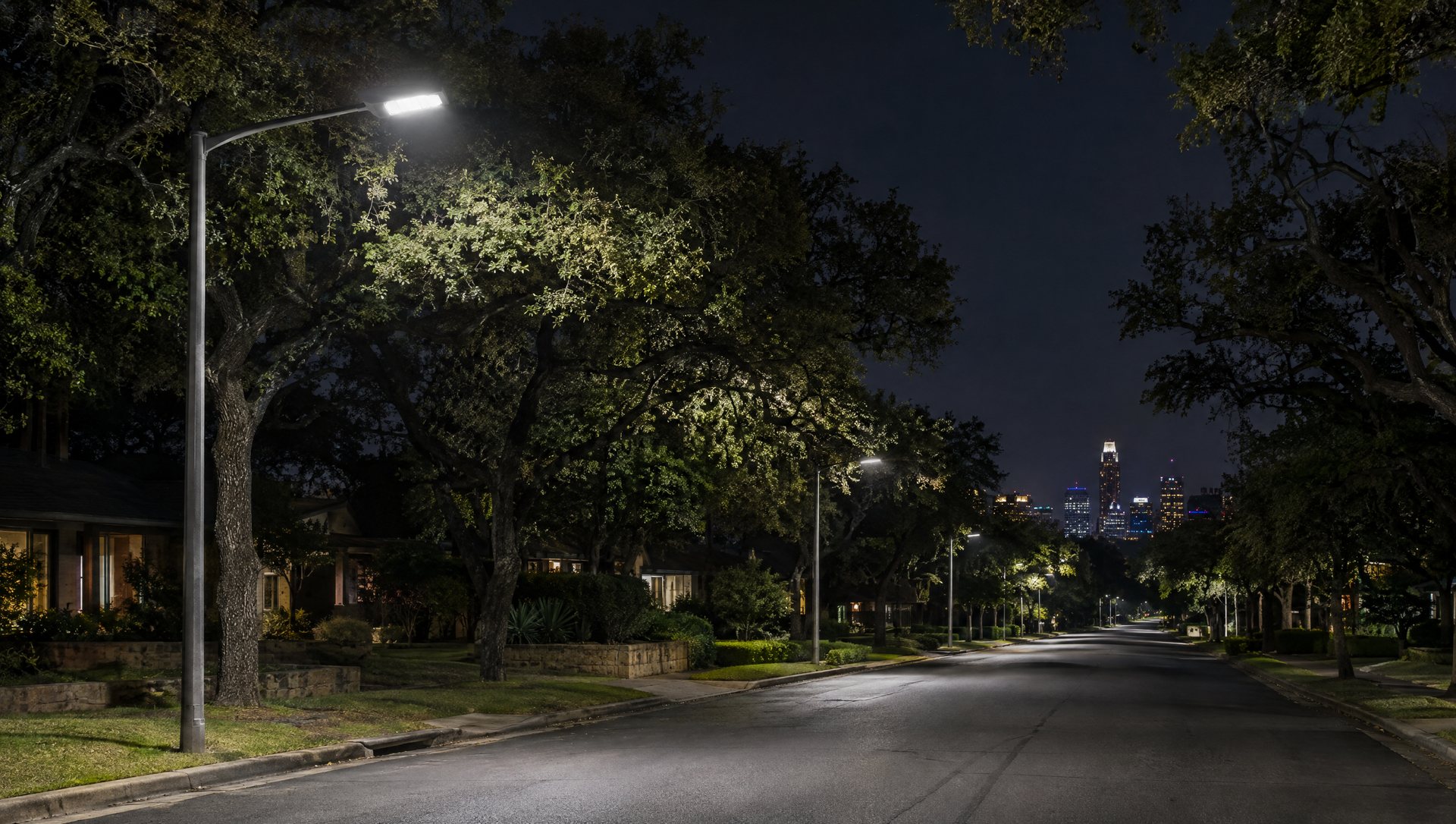
Most fixtures point down. The 2014 switch from globes to flat-glass fixtures matters more than most people realize. A globe sends light sideways and up, into bedroom windows and the sky. A flat-glass cobra head puts it on the road.
The system reports its own outages. Wireless photocells that report each light’s condition mean Austin Energy doesn’t have to rely on patrols or complaints to know a light is out.
Lighting decisions use crash data. The 2024 Vision Zero contract picked locations by looking at crash data and unlit conditions, not by whoever complained loudest. That’s how street lighting money should be spent.
The bad
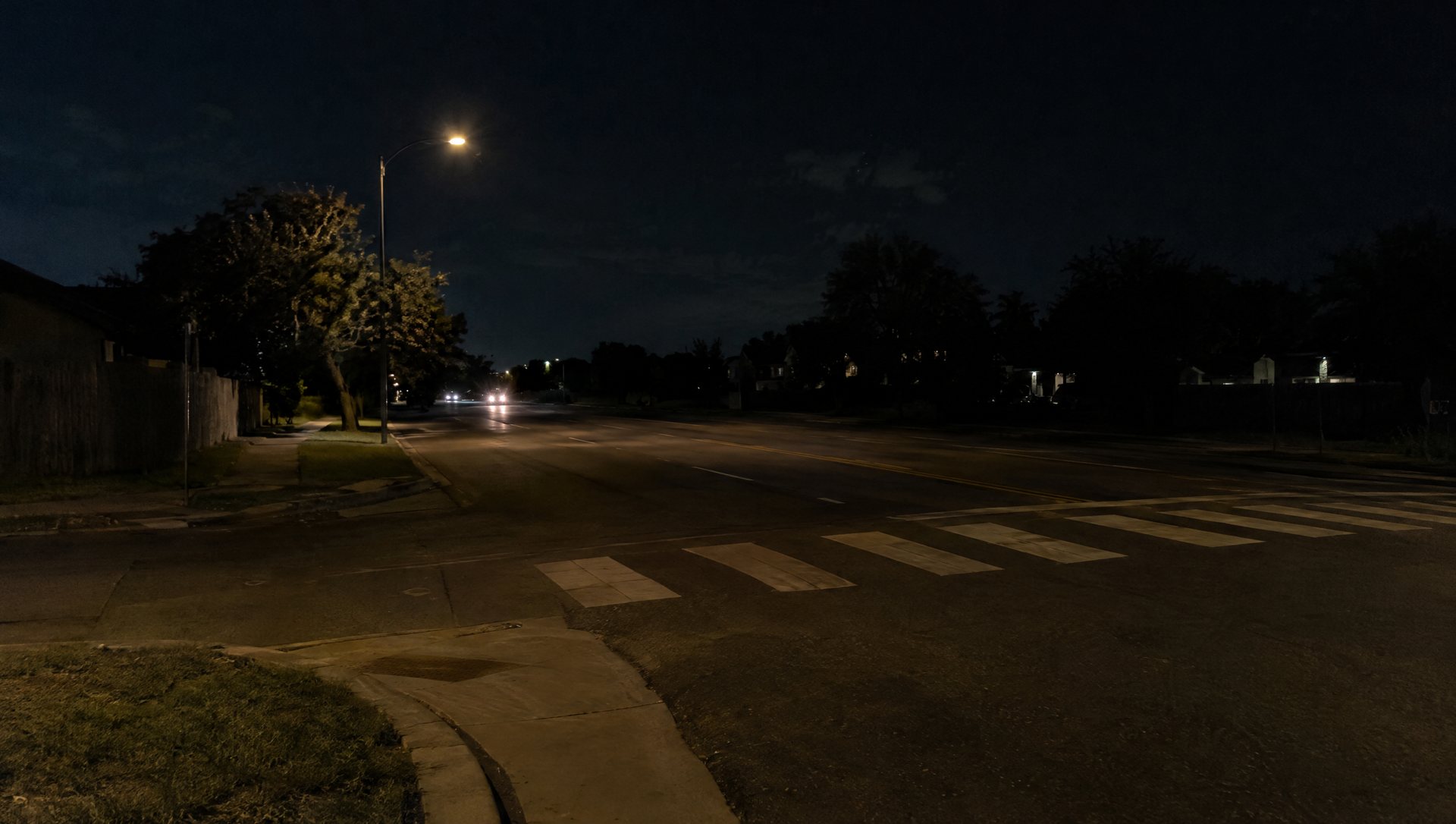
Dark spots took years to fix. West Campus needed a formal lighting study in 2019 and work running into 2023. The 2024 Vision Zero contract exists because places like Pearce Lane, Slaughter Lane at South First, and Oltorf at South Congress were dark enough at night to show up in crash data. Good lighting arriving after the crashes is still late.
There’s no easy public scoreboard. We could find dated LED progress figures from 2012, 2014 and 2017, but no recent Austin Energy figure showing what share of the system is LED today. If you know of a current, published number, we’d like to cite it.
LED color is a real trade-off. In 2016 the American Medical Association adopted guidance urging 3000K or lower color temperature for outdoor LED lighting such as roadways, citing glare and blue light. The Illuminating Engineering Society and NEMA pushed back, and the Department of Energy noted that color temperature alone doesn’t capture blue-light effects. The practical takeaway for Austin residents: if a new LED on your street looks harsh and blue-white, you’re not imagining it, and warmer options exist.
The cost is bundled into everyone’s bill. The Service Area Lighting charge is small per household, but because it’s tied to kWh, a family running the AC hard in August pays more toward streetlights than one with a smaller home, whether or not their block is well lit.
The ugly
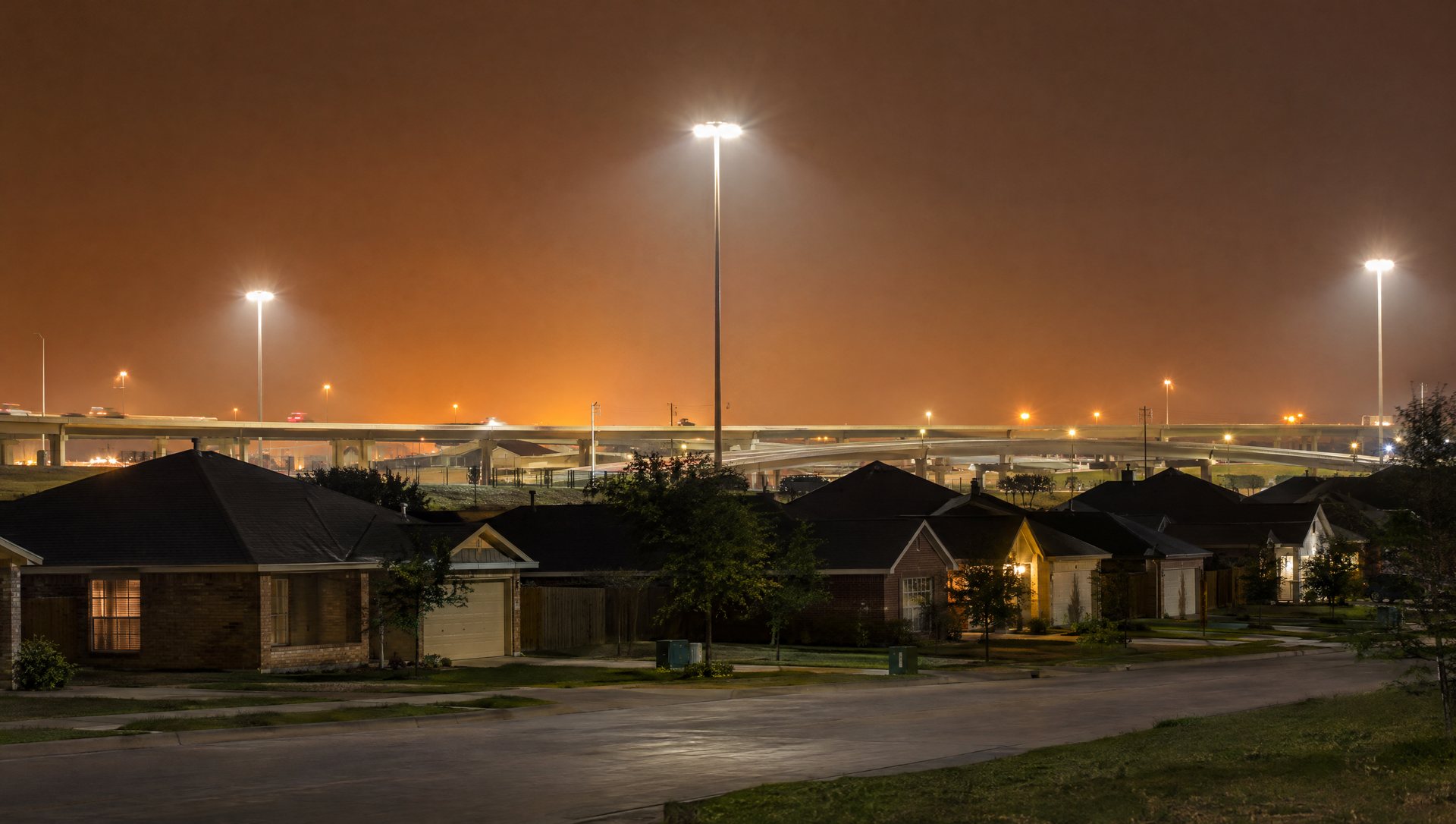
Highway floodlights next to homes. When TxDOT widened U.S. 290 along Sunset Valley’s northern edge, it installed high-mast floodlights near homes, including the mayor’s. A trial court enjoined them as a nuisance, and in 2002 an Austin appeals court found TxDOT had “intentionally and knowingly” shone the lights onto nearby homes, the Austin Chronicle reported. The Texas Supreme Court reversed in 2004, holding TxDOT kept its immunity and the city officials lacked standing. The neighbors lost, and the lights stayed. We cover this and other cases in our guide to light trespass and Texas light pollution cases.
Construction lights at 1 a.m. In a 2010 Austin case, homeowners in southeast Austin won a $200,988 nuisance verdict after subdivision crews set “three or four large bright lights” directly behind their houses and worked until 1 a.m. Not a streetlight, but a reminder that the worst light at night in a growing city is often temporary, and temporary can last months.
Skyglow keeps spreading. Each new subdivision, parking lot and sign adds to the dome over Austin. The Hill Country towns to the west have pushed back hard: Dripping Springs became Texas’s first International Dark Sky Community in 2014, and Horseshoe Bay followed in 2015. Austin’s 2006 shielding rules help on new commercial sites, but older fixtures and private lights still leak.
Streetlights in bedroom windows. Even a well-shielded cobra head can light a second-story bedroom when the pole sits right outside it. If that’s you, the fixes are on your side of the window (blackout shades) or a request to the utility, below. Light at night matters for sleep, which is why we cover it in our guide to circadian lighting at home.
What you can do about the light on your street
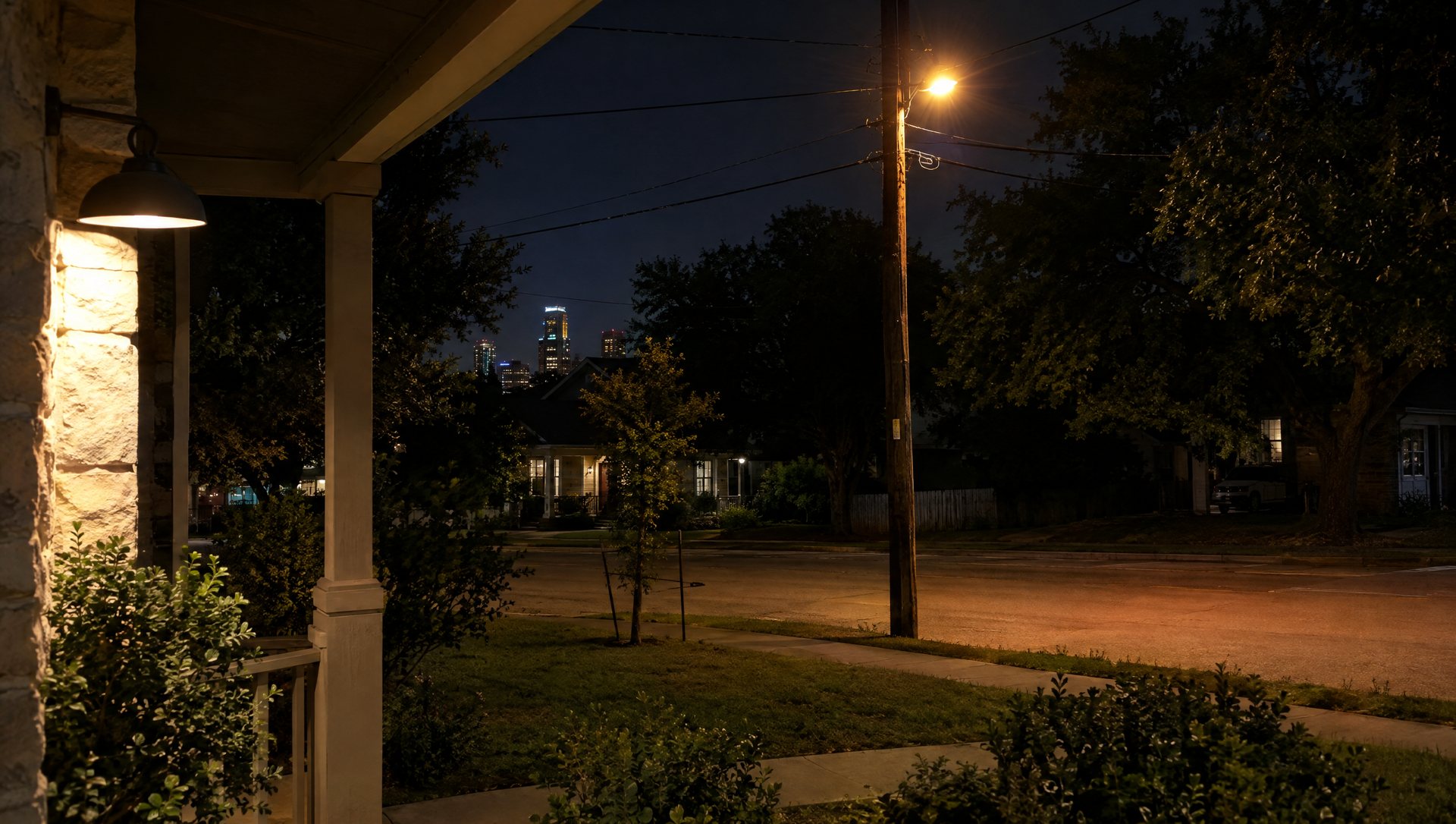
- Report an outage or a problem light through Austin 311. Austin 311 tracks these as “Austin Energy Street Light Issue” requests. Note the pole number if you can see it.
- Ask for more light where it’s needed. Austin Energy offers a free on-site evaluation when residents ask for more street lighting, and has an online request form. Have the address, the location of the dark area, and a pole number ready.
- Report a streetlight shining into your home the same way. Describe the problem specifically: which pole, which window, what time. A specific report is easier to act on than “the light is too bright.”
- Fix your own lights first. The light that bothers your neighbor is as likely to be your security flood as the city’s streetlight. Our guide to outdoor light shields that reduce glare shows how to aim and shield fixtures, and our overview of Texas lighting regulations covers the rules beyond Austin.
- Plan holiday lights with the street in mind. Roofline and tree lighting look best when it’s aimed at your house, uses warm white, and runs on a schedule. Our Austin holiday lighting timeline covers when to plan and install.
If you’re planning holiday or permanent lighting for your own home and want it to look good from the street without adding glare, we’re happy to talk it through at (737) 777-9099.
Sources
- Austin Energy, Lighting Services (residential): https://austinenergy.com/residential/residential-services/lighting-services
- Austin Energy, Other Line Items on Your Bill (Service Area Lighting): https://austinenergy.com/rates/residential-rates/other-line-items-on-your-bill
- Austin Energy, Residential Rates: https://austinenergy.com/rates/residential-rates
- National Register of Historic Places nomination, Austin Moonlight Towers (1976), Texas Historical Commission Atlas: https://atlas.thc.texas.gov/NR/pdfs/76002071/76002071.pdf
- Community Impact, “A guide to Austin’s moontowers” (2019): https://communityimpact.com/history/2019/05/29/a-guide-to-austins-moontowers
- Not Even Past (UT Austin history department), on the moonlight towers’ lamps: https://notevenpast.org/?p=580
- KUT, “Zilker Moontower Gets Removed Temporarily for a Touch-Up” (April 29, 2016): https://www.kut.org/austin/2016-04-29/zilker-moontower-gets-removed-temporarily-for-a-touch-up
- FOX 7 Austin, “Austin moontower gets upgraded with LED lights” (June 10, 2024): https://www.fox7austin.com/news/austin-moontower-gets-upgraded-led-lights
- Grist, “Austin dims its lights, everyone + science wins” (June 8, 2012): https://grist.org/cities/austin-dims-its-lights-everyone-science-wins/
- Austin Monitor, “Austin Energy automates streetlight system” (Sept. 16, 2014): https://www.austinmonitor.com/stories/whispers/austin-energy-automates-streetlight-system/
- Acuity Brands, “Austin Energy Renovates with Outdoor LED” (Sept. 18, 2017): https://insights.acuitybrands.com/infrastructure/austin-energy-renovates-with-outdoor-led-2
- FOX 7 Austin, “Austin Energy on track to complete West Campus lighting improvements by fall 2023” (Feb. 27, 2023): https://www.fox7austin.com/news/austin-energy-west-campus-lighting-improvements
- FOX 7 Austin, “City of Austin to begin lighting upgrades on 14 crash-prone areas in 2025” (Dec. 27, 2024): https://www.fox7austin.com/news/street-light-upgrades-austin-texas
- City of Austin Land Development Code, Subchapter E § 2.5 Exterior Lighting, as reproduced in zoning case C14-2024-0163: https://services.austintexas.gov/edims/document.cfm?id=455624
- LEDs Magazine, “AMA position on LED street lights draws more angst” (July 2016): https://www.ledsmagazine.com/articles/2016/07/ama-position-on-led-street-lights-draws-more-angst.html
- Austin Chronicle, “Naked City” (Sept. 6, 2002), on the Sunset Valley floodlights: https://www.austinchronicle.com/news/naked-city-11713509/
- DarkSky / University of Arizona case-law database, TxDOT v. City of Sunset Valley (Tex. 2004): https://findpolicy.darksky.org/case/texas-department-transportation-v-city-sunset-valley-0
- C.C. Carlton Industries, Ltd. v. Blanchard, 311 S.W.3d 654 (Tex. App.—Austin 2010): https://case-law.vlex.com/vid/cc-carlton-industries-ltd-885656993
- DarkSky, “Dripping Springs Named the First International Dark Sky Community in Texas” (2014): https://www.darksky.org/dripping-springs-named-the-first-international-dark-sky-community-in-texas/
- Austin 311 public request example, “Austin Energy Street Light Issue”: https://311.austintexas.gov/tickets/25-00104102