


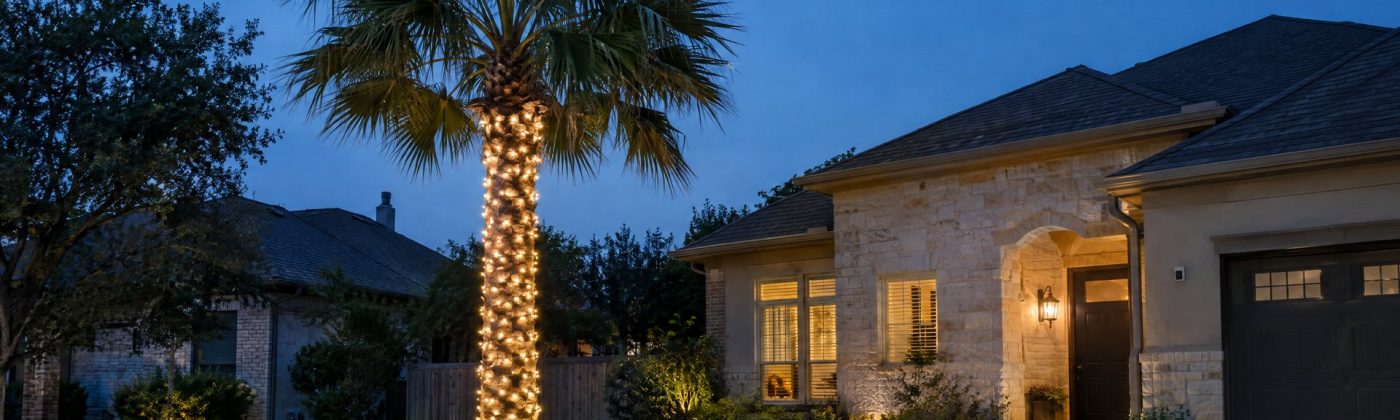
Christmas Lights on Palm Trees: How to Wrap Austin’s Palms
To put Christmas lights on a palm tree, wrap the trunk in a spiral from the base up and leave the fronds alone. Feet of lights = (lit height ÷ spacing between turns) × trunk circumference, so 8 feet of a 3-foot-around Mexican fan palm at 6-inch spacing takes about 48 feet, two 100-count mini sets.
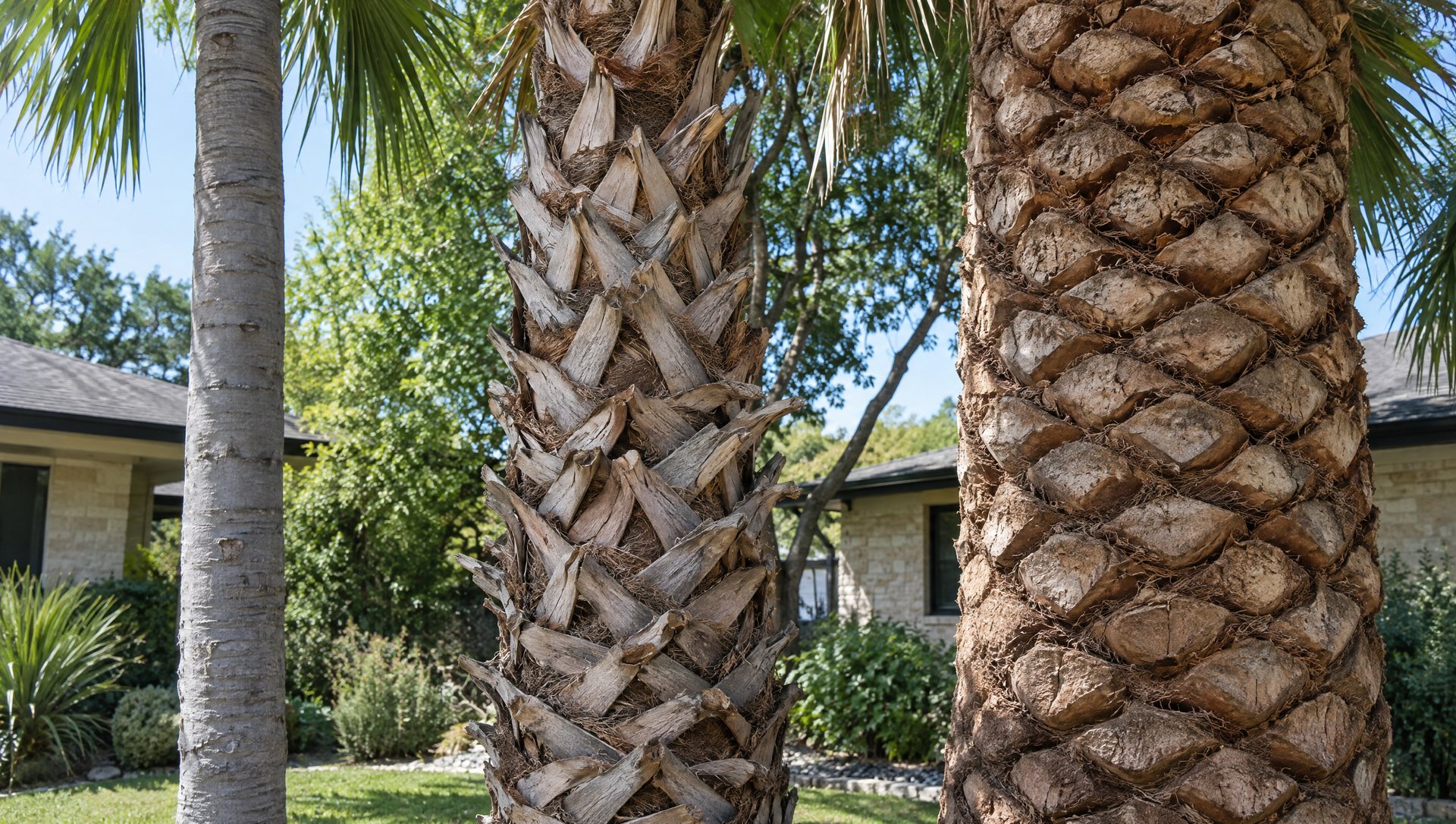
The method changes more by palm than people expect. A smooth Mexican fan palm lets the wire slide; a booted sabal holds it for you; a Canary Island date palm eats four times the lights. So start by knowing which one you have.
Know your palm first
These are the palms you’ll find in Austin yards, and what each means for the wrap. Trunk sizes are typical of mature landscape palms; measure your own.
Mexican fan palm (Washingtonia)
Tall and slim, roughly 2½ to 3½ feet around, with a smooth lower trunk on older trees and old frond bases (a “skirt” or boots) higher up. The smooth section is where the wire slides down the taper, so plan on ties. These palms grow tall fast, and many in Austin reach the service lines. Light the bottom 8 to 12 feet and leave the rest to an uplight.
Sabal or Texas palmetto (Sabal)
Stout, roughly 3½ to 5 feet around with the boots on. Those criss-crossed leaf bases are a gift: tuck the wire into them as you spiral and it stays exactly where you put it. The easiest palm in town to wrap well.
Canary Island date palm (Phoenix canariensis)
Massive, often 6 to 9 or more feet around, with a diamond pattern of old leaf scars. Takes two to three times the lights of a Mexican fan palm for the same height. Sharp spines sit at the base of the fronds; stay well below the crown.
Windmill palm (Trachycarpus)
Thin, roughly 2 to 3 feet around, wrapped in hairy brown fiber. The wire settles into the fiber and grips without help. An easy first project.
Pindo palm and sago
Pindo (Butia) has a short trunk under a low, spiny crown; sago “palms” are cycads with almost no trunk at all. There’s little to wrap. Light the ground around them instead: a ring of path lights or a single uplight.
Do the math before you buy
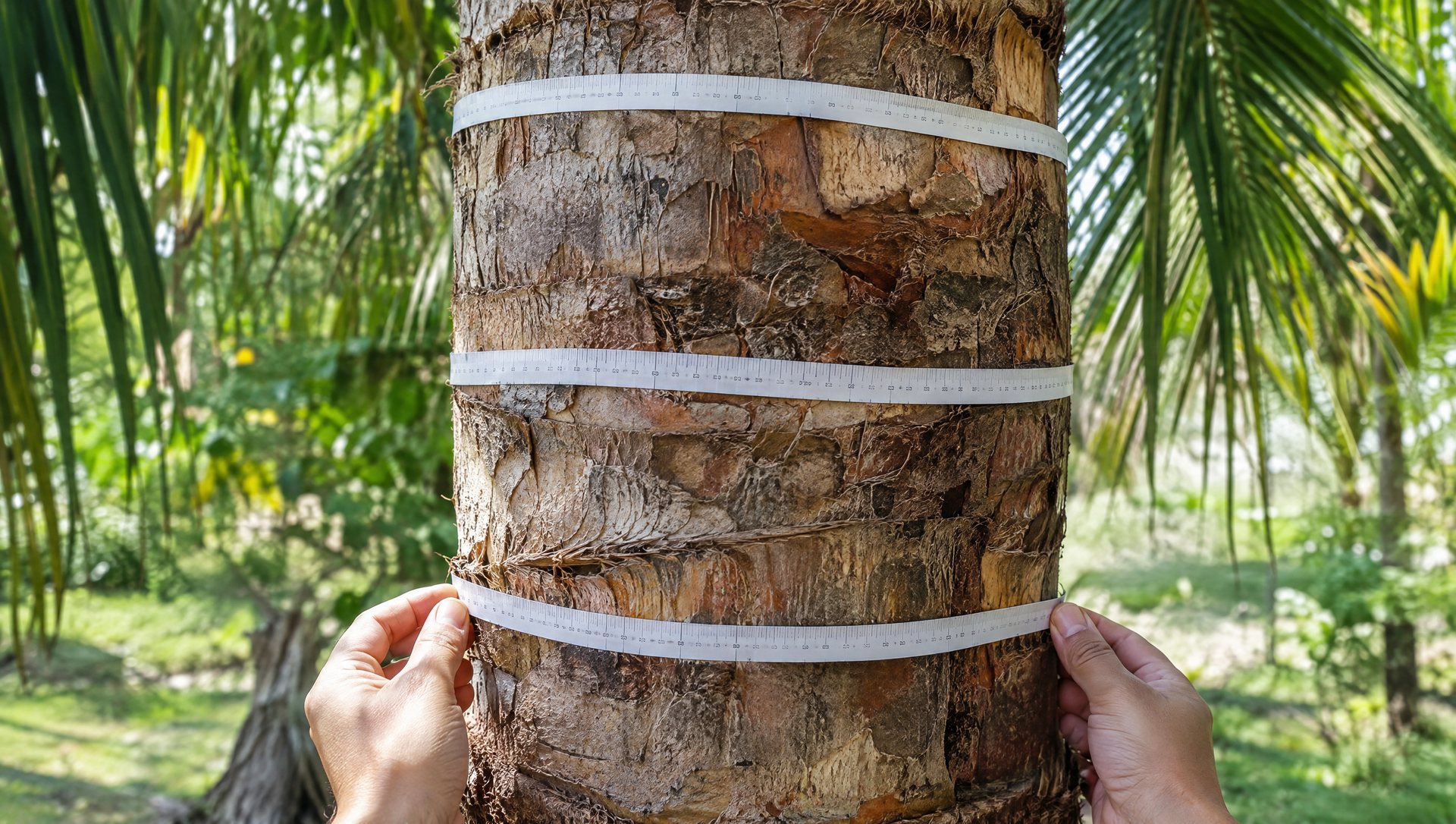
- Circumference. Wrap a soft tape (or a piece of string, then measure the string) around the trunk at the bottom, middle and top of the section you’ll light. Use the average. Canary Island date palms and old sabals can taper a lot.
- Lit height. Where the wrap stops (next section).
- Spacing. Six inches between turns gives a full, glowing column. Twelve inches gives a clear spiral with dark trunk showing between.
Turns = lit height ÷ spacing. Feet of lights = turns × circumference. Then add the lead to the outlet and about 10 percent for the start and the tie-off.
| Palm | Around | Lit height | 6-in spacing | 12-in spacing |
|---|---|---|---|---|
| Mexican fan | 3 ft | 8 ft | 48 ft (2 sets) | 24 ft (1 set) |
| Sabal | 4 ft | 8 ft | 64 ft (2 sets) | 32 ft (1 set) |
| Canary Island date | 8 ft | 8 ft | 128 ft (4 sets) | 64 ft (2 sets) |
Set counts assume 100-count LED minis at 4-inch bulb spacing, about 33 feet of lit wire per set, before the 10 percent extra. Round up.
What it costs to run: almost nothing. A 5mm LED mini draws roughly 0.07 watts, so the Canary Island date palm’s 400 bulbs pull about 28 watts. At six hours a night for 40 nights and Austin Energy’s Tier 3 rate of about 14.7¢ per kWh, that’s around $1 for the season. Our LED vs incandescent guide shows the full math.
Where to stop the wrap
Stop at a height you can reach from a free-standing stepladder, typically 10 to 12 feet. Never lean an extension ladder against a palm. The trunk is round, the ladder can roll sideways off it, and on a tall Washingtonia there’s nothing else to rest against.
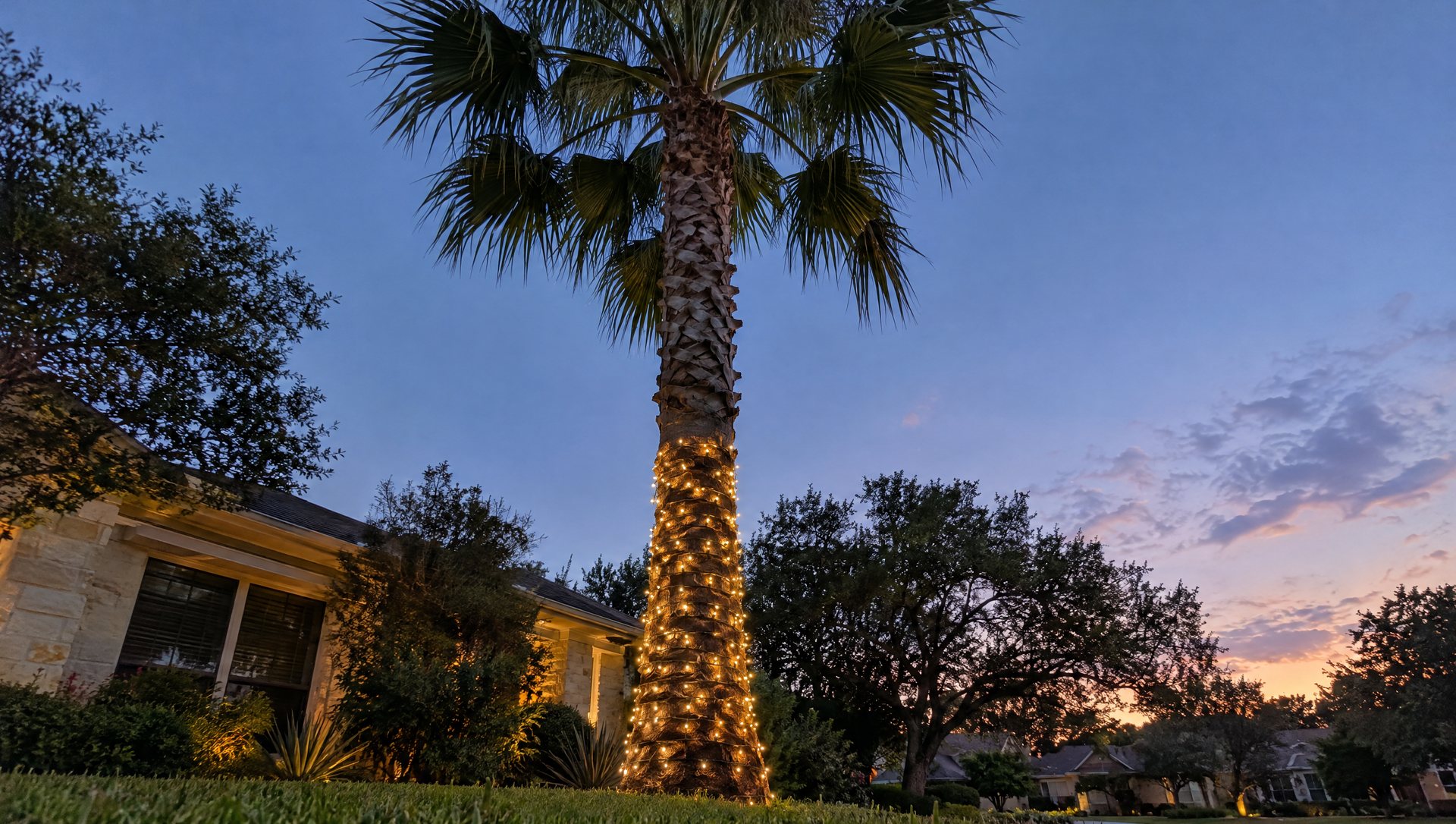
For a row of palms of different heights, stop every one at the same height. A consistent top line looks designed; ending each wrap wherever a set happens to run out looks accidental.
On a short palm (a young sabal, a windmill) the trunk may end at 4 or 5 feet. Wrap all of it and stop where the boots meet the crown.
Choosing the lights
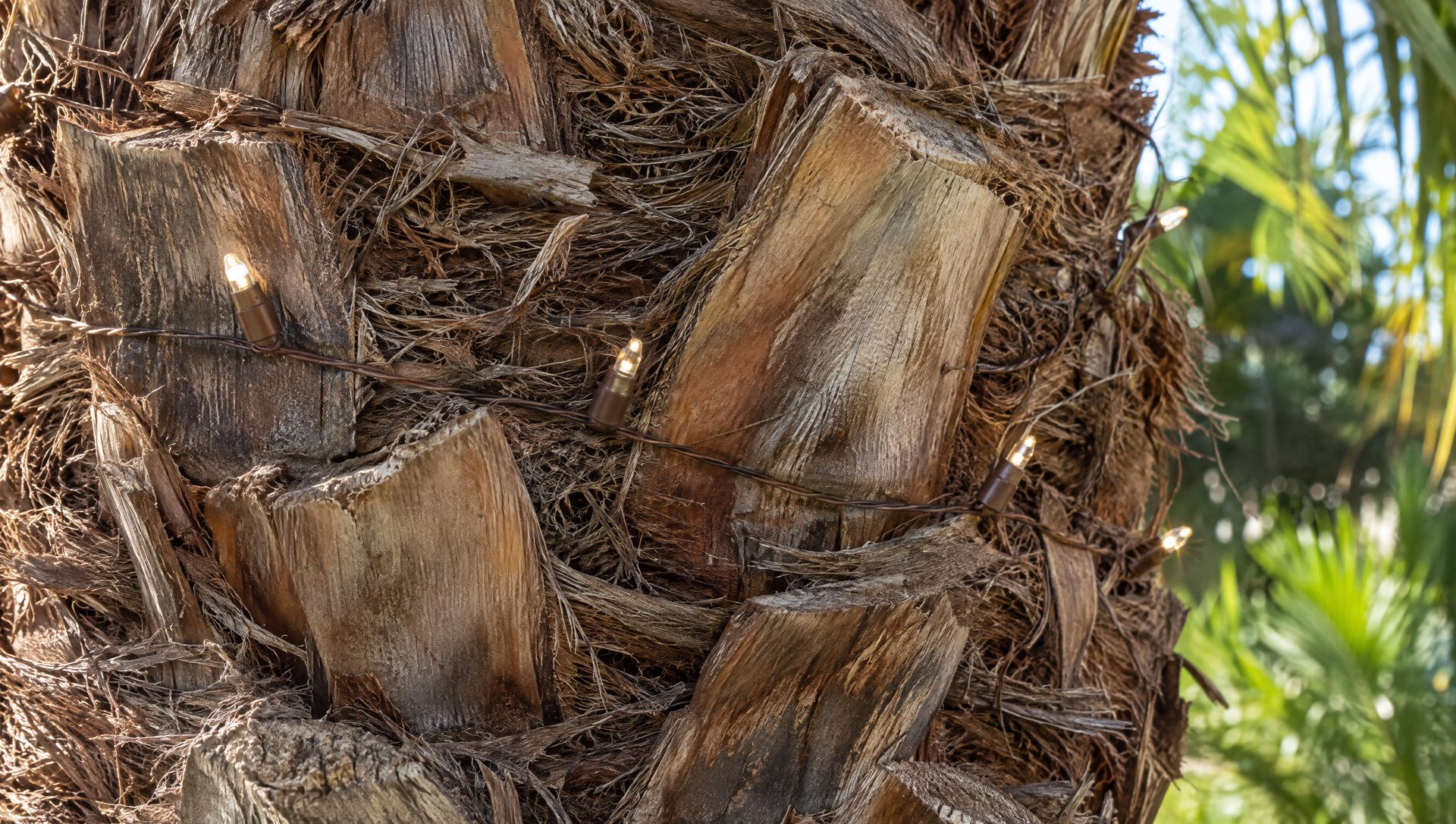
- 5mm wide-angle LED minis on brown or green wire for most palms. Brown wire disappears against almost every palm trunk; green shows on a gray Washingtonia. The wide-angle lens spreads light sideways, so the trunk glows instead of showing a dotted line. Sapien uses 5mm wide-angle LED minis for tree work.
- C9s on a big Canary Island date palm, where mini lights get lost on an 8-foot-around trunk. At 12-inch turn spacing with a bulb every 12 inches, that same 8 feet of trunk takes 64 C9 bulbs. See our C9 guide for socket wire.
- Color. Warm white is classic. But a palm is already a tropical tree in a Christmas display, so it carries bold color better than an oak does: blue, green or multicolor all work. If you go colorful, keep the house warm white. Our colored vs white guide and blue and white guide cover combinations.
Check the “connect up to” limit on the box. Most LED mini sets connect 40 or more end to end. A long wrap across several palms can exceed an older incandescent set’s limit of 3 to 5.
Buy every set for one palm, or one row of palms, from the same product and order. Two batches of warm white on one trunk can look like two colors.
The wrap, step by step
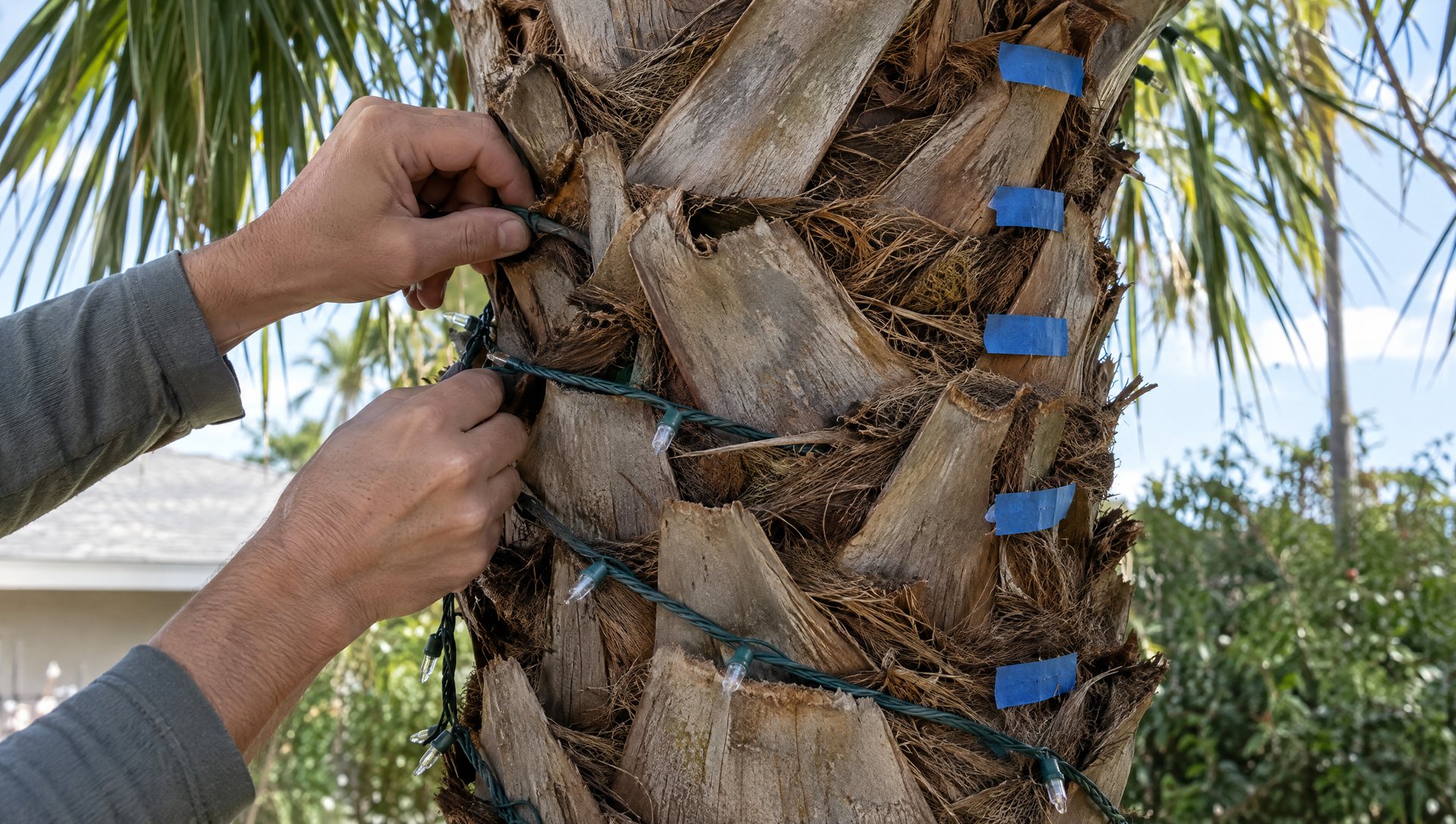
- Test the lights on the ground. Plug in every set, then unplug.
- Mark your spacing. Run a strip of painter’s tape vertically up the back of the trunk (the side the street doesn’t see) and mark it every 6 or 12 inches. Each turn crosses the tape at a mark. That’s the whole trick to an even spiral.
- Start at the base, plug end on the side facing your outlet, connection tucked off the ground.
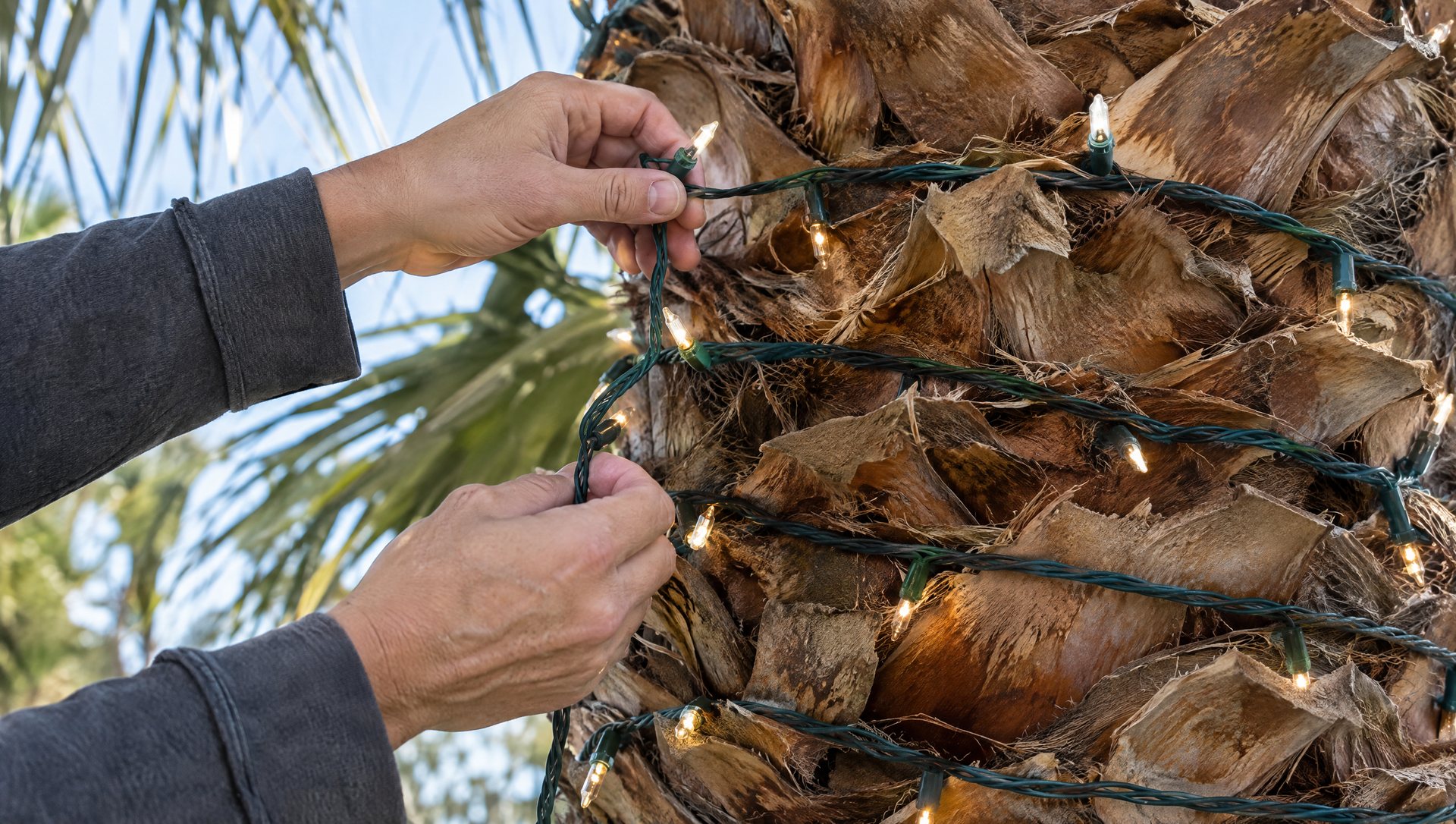
- Spiral upward at your spacing, keeping the wire snug against the trunk, not tight. A strangling wrap crushes boots and fiber and is harder to take down.
- Join sets on the back side as you go. The next set plugs into the end of the last; keep that connection on the back of the trunk where it’s out of view and can shed water.
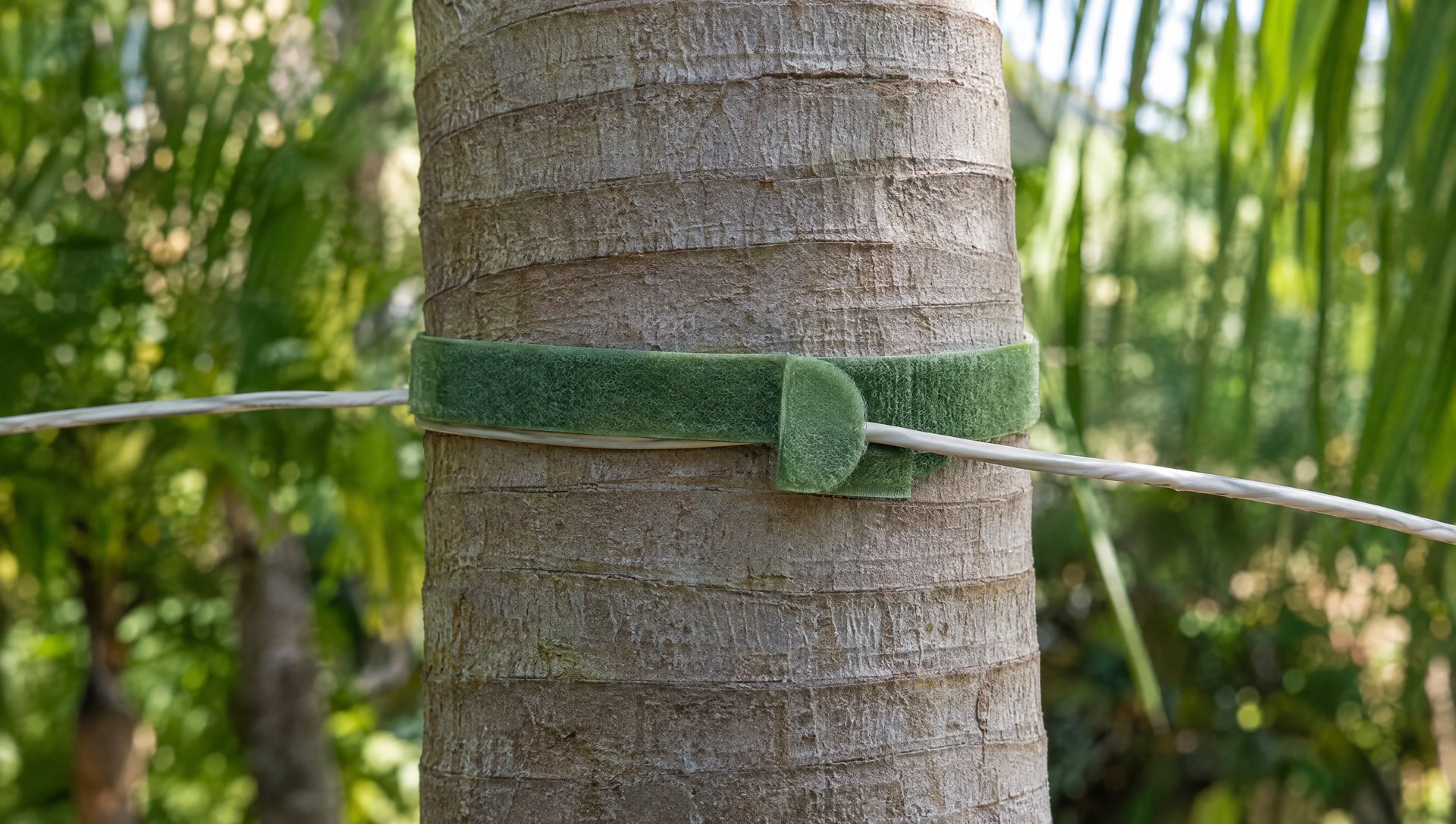
- Secure the top with a Velcro plant tie or a loosely closed zip tie. You’ll cut it off in January.
- Pull the tape once the spiral is done. Then walk to the street at dusk and look.
Keeping the wire where you put it
- Sabal and Canary Island date palms: tuck the wire into the boots or the diamond leaf scars on every turn. They act as natural hooks and the wire won’t slide.
- Windmill palms: the fiber grips the wire on its own. Press it in lightly.
- Smooth Mexican fan palm trunks: the wire slides down the taper. Two fixes. Either add a loose Velcro tie every three or four turns, or run a length of brown jute twine straight up the back of the trunk, tied off at the top and bottom, and tie each turn to it. The twine guide holds the spiral without anything gripping the trunk.
Never nail, staple or screw into a palm
Palms don’t heal wounds the way oaks do. An oak grows new wood over a staple hole; a palm has no layer that does that, so the hole stays for the life of the tree.
Worse, a fresh wound is an entry point for disease. University of Florida plant pathologists link wounds from nails and climbing spikes to Thielaviopsis trunk rot, a fungus that infects palms through fresh trunk wounds.
Sapien’s general tree practice can include small removable staples where a wrap won’t hold. On palms, we don’t staple. Boots, fiber, Velcro ties and twine guides do the job without a hole.
The crown: uplight it, don’t climb it
Wrapping individual frond stems is high work. The fronds move in the wind, the work happens at the top of a ladder against a round trunk, and Canary Island date and pindo palms have sharp spines at the frond bases. It’s not a weekend DIY job.
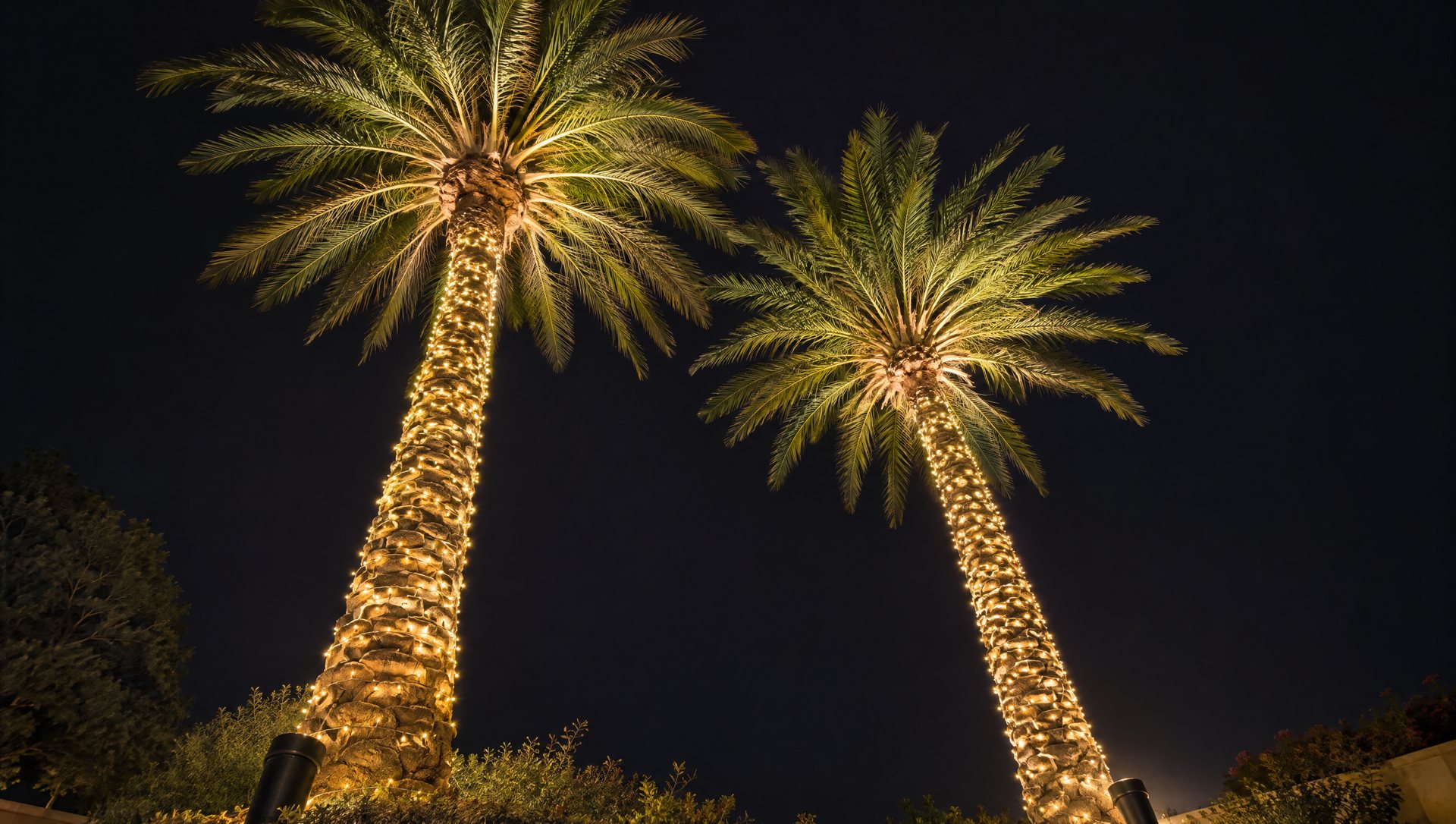
The safe DIY option for the crown: an outdoor spotlight on a ground stake 2 to 3 feet from the trunk, aimed up into the crown. A wrapped trunk with an uplit crown looks finished, and nobody climbs anything. Lighting the fronds themselves is work for a pro with the right equipment. Warm white or a soft green uplight both look good on fronds.
Overhead lines. Keep ladders, poles and lights at least 10 feet from any overhead power line. Many Austin Washingtonias grow right up into the service drop. If yours has, the crown is off limits for DIY, full stop. Our installation safety guide covers ladder setup.
Freeze-damaged palms. A palm with a brown or partly dead crown after a hard winter still makes a good wrapped trunk. Leave the crown dark until it recovers; uplighting a damaged crown only shows the damage.
Three looks that work
The pair. Two palms flanking a walk or driveway, same color, same stopping height, same spacing. They frame the entrance without any roofline lighting at all. For the path between them, see our pathway and driveway guide.
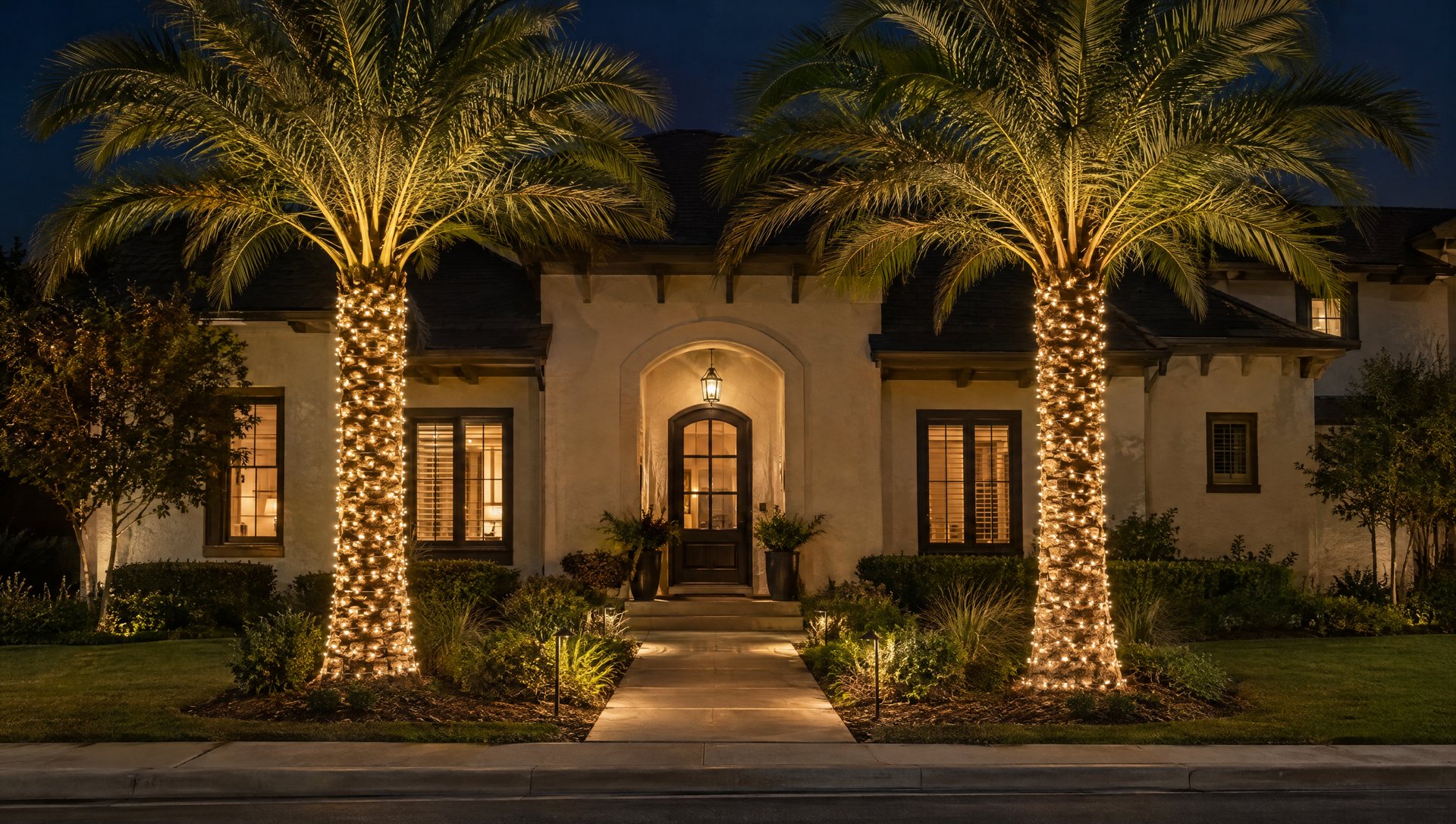
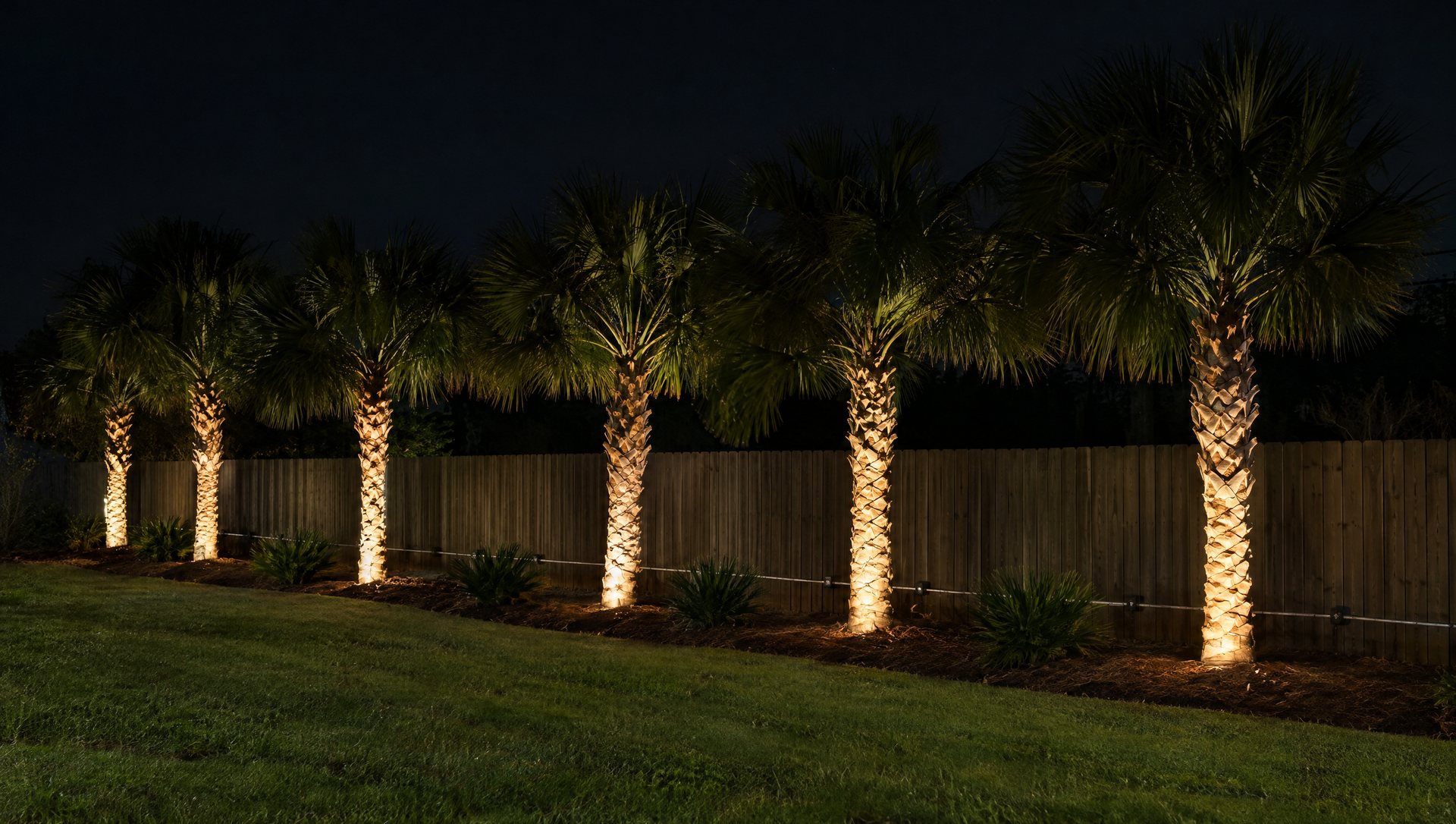
The row. Three or more palms along a fence or the street edge, all stopped at the same height. Consistency is the entire effect. One palm wrapped tighter than the others is the first thing anyone notices.
The color accent. Blue or green palm trunks with a warm-white porch and roofline. One bold color on the palms, simple everywhere else. This works especially well on Mediterranean-style stucco homes, where palms are part of the architecture.
Power, sprinklers and pools
- GFCI outlet. Plug into a GFCI-protected outdoor outlet; ESFI’s holiday guidance covers the electrical basics.
- Route cords along the back of the bed, not across the lawn where the mower goes or across a walk where people trip.
- Keep connections off the ground, tucked into a boot or low frond base on the back of the trunk, plug ends pointing down. Austin sprinklers still run in December.
- Pool palms. Palms by a pool get splashed, and pool decks drain toward the beds. Keep every connection high and away from the water, and never run a cord across a pool deck.
- Repeated GFCI trips mean a wet or damaged connection. Find it before you reset again.
If you need an outlet where there isn’t one, that’s a licensed electrician’s job; Sapien does plug-in work only.
Takedown
Unplug, cut the top tie, and unwind from the top down, the reverse of the wrap. Ease the wire out of the boots rather than yanking it, which tears the leaf bases. Remove every tie, the twine guide and any leftover tape.
Coil each set separately and label it by palm and position: “left driveway palm, set 2 of 2.” Next year the plug ends are already in the right place.
Sapien’s takedown window for our installs is January 2 through January 15. If you need a different date, ask before booking.
If you’re hiring it out
A useful quote for palm lighting spells out the number of palms, the lit height and spacing on each, the light type and color, whether the crown is included and how, and the takedown date.
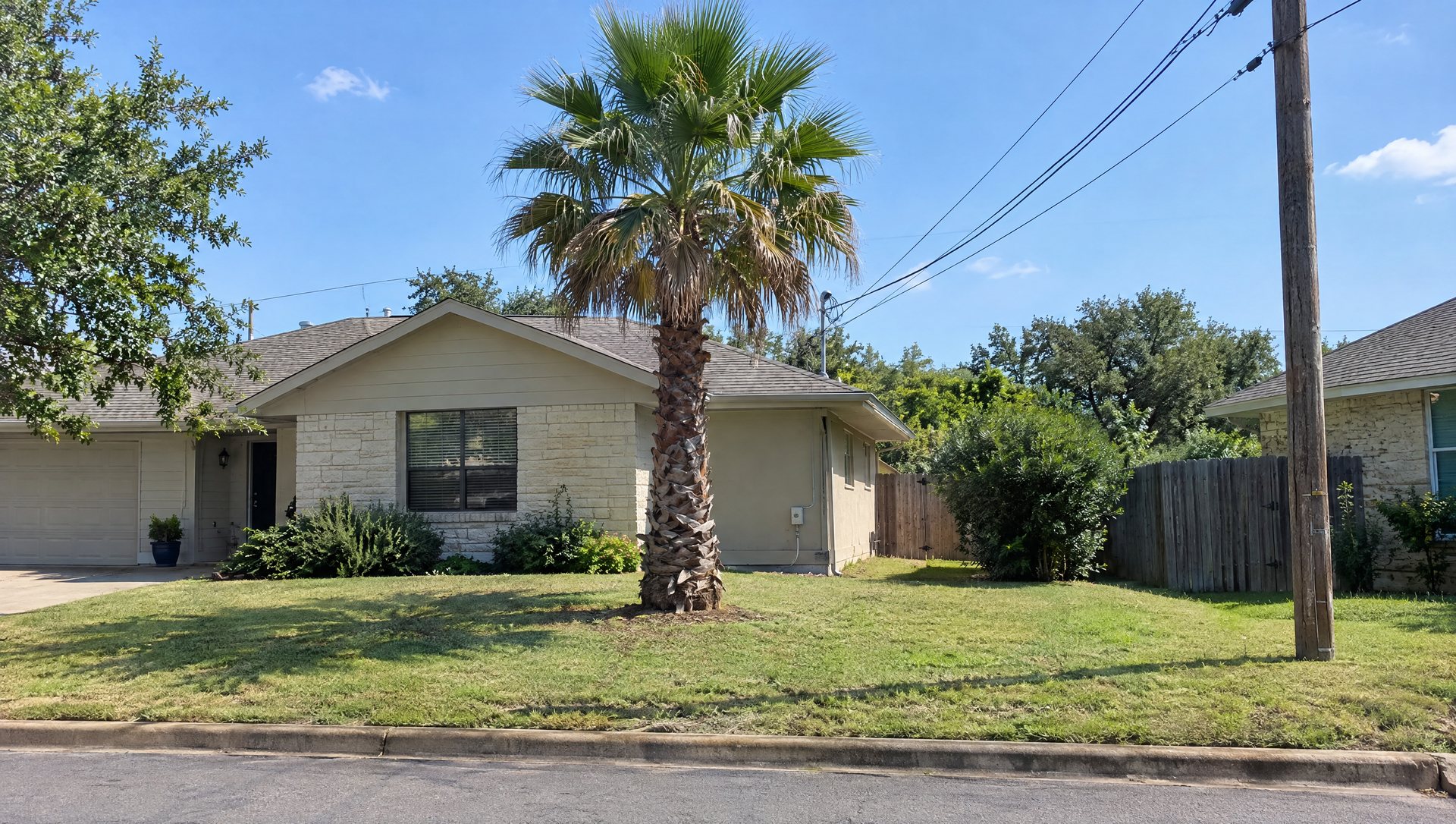
To get one from us, text photos of each palm trunk with something for scale (a person or a door works), plus one wide shot showing the outlet and any overhead lines, to (737) 777-9099, or use our contact page. Palms are part of our Austin Christmas light installation work alongside rooflines and trees.
Frequently asked questions
Should I wrap the palm fronds?
Not as a DIY project. Frond work is high, moving and often spiny. Uplight the crown from the ground instead.
How do I keep lights from sliding down a palm trunk?
On booted palms, tuck the wire into the boots. On smooth trunks, add a loose Velcro tie every three or four turns, or tie each turn to a vertical twine guide up the back.
Sources
- University of Florida IFAS: Thielaviopsis trunk rot of palm
- Electrical Safety Foundation: holiday electrical hazards
- Austin Energy: residential rates
About the author. Rick Safeman owns Sapien Lighting & Installation in Austin, Texas.