


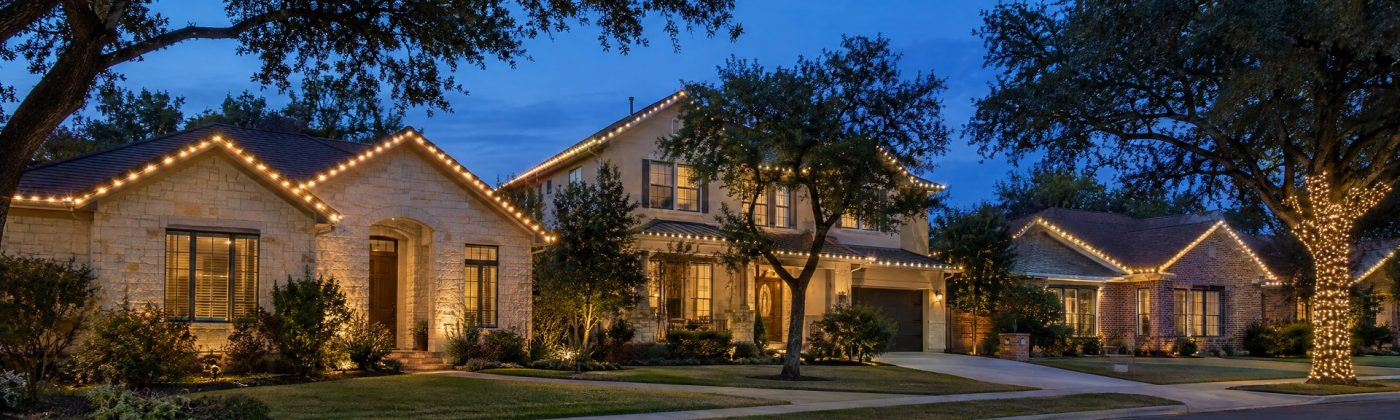
How to Choose a Christmas Light Installer in Austin: 12 Questions to Ask
To choose a Christmas light installer in Austin, compare written scope, not the headline price. Texas has no state license for holiday-light installers, so check what you can: a current general liability certificate, how the crew is covered if someone gets hurt, an itemized quote, who owns the lights, a mid-season service commitment and a removal date. Get two or three written quotes and ask each installer the same 12 questions.
| Question | Answer |
|---|---|
| Is there a license to check? | No state license. TDLR’s list of the programs it licenses has no program for holiday-light installers (read October 2026). Electricians are licensed, and any new outlet or circuit is an electrician’s job. |
| What insurance should an installer show? | A current certificate of general liability insurance. Ask separately how workers are covered, because general liability does not cover the crew. |
| How many quotes? | Two or three, in writing, for the same parts of the house. |
| What must be in writing? | Areas lit, light type and color, who owns the lights, service terms, install window, removal window, total price, payment schedule and cancellation terms. |
| Is a deposit normal? | Yes. The Texas Attorney General says to expect a partial payment in advance. Full payment before any work is the warning sign. |
| Can I cancel after signing? | Sometimes. The FTC’s Cooling-Off Rule covers certain sales made at your home, and Texas Business and Commerce Code chapter 601 has its own test. Each allows three business days. Many sales do not qualify, so get the installer’s own cancellation terms in writing. |
| Who owns the lights? | It depends on the company. Some supply and keep them. Some sell them to you. Ask before you compare prices. |
| What are the red flags? | Full payment up front, cash only, no written scope, no proof of insurance, a business you cannot look up, pressure to sign today. |
| What do I send to get a quote? | Daytime photos of the front of the house, the parts you want lit, which trees, and the date you want the lights on. |
This guide is for an Austin-area homeowner who has decided to hire and has two or three names from a search, a neighbor or a marketplace. If you are still working out a budget, start with what Christmas light installation costs in Austin, then come back with your quotes in hand.
- The 12 questions
- Texas licensing
- Reading reviews and photos
- What a good installer asks you
- Red flags
- Quote comparison worksheet
- How Sapien answers
- When not to hire
The 12 questions to ask a Christmas light installer
These 12 questions cover the places where Christmas light quotes differ. Ask every installer the same ones, in writing if you can. Each links to why it matters and what a good and a weak answer sound like.
- What insurance do you carry, and will you send a current certificate?
- Who will be on my roof, and how are they covered if they get hurt?
- What does the price include, line by line?
- Who owns the lights, and where do they go in January?
- What lights will you use on my house?
- How will you attach them to my roof?
- How do you wrap trees, and how is tree work priced?
- What happens if lights go out mid-season?
- What happens if something gets damaged?
- When will you install, and when do the lights come down?
- How much is due up front, and when is the rest due?
- Will you put all of it in writing, and what are the cancellation terms?
Short on time? Ask 1, 4 and 12. Or paste this into a text or email to each installer:
Before I compare quotes, can you send me: (1) your current certificate of liability insurance, and how your crew is covered if someone is hurt; (2) what the price includes and who owns the lights; (3) for trees, which ones, how far up and out, and the spacing between wraps; (4) the install week and the removal window; (5) the payment schedule and your cancellation terms.
Do Christmas light installers need a license in Texas?
Texas does not license holiday-light installers at the state level. The Texas Department of Licensing and Regulation (TDLR) licenses electricians, and TDLR’s list of the programs it licenses, read in October 2026, has no program for holiday-light installers, handymen or general contractors. So the word “licensed” on a light installer’s website tells you less than it seems to. If an installer uses it, ask what the license is for.
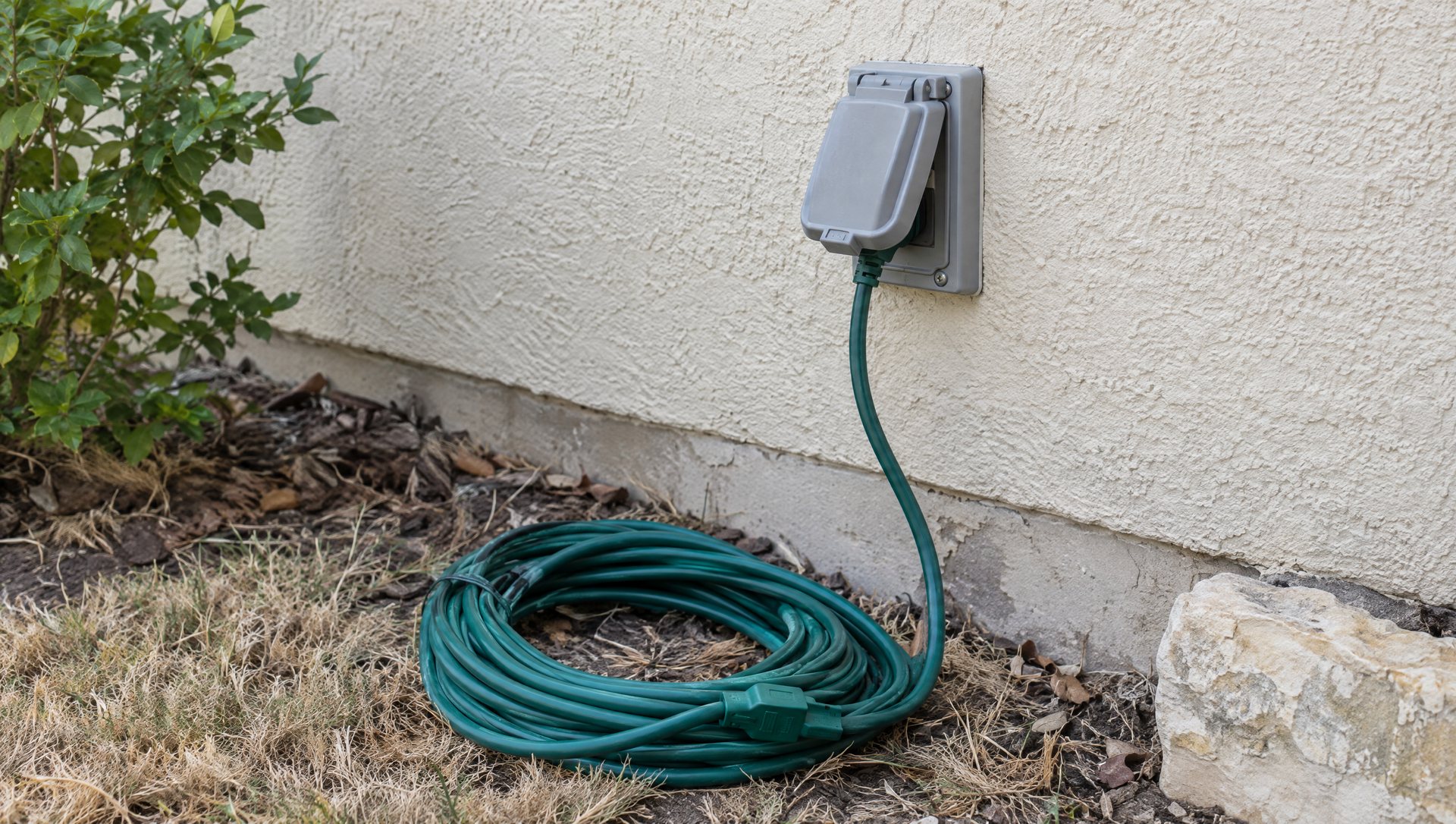
The line the law does draw is at the power source. Texas Occupations Code chapter 1305 requires a license to perform or offer electrical work. Section 1305.003(a)(13) exempts landscapers installing low-voltage exterior lighting and “holiday lighting excluding any required power source.” Hanging plug-in lights is one thing. Adding an outlet, a circuit or any wiring is electrical work.
The City of Austin follows the same split. Austin’s electrical code exempts temporary holiday decorative lighting from an electrical permit. A new receptacle or circuit needs one. Other cities set their own rules; the Texas lighting regulations guide covers more of them.
What this means for hiring: if your house needs a new outdoor outlet, that is a job for an electrician, and you can check one at TDLR’s license search. Be careful with a light installer who offers to add an outlet without naming the electrician who will do it.
What insurance should a Christmas light installer have?
A Christmas light installer should be able to show a current certificate of general liability insurance and tell you how its workers are covered if one is hurt. Those are two separate things, and most checklists ask about only one.
1. What insurance do you carry, and will you send a current certificate?
Why it matters. General liability insurance is the policy that pays when a business damages someone’s property or injures someone who is not its employee. The Texas Department of Insurance describes commercial general liability as coverage for bodily injury and property damage claims that come out of a business’s operations. On a light job, that means a cracked roof tile or a ladder through a window.
The proof is a certificate of insurance, usually a one-page form titled Certificate of Liability Insurance (ACORD 25, one of the forms on TDI’s certificates page). It names the insurer, the policy dates and the limits. Under Texas Insurance Code chapter 1811, a certificate is a summary for information only and cannot change the policy.
A good answer. “Yes. I’ll have it sent over.” The certificate arrives, the business name matches the name on your quote, and the policy dates cover your install and removal dates. Removal is often in January, so a policy that expires in December deserves a follow-up question. Ask that the certificate come straight from the insurance agent’s email, and allow a day or two.
A weak answer. “We’re fully covered, don’t worry about it,” with no document. A slow reply in a busy week is not a red flag. A refusal is one.
Some checklists tell you to demand a set dollar limit. We found no public source that sets a standard limit for this work. Read the limit on the certificate and decide whether it fits your house.
2. Who will be on my roof, and how are they covered if they get hurt?
Why it matters. General liability does not cover the installer’s own crew. TDI says those policies are not meant to provide workers’ compensation. And TDI’s workers’ compensation guide says Texas does not require most private employers to carry workers’ compensation at all. So an installer can truthfully claim insurance and have nothing in place for a worker who falls.
Some employers buy alternative injury policies instead. TDI says Texas law does not treat those as workers’ compensation, and that they carry dollar and time limits.
A good answer. A direct one. “Our installers are employees and we carry workers’ compensation.” Or “we don’t carry workers’ comp; here is what we carry instead.” Either way, you learn who is on the roof (employees or subcontractors) and what covers them. TDI links a workers’ compensation coverage lookup where you can check an employer by name.
A weak answer. “That’s all covered under our insurance,” or not knowing who will show up. Favor the installer who answers plainly.
What should a Christmas light installation price include?
Two quotes for the same house can be far apart and both be fair, because they are quotes for different things. Make the scope match before you compare prices.
3. What does the price include, line by line?
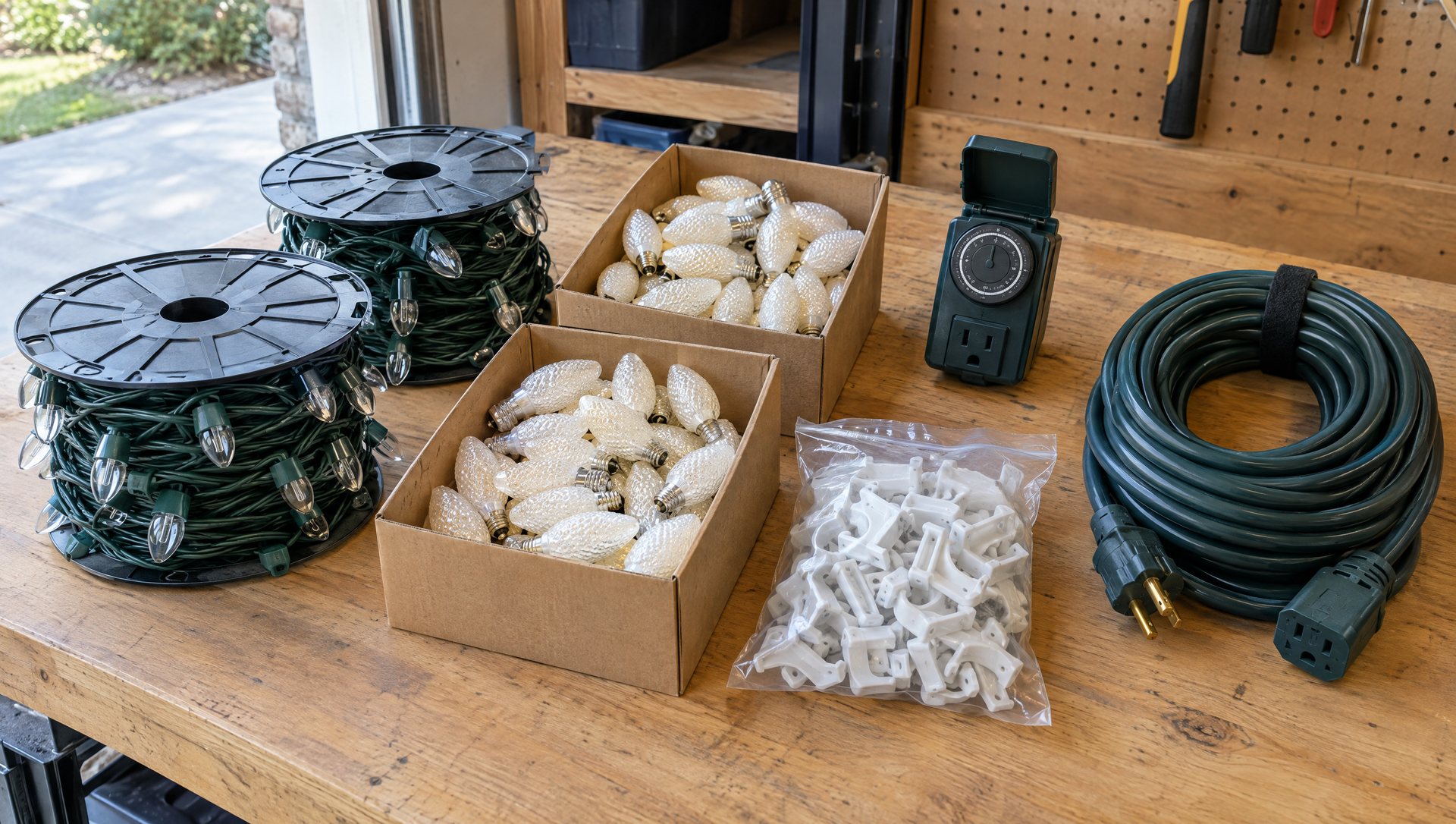
Why it matters. A full-service seasonal install usually bundles design, the lights, clips, a timer, installation, service during the season, removal and storage. An install-only price covers labor to hang lights you already own. The two are not comparable.
Ask each installer to confirm these items:
- Which parts of the house are lit, and roughly how many feet of roofline. A quote for “front roofline” may or may not include the gables, the garage and the second-story peaks.
- The lights themselves, the clips, the extension cords and a timer.
- Service calls during the season.
- Removal, and by what date.
- Storage between seasons, if the installer keeps the lights.
- Whether sales tax is included in the total.
Good: a written quote that lists the areas, the light type and color, and the services, with one total. Weak: a single number in a text message. Ask for the breakdown.
4. Who owns the lights, and where do they go in January?
Why it matters. Ownership decides what you are paying for and what next year looks like. There are two common models.
- Service or lease model. The installer supplies the lights, takes them down, stores them and brings them back next year. You are paying for a lit house each season. If you switch companies, the lights stay with the installer.
- Customer-owned model. You buy the lights, often custom-cut to your roofline, and pay for installation and removal each year. The first year costs more. You store them, or pay for storage, and you can take them to another installer.
Neither model is wrong. The mistake is comparing a first-year customer-owned price against a service price as if they were the same purchase. The trade-offs, with worked costs, are in do Christmas light installers provide the lights?
A good answer. One clear sentence: who owns the lights, who stores them, and what the second-year price is based on.
A weak answer. “We’ll sort that out in January.”
What lights and clips will the installer use on your roof?
Two things decide whether the line looks straight and whether your roof is untouched in January: the lights and the clips.
5. What lights will you use on my house?
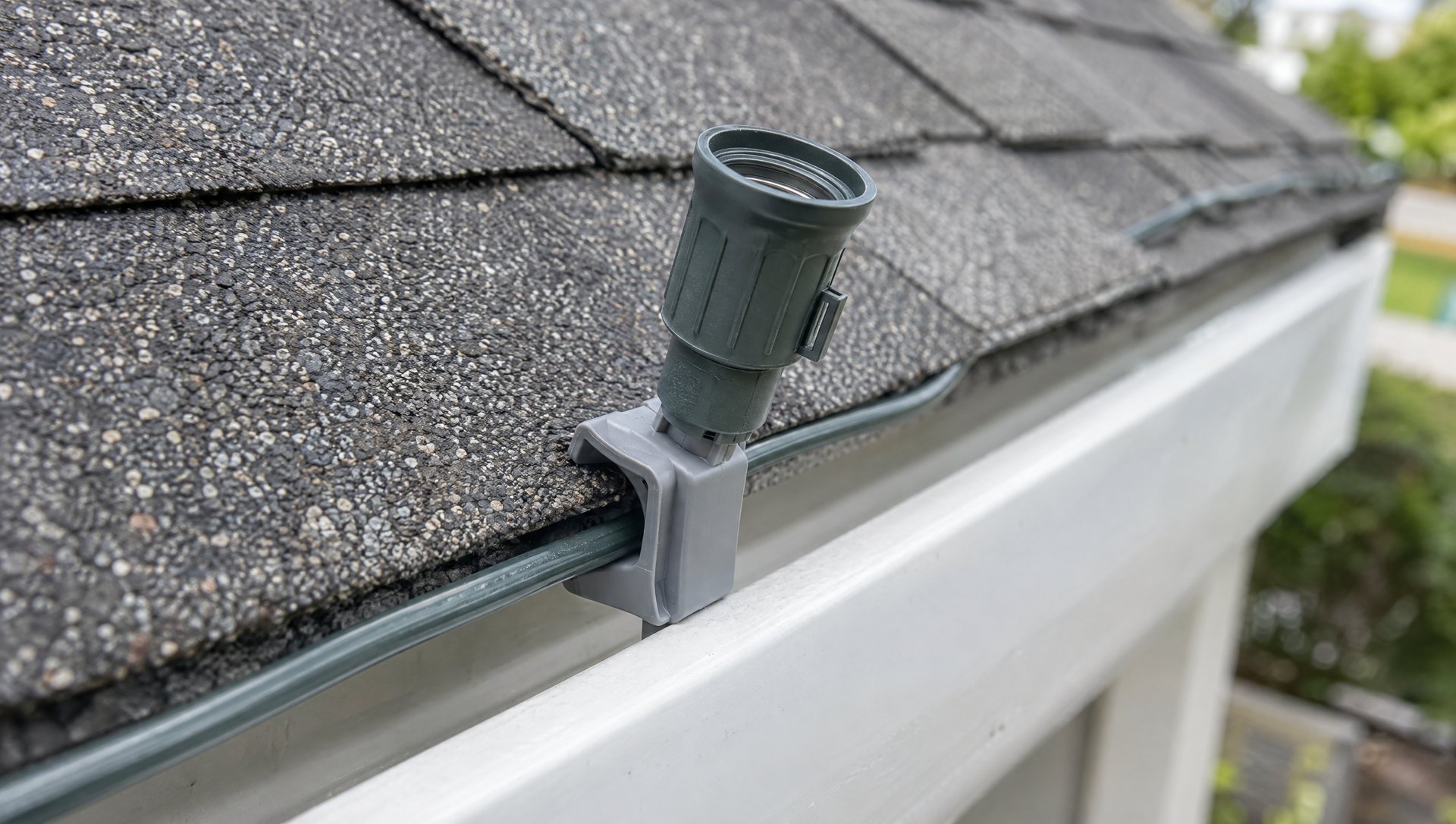
Why it matters. Professional roofline work is usually C9 LED bulbs screwed into wire that is cut to the length of each roof section. There is no slack, no dark extra bulbs tucked behind a gutter, and a single bulb can be swapped. Store-bought sets come in fixed lengths.
Mini lights for trees and bushes differ in another way. Pro suppliers describe commercial mini-light strings as one-piece, with the bulb sealed into the socket to keep water out, and retail sets as two-piece with removable bulbs. One pro supplier, Christmas Designers, estimates retail sets last about 2 to 3 seasons and a top commercial set about 5 to 6 seasons when it is taken down each year (its 2025 support page; an older article said 6 to 7). Those are a seller’s estimates, not test results.
Good: the bulb type, the spacing, the color (warm white, cool white or a mix) and whether runs are cut to fit. Our guide to C9 Christmas lights explains the roofline bulb, and LED vs incandescent Christmas lights covers the bulb technology. Weak: “commercial-grade LEDs” and nothing else. That phrase has no fixed meaning, so ask what it means on your quote.
6. How will you attach the lights to my roof?
Why it matters. Lights should come off in January and leave nothing behind. That means clips, not fasteners that make holes. CertainTeed, a shingle manufacturer, says in its holiday roof guide to hold lights with plastic clips instead of nails or staples, because fasteners that puncture roofing lead to leaks.
Austin roofs make this question matter more:
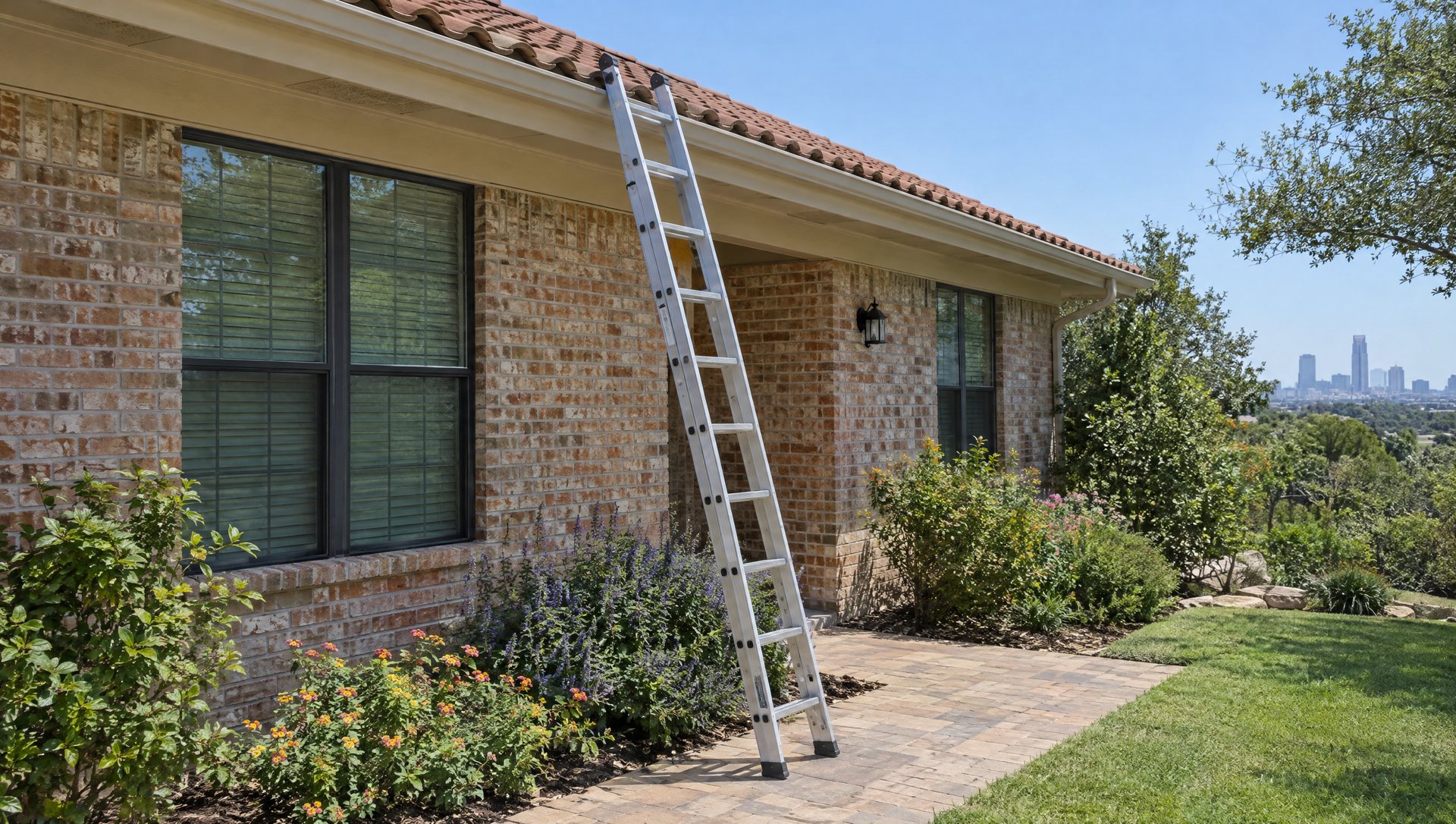
- Tile. The Tile Roofing Industry Alliance says in its roof maintenance guide that only trained professionals should walk on tile, that foot traffic can break tiles, and that holiday lights can be hung from a ladder instead. Ask how the crew reaches your roofline and whether anyone walks the tile.
- Standing-seam metal. Supplier clip guides say magnetic clips hold only on metal a magnet sticks to, such as steel. Ask what the installer uses if yours is aluminum.
- No gutters, or stone and stucco up to the eave. Many Hill Country style homes have nothing for a gutter clip to grab. Ask what holds the line and what it leaves behind.
Good: names the clip for your surface and says where the crew will and will not walk. Weak: “Whatever works when we get up there,” or no answer for the tile. For more on roof and ladder risks, see our guide to roof and ladder safety for light installation.
Can the installer wrap your trees, and how is that priced?
Tree quotes are the hardest to compare, because a wrapped live oak can use more lights than the whole roofline. Two installers can use the same words for very different amounts of work.

7. How do you wrap trees, and how is tree work priced?
Why it matters. Here is what the terms mean in this guide:
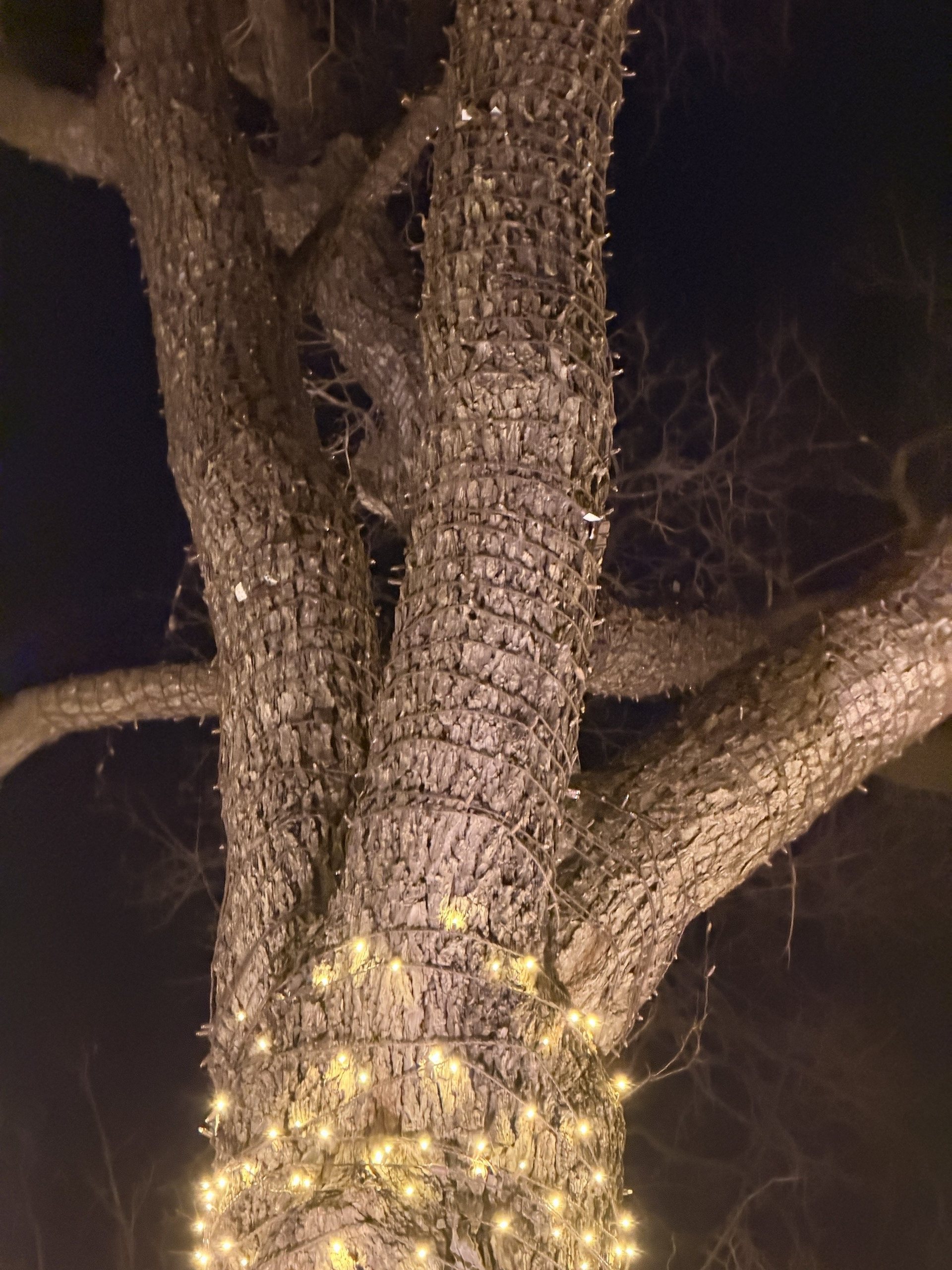
- Trunk wrap. A light string spiraled up the trunk from the base to where the limbs start.
- Trunk-and-limb wrap. The same spiral, continued out along the main limbs.
- Canopy lighting. Lights carried into the smaller branches above the main limbs. Installers use this term loosely, so ask what they mean by it.
Most homeowners expect a tree price based on height. The footage comes more from how big around the trunk is, how many limbs get wrapped and how close together the wraps are.
Example. A trunk 24 inches across is about 6.3 feet around. Wrapped with 3 inches between rows, that is 4 rows per foot of height, or about 25 feet of lights for every foot you go up. Six feet of trunk takes about 150 feet of lights. Open the spacing to 6 inches and the same trunk takes about 75 feet. Two installers can both say “trunk wrap” and be quoting twice the lights. The cost to wrap a tree in Christmas lights turns that footage into price ranges by tree size.
So ask each installer:
- Which trees, and trunk only or trunk and limbs?
- How far up, and how far out on the limbs?
- What spacing between wraps?
- What is the price unit: per tree, per strand or per foot?
- Will the lights come off after the season?
That last one protects the tree. Davey Tree’s arborists write that lights wrapped around branches and left in place will eventually girdle them as the tree grows. A seasonal wrap should come off every year. Nothing should be nailed or screwed into a tree, and any small staples used to hold a wrap should come out with it. On oaks, ask for a staple-free wrap.
One more check for trees near the street. The Electrical Safety Foundation’s outdoor decorating guidance says to keep yourself and your equipment at least 10 feet from power lines. If a limb runs near a line, a careful installer will leave that limb dark.
A good answer. Names the trees, the wrap type, the spacing and the unit price, and says the wrap comes off in January. This matters for live oaks and for crape myrtles (also spelled crepe myrtles), which have several thin trunks to wrap instead of one. Live oaks get their own guide: Christmas lights on live oak trees.
A weak answer. “Trees are $X each,” with no coverage or spacing. It may be a fair price. You cannot tell what it buys.
If trees are the main thing you want lit, say so in your first message and send a photo of each tree.
What happens if the lights go out, or something gets damaged?
Lights sit outdoors for weeks in wind, rain and the odd freeze. On some houses something will need attention. Ask now what the installer does when that happens.
8. What happens if lights go out mid-season?
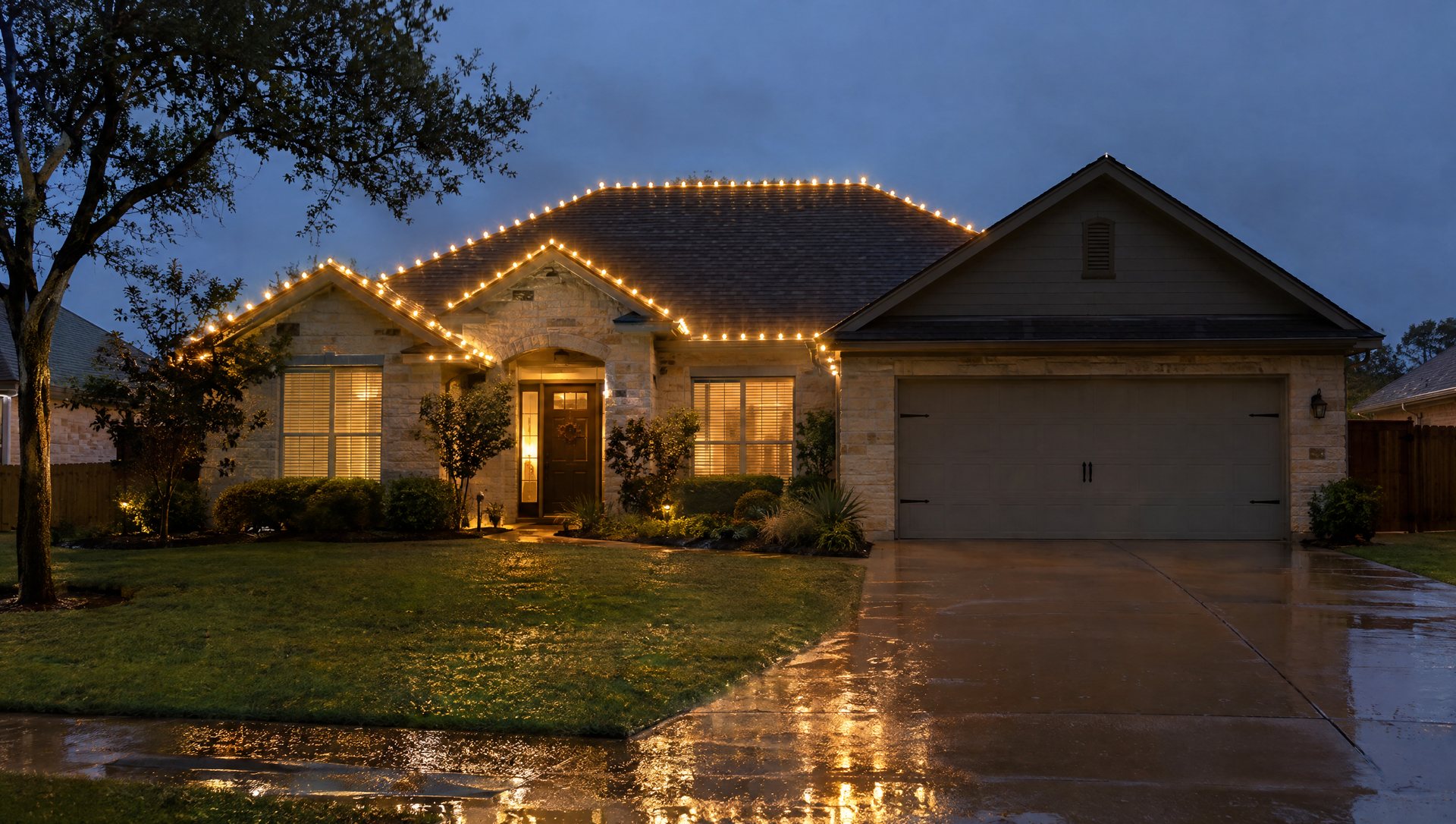
Why it matters. A dark section the week before Christmas arrives when crews are busiest. Often the cause is not a bad bulb. Outdoor outlets are GFCI-protected, and one pro supplier, Christmas Designers, notes that a little moisture in an outlet or cord connection is enough to trip one. That cuts power to everything plugged into it.
So ask where the lights plug in, whether a timer is included, and what to do when an outlet trips. A careful installer shows you the outlet’s reset button before leaving. If an outlet keeps tripping, that is a reason to call, not something to work around.
Good: says who to contact, how (a text with a photo is typical), how soon someone comes, whether the visit costs anything, and what is not covered. Common exclusions are a timer someone unplugged, or damage from a yard crew or a storm. Ask for the response time in writing. Weak: “Just call us.” Ask what happens after you call.
9. What happens if something gets damaged?
Why it matters. The usual damage is small: a cracked tile, a bent gutter, a broken sprinkler head under a ladder foot.
Good: a process. They tell you when it happens, document it with a photo, and repair or pay for it. Weak: “That doesn’t happen with us.” Nobody who works on roofs for a living can promise that.
Take your own photos of the roofline, gutters and beds before the install. Do it again after removal.
When will the installer put the lights up and take them down?
Get three dates in writing: the install week, the lights-on date and the removal window.
10. When will you install, and when do the lights come down?
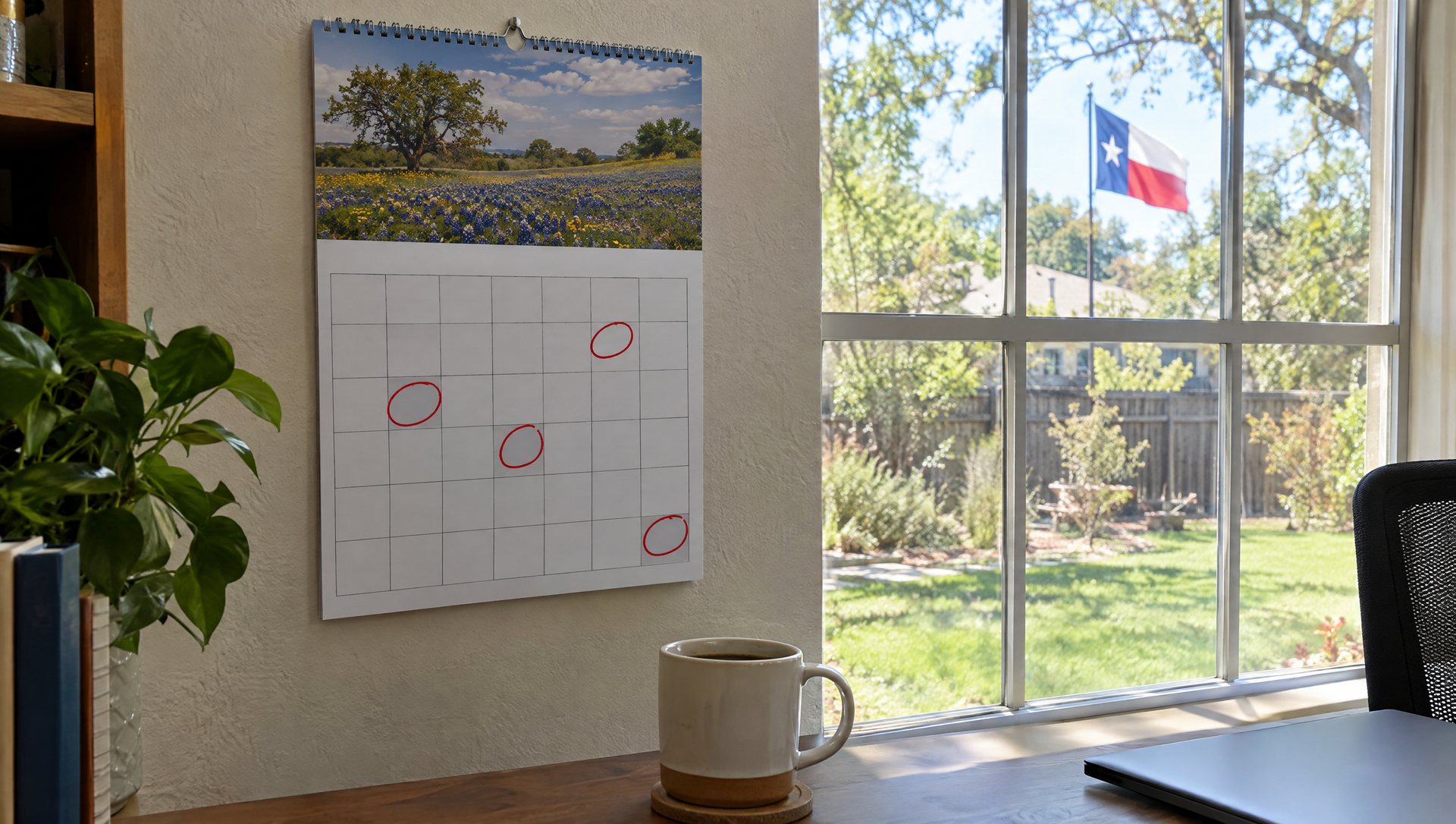
Why it matters. Many people want the lights on by Thanksgiving weekend. Thanksgiving is November 26 in 2026. Installers work through October and November to get there, and some put lights up early and turn them on later. Ask whether yours does. The Austin holiday lighting timeline lays out the season week by week, and Christmas lights before Thanksgiving covers the early-install question.
Get the removal date too. If you live in an HOA, find its rule on holiday decorations before you sign, because the deadline is yours to meet, not the installer’s. No state law sets a takedown date. Your association’s recorded rules do, if it has any.
Good: an install week, the date the lights turn on, a removal window, and what happens when rain moves the schedule. Weak: “Sometime in January.” Ask for the latest date, and compare it with your HOA’s.
How much should you pay up front, and can you cancel?
A deposit is normal. Paying everything before any work is where the consumer agencies draw the line.

11. How much is due up front, and when is the rest due?
Why it matters. The Texas Attorney General’s guidance on hiring contractors says that in most cases a contractor will ask for partial payment in advance, and that you should not pay in full until the work is complete and you have inspected it. The Federal Trade Commission’s home improvement advice says not to pay the full amount up front and to be wary of anyone who takes only cash.
Neither agency gives a percentage, and we found no public source that sets a standard deposit for seasonal lighting. Seasonal lighting is different in one way: the service runs past install day, because removal is part of what you bought. Some full-service companies ask for the balance on install day, before removal has happened. That is a term to weigh against the rest of the answers, not proof of a scam.
A good answer. A written schedule: how much holds the date, when the balance is due, and a traceable way to pay (card or check). Balance after you have seen the lights on is the most buyer-friendly version.
A weak answer. The full amount in cash before any work, with no written quote and no receipt.
12. Will you put all of it in writing, and what are the cancellation terms?
Why it matters. The Texas Attorney General’s advice is to get a written contract that says what will be done and when, to not sign anything with blanks, and to keep a copy. For Christmas lights, one or two pages holding the answers to questions 3 through 11 will do.
Do not count on a legal right to cancel. Two separate laws can apply, and neither covers every sale.
- The federal Cooling-Off Rule. The FTC’s rule gives three business days to cancel certain sales made at the buyer’s home ($25 or more) or at other places away from the seller’s regular place of business ($130 or more). The FTC says it does not cover sales made entirely online, by mail or by phone.
- Texas Business and Commerce Code chapter 601. The Texas statute has its own test for sales over $25 that a merchant solicits in person away from its place of business. The deadline is midnight of the third business day after signing.
A quote built from photos and accepted by email may fit neither law. Your contract and, for a dispute, a Texas attorney answer your case.
Good: the installer’s own cancellation terms, written into the agreement: how to cancel, by when, and what happens to the deposit. Weak: “We don’t really do contracts.” A quote you accept in writing is what you will both point to later. Make sure the terms are on it.
How do you read installer reviews and photos?
Reviews help most when you read them for specifics instead of counting stars. The FTC’s guidance on evaluating online reviews makes the point that you cannot reliably spot a fake review by reading it, so it suggests checking the pattern around the reviews instead. Applied to light installers:

- Use more than one site. Compare Google with at least one other platform.
- Check the dates. This is seasonal work, so reviews should cluster from November to January, across more than one year if the company says it has been around that long. A burst of reviews within a few days is one of the patterns the FTC says to watch for.
- Look at the reviewers. The FTC suggests looking at what else a reviewer has written. One single-review profile proves nothing. A page full of them is a pattern.
- Remember incentives. The FTC notes that some reviewers get something in return for a review.
- Read the middle and the bottom. This one is our own judgment, not the FTC’s. Three-star reviews and the company’s replies to complaints tell you how problems get handled.
A new company with few reviews is not a bad company. With a newer company, rely more on the certificate, the written scope and the payment terms.
What to look for in an installer’s photos
Ask for the installer’s own photos of a house like yours: same number of stories, same roof type, and trees if you want trees. In those photos, look for straight lines along the eave, even bulb spacing, bulbs pointing the same way and no loose wire across windows or down walls. A daytime photo shows this better than a night one. You can judge ours the same way in photos of our Austin installs.
What should a good installer ask you?
The questions an installer asks you are a fair test of how the job will go. A quote given without them is a guess. Expect most of these before a firm price:

- Which sides of the house do you want lit, and from where will people see it?
- How many stories, and what is the roof made of?
- Where are your outdoor outlets, and do they work?
- Which trees and bushes, and how much of each?
- What date do you want the lights on, and is there a party or event behind it?
- Do you have an HOA, and does it have rules on dates or colors?
- What look do you want: warm white, cool white, color, or a mix? Colored vs white Christmas lights can help you decide.
- Is there anything about access we should know, such as gates, dogs or a steep lot?
You can answer most of these before anyone asks. Which photos to send for a quote lists the photo set and notes that let an installer price your house without a visit.
What are the red flags when hiring a Christmas light installer?
These red flags come from the Texas Attorney General’s and the FTC’s contractor guidance, plus our own judgment where marked. One alone is a reason to ask more questions. Several together are a reason to move on.
| Red flag | Why it matters | Basis |
|---|---|---|
| Full payment before any work | You have nothing to hold back if the crew does not show. | Texas AG, FTC |
| Cash only | No record and no way to dispute the charge. | FTC |
| No written scope, or a contract with blanks | You cannot hold anyone to what was said on the phone. | Texas AG |
| Will not send a certificate of insurance | A claim of coverage with no document is a claim you cannot check. | FTC (ask for proof of insurance) |
| No business you can look up | A registered Texas company can be searched by name on the Texas Comptroller’s franchise tax account search. A sole owner may not appear there, so ask for the legal name and a mailing address. | Our judgment |
| Pressure to sign today | An installer’s schedule can be tight in November. A day to read the quote is still a fair ask. | FTC |
| A bid far below the others | The Attorney General says to be wary of one. Ask what it leaves out before you rule it in or out. | Texas AG |
| Offers to add an outlet or wiring without naming an electrician | That is licensed electrical work in Texas, and it needs a permit in Austin. | Occupations Code ch. 1305 |
On low bids, some context helps. Of the five Austin-area installers we found publishing prices in October 2026, the two that state a minimum set it at $450 and $500 for full-service work, and none starts lower. A quote well under that may be install-only or a smaller scope, not a scam. Ask which.
Things that are not red flags
- A quote from photos. Clear daytime photos are enough for most rooflines. A site visit makes more sense for large trees and big properties.
- A price above a national average. National averages on cost sites mix small install-only jobs with full-service ones.
- A no on part of your plan. An installer who will not walk your tile roof or wrap a limb near a power line is showing judgment.
How to compare two or three quotes on one page
Put the answers in one table. Copy this worksheet, fill a column for each installer, and leave a cell blank when you did not get an answer in writing. Blanks are what to ask about before you sign.

| Item | Installer A | Installer B | Installer C |
|---|---|---|---|
| 1. Liability certificate received, dates cover install and removal | |||
| 2. Who does the work, and how they are covered | |||
| 3. Areas lit and feet of roofline | |||
| 4. Who owns the lights; storage | |||
| 5. Light type, spacing and color | |||
| 6. Attachment method for my roof | |||
| 7. Trees: which ones, wrap type, spacing, price unit | |||
| 8. Service response time and exclusions | |||
| 9. Damage process | |||
| 10. Install week, lights-on date, removal window | |||
| 11. Deposit and when the balance is due | |||
| 12. Cancellation terms in writing | |||
| Total price, and whether tax is included |
Fill in the price row last. Once rows 3, 4 and 7 match across the columns, the totals mean something. Until they match, a lower total may only be a smaller job.
How Sapien answers these questions
Sapien Lighting & Installation is one of the Austin installers you might be comparing, so here are our answers to the parts of the list we can state here. Hold them to the same standard, and ask us the rest in writing along with your quote.
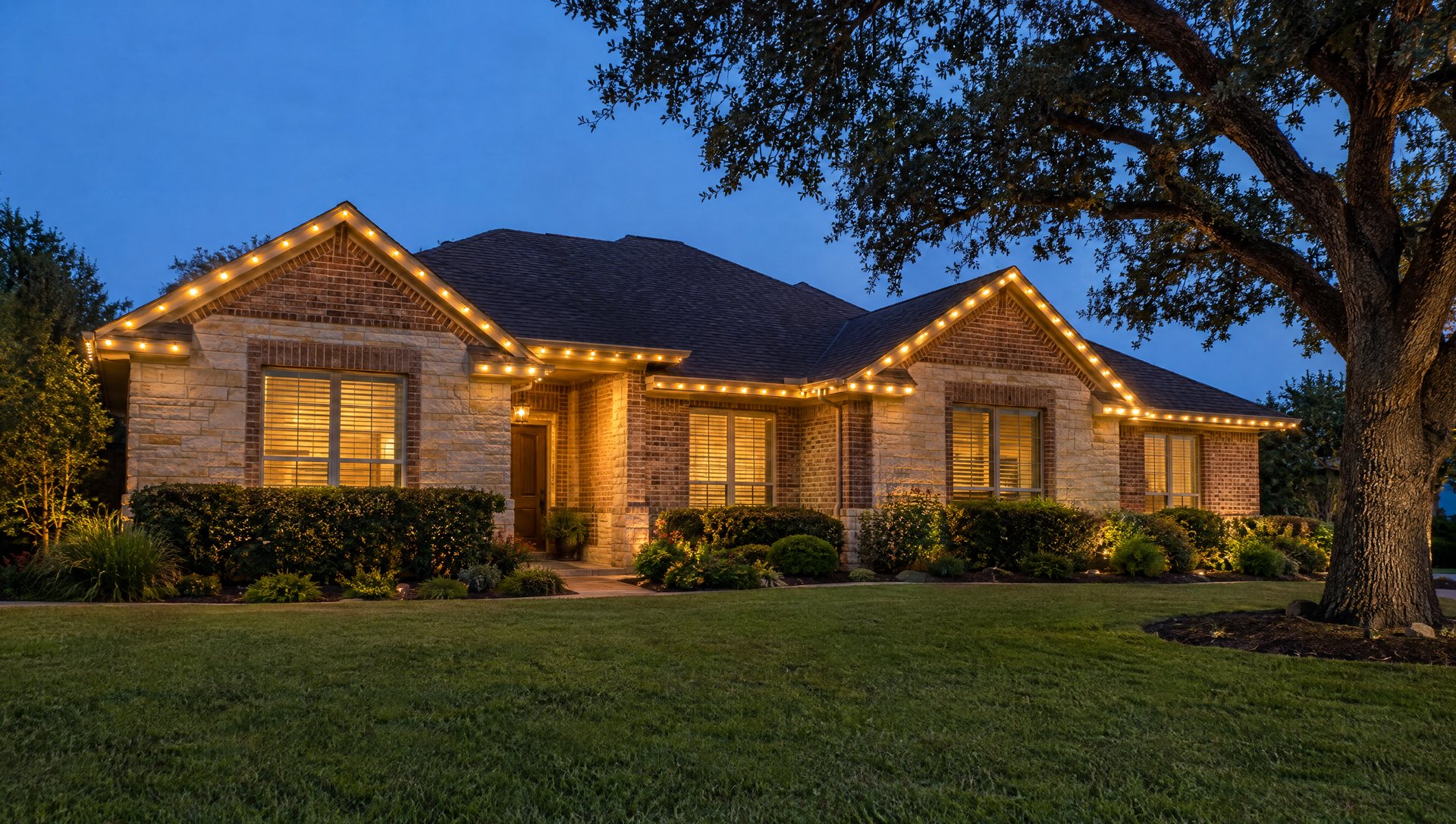
- What every install includes (question 3): a custom design, commercial-grade lights and clips, installation, repairs if anything goes dark during the season, and takedown in January.
- Removal (question 10): takedown happens January 2 to January 15.
- Deposit and payment (question 11): a 50% deposit books your install date, and the balance is due after the lights are up.
- Minimum job: $500.
- Insurance (question 1): Sapien is fully insured.
- Electrical work: we install plug-in seasonal lighting only. We do not add outlets, circuits or hardwired fixtures. If your house needs an outlet, that is a job for a licensed electrician.
- Quotes: from daytime photos you text to (737) 777-9099 or send through the contact page.
For the insurance certificate, crew coverage and who keeps the lights (questions 1, 2 and 4), ask us exactly as you would ask anyone else, and expect the answer in writing.
When is hiring an installer the wrong call?
Hiring is not the right answer for every house. If your home is one story with low eaves, you already own good lights, and you are steady on a ladder, doing it yourself is a reasonable Saturday. You give up the custom fit and the takedown service, and you keep the installer’s fee. How to hang Christmas lights outside walks through it, and DIY vs professional Christmas lights cost runs the numbers.
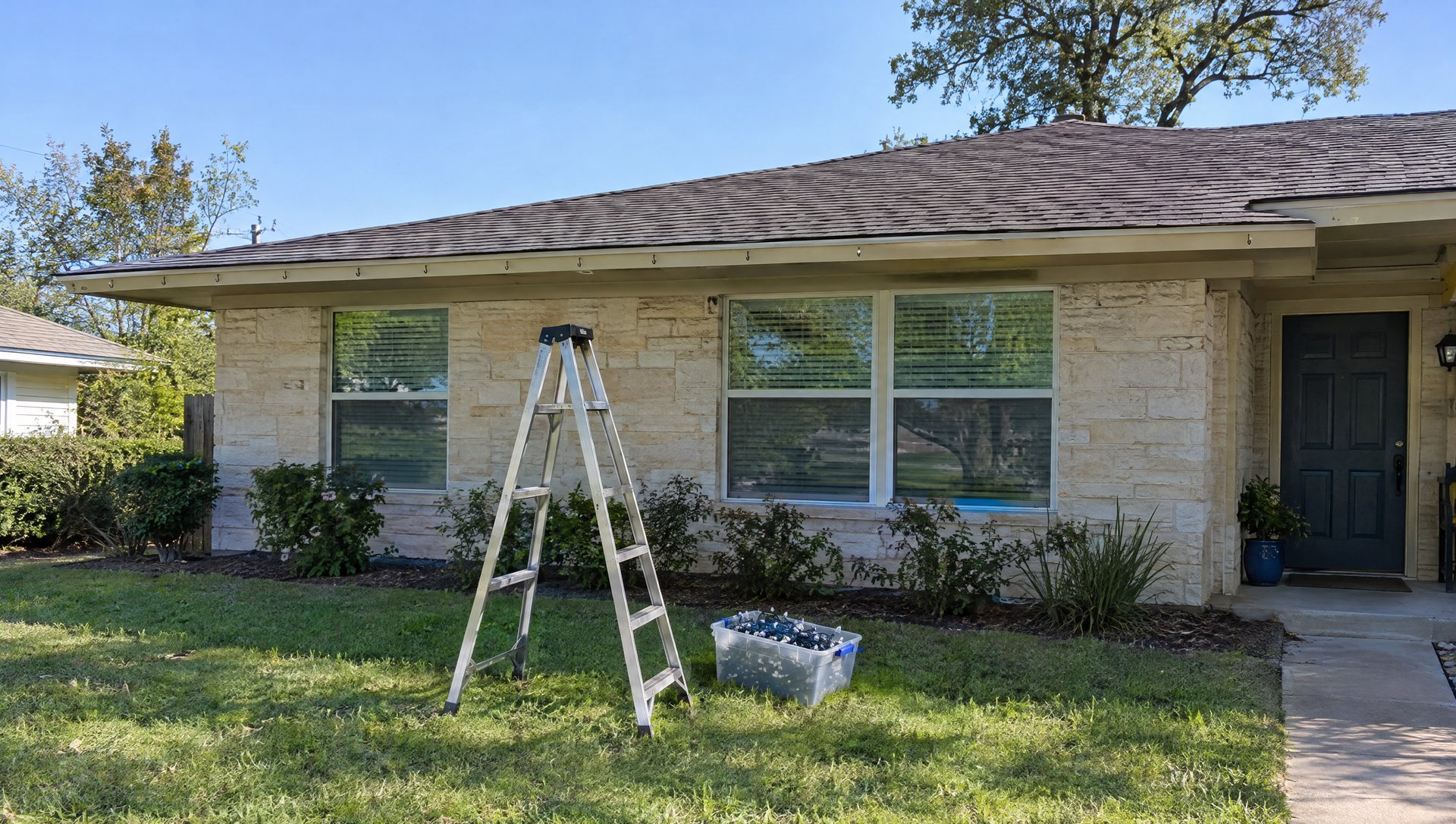
Know the risk first. The Consumer Product Safety Commission’s estimate is that about 14,900 people went to emergency rooms with holiday decorating injuries between November 1, 2022 and January 31, 2023, the most recent season it had published when we checked in October 2026. That number covers all decorating, indoors and out. CPSC says nearly half of the injuries involve falls.
We would not do these parts yourself:
- A tile roof that someone would have to walk on. The Tile Roofing Industry Alliance says to leave that to trained professionals. We would treat a metal roof the same way.
- Two-story peaks you cannot reach from a ladder on firm, level ground.
- Any part of the job within 10 feet of an overhead power line. Leave that part dark, whoever does the work.
Two other cases: if the house needs a new outlet, call an electrician first. And if you expect to pay for a seasonal install every year for many years, compare it against a permanent system. Our guide to the cost of permanent Christmas lights covers that option.
Ready to compare? Text a few daytime photos of the front of your house to (737) 777-9099, tell us which parts and which trees you want lit and the date you want them on, and hold our quote to the same 12 questions as the others.
Frequently asked questions
Does it matter how long a Christmas light installer has been in business?
Less than the paperwork does. We would pick a new company with a current certificate, a written scope and fair payment terms over an older one that will not put its answers in writing.
Will an installer hang lights I already own?
Some will and some will not. Some full-service installers only hang lights they supply. Ask up front, and expect any service promise to be narrower on your own lights.
How far ahead should I book a Christmas light installer in Austin?
Ask each installer for its current lead time and its last date for a pre-Thanksgiving install, and get the install week in writing. Thanksgiving is November 26, 2026. Tree wrapping takes the most crew time, so mention trees in your first message.
Should I tip Christmas light installers?
Tipping is optional. Angi’s guide to hiring a light installer says installers do not expect a tip, though one is appreciated. The Emily Post Institute’s holiday tipping guide has no entry for light crews.
Sources
- Texas Department of Licensing and Regulation: programs licensed and regulated by TDLR (no program for holiday-light installers; read October 2026)
- Texas Occupations Code chapter 1305 (electrician licensing; the holiday-lighting exemption in section 1305.003(a)(13))
- City of Austin Code chapter 25-12, article 4, Electrical Code (permit exemption for temporary holiday decorative lighting; permits for new receptacles and circuits)
- TDLR license search (checking an electrician’s license)
- Texas Department of Insurance: commercial general liability insurance (what general liability covers and does not cover)
- Texas Insurance Code chapter 1811 (what a certificate of insurance is and its limits)
- Texas Department of Insurance: certificates of insurance (approved certificate forms, including ACORD 25)
- Texas Department of Insurance: workers’ compensation insurance guide (coverage is optional for most private employers; alternative policies)
- Texas Department of Insurance: workers’ compensation coverage verification (employer coverage lookup)
- Christmas Designers, a pro lighting supplier: blog articles on retail versus commercial Christmas lights, on how long LED Christmas lights last, on choosing light clips, and on GFCIs and Christmas lights, and its support page on year-round lighting expectations (updated about 2025), read October 2026 (one-piece and two-piece construction; its estimate of seasons of service; magnetic clips hold on steel only; moisture trips GFCI outlets)
- CertainTeed: holiday roof safety (clips instead of nails or staples on shingles)
- Tile Roofing Industry Alliance: roof maintenance guide (walking on tile; hanging lights from a ladder)
- Davey Tree: keeping outdoor tree lights on year round (wrapped lights left in place girdle branches)
- Electrical Safety Foundation: outdoor decoration safety tips (10 feet from power lines)
- Texas Attorney General: how to avoid home improvement scams (partial payment, written bids, low bids, written contracts)
- Federal Trade Commission: how to avoid a home improvement scam (payment, cash-only, estimates, proof of insurance, pressure to decide)
- Federal Trade Commission: the Cooling-Off Rule (three business days, thresholds, exclusions)
- Texas Business and Commerce Code chapter 601 (Texas right to cancel certain sales)
- Federal Trade Commission: how to evaluate online reviews (review patterns to check)
- Texas Comptroller: franchise tax account status search (looking up a registered entity by name)
- Consumer Product Safety Commission: holiday safety release, November 19, 2024 (decorating injury estimate)
- Angi: hiring a pro to hang Christmas lights (tipping is optional)
- Emily Post Institute: holiday tipping guide (no entry for light crews; read October 2026)
About the author. Rick Safeman owns Sapien Lighting & Installation in Austin, Texas.