


The history of Christmas lights is shorter and stranger than most retellings make it. People have lit fires and lamps in midwinter for as long as there are records, but lights on a Christmas tree are a few centuries old, and electric Christmas lights are barely 140. In that time the industry went from a single executive’s parlor in Manhattan to strings sold at every hardware store, and from 7-watt glass bulbs to LED systems that stay on a roofline all year.
This is the fact-checked version, era by era. Along the way it corrects several claims that get repeated online, and it includes the Austin chapter: a city that hangs its official Christmas tree from a 19th-century moonlight tower.
Before Electricity: Candlelit Trees (1500s to 1800s)
Midwinter festivals of light are ancient. Romans marked Saturnalia in December, and many northern European cultures lit fires around the solstice. It is tempting to draw a straight line from those fires to the lights on your gutter, but the documented history of the Christmas tree itself starts much later, in the German-speaking lands of the 16th century.
The early records are about trees, not lights:
- A record from Sélestat in Alsace dated December 21, 1521 is often cited as the first written mention of a Christmas tree.
- Strasbourg Cathedral had a tree in 1539.
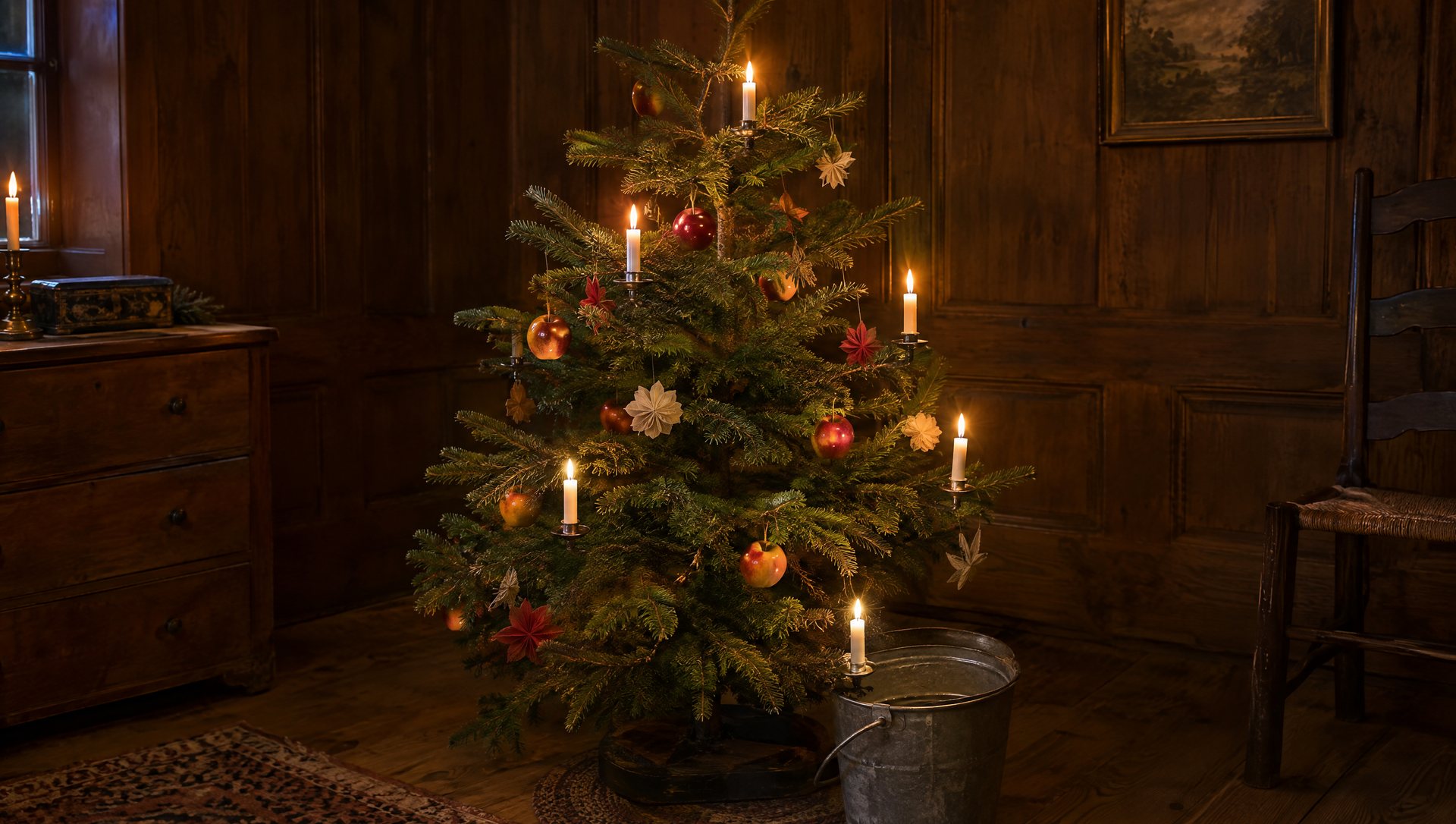
- A 1597 record from Türckheim, also in Alsace, describes trees decorated with apples, gingerbread, sugar candy and paper flowers. No candles yet.
Candles come into the written record a little later. One of the most-quoted early references is a 1708 letter from Liselotte von der Pfalz, the German-born Duchess of Orléans, describing a boxwood tree with a candle on every branch, a custom from her native Palatinate. Moravian communities were also known for lighting candles on their trees.
The popular story that Martin Luther invented the lit tree after seeing stars through evergreens is just that, a story. It shows up in 19th-century prints, not in anything Luther wrote.
Candles on a dry evergreen were exactly as dangerous as they sound. Families lit them for short stretches under close watch, not for hours on end. Small clip-on candleholders were common by the late 1800s. That fire risk is the single biggest reason electric lights caught on once they were affordable.
How a Royal Engraving Spread the Lit Tree (1848 to 1850)
German immigrants brought decorated trees to Britain and America well before the mid-1800s, but one picture did more than any immigrant family to make the candlelit tree fashionable.
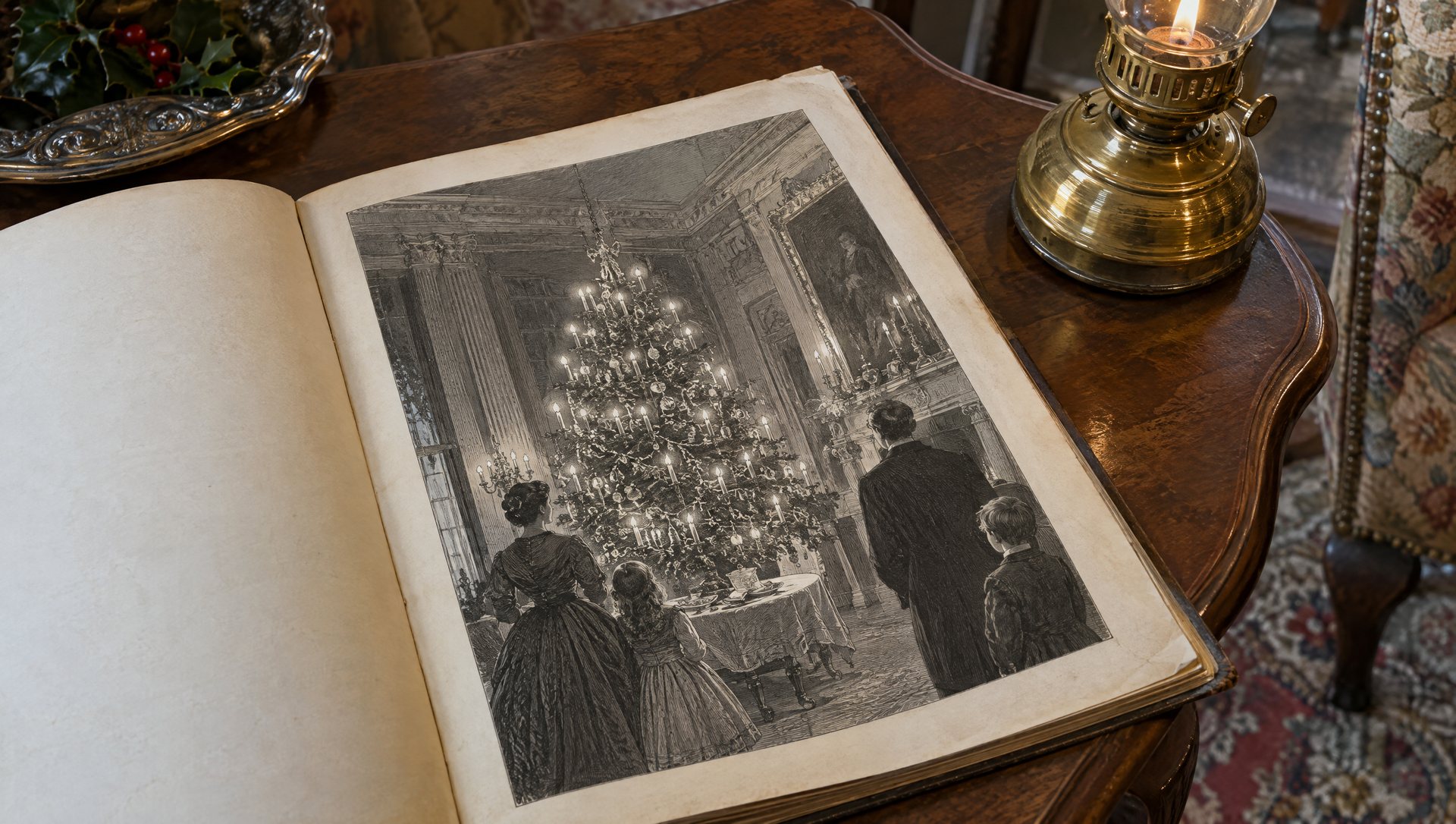
On December 23, 1848, the Illustrated London News published an engraving of Queen Victoria, her German-born husband Prince Albert, their children and the Queen’s mother gathered around a tabletop tree covered in candles at Windsor Castle. Two years later, in December 1850, the American magazine Godey’s Lady’s Book reprinted an adapted version, with Victoria’s tiara and Albert’s moustache removed so the family looked like a well-to-do American household. Godey’s was one of the most widely read magazines in the country, and historians credit it with spreading the decorated, candlelit tree across middle-class America in the 1850s.
The First Electric Christmas Lights (1880 to 1882)
Thomas Edison demonstrated his practical incandescent lamp at the end of 1879. During the 1880 holiday season he strung his new bulbs around the Menlo Park laboratory compound in New Jersey, where passengers on the New York to Philadelphia railroad could see them at night. It was advertising for electric light, not a Christmas tree, but it is often called the first electric holiday light display.
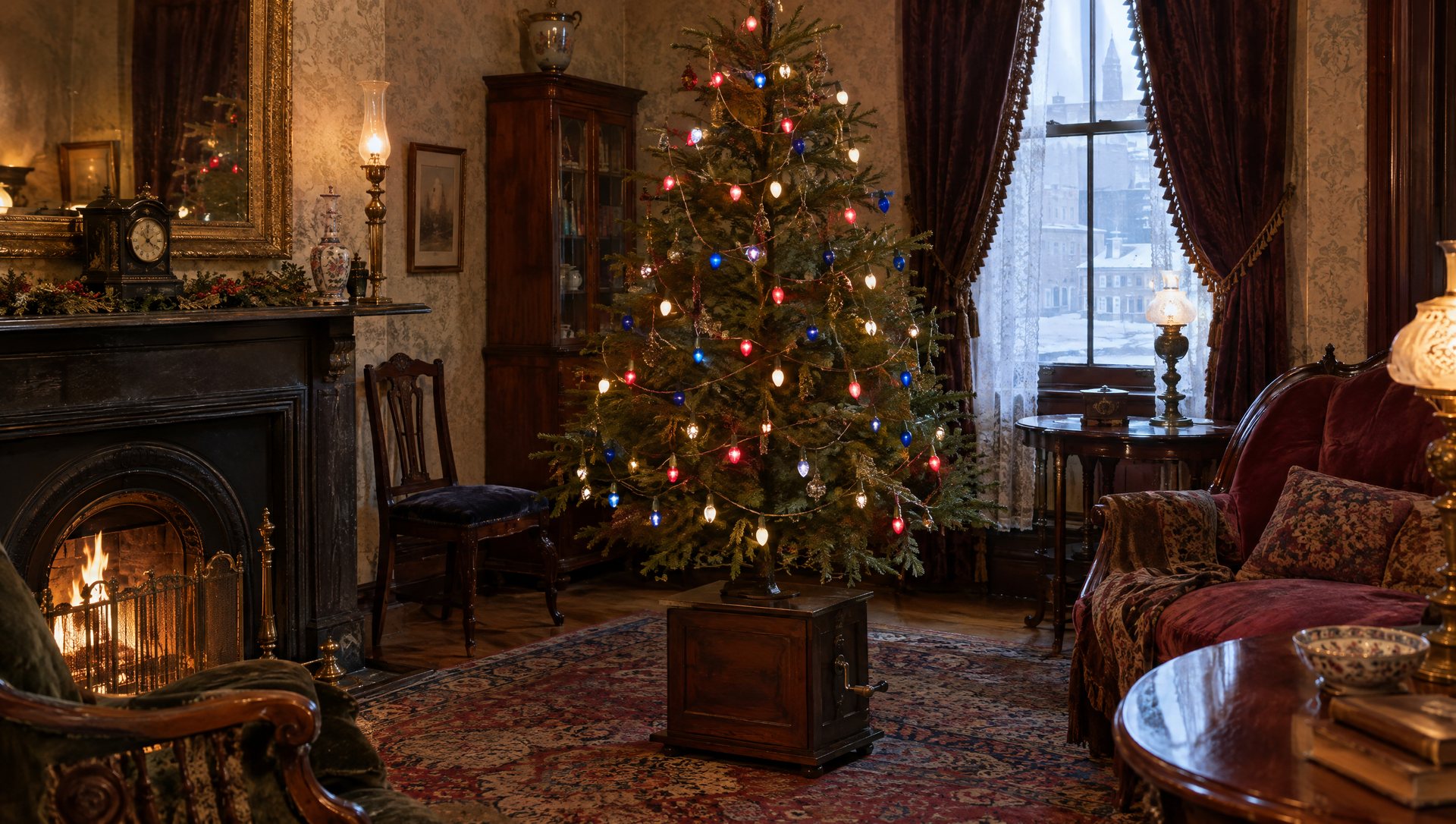
The first electrically lit Christmas tree belongs to Edward H. Johnson, a longtime Edison associate and an executive of the Edison Electric Light Company. In December 1882, Johnson hand-wired 80 small red, white and blue bulbs onto the tree in the parlor of his New York City home near Fifth Avenue. The tree sat on a rotating platform that turned about six times a minute, and another 28 lights hung on wires near the ceiling.
What we know about it comes mostly from William Croffut, a reporter for the Detroit Post and Tribune, who visited and described the bulbs as “dainty glass eggs.” Johnson’s tree did not start a craze. Few homes had electric service in 1882, and every light had to be wired by hand.
From Electricians to Store Shelves (1890s to 1920s)
For the next two decades, an electric tree was a rich family’s luxury. Wealthy households paid electricians as much as $300 a season to install and maintain lights on a single tree.
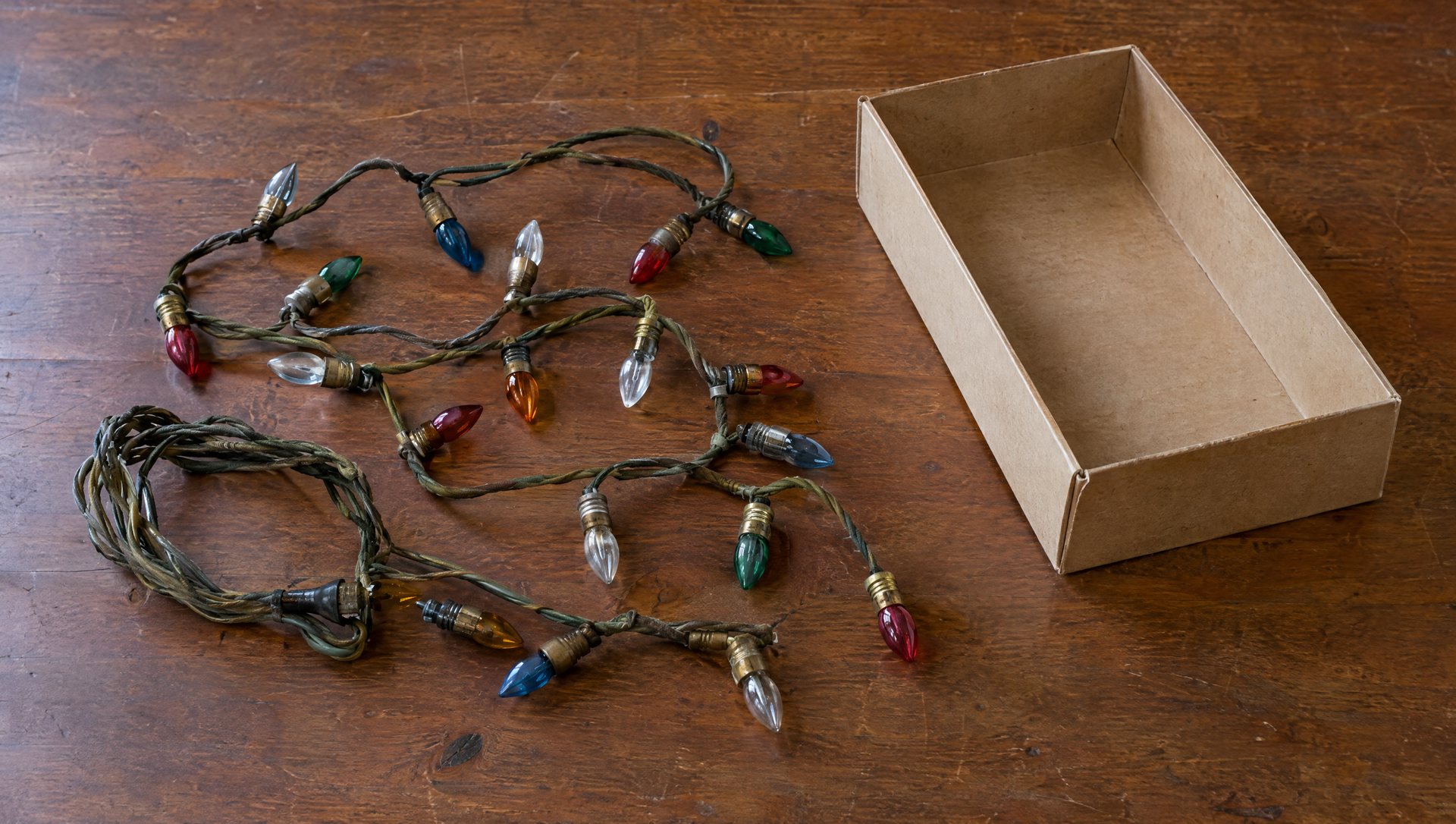
A few milestones moved electric lights toward the mainstream:
- The White House. Electricity was installed in the White House in 1891. The first electric lights on a White House family tree are usually dated to Grover Cleveland’s second term; the White House Historical Association and History.com place it in 1894, while some sources say 1895.
- Ready-made strings. General Electric began selling pre-assembled strings, called festoons, of eight sockets each. A set of three festoons cost $12, a large sum at the time, and some department stores rented them for the season instead.
- Outdoor public trees. The first recorded outdoor electrically lit public Christmas tree was in San Diego in 1904, followed by Appleton, Wisconsin in 1909 and New York City’s Madison Square in 1912.
- The National Christmas Tree. At 5 p.m. on Christmas Eve 1923, President Calvin Coolidge walked to the Ellipse and pressed a button to light a 48-foot balsam fir from Vermont, covered in 2,500 electric bulbs. The event was organized with help from the Society for Electrical Development, an industry group that understood exactly what a public demonstration could do for sales. The president has taken part in a National Christmas Tree lighting ever since.
Even so, candles held on for a long time. Electric lights did not replace candles on most American trees until around 1930, and rural households waited until electrification reached them in the 1930s and 1940s.
NOMA and the Big-Bulb Era (1925 to 1960s)
By the mid-1920s, dozens of small companies made Christmas light sets. In late 1925, a group of them, organized by Albert Sadacca and Joseph Bloch, formed a trade association called the National Outfit Manufacturers Association, or NOMA. The members merged into a single company by the end of 1926, and NOMA-branded sets were on sale for the 1927 season. NOMA became the largest Christmas light maker in the world for the next few decades.
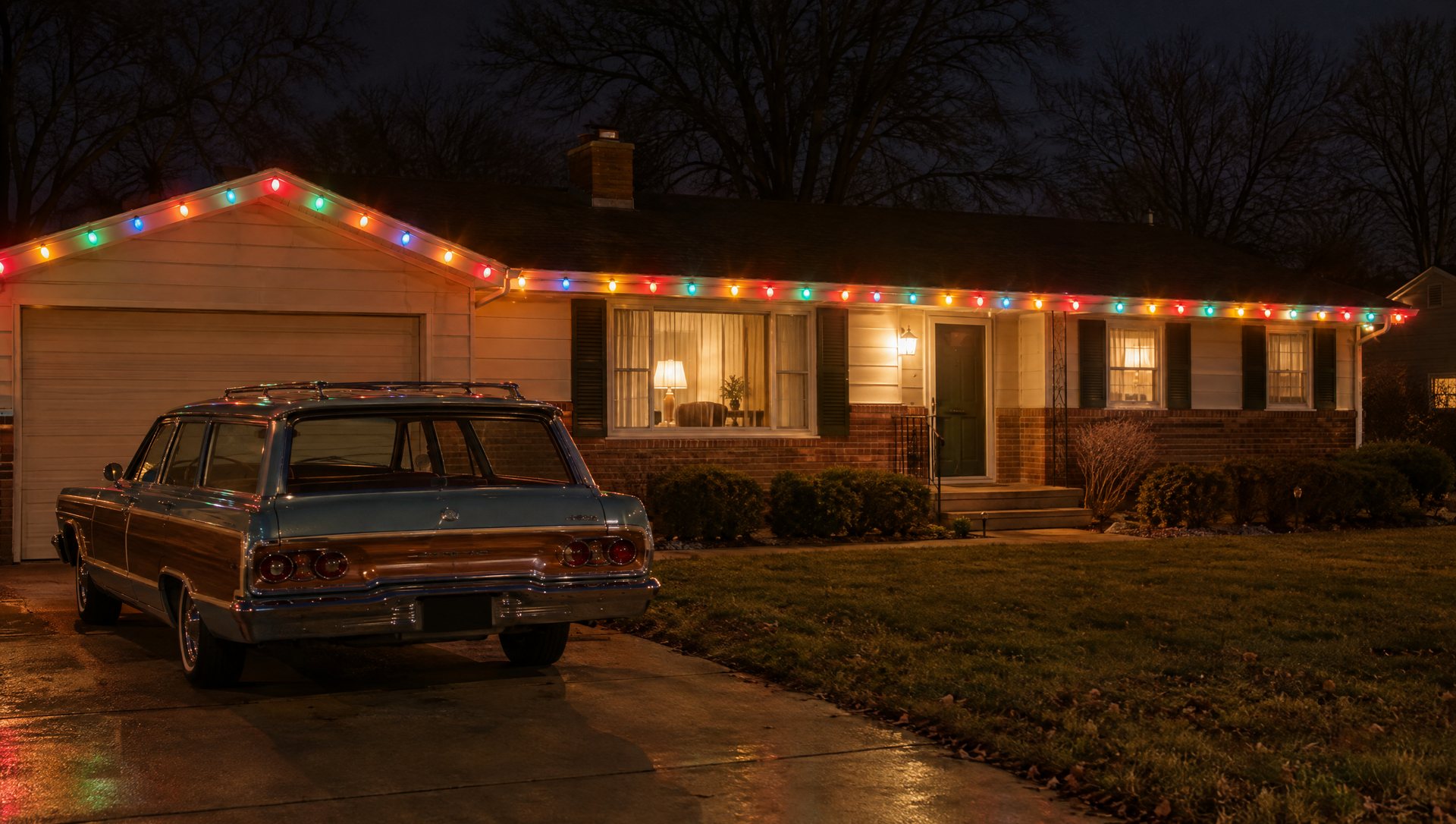
A few NOMA-era developments still shape what you buy today:
- Bubble Lites, 1946. NOMA introduced the bubble light right after World War II, when a public that had made do with old sets during the war bought nearly everything the company could make. The liquid inside, heated by a small bulb at the base, bubbles continuously.
- The C7 and C9 bulb. The large-base outdoor bulbs (the “C” refers to the cone or candle shape, the number to the diameter in eighths of an inch, so a C9 is 1 1/8 inches across) became the standard for outdoor work. A traditional incandescent C9 draws about 7 watts. Those same shapes are what commercial installers use on Austin rooflines today, just with LED guts.
- Outdoor home displays. Outdoor lighting kits were sold in quantity starting in the 1930s, and outlining the whole house became common in the 1960s, when postwar tract housing gave America miles of long, low rooflines.
- Miniature lights. Small “fairy” lights first manufactured in Italy brought much lower wattage per bulb and made dense tree wraps practical.
Imports eventually undercut the American makers. NOMA Lites filed for bankruptcy in 1965.
How Austin Lit Up
Austin’s holiday lighting history has its own landmarks, and two of them are still running.
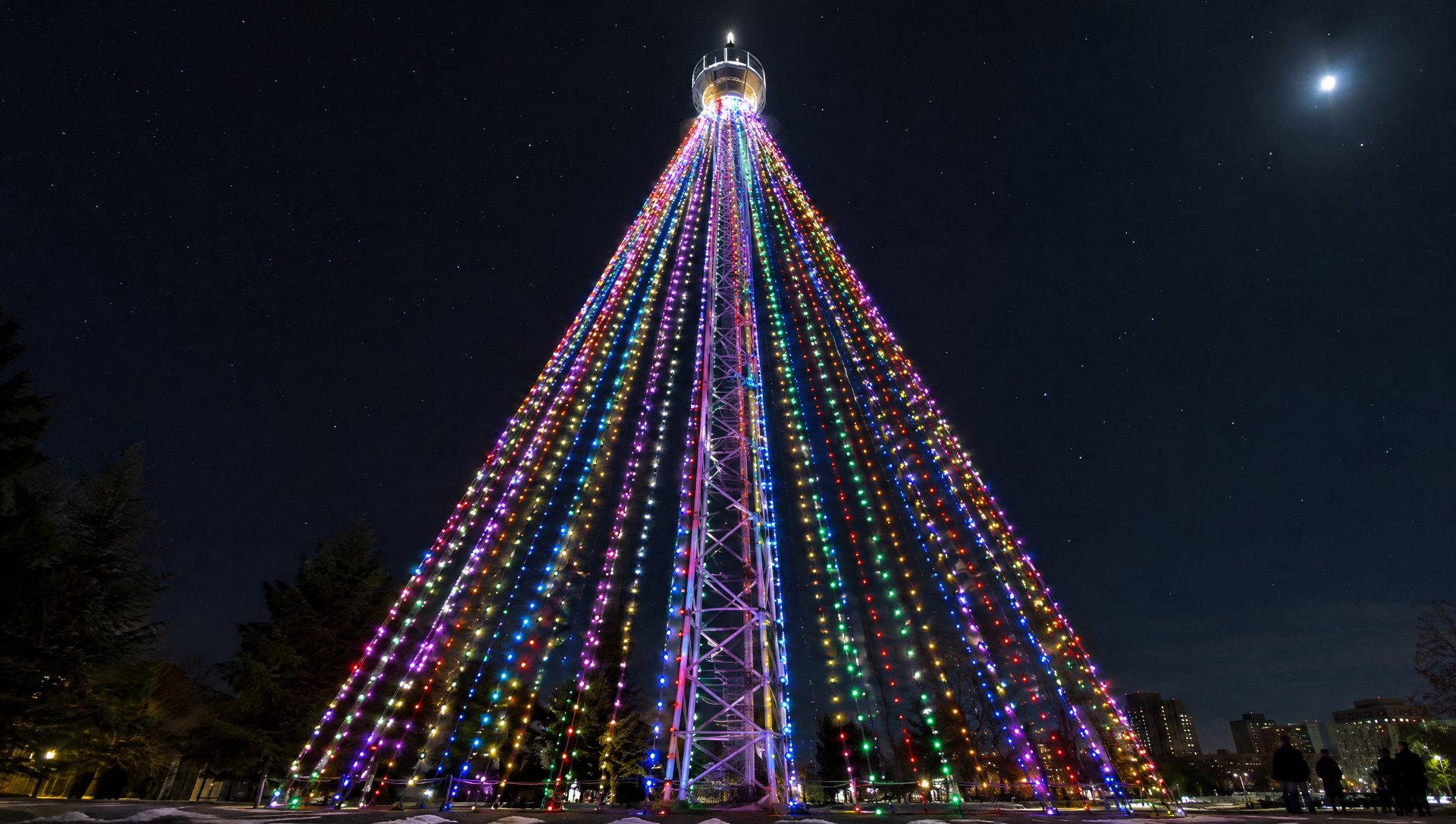
The moonlight towers. In the mid-1890s Austin put up a network of 165-foot moonlight towers, built by the Fort Wayne Electric Company and bought secondhand from Detroit according to the city, each topped with arc lamps to light whole neighborhoods from above. Austin is the only city in the world known to still have them standing and lit. The last tower was switched to LED bulbs in 2024. (For more on how the towers fit into Austin’s street lighting today, see our look at the good and bad of Austin street lights.)
The Trail of Lights, 1965. The Austin Trail of Lights began in 1965 with a Yule log gathering in Zilker Park and grew into one of the city’s oldest holiday traditions. The organizer lists the 2026 Trail of Lights for December 10 to 23 at Zilker Park.
The Zilker Holiday Tree, 1967. On December 10, 1967, Mayor Pro Tem Emma Long lit the first Zilker Holiday Tree: strands of lights hung from the top of the moonlight tower in Zilker Park to form a 155-foot cone. Today it is 39 streamers of 81 multicolored LED bulbs each, topped by a 10-foot double star with 150 frosted bulbs, 3,309 lights in all. Standing in the middle of it and looking up is a rite of passage for Austin kids.
37th Street, mid-1980s. Residents of West 37th Street, just north of the University of Texas, started covering their bungalows in lights and found objects in the 1980s, turning the block into a walking tour. The tradition faded in the mid-2000s as the original residents moved away, then came back after newer residents revived it around 2015.
Johnson's tree had 80 bulbs, with another 28 on wires near the ceiling. The Zilker total is 39 streamers of 81 bulbs plus the 150-bulb star.
Source: History.com, National Park Service and City of Austin, listed in Sources
Show the numbers
| Bulbs | |
|---|---|
| Johnson's parlor tree, 1882 | 80 bulbs |
| National Christmas Tree, 1923 | 2,500 bulbs |
| Zilker Holiday Tree, today | 3,309 bulbs |
LEDs and Smart Control (1990s to Today)
Light-emitting diodes started showing up in holiday strings in the 1990s. Early LED Christmas lights had a cold, harsh look; early white LEDs often had a bluish or yellowish cast, and many people rejected them on looks alone. The technology improved, and the economics were impossible to argue with.

The math is simple. A current LED C9 replacement bulb is rated around 0.6 watts, against about 7 watts for the incandescent C9 it replaces. On a 150-foot roofline with a bulb every foot, that is 90 watts instead of 1,050 watts: under 1 amp instead of almost 9 amps on a 120-volt circuit. Homes that used to need several circuits for a big display can now run it from one outlet. LEDs also run cool to the touch, which removes most of the heat risk that remained after candles disappeared.
150 x 7 W = 1,050 W, almost 9 amps on a 120-volt circuit. 150 x 0.6 W = 90 W, under 1 amp.
Source: Sapien Lighting calculation from the figures in this post
Show the numbers
| Watts | |
|---|---|
| Incandescent C9s | 1,050 W |
| LED C9s | 90 W |
Permanent lighting: the newest chapter
The most recent shift is permanent lighting: individually addressable RGB LEDs mounted in a low-profile channel along the roofline and controlled from a phone. The same lights do warm white for everyday, orange for Halloween, and red and green in December. Manufacturers market these systems on weather sealing; some professional brands advertise IP68 ratings for their light assemblies, and one popular DIY kit lists IP67 for its strings, with IP65 for the control box and power adapter. (What those numbers mean, and why they matter in Austin storms, is covered in our guide to IP ratings for permanent holiday lighting.)
The tradeoff is upfront cost against a lifetime of hanging and removing strings. Our breakdown of what permanent Christmas lights cost lays out what drives the price, and the permanent Christmas light installation guide covers how a proper install is done.
Myths the Internet Keeps Repeating
A surprising amount of Christmas light “history” online is wrong. These are the most common.
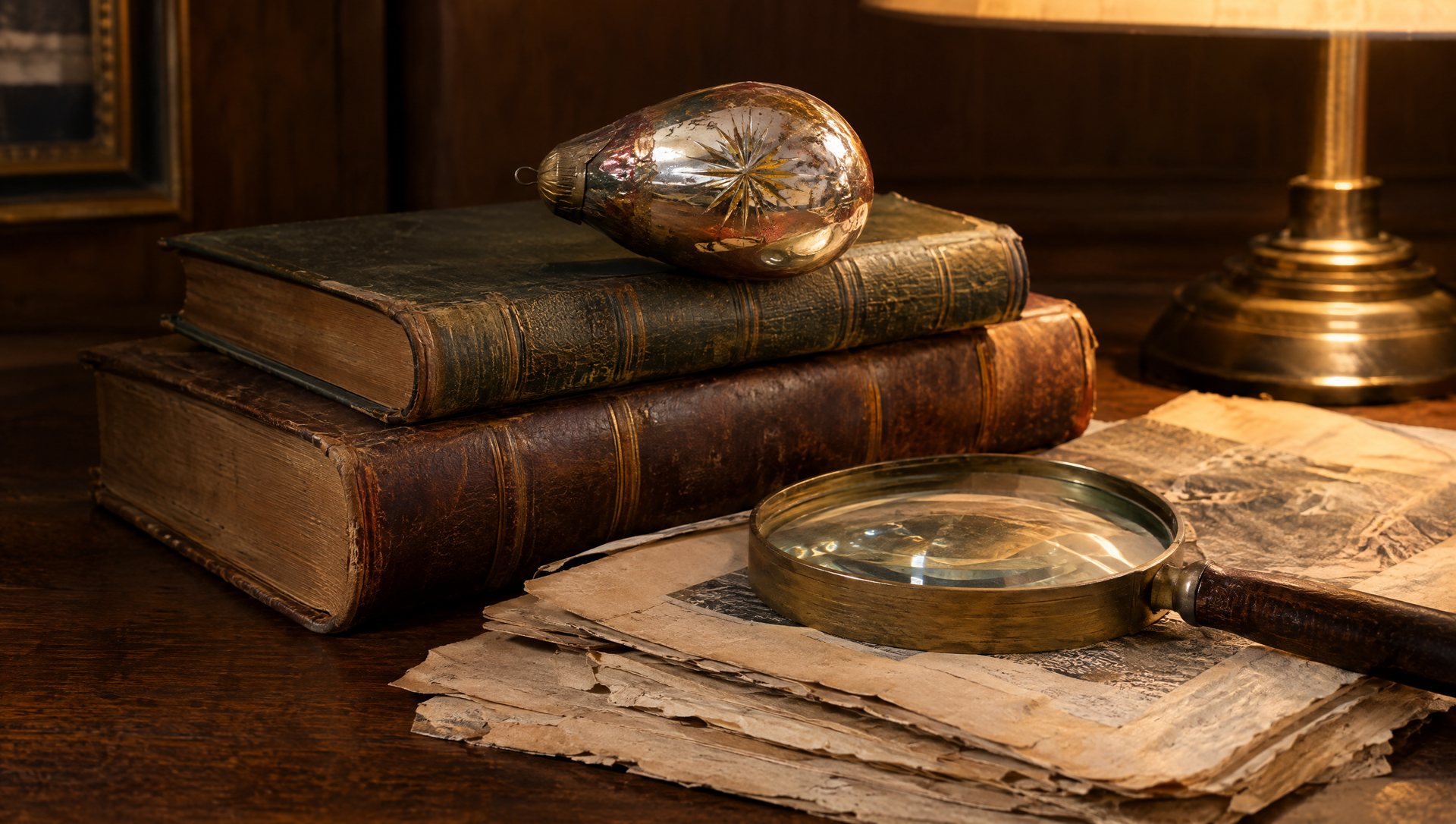
Myth: Christmas lights have a 1,000-year history. Fact: Winter fire festivals are ancient, but the earliest written records of Christmas trees are from the 1500s, candles on trees appear in records around 1700, and electric Christmas lights date to 1882.
Myth: Franklin Pierce put the first lit Christmas tree in the White House in 1856. Fact: The White House Historical Association counts Benjamin Harrison’s 1889 tree as the first documented White House Christmas tree. The Pierce story has n