


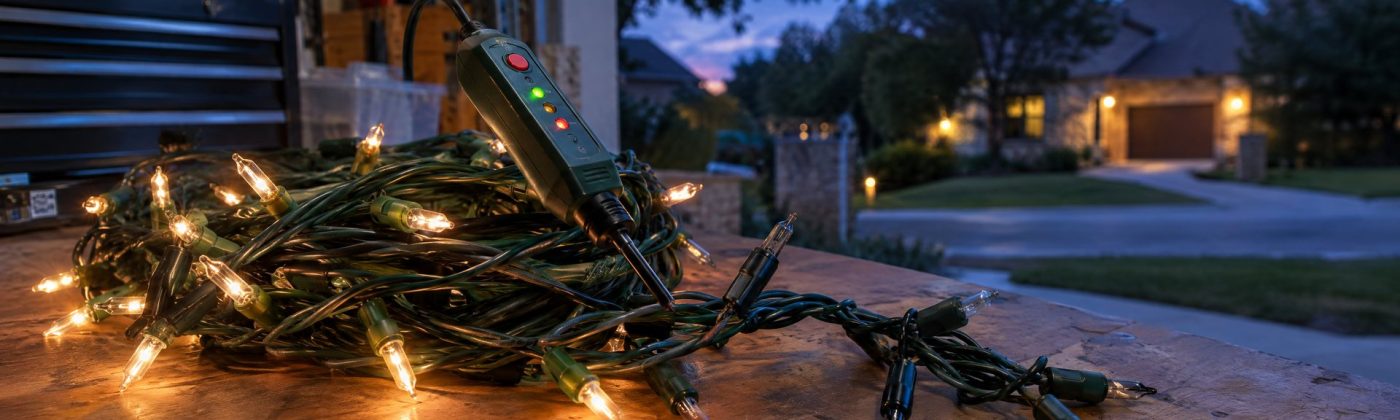
Christmas Light Testers: Do They Work, and How to Use One
Yes, Christmas light testers work, but only on the lights they were designed for. A LightKeeper Pro-style tool is very good at one job: bringing a dark section of incandescent mini lights back to life and then helping you find the bad bulb. It isn’t made for LEDs, rope lights or sets with a control box, and the LED testers that do exist mostly find a fault rather than fix it.
So before you spend money on a tester, spend a minute on two things: what’s actually dark, and what kind of string it is. Half the “my tester doesn’t work” complaints are a tester being used on the wrong problem.
The 60-second triage
Plug the string in on a dry bench or the garage floor and look at the pattern of what’s dark. The pattern tells you which tool, if any, you need.
One bulb dark, the rest lit. No tester needed. On most strings that means one burned-out bulb whose shunt did its job (more on shunts below). Replace it with the exact bulb the tag specifies.
One section dark, the rest lit. On incandescent mini lights, this is the classic tester job. A 100-light set is usually two 50-bulb sections, so “half the string is out” is one section down. Skip to the step-by-step.
The whole string dark. Not a bulb problem. Check the fuses in the plug first (our fuse guide walks through it), then the plug and the connection into this string. If this string is plugged into the end of another one, test it on its own.
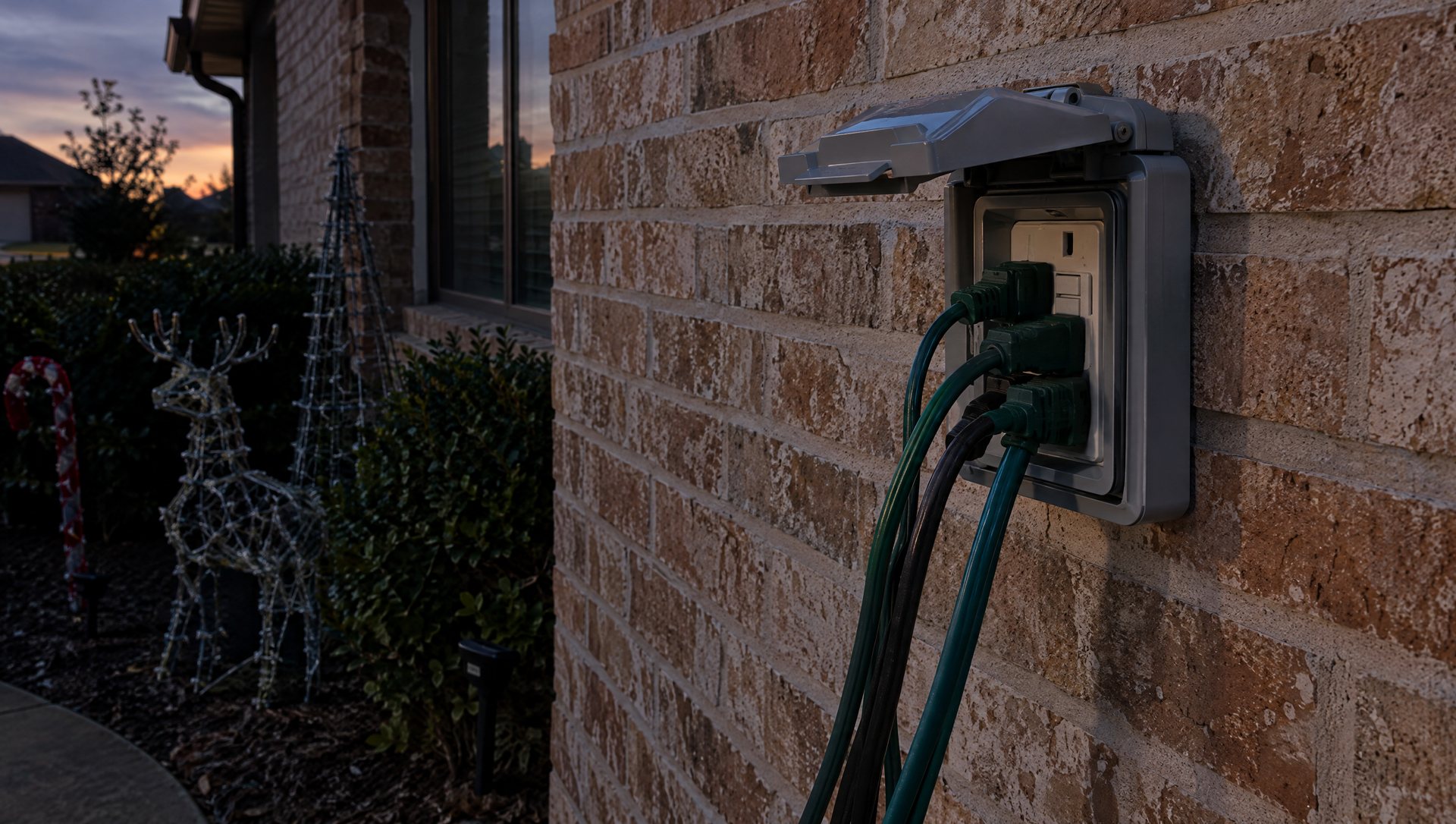
Several strings or decorations dark at once. Look upstream. A tripped GFCI outlet, a timer, an extension cord or the outlet itself is the likely cause, and buying three testers won’t fix an outlet. If the GFCI trips again right after you reset it, there’s usually a wet connection somewhere on the circuit.
It’s flickering, not dark. That’s a different set of causes, from loose bulbs to cheap LED drivers to sprinkler water. See why Christmas lights flicker.
Know what kind of string you’re holding
Testers are made for specific designs, and the exclusion list printed on the package is the real buying guide. Check the cord tag and look at the bulbs.
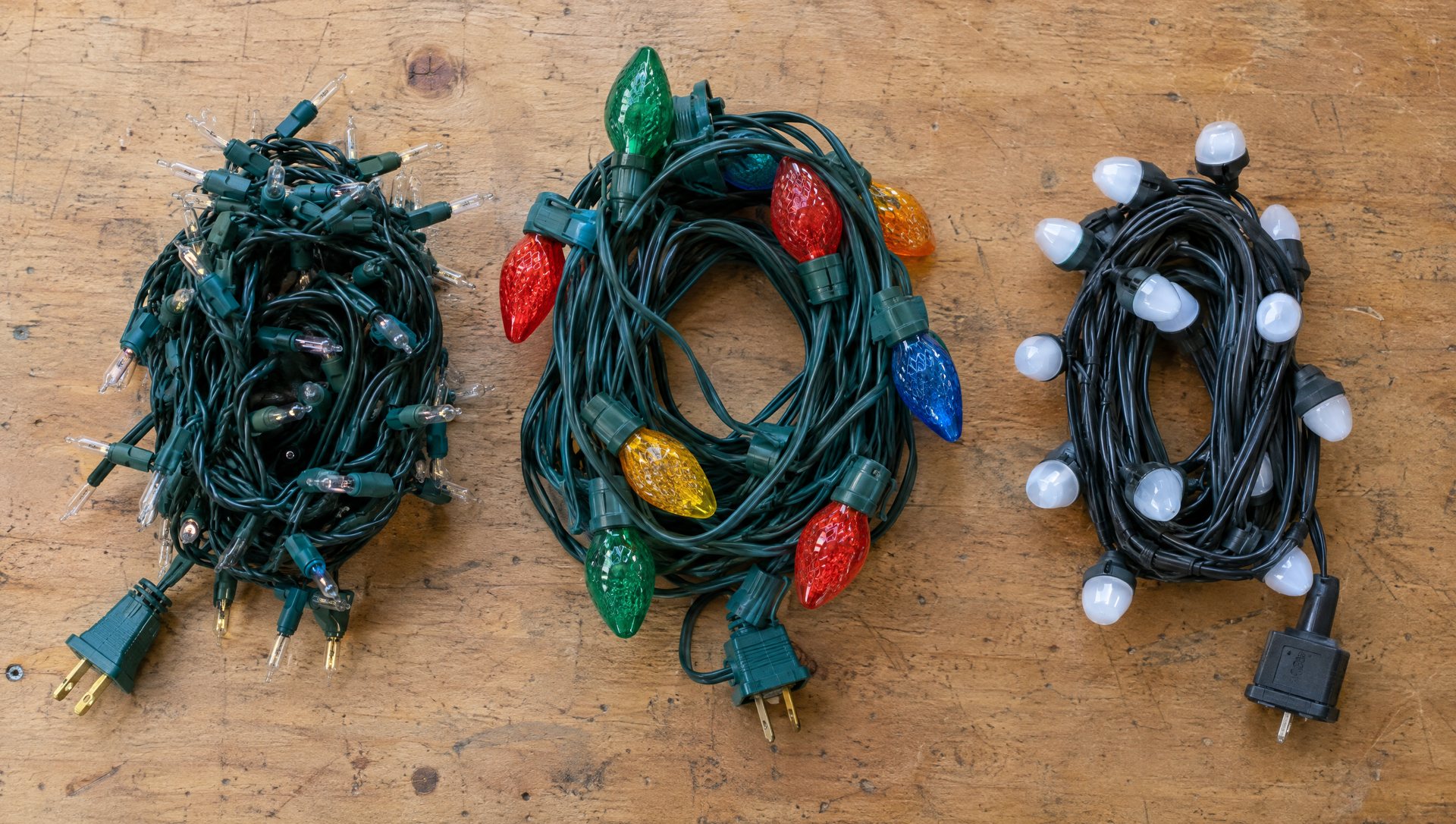
- Incandescent mini lights. Small glass bulbs that pull out of plastic bases and feel warm when lit. This is where testers do their best work.
- Replaceable-bulb C7 or C9 strings. Big screw-in bulbs. On most of these sets each socket is wired independently, so a dead bulb is easy to spot and swap. You need the right replacement bulb, not a tester. Our C9 Christmas lights guide covers bulb and socket types.
- Sealed LED strings. Bulbs molded into the wire, cool to the touch. Most testers don’t apply, and repair options are limited.
- Smart, app-controlled, adapter-powered or battery sets. Start with the manufacturer’s troubleshooting. Handheld light testers aren’t built for these.
Two details on the tag matter more than most people think. First, the bulb voltage. Mini-light sets are built so the bulbs in each section add up to household voltage: a 50-bulb section uses bulbs of about 2.5 volts each, and a 35-bulb section uses higher-voltage bulbs of about 3.5 volts. They look identical. Swap one kind into the other kind of string and it will burn out fast or glow dim. Second, the fuse rating, which you’ll want on hand before you open the plug.
If your set has a control box, a power adapter, or batteries, read the exclusion list on any tester before you buy it. It often names your exact set.
Why a whole section of mini lights goes dark
Incandescent mini lights are wired in series within each section. Electricity passes through bulb 1, then bulb 2, and so on through all 50, and only then back to the plug. Break the path anywhere and the whole section goes dark.

Bulb makers solve the obvious problem, one burned-out filament killing 49 good bulbs, with a tiny wire inside each bulb’s base called a shunt. When the filament burns out, the voltage across that bulb jumps, the shunt’s coating breaks down, and the shunt closes the gap so current keeps flowing past the dead bulb. Usually it works, which is why you mostly see single dark bulbs.
When it doesn’t work, the section goes dark. The usual causes are a shunt that failed to close, a bulb that’s loose or has a bent lead, a cracked bulb, or a bulb that’s missing entirely. A missing bulb is the easy one to overlook: pull a dead bulb out “to deal with later” and you’ve just turned off 49 others.
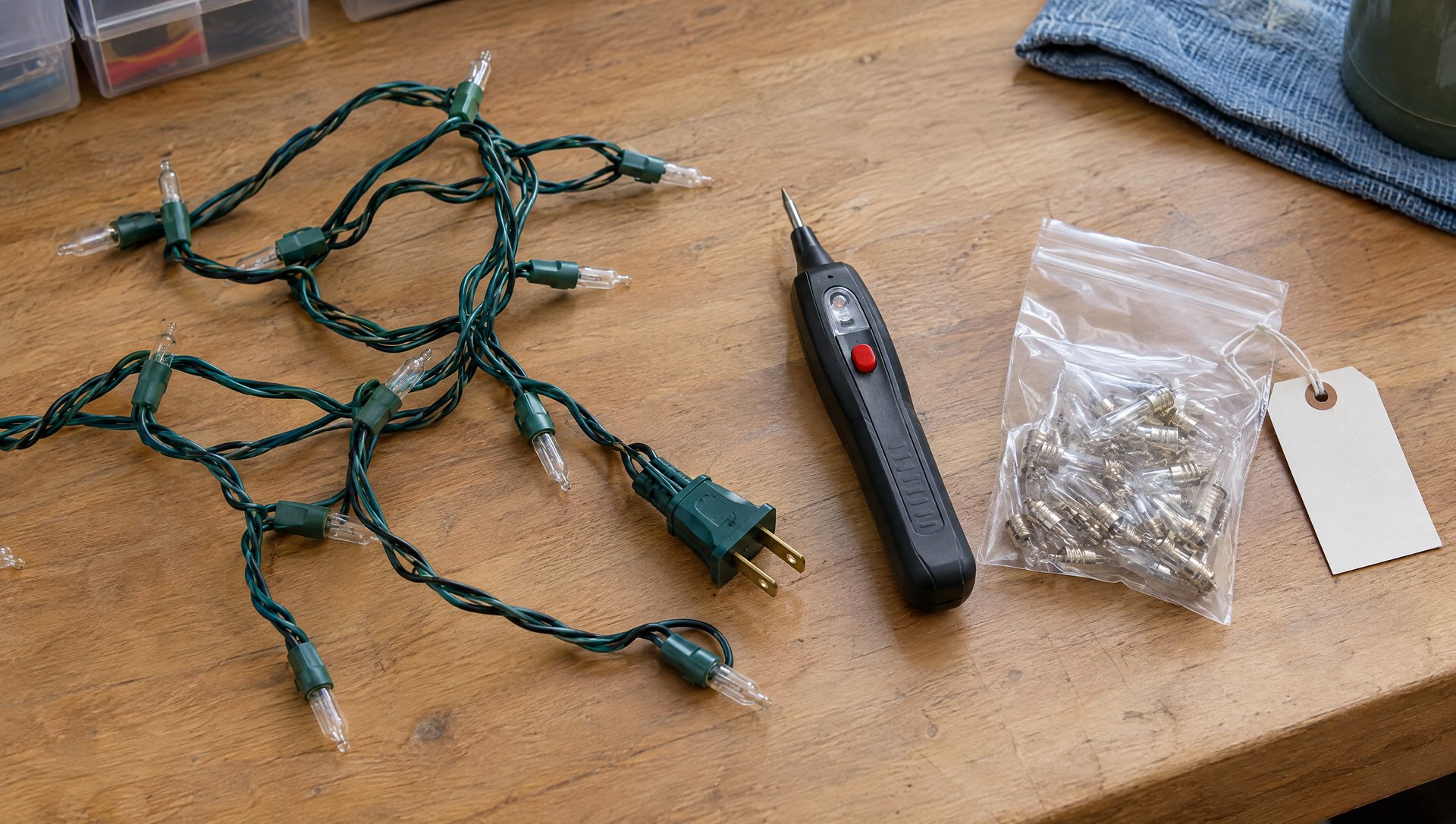
That failed-shunt case is exactly what a LightKeeper Pro is designed to fix. It sends a pulse through the section strong enough to make a stuck shunt close.
Step by step: using a LightKeeper Pro on a dark section
These steps follow the LightKeeper Pro manufacturer instructions. Read the manual that came with your tool too; it’s the final word on your model.
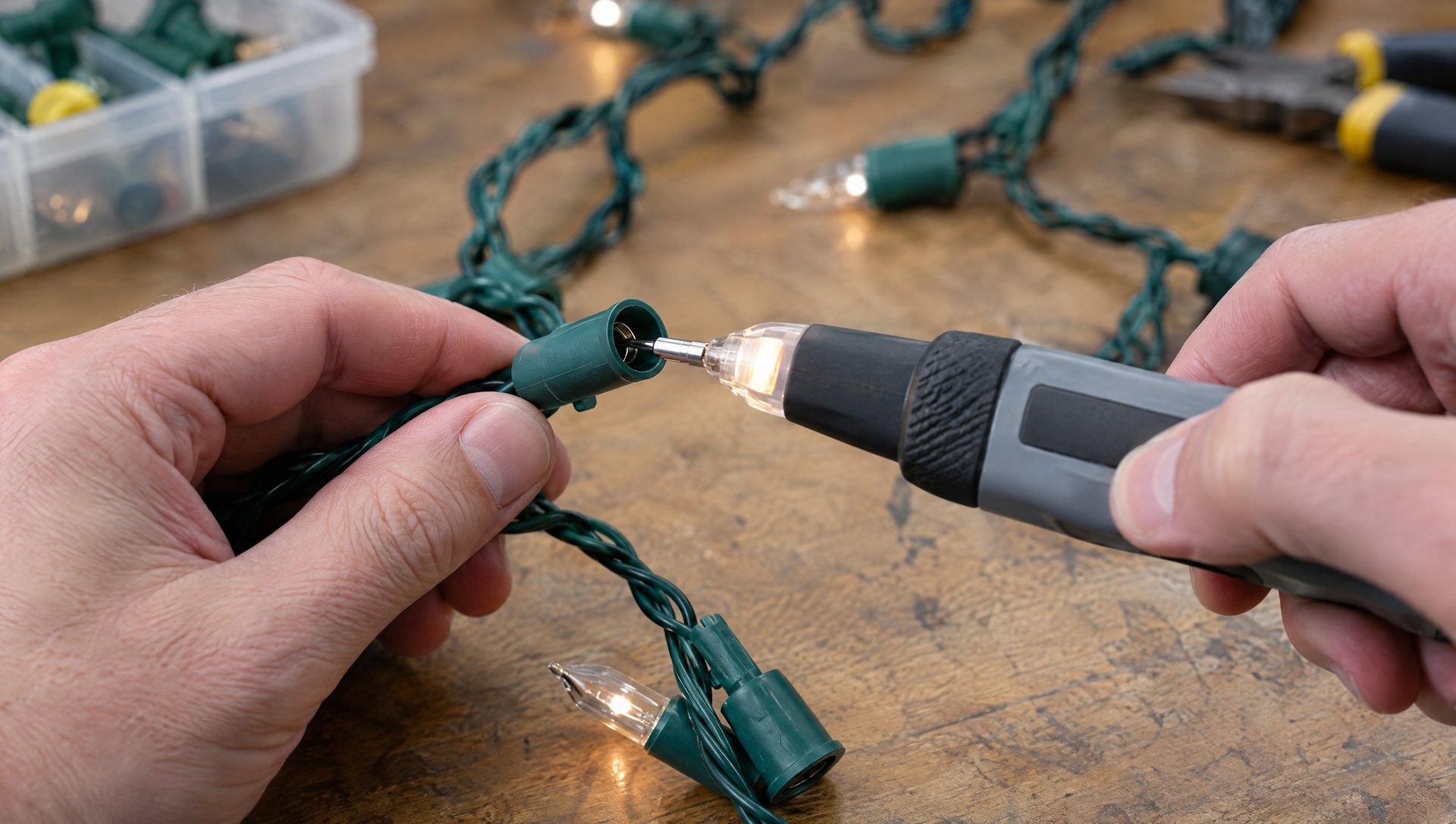
- Pull one bulb from the dark section. Any bulb.
- Plug the empty socket onto the tool’s socket connector.
- Plug the string in and pull the trigger, up to 30 times. Each pull sends a pulse through the section that can make a stuck shunt close.
- If the section lights, unplug the string and put the removed bulb back in its socket.
- If it stays dark, use the tool’s built-in voltage detector. Hold the button and move the tip along the section starting from the plug end. It beeps where there’s voltage. The problem bulb is between the last beep and the first silent spot. Unplug the string, then pull and check the bulbs in that stretch.
Once the section is lit, look for bulbs that stayed dark. Those are burned out with their shunts closed. Replace each one with the exact bulb the tag specifies. The tool’s bulb tester helps here: a good bulb lights when you put it in the slot.
The manual is explicit that the LightKeeper Pro isn’t intended for LEDs, rope lights, or sets with control boxes. And if you’re not comfortable working with a string that’s plugged in, skip the trigger step and replace the set.
Why you shouldn’t leave dead bulbs in
It’s tempting to stop once the section lights. Don’t. Every shunted bulb pushes more voltage onto the bulbs still working.
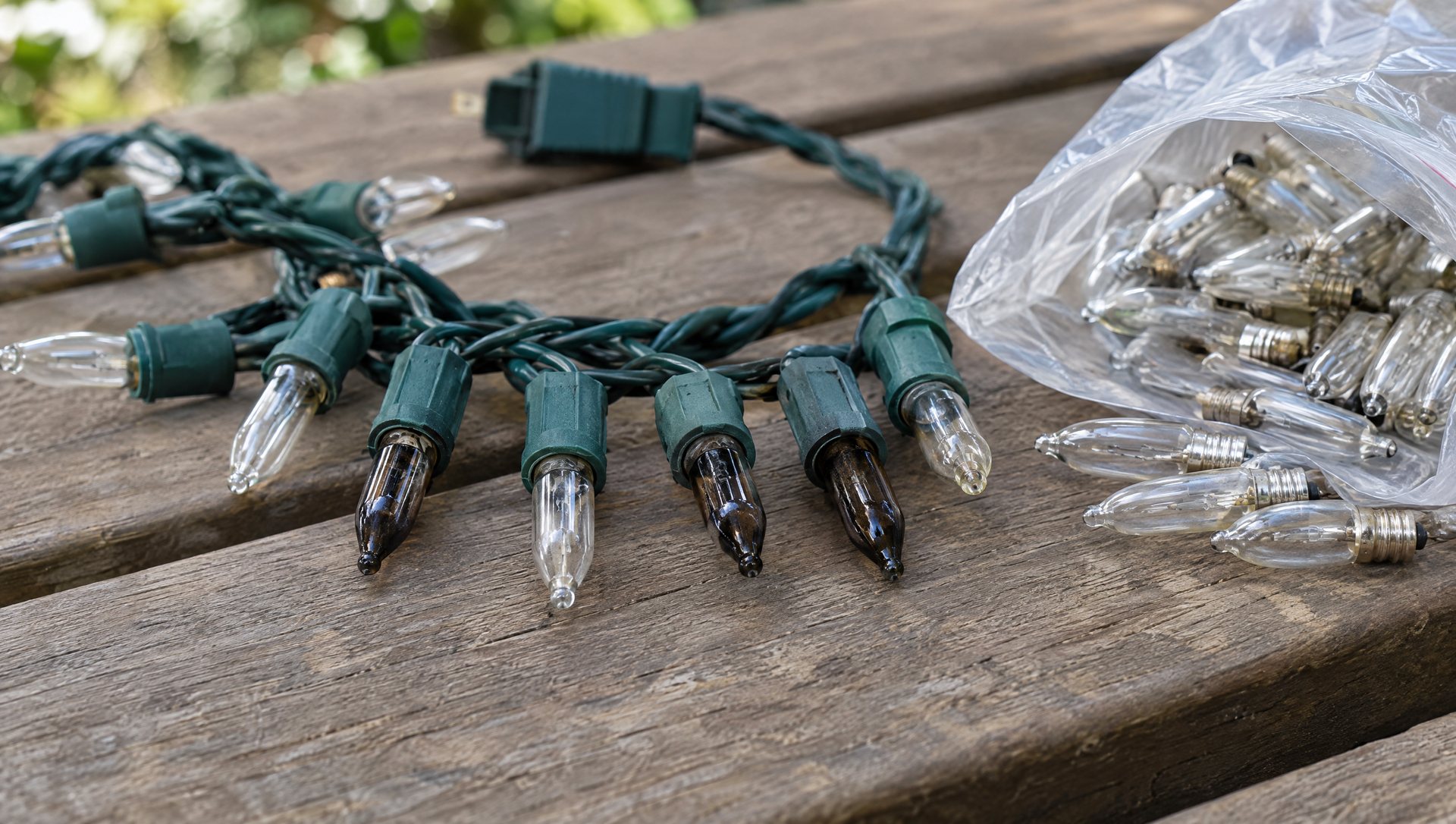
Here’s the math on a 50-bulb section on a 120-volt outlet. With every bulb working, each one gets about 2.4 volts. Short out five dead bulbs and the remaining 45 split the same 120 volts: about 2.67 volts each, roughly 11 percent more than they were built for. Filaments run hotter and burn out sooner, which shunts more bulbs, which raises the voltage on the rest again. That’s how a string that “had a couple dead bulbs” last year has a dozen this year.
Keep a bag of the correct spare bulbs with each set, and replace dead ones the same evening.
Do LED Christmas light testers work?
Partly. The LED Keeper Pro instructions describe a tool for conventional series-wired LED sets. It locates the bad bulb or socket by piercing the wire insulation with a probe and lighting sections in turn until it narrows down the fault. It excludes incandescent sets, rope lights, sets with control boxes, low-voltage sets (which covers most pre-lit trees) and battery sets.
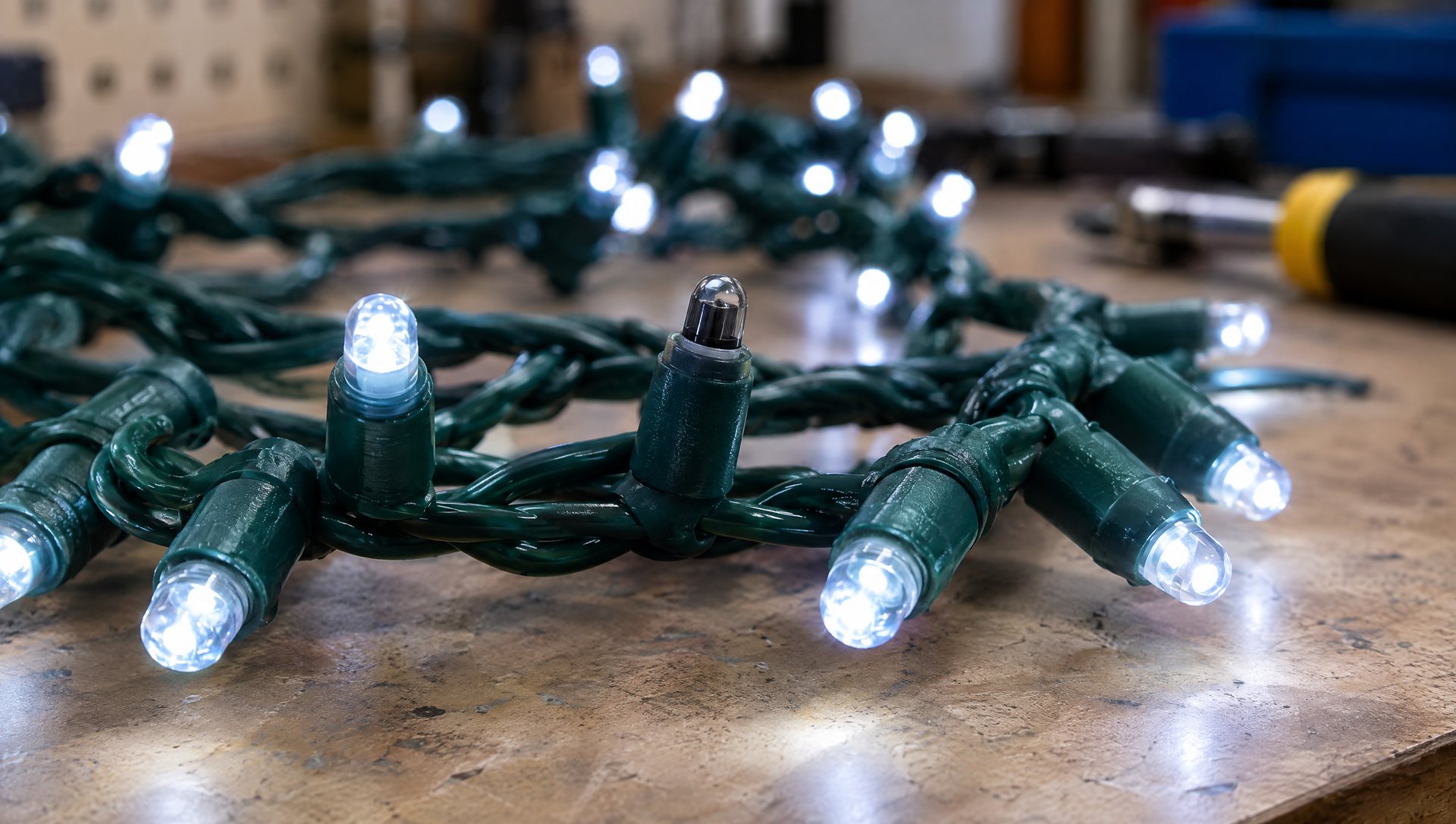
What happens after that depends on the string. If the LED bulbs are replaceable, you swap the bad one. If they’re sealed, the kit includes a bypass part that doesn’t light but keeps the rest of the string working.
Two honest caveats. Most LED strings fail at a sealed bulb or a cracked solder joint, so the realistic outcome is a working string with one permanently dark spot. And every hole the probe makes is a new path for water into an outdoor cord. We would not put a string with pierced insulation back on a roofline. For an indoor tree, it may be worth it.
If you’re still deciding between the two kinds of lights, this is one real difference that rarely makes the comparison charts: incandescent minis are fixable at home, and sealed LEDs mostly aren’t. Our LED vs incandescent Christmas lights guide covers the rest.
The rest of the toolbox: fuse tester, multimeter, voltage pen
| Tool | Works on | What it can’t do |
|---|---|---|
| LightKeeper Pro (and similar) | Incandescent mini-light strings | LEDs, rope lights, sets with control boxes |
| LED Keeper Pro (and similar) | Conventional series-wired LED strings | Smart, low-voltage, battery, rope, control-box sets |
| Fuse tester | A fuse removed from an unplugged plug | Tell you why the fuse blew |
| Multimeter (continuity) | Removed fuses and bulbs | Safely test anything plugged in |
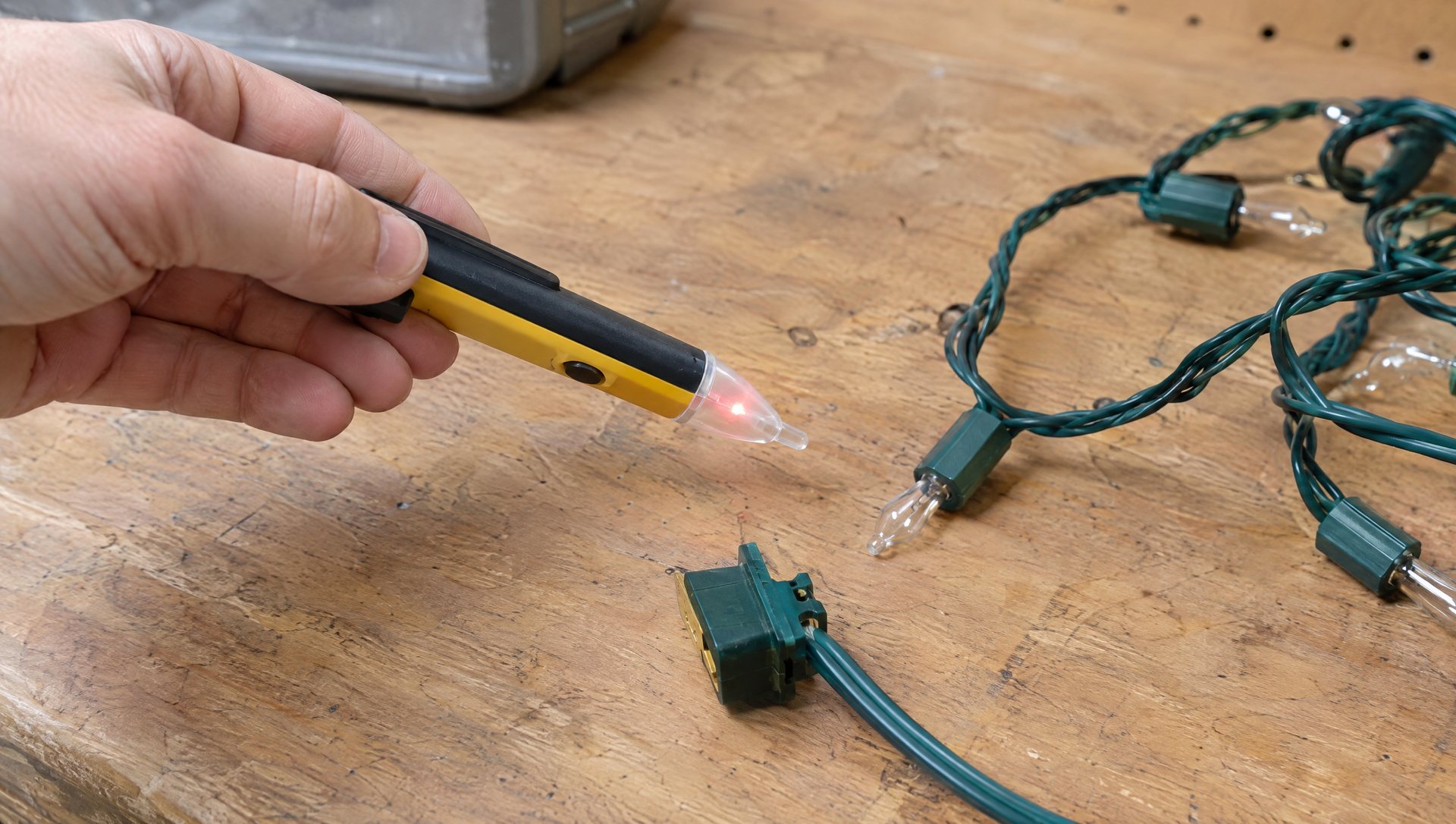
| Non-contact voltage detector | Finding where power stops along a string | Prove a wire is safe to touch |
A multimeter you may already own does two useful things for lights: continuity on a fuse you’ve taken out of an unplugged plug (a good fuse beeps or reads near zero ohms), and continuity on a single mini bulb held across the probes. It does not replace a LightKeeper for a dark section, because it can’t close a shunt.
A pen-style non-contact voltage detector is handy for finding where power stops along a string, the same job as the detector built into the LightKeeper. Here’s the rule that matters: no beep is not proof a wire is dead. The pen can miss voltage through thick insulation, a weak battery, or how you’re holding it. Unplug before you handle bulbs, open a fuse door, or make any repair.
Is a tester worth buying? Three collections
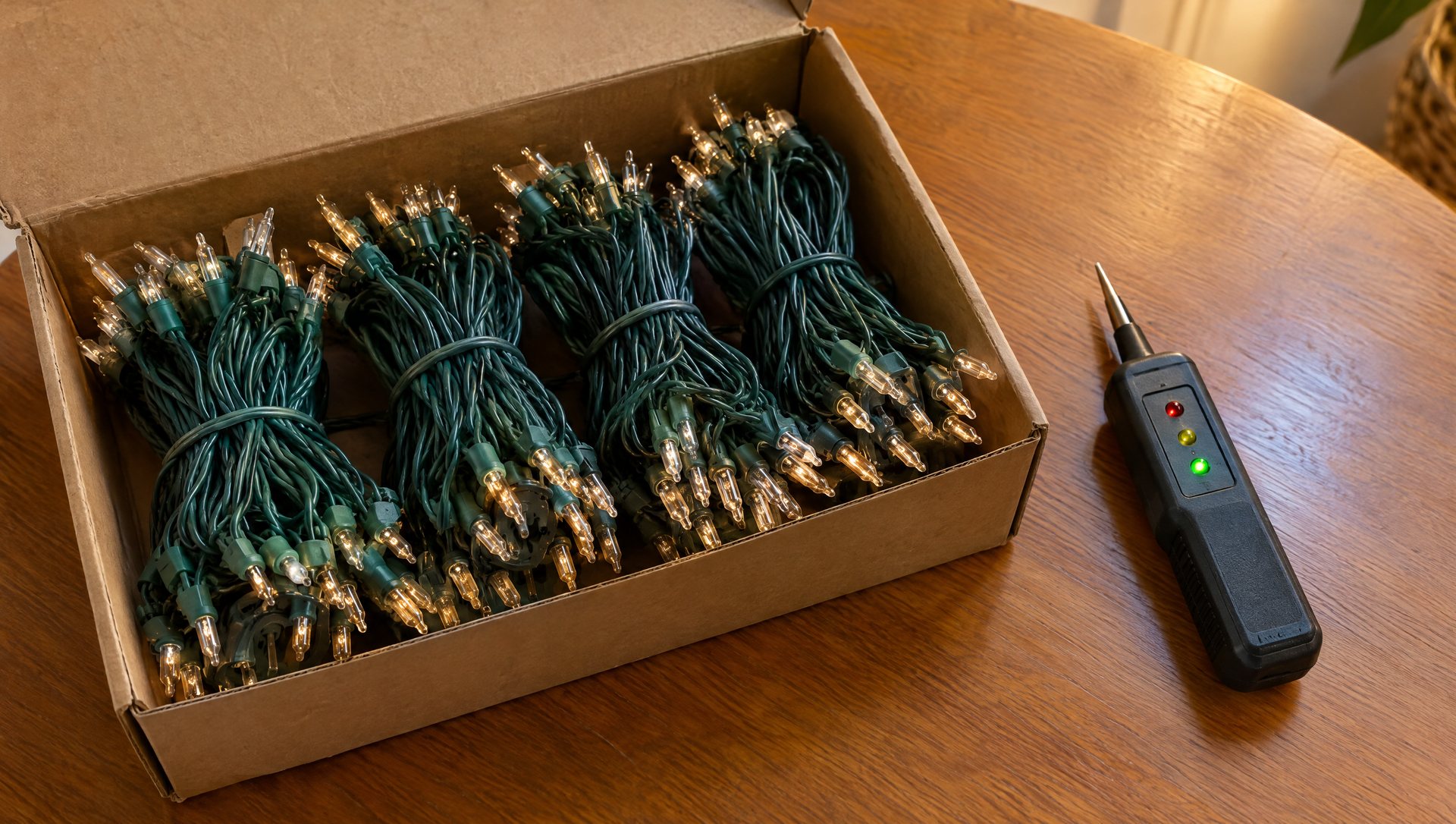
The incandescent collection. A dozen mini-light strings in good shape, maybe a pre-lit incandescent tree from a decade ago. Yes, buy one. A pre-lit tree is where a tester earns its keep, because you can’t easily unwind the strings to hunt for a bad bulb by hand. One evening of saved bulb-pulling pays for it.
The all-LED house. Sealed LED strings on the shrubs, LED C9s on the roofline, a smart string on the porch. No. The LightKeeper doesn’t apply, the LED tester punctures the cords you’d put outside, and the C9s just need replacement bulbs. Put the money toward a spare string and a few spare bulbs.
The mixed garage. Some old incandescent minis for the indoor tree, LEDs outside. Buy the tester for the indoor strings only, plus a pack of the right fuses for every set, and stop trying to rescue the outdoor LEDs.
Whatever you own, work on a dry bench, one string at a time, never on a wet string fresh from the yard. For lights installed up high, call whoever installed them. Nobody should be leaning off a ladder with a tester in one hand and a live string in the other; our light installation safety guide covers ladder work in more detail.
When a string should go in the trash, not on the bench
A tester fixes bulbs. It can’t make a damaged string safe. Retire the set when you see any of these:
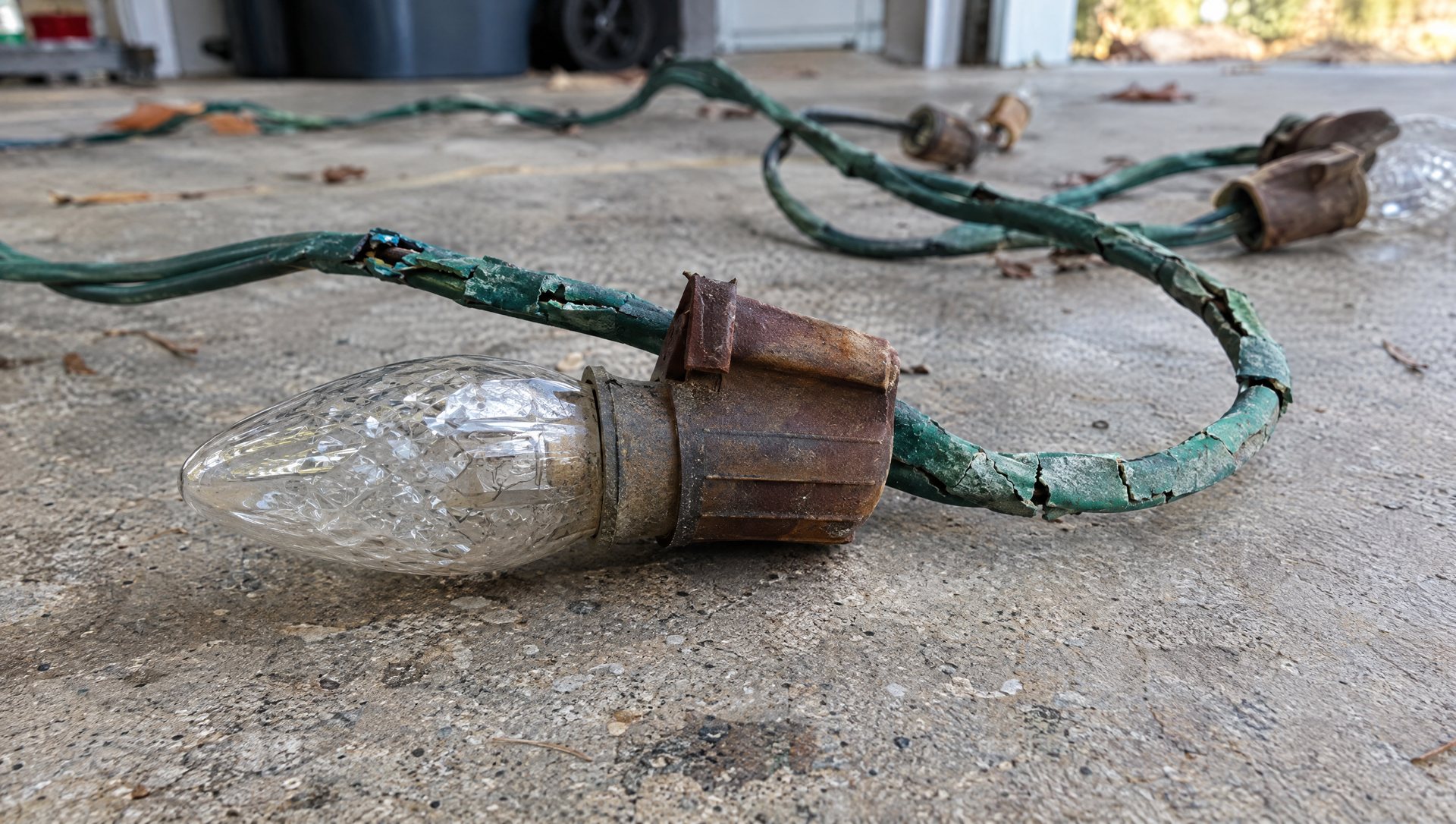
- Cracked, stiff or chalky insulation, especially on strings that have spent summers in an Austin attic or a few seasons in full Texas sun.
- A melted, discolored or brown socket.
- A cracked plug, bent prongs, or a fuse door that won’t stay shut.
- A replacement fuse that blows again.
- Several dead sealed LEDs on a string you can’t fix.
- Bare copper anywhere, including where a squirrel or a mower got to it.
Cheap sealed LED strings in particular aren’t worth an evening. A new set is usually the better use of your money and your night.
Label it so next year’s test takes two minutes
Label a working string with its bulb voltage and fuse rating. Label a failed one with the symptom, “first 50 dark” or “fuse blew twice,” and decide right away whether it’s getting repaired or leaving the collection. Keep its spare bulbs in a small bag tied to the plug end. Next November, that tag saves you from repeating the same troubleshooting, and keeps a 3.5-volt bulb out of a 2.5-volt string.
If a section of a display we installed has gone dark, don’t climb up with a tester. Text a photo showing the whole affected area to (737) 777-9099 or use the contact page, and tell us which sections still work.
Sources
About the author. Rick Safeman owns Sapien Lighting & Installation in Austin, Texas.