


The cheapest Christmas light installation, a $100 low end on Angi’s Austin page or $1.25 to $3 per foot install-only, usually buys hanging only. You supply the lights, and takedown, storage and mid-season fixes cost extra or are not offered. Compare bids on the same scope. Austin-area installers that publish prices started full service at $450 to $500 when we checked in October 2026. The honest way to pay less is to light less, not to buy a thinner job.
- Lowest prices on cost guides
- $100 on Angi’s Austin page; about $133 nationally on Thumbtack (both checked October 2026)
- Typical minimum per job
- $150 to $300 at most companies (Angi national guide, checked October 2026)
- Install-only rate, your lights
- $1.25 to $3 per linear foot (Thumbtack and Angi, checked October 2026)
- Installed rate with lights
- $5 to $12 per linear foot (HomeGuide, checked October 2026; it does not say whether takedown and storage are included)
- Austin-area full-service starting prices
- $450 to $500, takedown and storage included (five installers’ published prices, checked October 2026)
- First question to ask a low bidder
- Who supplies the lights, and who takes them down?
- Cheapest honest way to pay less
- Light less: the front roofline and one focal tree
- Sapien’s minimum charge
- $500
- What Sapien includes
- A custom design, commercial-grade lights and clips, a timer, installation, repairs if anything goes dark during the season, and takedown in January
This page is for an Austin-area homeowner holding a quote well under the others. For the full price picture, see what Christmas light installation costs in Austin. For why a fair quote costs what it does, see why Christmas light installation is expensive.
What does the cheapest Christmas light installation actually buy?
Cheap Christmas light installation usually means one of three services:
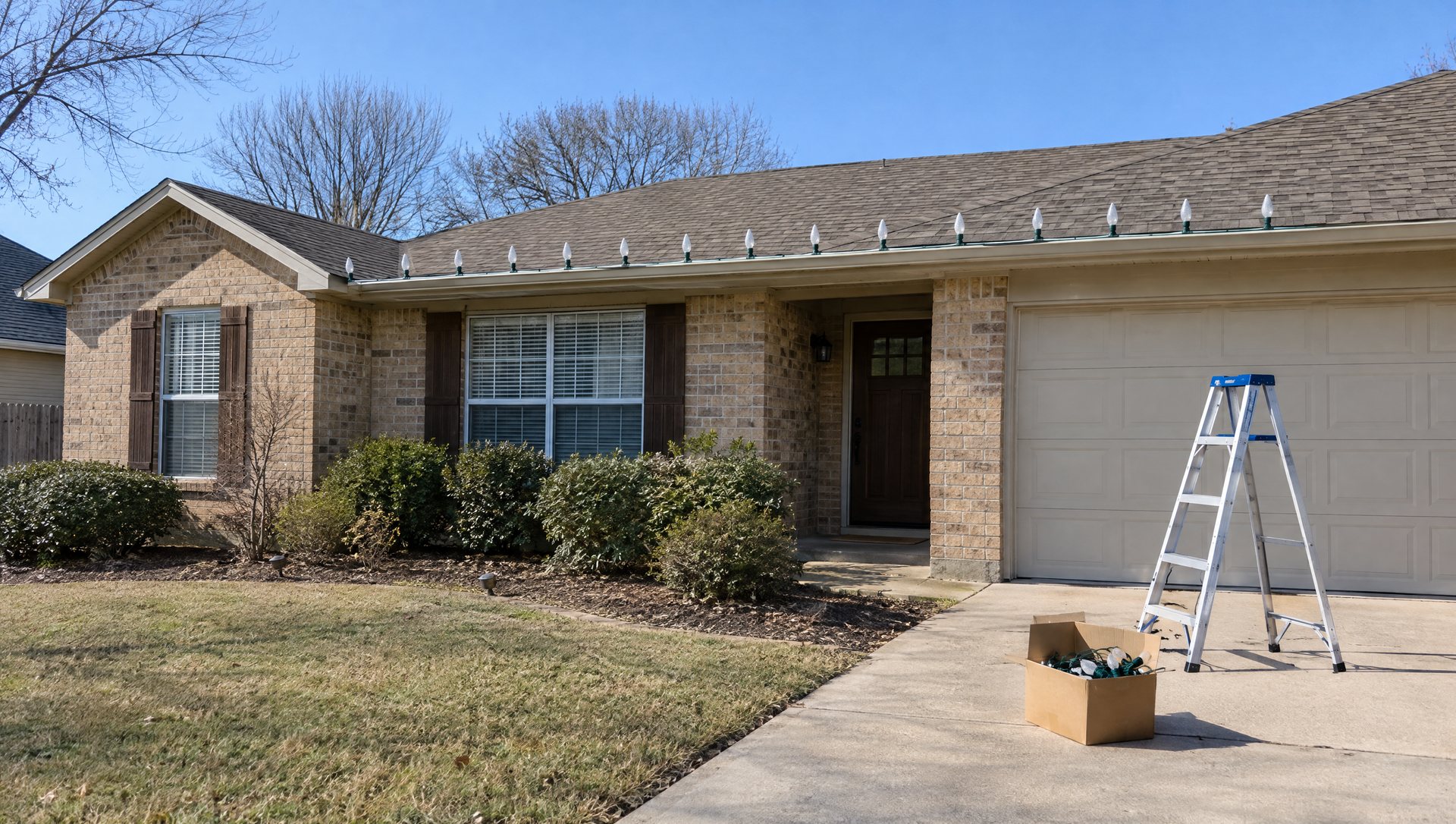
- Install-only. You buy the lights and the installer hangs them. Thumbtack’s national price page and Angi’s hire-a-pro guide both put this at $1.25 to $3 per linear foot, lights not included (checked October 2026).
- Lights sold to you. The installer supplies and hangs lights that become yours. Takedown may not be included.
- Full service. The installer supplies, hangs, takes down and stores the lights, and many packages cover repairs during the season. HomeGuide’s cost guide puts installation with lights at $5 to $12 per linear foot and does not say whether takedown and storage are included (October 2025 edition, checked October 2026).
Most crews also have a minimum charge: $150 to $300 per job at most companies, per Angi’s national cost guide (checked October 2026). A $100 quote sits below that.
Cost-guide low ends blend all three services. Angi’s Austin page gives an average of about $301 (as of October 2026), which by our arithmetic is its national $444 times 0.68 (444 x 0.68 = 301.92). Treat it as a modeled estimate, not a survey of Austin installers.
Five Austin-area installers that post their own prices started at $450 and $500 for full service in October 2026, all with takedown and storage. A $150 bid and a $500 bid are usually two different services. Our guide on who provides the lights covers the ownership models.
Why is one Christmas light quote half the price of another?
A quote at half the price usually covers less work or leaves some costs with you. Three things move the price most:
- Who buys the lights. A pricing guide written for installers puts wholesale materials for a pro roofline at about $1.50 to $3.00 per foot (March 2026 guide, checked October 2026). That is about the whole install-only rate.
- Takedown. HomeAdvisor and HomeGuide price removal-only jobs separately. A bid without takedown covers only half the job.
- Service visits. A strand that goes dark in December needs a return trip. Ask whether it is in the price.
To compare two quotes line by line, see how to read a Christmas light installation quote.
A low bid and a full-service bid on the same house (example)
To judge a low bid, add back what it leaves out. Example: a one-story home with 150 feet of front roofline, priced with third-party ranges, not Sapien prices.
Example, 150 ft
Install-only bid
- Hanging labor
- $187.50 to $450 (150 ft at $1.25 to $3)
- Lights
- 9 retail C9 strings, 17 ft each (153 ft), $206.91 at $22.99 regular
- Timer
- $20.95, outdoor digital, regular price
- Clips and a cord to the outlet
- Not counted; ask who supplies them
- Takedown
- $100 to $400, removal-only
- Storage until next year
- You store them
- Year-one total
- About $515 to $1,078
Full-service bid HomeGuide’s installed range
- Hanging labor
- Included
- Lights
- Included
- Timer
- Ask; some packages include it
- Clips and a cord to the outlet
- Ask
- Takedown
- Not stated by HomeGuide; confirm
- Storage until next year
- Not stated by HomeGuide; confirm
- Year-one total
- $750 to $1,800
Inputs: install-only rate from Thumbtack and Angi; one online retailer’s 25-bulb C9 string (17 ft, bulbs sealed in, retail grade) and one pro supplier’s timer at regular prices on October 4, 2026 (holiday sales may lower both); removal from HomeAdvisor and HomeGuide; full service from HomeGuide’s 150-foot row. All checked October 2026. HomeGuide does not say whether its range includes takedown and storage, so get both confirmed in writing.
On labor alone, the low bid is about one quarter of full service. Add lights, a timer and takedown, and full service is only about 1.5 to 1.7 times the low bid, before storage, service visits and your time. You do keep nine strings, good for about 2 to 3 seasons by suppliers’ estimates.
- Low end
- High end
Install-only: 150 ft x $1.25 to $3 = $187.50 to $450. Add 9 retail C9 strings ($206.91), a $20.95 timer and $100 to $400 removal: about $515 to $1,078. HomeGuide: 150 ft x $5 to $12 = $750 to $1,800.
Source: Sapien Lighting calculation from the figures in this post
Show the numbers
| Low end | High end | |
|---|---|---|
| Install-only labor | $187.50 | $450.00 |
| Install-only plus lights, timer and takedown | $515.00 | $1,078.00 |
| Installed with lights (HomeGuide) | $750.00 | $1,800.00 |
How can you lower the price without getting a worse job?
To pay less without a worse job, buy less: fewer feet, fewer trees, a simpler line. These work:
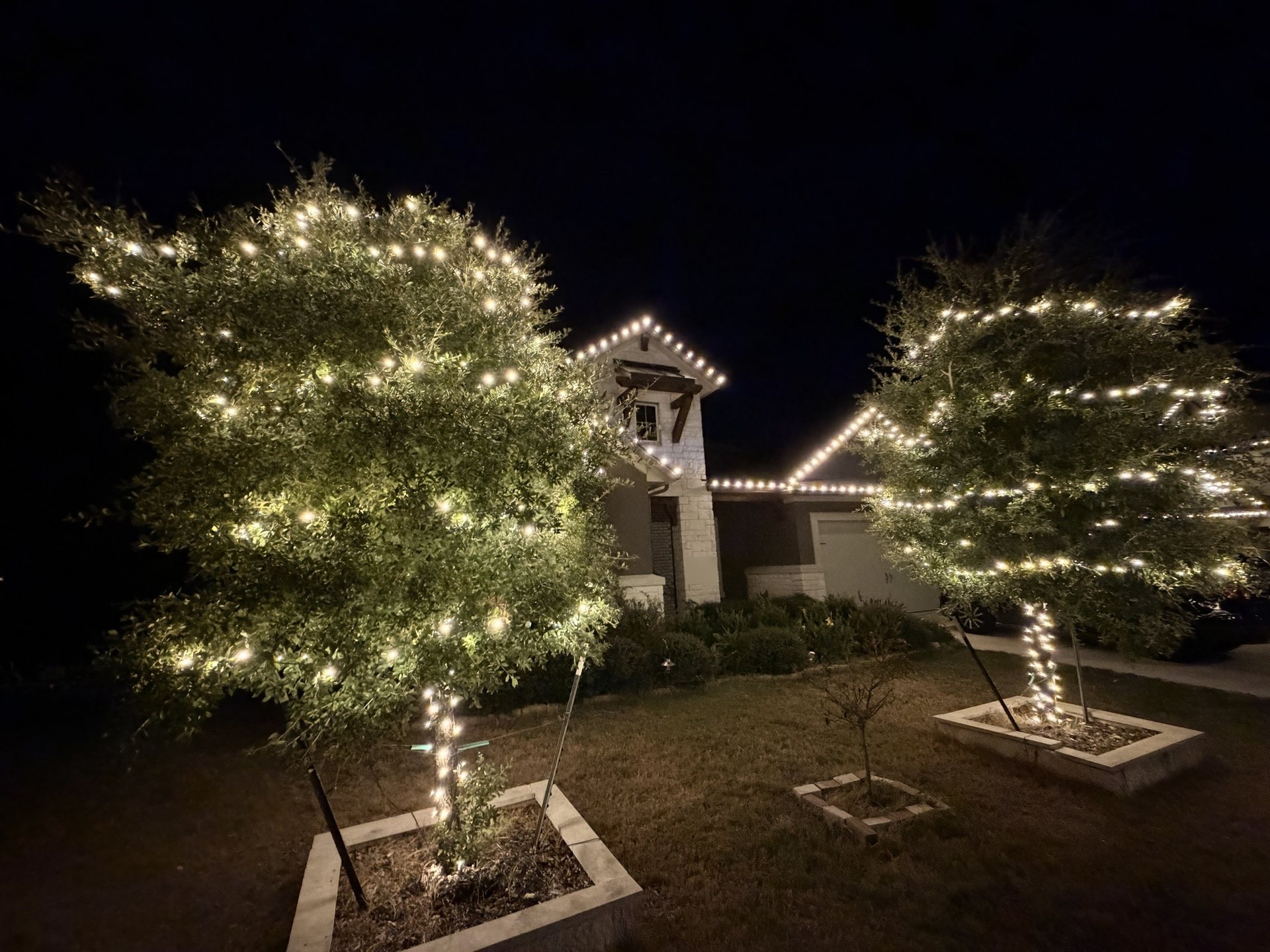
- Light the front only. Our guide to where Christmas lights make the biggest impact covers the trade-offs.
- One focal tree instead of many. One well-wrapped live oak or crape myrtle in the front yard reads better from the street than several thin wraps. Small trees can also get a light pass through the leafy canopy instead of a dense wrap; at Sapien that runs about $195 to $450 per tree.
- A simpler roofline. One straight C9 line on the main eave costs less than outlining every peak and dormer.
- Your own lights, where an installer accepts them. Use only sets marked for outdoor use. The Consumer Product Safety Commission says to throw out any set with cracked sockets or frayed wire.
- Ask about date-based pricing. The installer pricing guide advises installers to charge 10% to 20% more in early December and 25% to 50% more for last-minute jobs. That is advice to installers, not a survey of Austin prices, so ask any installer whether its price depends on the install date. Some Austin-area installers advertised early-booking discounts in early October 2026; ask whether any discount still applies on the day you book.
When is a cheap Christmas light installer the right call?
An install-only crew fits when most of these are true:
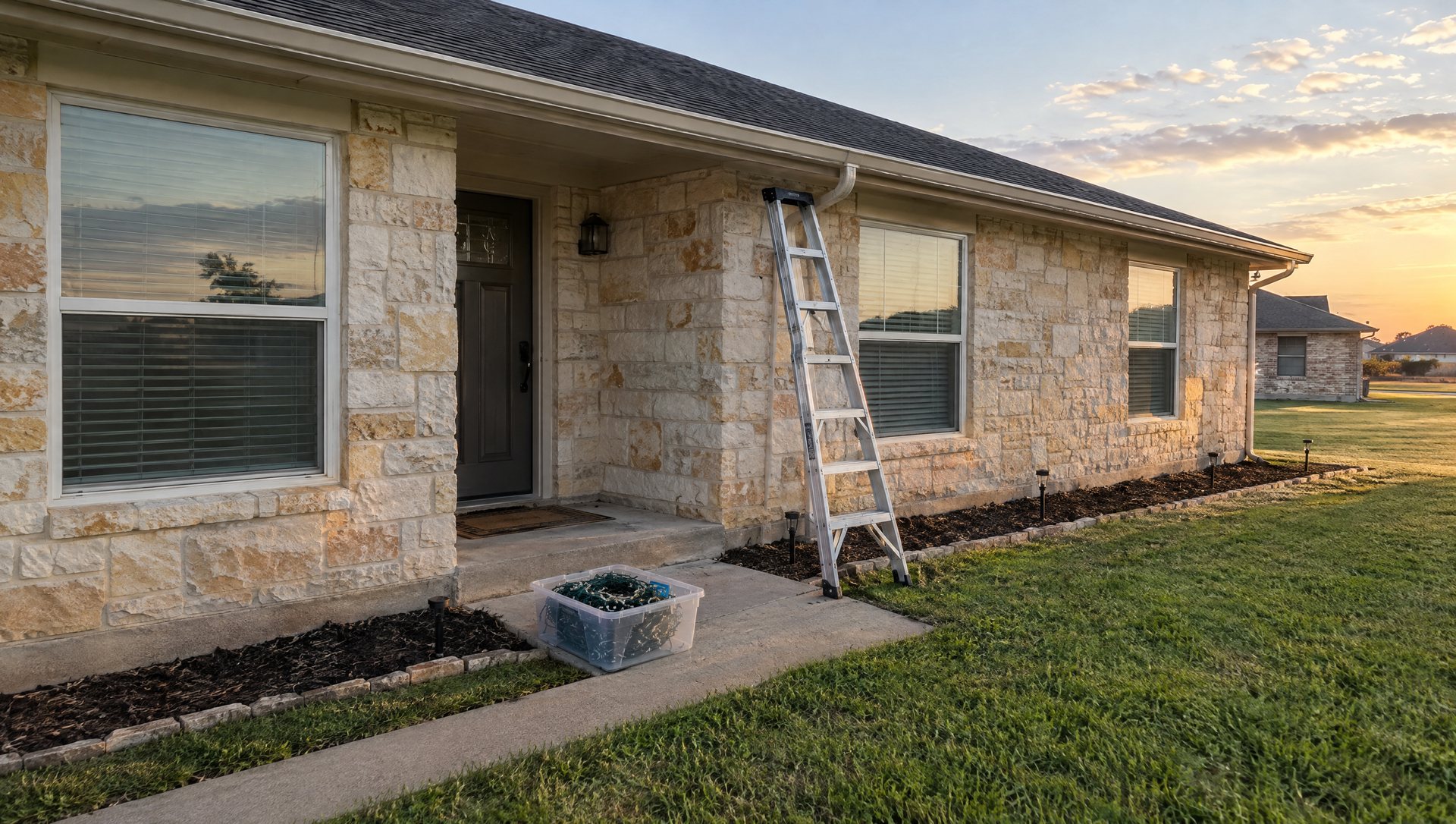
- The job is a single-story front roofline.
- You own outdoor-rated lights in good shape.
- You can take them down before any HOA deadline without a tall ladder, roof work or overhead wires.
- There are no trees, or you will remove a trunk-only wrap every year.
- You can live without service visits.
If two or more of those are false, we’d expect most of the savings to be gone by January.
Where do low Christmas light bids cut corners?
You can spot most cut corners on the quote or on the house. A missing item is not proof of a bad installer, just a cost you pay elsewhere.
| Corner | How you can tell | What it can cost you | Ask |
|---|---|---|---|
| No takedown or storage | Nothing on the quote about January | Removal-only pricing, or your own ladder work | Who takes them down, when, and who stores them? |
| No mid-season service | No line about outages | A dark section until you fix it | What if a strand goes out in December? |
| Retail two-piece strings | Boxed store sets with removable bulbs | About 2 to 3 seasons, by suppliers’ estimates | What lights, and who owns them after? |
| Standard lengths | Extra string coiled at corners and peaks | An uneven line | Do you cut wire to length? |
| Indoor-only lights or cords | A green UL holographic label, or a cord with no W in its printed code (SJTW is outdoor-rated) | Lights and cords not built for rain | Is everything marked for outdoor use? |
| Too many sets on one run | One cord feeding the whole roofline | Blown plug fuses and dark sections | How many sets per run, and does it match the tag? |
| Staples or nails in the roof | Staples along the shingles or gutter | Holes in shingles that can leak; damaged insulation | Which clips do you use on my roof? |
| Cords through doors or windows | A cord pinched in a door or window | Damaged insulation | Where will the lights plug in? |
| Lost GFCI protection | Lights moved to a non-GFCI outlet after tripping | Lost shock protection | What do you do when a GFCI trips? |
Sources: the National Fire Protection Association’s tip sheet says to use clips, not nails, and to follow the maker’s limit on strands connected. Shingle maker CertainTeed says nails and staples puncture roofing and lead to leaks. The Electrical Safety Foundation International covers outdoor marks, GFCI circuits and cords in doors and windows, and its extension-cord guide explains the W. The standard-length row and the cost in the run row are our judgment.
Do cheap installers use store-bought lights?
Ask, because the two are built differently. One pro supplier that sells pro-grade sets explains that pro-grade LED strings are one piece, with bulb, lens and socket sealed together, while retail sets are usually two-piece with removable bulbs. It puts retail-grade sets at about 2 to 3 seasons and a top commercial set at about 5 to 6 seasons with yearly takedown (its newer support page; an older article of its said 6 to 7), and says the two-piece socket lets moisture in.
Why is a cheap tree-wrap price lower?
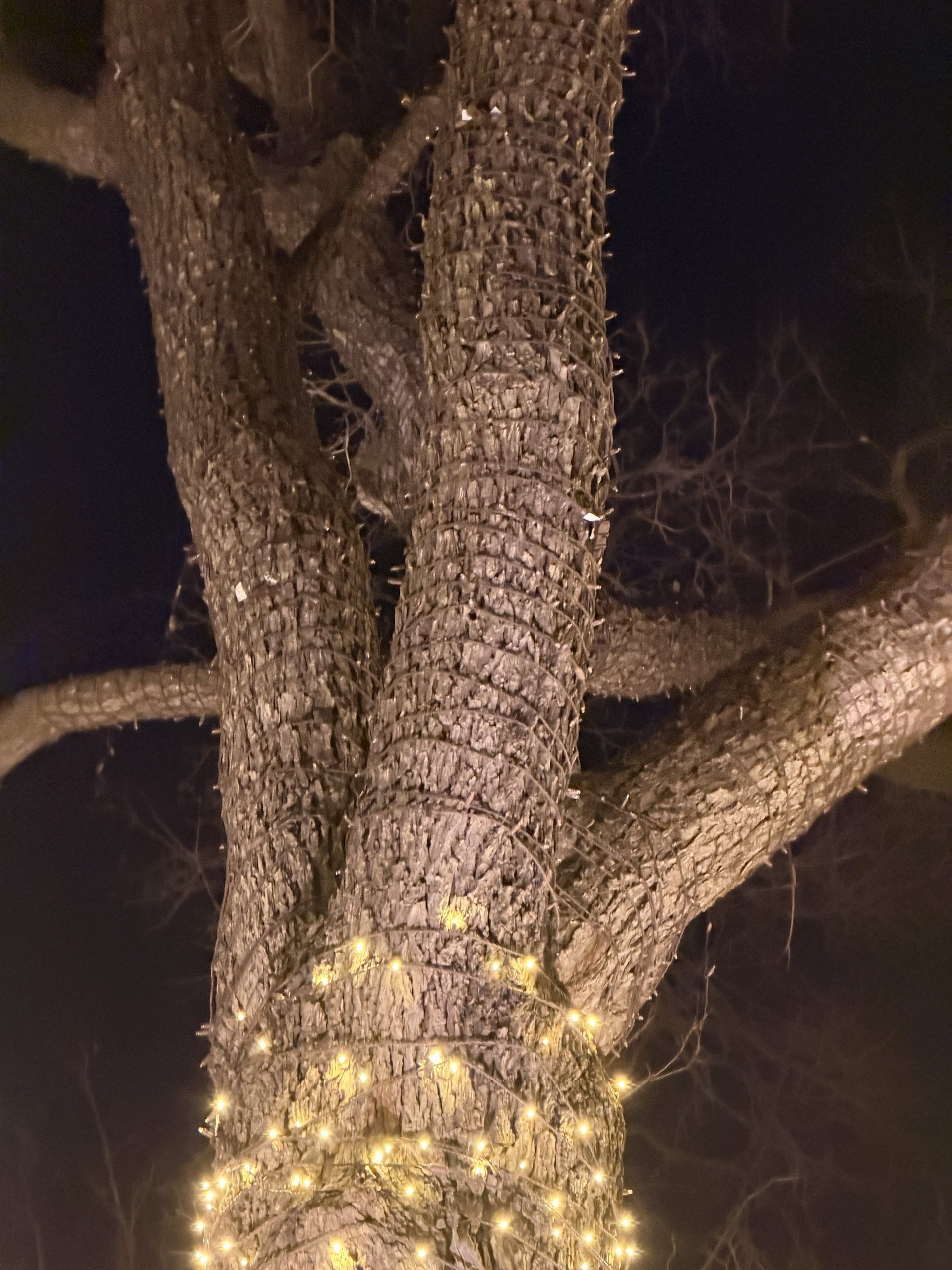
Tree prices are where a low bid shrinks most quietly. A trunk wrap spirals a light string up the trunk; a trunk-and-limb wrap carries it out along the main limbs, which takes more string and time.
Footage depends on trunk size, wrap spacing and limb count, not height alone. By our arithmetic from Davey Tree’s wrapping formula, a 24-inch-diameter trunk takes four times the string of a 6-inch one at the same height and spacing. A cheap tree price usually means trunk only, wider spacing or fewer limbs. Ask which. For scale, Sapien’s typical 2026 prices run $195 to $275 for the trunk of a small or medium tree and $450 to $950 for a large oak’s trunk, or a large live oak’s trunk plus some limbs.
A cheap wrap can also fail in ways you only see after dark: connections left without proper covers, old strings, or too many lights on one circuit can leave whole sections of a tree dark by mid-December.