


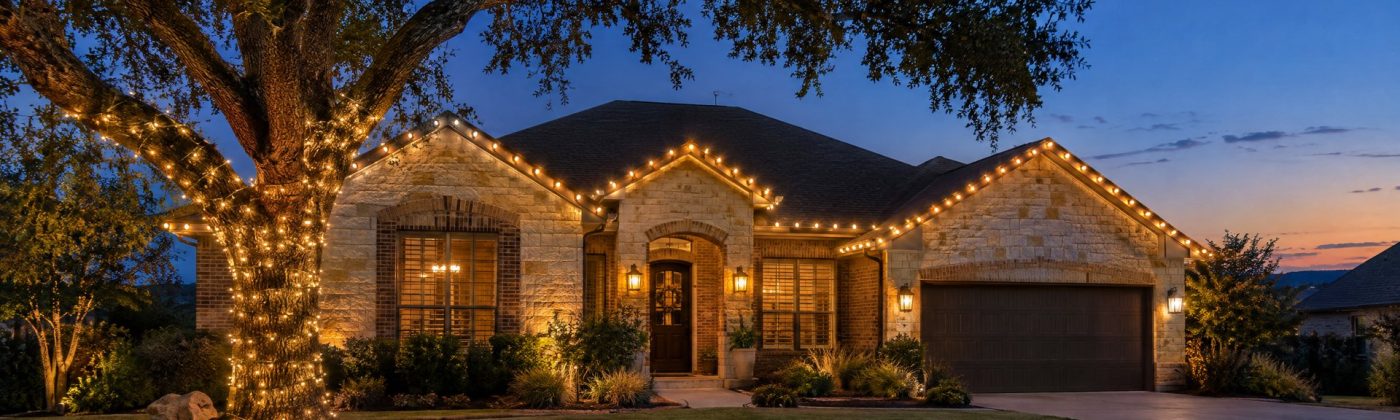
Christmas Light Photos in Austin: How to Judge Before and After, Day and Night
A before-and-after of Christmas lights shows the same house from the same spot, once in daylight and once lit. It is the most useful kind of installer photo, and also the easiest to flatter. To judge any installer’s photos, check for a straight roofline, even bulb spacing, clean corners, one consistent white and hidden cords. Then ask whether the lit photo was taken at dusk or in full dark.
The short version
- Ask for the daytime view too. Lights on a timer are off all day.
- Dusk photos flatter. A full-dark photo shows what you will see from the street.
- Zoom in on the roof edge. Straight lines and even spacing are hard to fake.
- Ask what was installed. Scope drives price.
- Run a gallery photo through an image search. Stock photos turn up on other sites.
This page is for Austin homeowners looking through installer photos, ours or anyone’s, before asking for a quote. Photos are one check. The others are in our questions to ask a Christmas light installer.
What should a before-and-after photo show?
A before-and-after photo of Christmas lights is the same house, shot from the same position, in daylight and lit. The daytime photo is the baseline; the lit one shows what the lights added. A lit photo alone is only an “after”, with nothing to compare it to. Two photos of different houses are not a pair, however similar they look.
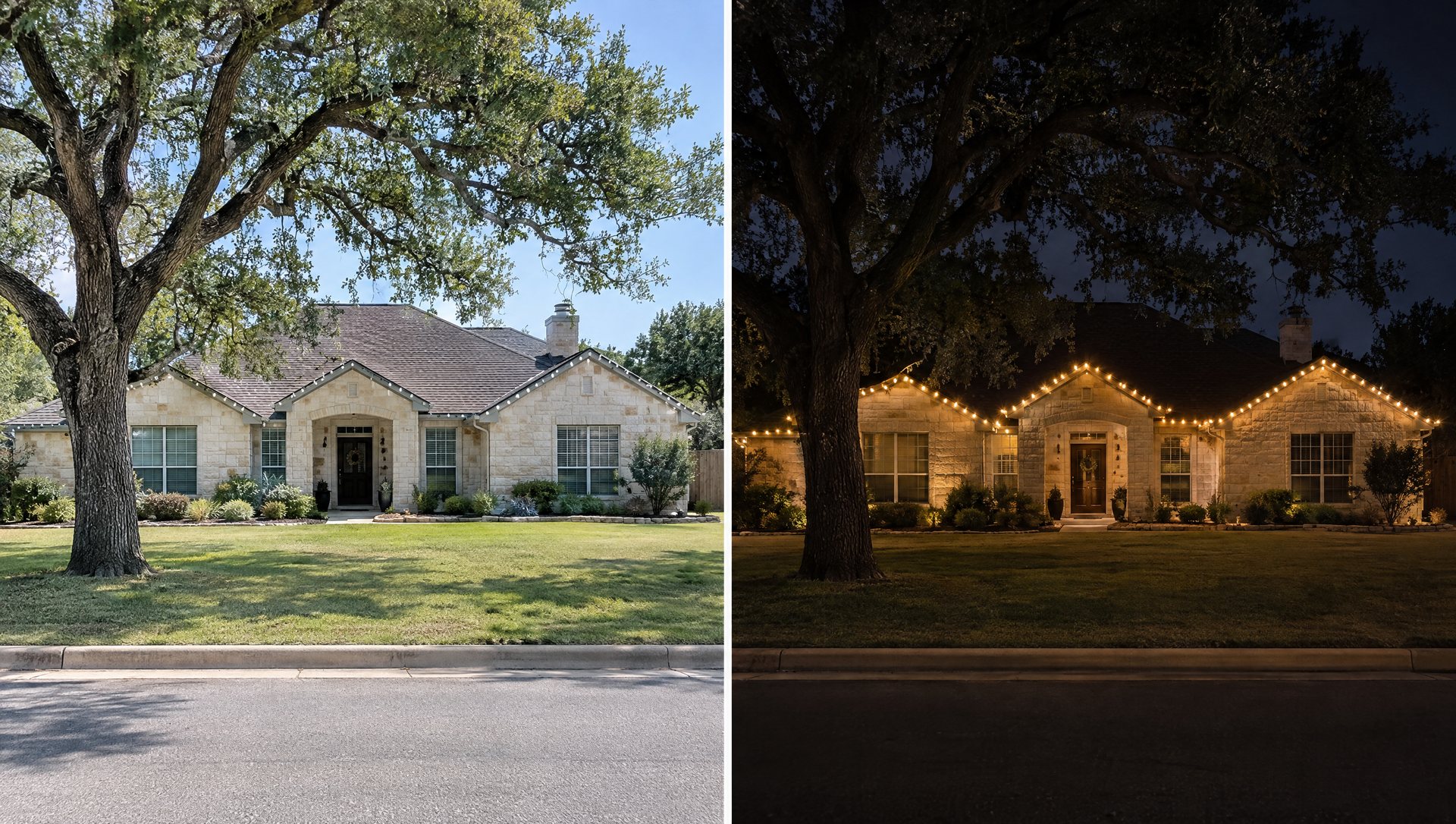
The most useful sets also say what was installed: which bulb, which parts of the house and which trees. Scope drives the look and the price. Our Christmas light installation cost guide shows how roofline only, roofline plus trees and a full property differ.
What do Christmas lights look like in daylight?
In daylight, installed roofline lights look like a row of bulbs along the roof edge, with a thin wire between them. Lights on a timer are off all day, so the daytime look matters as much as the lit one.
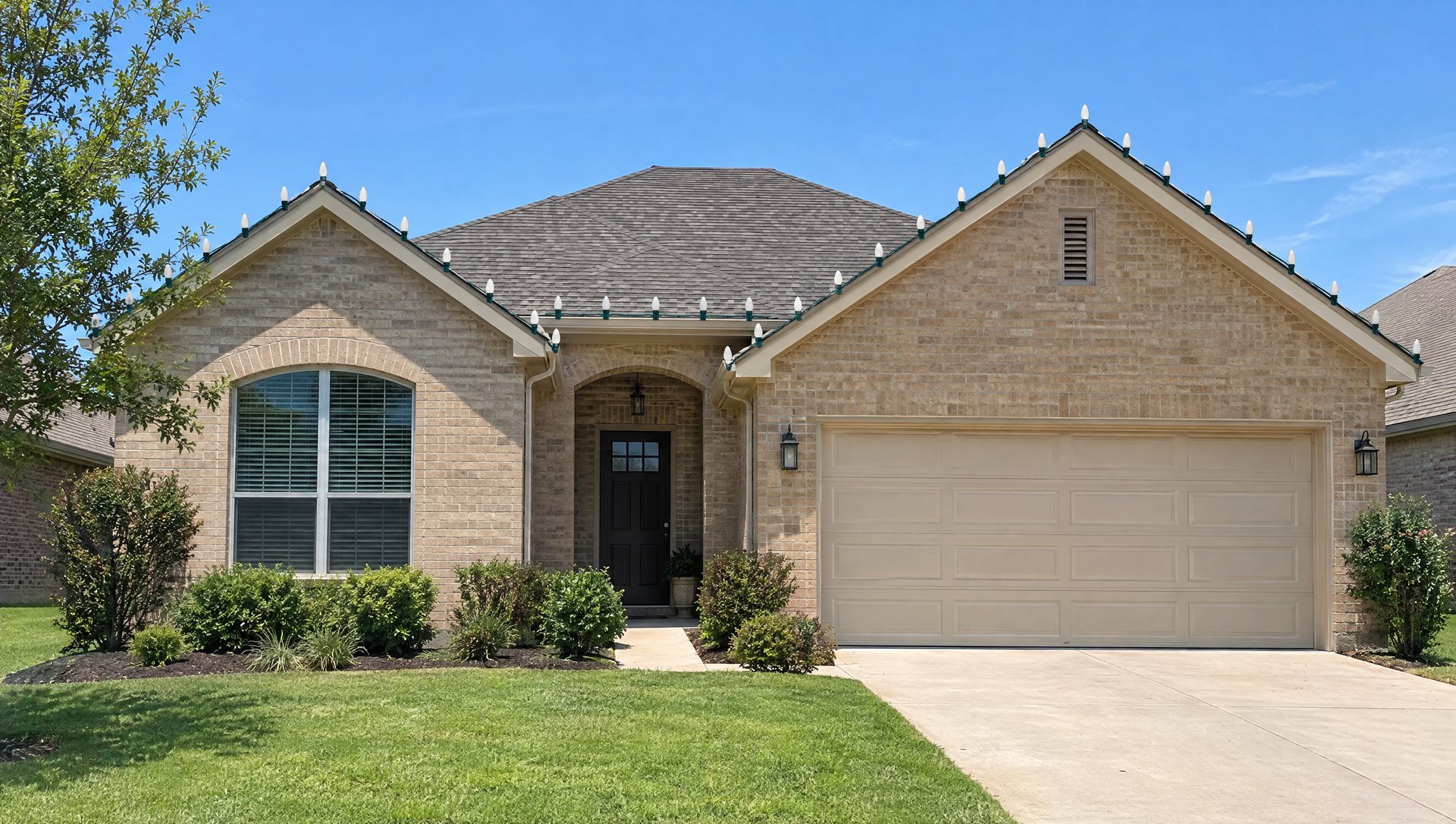
The daytime view is where workmanship shows. We look for three things:
- Bulbs that point the same way. Bulbs sit upright on a gutter and often point outward on a fascia board. Whatever the direction, every bulb should match.
- Even spacing. Roofline strings of C9 bulbs (the large, cone-shaped ones) commonly have a bulb every 12 inches; the supplier Christmas Lights Etc uses that spacing in its roofline example. A gap or a bunched corner is easy to spot. More on the bulb itself in our guide to C9 Christmas lights.
- Cords you have to look for. The cord down to the outlet should follow a corner, downspout or trim line, not cross a wall or window.
Neat work reads by day as one straight, even line of unlit bulbs. Leaning bulbs and cords crossing a wall are what make lights look bad in daylight.
Why do lights look different at dusk than in full dark?
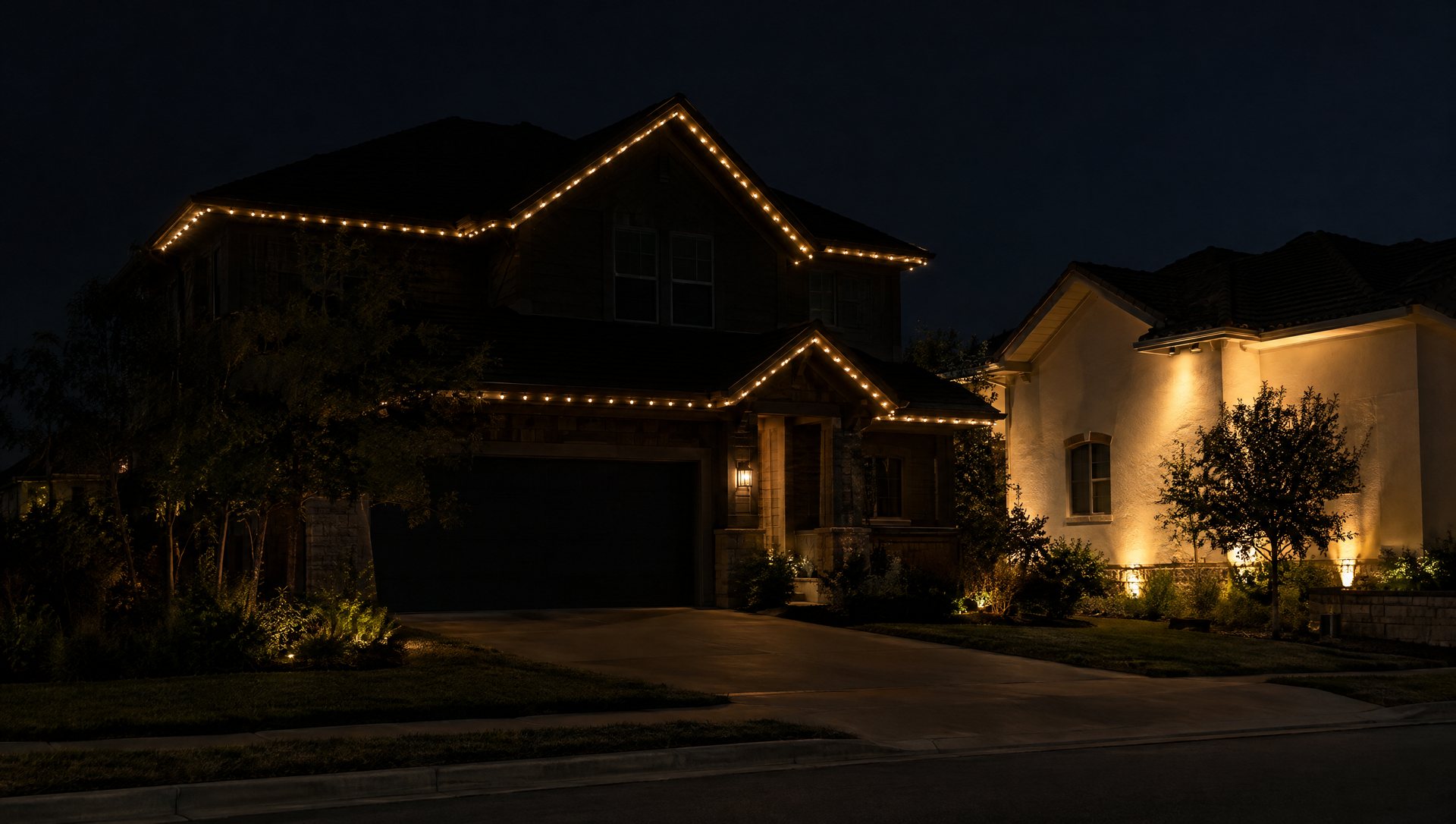
At dusk the sky is still blue and the walls, stone and roof still show, so the lights look balanced against the house. In full dark only the lights show and the walls go black. Many gallery photos are shot at dusk for that reason.
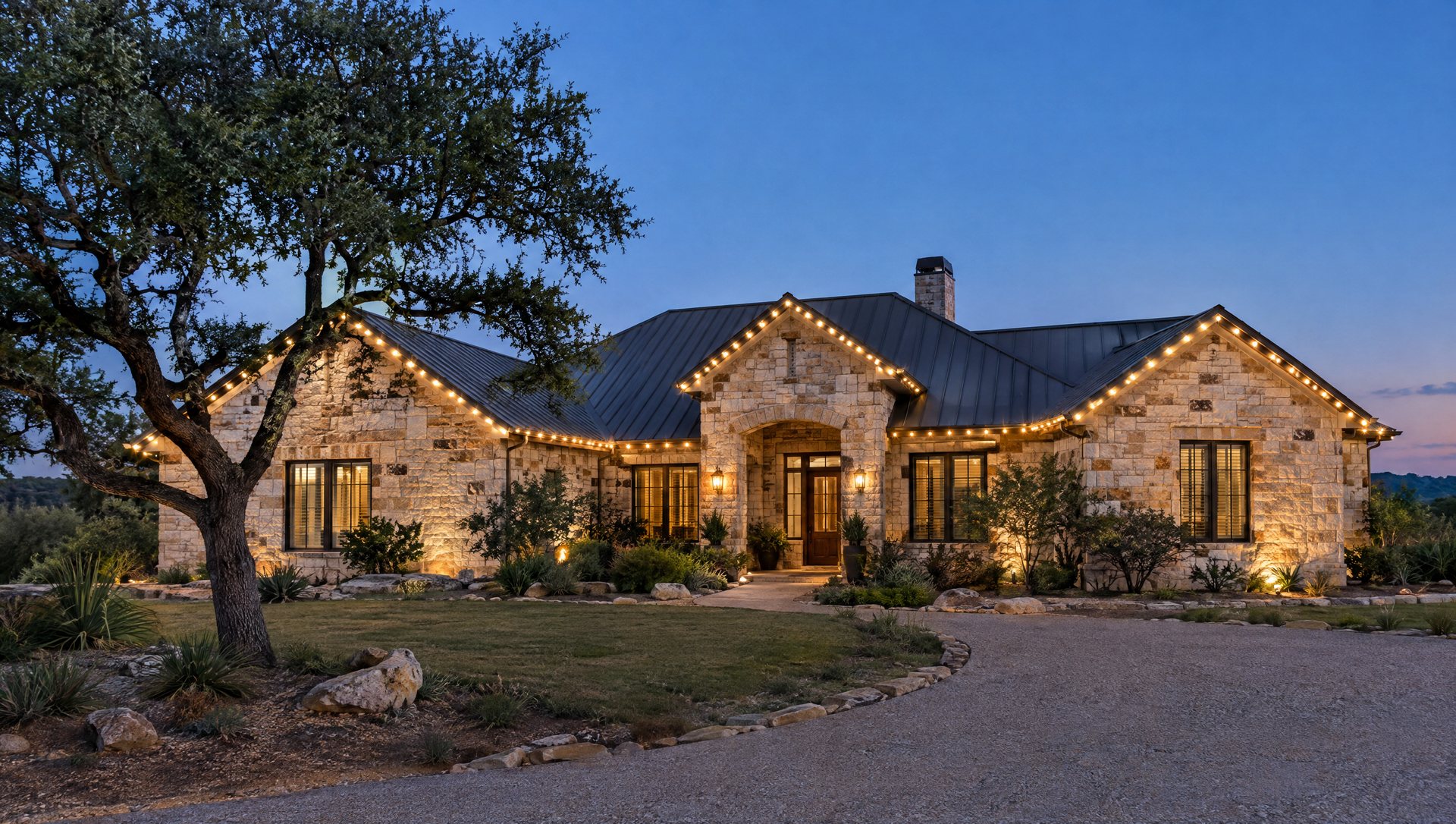
In Austin the dusk window is short and early. Sunset is about 5:30 PM from late November into the first week of December 2026, according to the NOAA solar calculator table for Austin. U.S. Naval Observatory data puts the end of civil twilight, the last usable daylight, 25 to 27 minutes after sunset all season. By about 6:00 PM in early December the usable daylight is gone, so the full-dark view is the one you live with for most of the evening.
Phones add a second effect. Apple says Night mode on an iPhone turns on by itself in low light and that a capture can take several seconds. In our judgment, that long exposure often shows more of the house than you would see from the street.
Compare like with like: dusk with dusk, dark with dark. A full-dark photo shows what you will see from the street. The daytime photo shows the workmanship.
How do you judge an installer’s photos?
Zoom in. The details that separate careful work from rushed work are small but show in any sharp photo.
| What to look at | Good sign | Warning sign |
|---|---|---|
| Roofline | The line of bulbs follows the roof edge with no sag between bulbs | Dips, waves or a line that drifts off the edge |
| Bulb spacing and direction | Even gaps, every bulb pointing the same way | Bunched or missing bulbs, bulbs at mixed angles |
| Corners and gable peaks | The line turns the corner cleanly and meets at the peak | A loop of spare wire at the corner, or a peak that stops short |
| Color of white | One white across the whole house | Yellower and bluer sections side by side in the same frame |
| Cords and plugs | Hard to find in the photo | Cords across walls, windows or walkways |
| Tree wraps | Even spacing up the trunk, limbs wrapped to a clear stopping point | Gaps, bunching or dark sections on the same trunk, or one main limb left dark |
| What is lit | The caption says which parts were in the job | You cannot tell what the customer bought |
| When the photo was taken | Weeks after install, lines still straight | Only install-day photos, which cannot show a cold front’s effect |
“Warm white” is not one color. It runs from roughly 2600 K to 3000 K depending on the brand. The bulb maker Minleon labels a 2600 K and a 2700 K warm white, and the supplier The Christmas Light Emporium sets its warm white at 3000 K. The Emporium also explains that LEDs are sorted into color bins and shift slightly as they age. Mixed brands, or old sets beside new ones, can show up as two whites on one house. If you are still choosing a color, see warm white vs cool white Christmas lights.
A phone photo will not tell you how warm a white is. In our experience, bulbs overexpose at night and the camera shifts the color. It does show a mismatch between two sections in the same frame.
Several of these warning signs are on our list of common lighting mistakes. To test your eye, try our pro vs DIY Christmas lights photo comparison.
Which five views should you ask an installer for?
- From the street, straight on. The whole design, as most people see it.
- From the driveway approach. How the lines hold up at an angle.
- The front entry, up close. Wreath, garland and cords where guests stand.
- A close-up of the roof edge or a wrapped trunk. Spacing and neatness at arm’s length.
- The same front view in daylight. How the house looks all day.
How can you tell a real job photo from a stock photo or mockup?
The quickest check for a stock photo is to search it with Google Lens. Google’s help page on searching with an image says the results can include websites with the same image or a similar one. A stock photo tends to turn up on several companies’ sites.
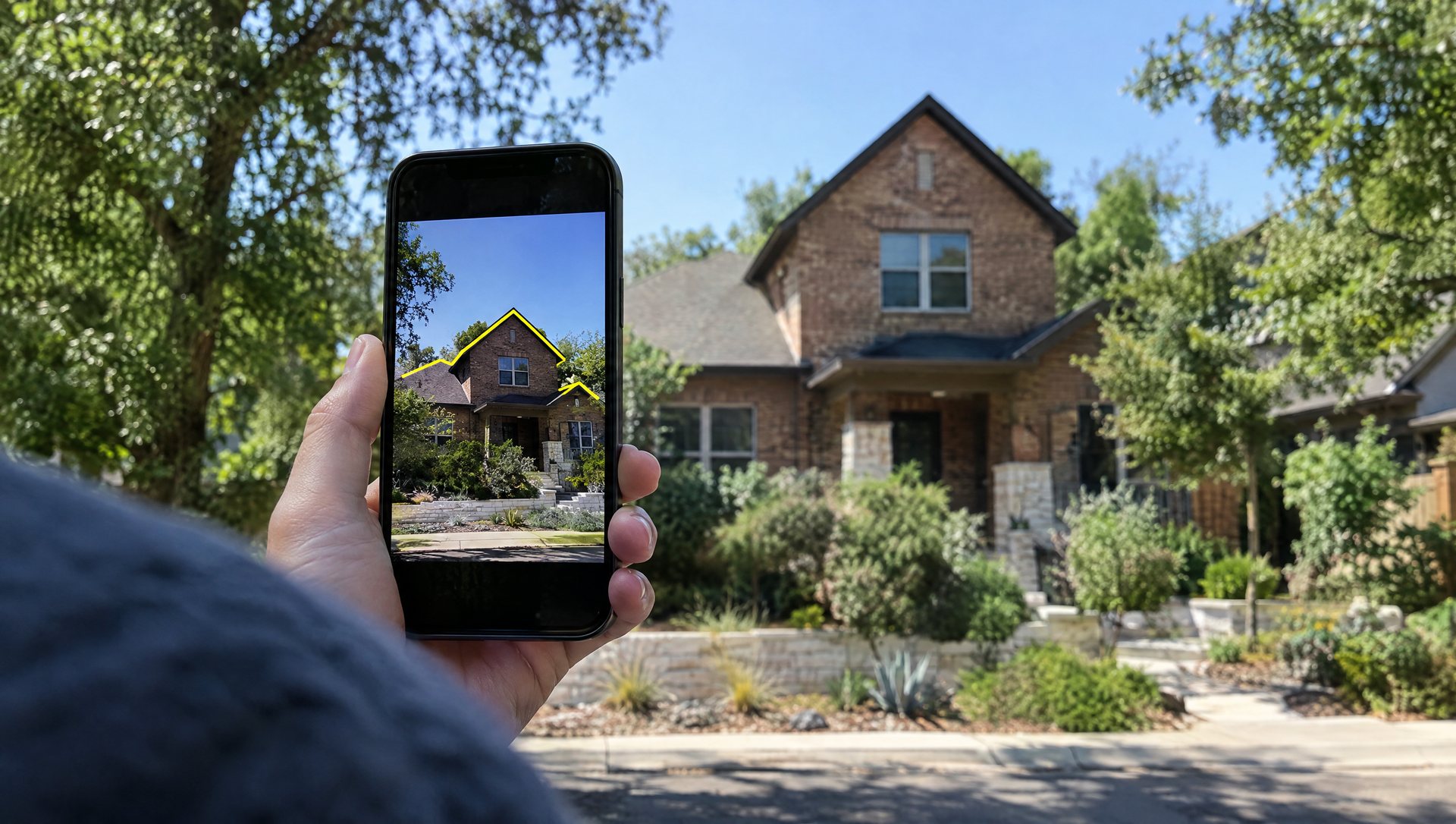
Other signs worth a question:
- Snow on the lawn, or a house style you do not see around Austin, in a gallery of “local” work.
- A halo of light on the wall or roof in a daytime photo. In our experience, a lit bulb in daylight shows as a small bright dot and does not throw a glow, so a daytime halo is usually drawn on.
- No captions: no scope, no season and no general area.
A design mockup is different. Drawing lights onto a customer’s own photo is a normal way to show a plan. It should be labeled, and kept out of a gallery of finished jobs.
We hold ourselves to the same rule on this page: the pictures marked “Illustration” are illustrations, not jobs, and the two photos are labeled with whose work they show.
What do wrapped trees look like by day and at night?
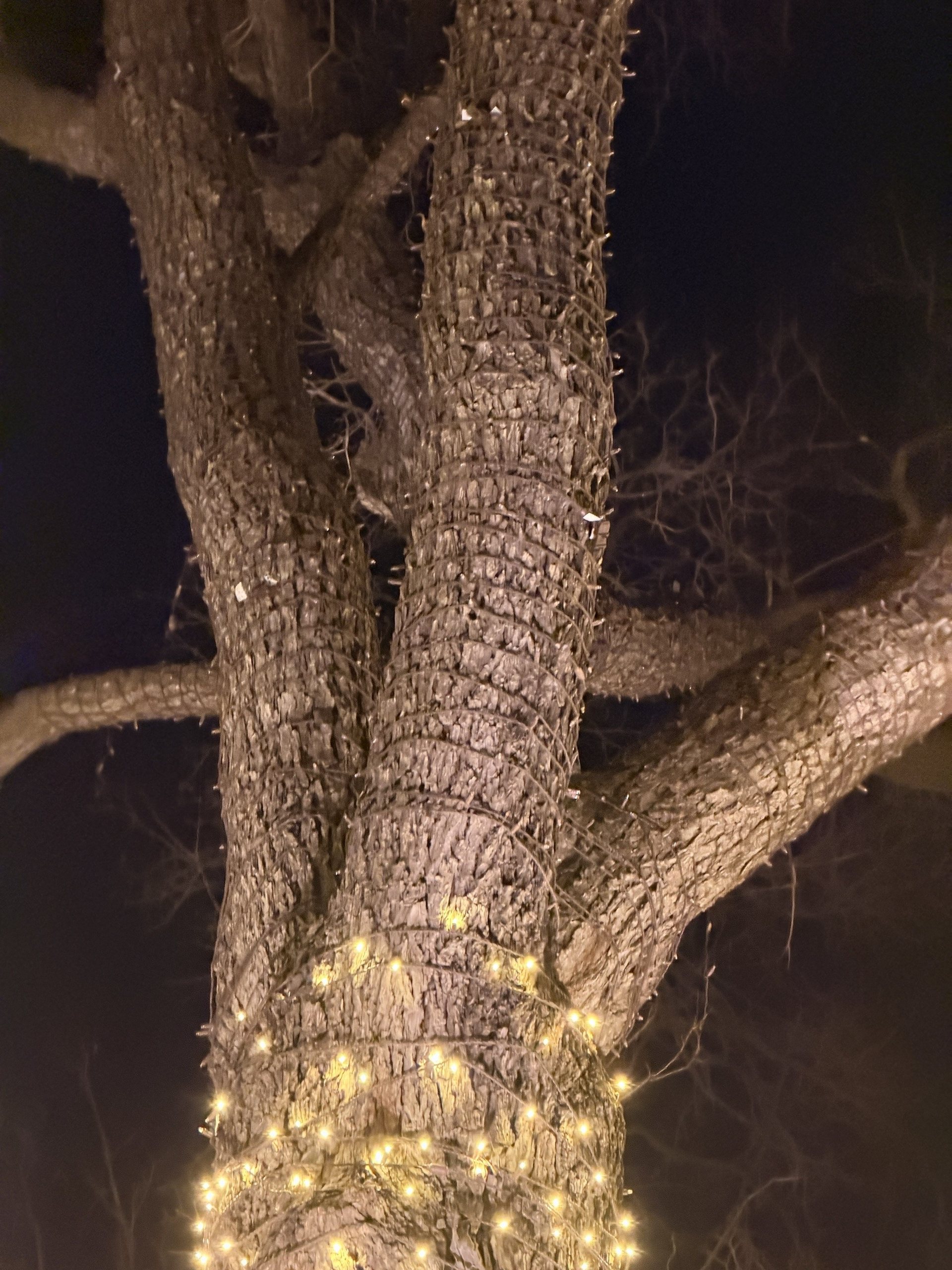
By day, a wrapped trunk shows bands of wire and small bulbs. From the street it reads as texture on the bark, and up close you can see every turn. The Christmas Light Emporium says a small 5mm bulb nearly disappears against bark in daylight, and Christmas Designers suggests wire that blends with the tree. At night the same tree is often the brightest thing in the yard.
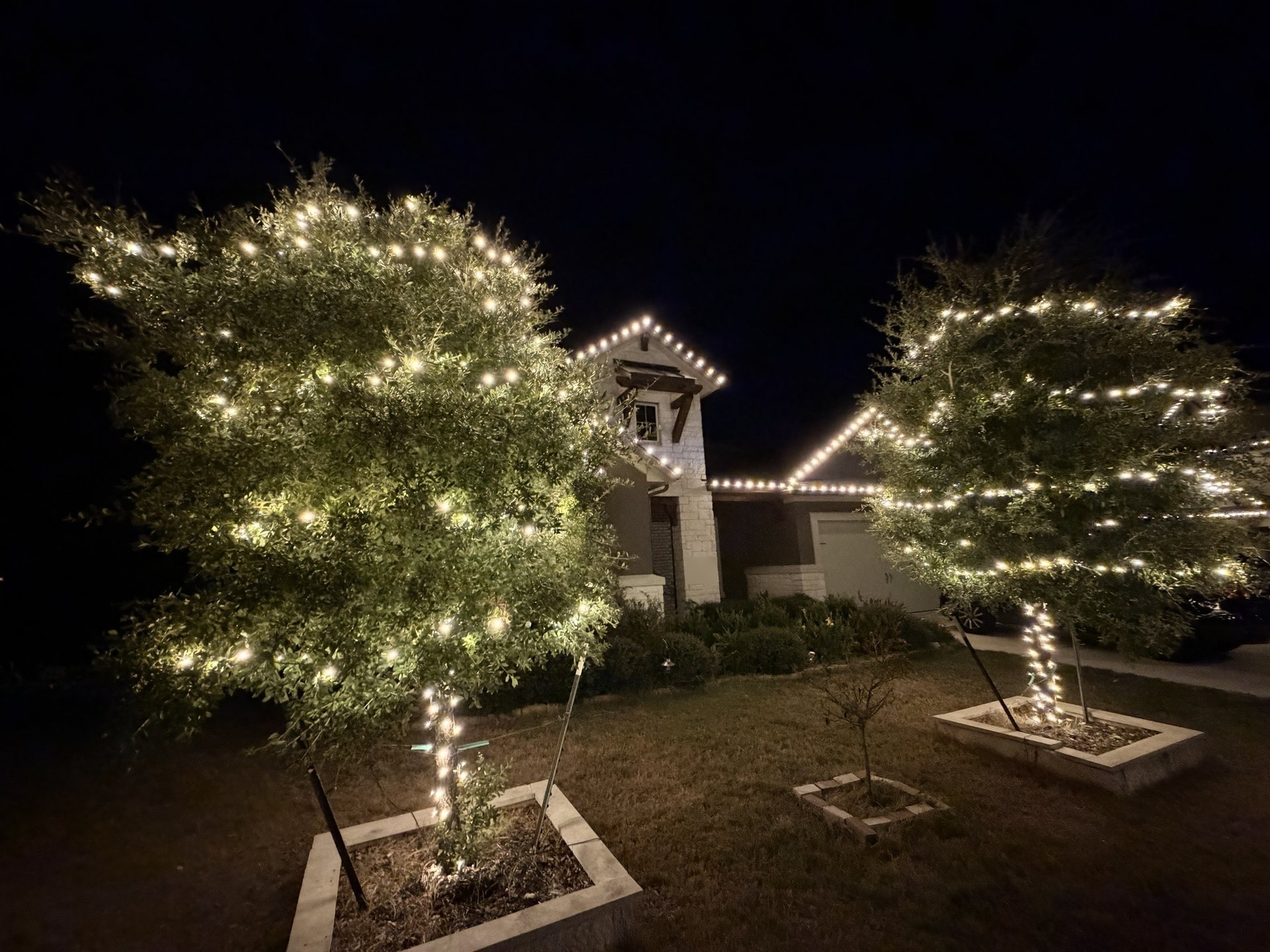
A trunk wrap is a light string spiraled up the trunk from the base. A trunk-and-limb wrap, which suppliers call a branch wrap, carries that spiral out along the main limbs. Smaller trees can also have the leafy canopy wrapped lightly. In a photo, check how far out the limbs the wrap runs and whether the spacing stays even all the way.
Coverage is also what sets the price. As a guide, our typical 2026 prices run $195 to $275 to wrap the trunk of a small or medium tree and $450 to $950 for a large live oak’s trunk or trunk plus some limbs, confirmed from photos of your tree. The full range is in what it costs to wrap a tree in Christmas lights, and Austin’s most common yard tree has its own guide: Christmas lights on live oak trees.
What a photo cannot tell you
A photo shows one evening. It does not show how the lights held up through a cold front, how fast a dark section was fixed, what the job cost or whether the lights came down on time.
Service speed, removal dates and weather policy are questions to put to any installer in writing before you book. Our guide on how to read a Christmas light installation quote shows what that paperwork should cover.
A photo of another house is also not a preview of yours. Roof shape, wall color and trees decide the result. In our experience, light limestone, stucco and pale brick pick up the glow, and dark shingles and deep eaves disappear at night.
Two things we decline to do: pass off a rendered picture as a past job, or promise that your house will match a photo of a home with a different roof. A photo you found is still a good starting point for the style (bulb type, color and which parts are lit); your roof shape, outlets and trees decide how close the result can be. If you want help turning a photo into a plan, see what happens in a Christmas lighting design consultation.
Take your own “before” photo
Your daytime photo is the “before”, and it is also how we quote. Stand in the street, straight across from the house, and take the whole front in one frame in daylight. Add one from the driveway approach and a close-up of any tree you want wrapped. If you hire someone, take the “after” from the same spot, once at dusk and once in full dark, and you have a pair worth keeping.
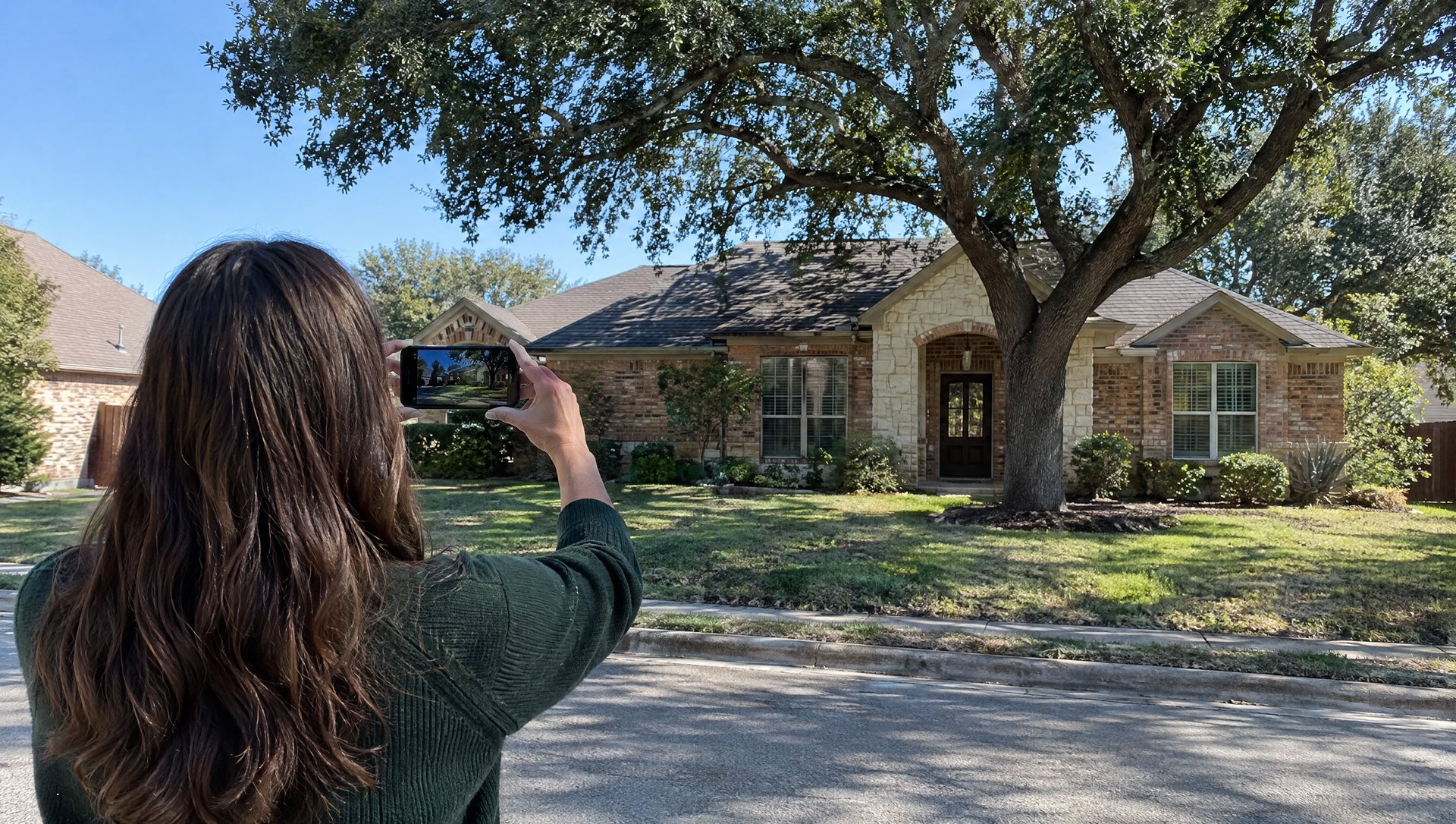
Text those daytime photos to (737) 777-9099, or use the contact page, and tell us which parts you want lit. Jobs start at $500, and here is how a quote from photos works.
Sources
- NOAA Global Monitoring Laboratory: solar calculator table for Austin, 2026 (sunset times)
- U.S. Naval Observatory: sun and civil twilight data for Austin, December 1, 2026 (end of civil twilight)
- Apple Support: Use Night mode on your iPhone (Night mode)
- Christmas Lights Etc: how many watts and amps Christmas lights use (12-inch spacing in the roofline example)
- The Christmas Light Emporium: warm white, pure white and cool white (3000 K warm white, color bins and aging)
- Christmas Designers: Minleon C9 V2 bulb specifications (2600 K and 2700 K warm whites)
- Google Search Help: Search with an image on Google (image search results)
- The Christmas Light Emporium: how to wrap trees with Christmas lights (5mm bulbs against bark, branch wrap)
- Christmas Designers: how to wrap trees with lights (wire color chosen to blend with the tree)
- Christmas Lights Etc: wrapping trees with lights (trunk wrap and branch wrap methods)
About the author. Rick Safeman owns Sapien Lighting & Installation in Austin, Texas.