


Commercial Christmas Light Installation in Austin: Cost, Approvals and Permits
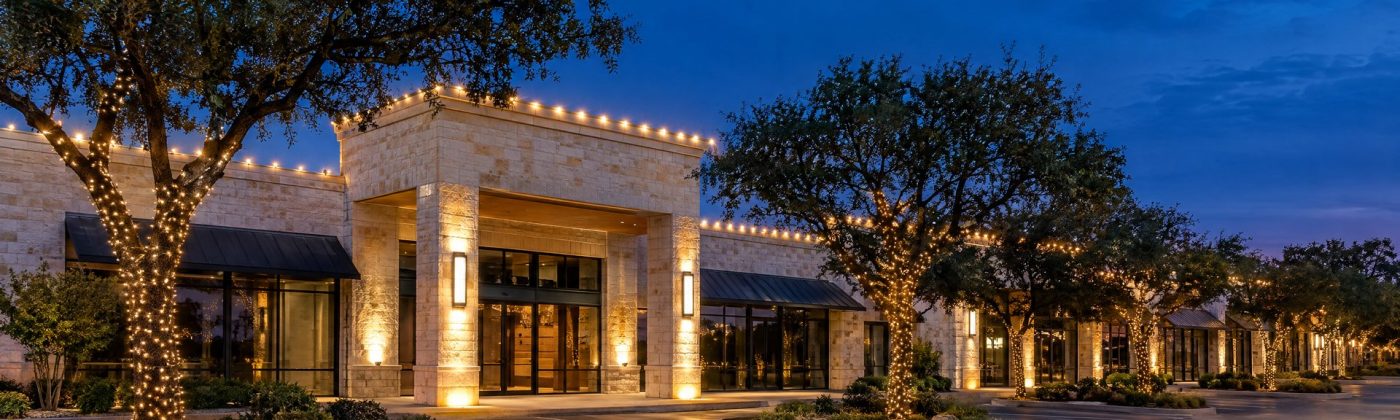
Commercial Christmas light installation is a seasonal service: an installer plans the display, lights the building’s roofline, entry and trees, services it through December and takes it down. Before signing, a business should settle three things: the landlord’s written approval, the installer’s insurance paperwork, and which outlets the lights will use. One Austin installer’s November 2024 post put commercial jobs at $2,500 to $25,000 or more (checked October 2026). Sapien Lighting & Installation quotes commercial work per property, after a site walk.
| Question | Short answer (Austin, as of October 2026) |
|---|---|
| What does the service include? | Usually a plan, the lights, installation, service during the season and takedown. Get the list in writing. Sapien’s list: a custom design, commercial-grade lights and clips, installation, repairs if anything goes dark during the season, and takedown in January. |
| Who has to approve it? | The property owner or landlord, in writing. Often the property manager and brand rules too. |
| What insurance paperwork should we get? | A certificate of liability insurance, plus the endorsement if your lease requires an additional insured. Ask how the crew is covered if someone gets hurt. |
| Do we need an electrical permit in Austin? | Inside Austin city limits, not to install temporary holiday lighting. A new outlet or circuit needs a permit pulled by a TDLR-licensed electrical contractor. Sapien installs plug-in lighting only. |
| What do commercial jobs cost? | One Austin installer’s November 2024 post put small businesses at $2,500 to $5,000 and large properties at $8,000 to $25,000 and up (checked October 2026). Other published figures differ; see the cost table below. |
| How far ahead should we book? | Sapien’s usual lead time is 1 to 2 weeks; text us to check open dates. Landlord and vendor approvals add time on top. |
| When should lights be on for retail? | For holiday shopping, aim for Black Friday (November 27, 2026) or Small Business Saturday (November 28, 2026). |
| How long can they stay up? | OSHA’s workplace rule caps temporary holiday wiring at 90 days. Sapien takes lights down January 2 to January 15. |
This guide is for owners and managers of Austin storefronts, restaurants, offices and retail centers deciding on outdoor holiday lights this season. If you are lighting a home, start with what residential Christmas light installation costs in Austin instead.
- What commercial installation includes
- How a commercial job differs from a home
- Who has to say yes
- Insurance paperwork to ask for
- Permits, electricians and Texas rules
- Power, outlets and cords
- What to light
- Entry, parking-lot and street trees
- Commercial-grade lights: buy or have them supplied
- What it costs
- When to book, install and turn on
- When wind or rain knocks the lights out
- Do lights bring more customers?
- When we’d tell you to do something else
- How Sapien handles commercial work
What does commercial Christmas light installation include?
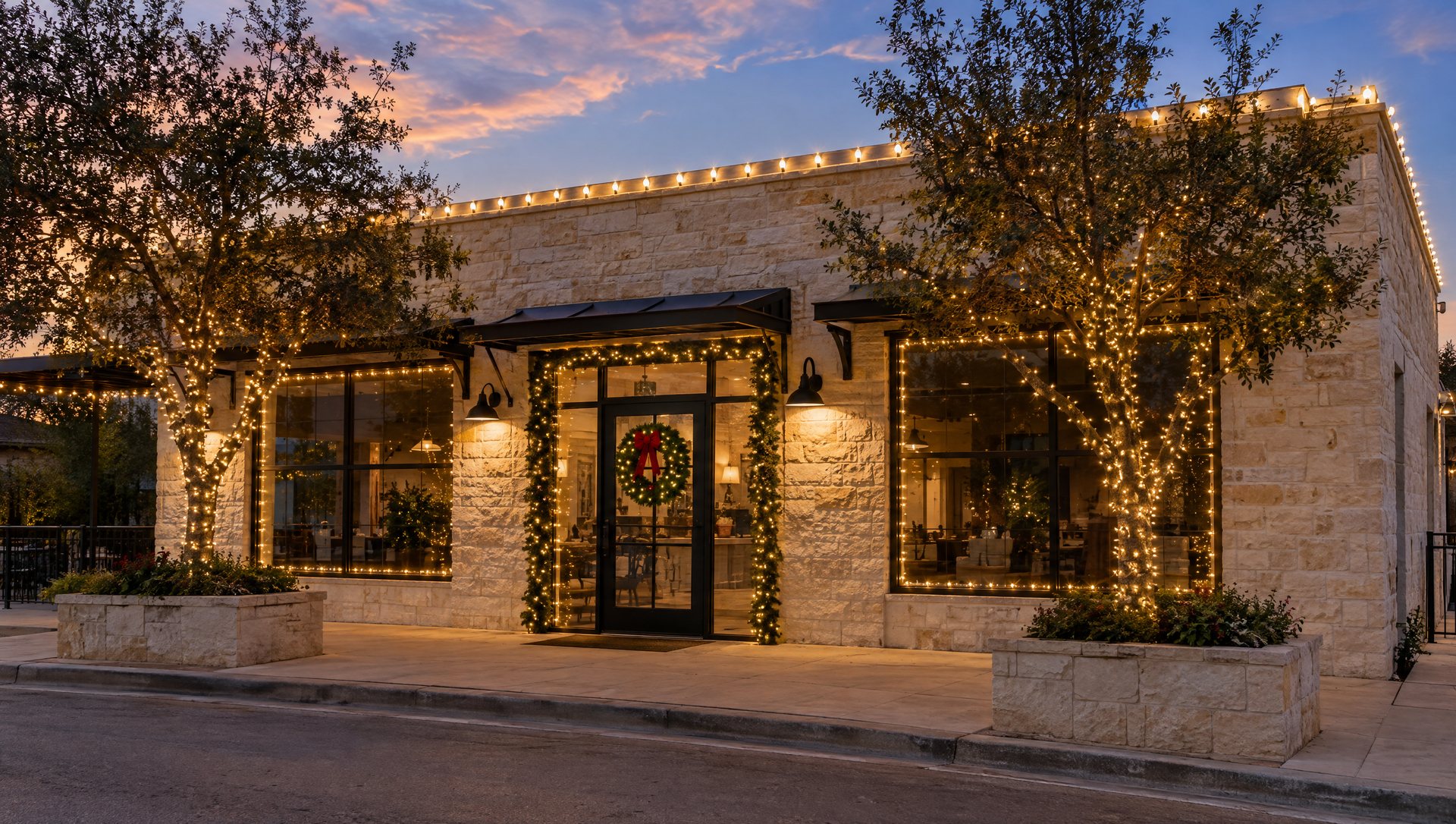
Commercial installation is the same seasonal service homeowners buy, scaled to a business. A full-service job usually covers five things:
- A plan. Which parts get lights, what kind, and where they plug in.
- The lights. Supplied by the installer, or the business’s own lights installed.
- Installation. Rooflines and parapets, entries, columns, windows, wreaths and garland, and trees.
- Service during the season. Someone to call when a section goes dark.
- Takedown. Removal after the season, and sometimes storage until next year.
Some installers sell only the labor; you supply the lights and arrange takedown. Before you compare two quotes, check that both cover all five items or say which they leave out.
How is a commercial job different from a home?
The lights are mostly the same as on a house. What changes is the building, the schedule and the paperwork.
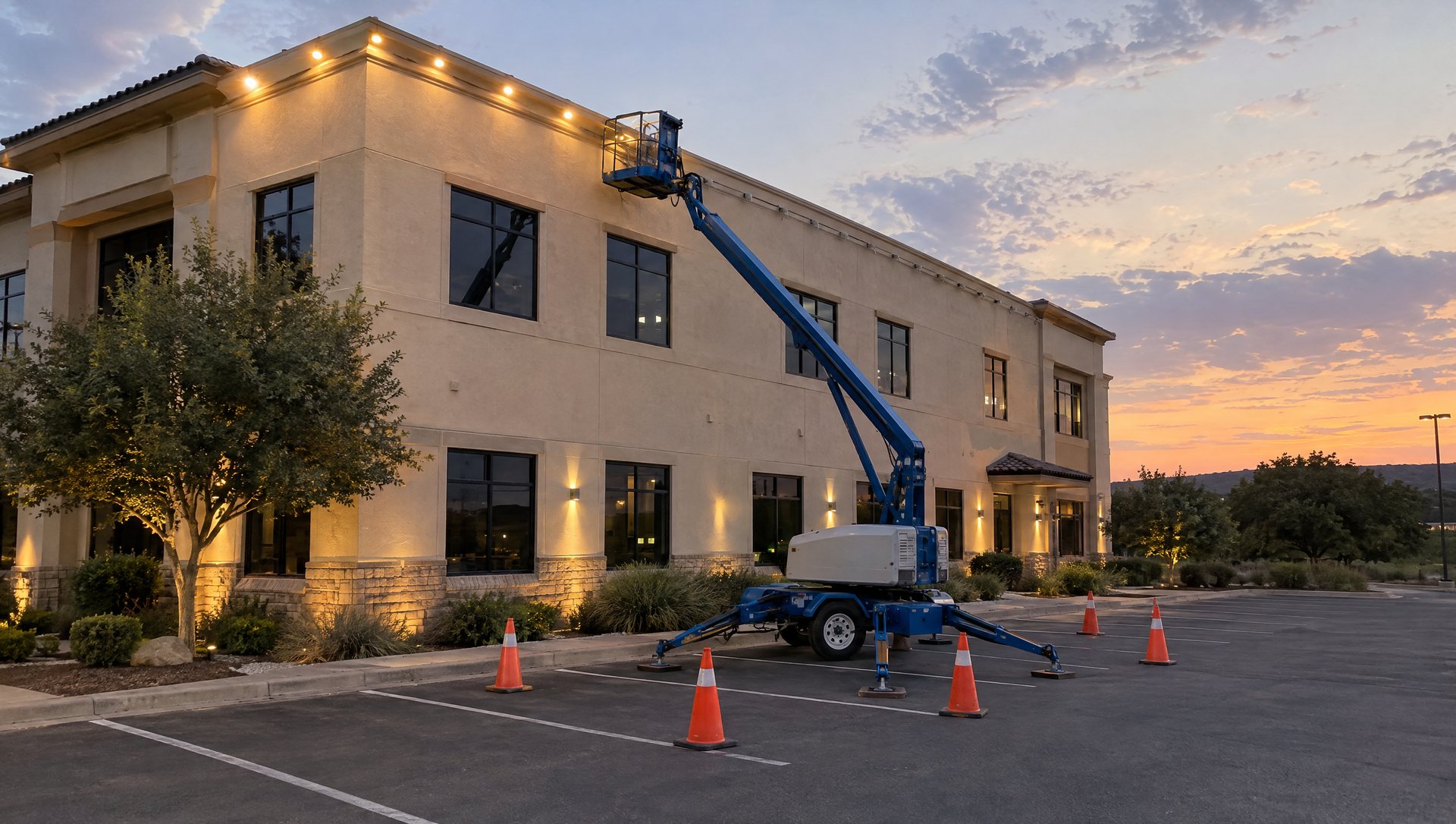
- Height and access. Storefronts often have tall parapets, flat roofs or two-story facades. Some need a lift instead of a ladder. For scale, the Dozr rental marketplace listed a 36-foot towable boom lift in Austin at $478 a day as of October 2026, before delivery fees.
- Crew time. A pricing guide written for installers puts an average commercial job at 6 to 12 crew hours, against 3 to 4 for a home (Christmas Lights HQ, March 2026). Height, trees, lifts and after-hours work add more.
- Working around customers. Crews may need to work before opening or after closing, with walkways and parking blocked off. Agree on work hours in the contract.
- More people involved. A homeowner decides alone. A business may need a landlord, a property manager and a brand team to agree.
Who has to say yes before lights go up?
The landlord or property owner has the final say on a leased building, and a landlord approves a specific design, not a wish. So learn the rules first, then send a written proposal for a written yes. Here is the order we’d work in.
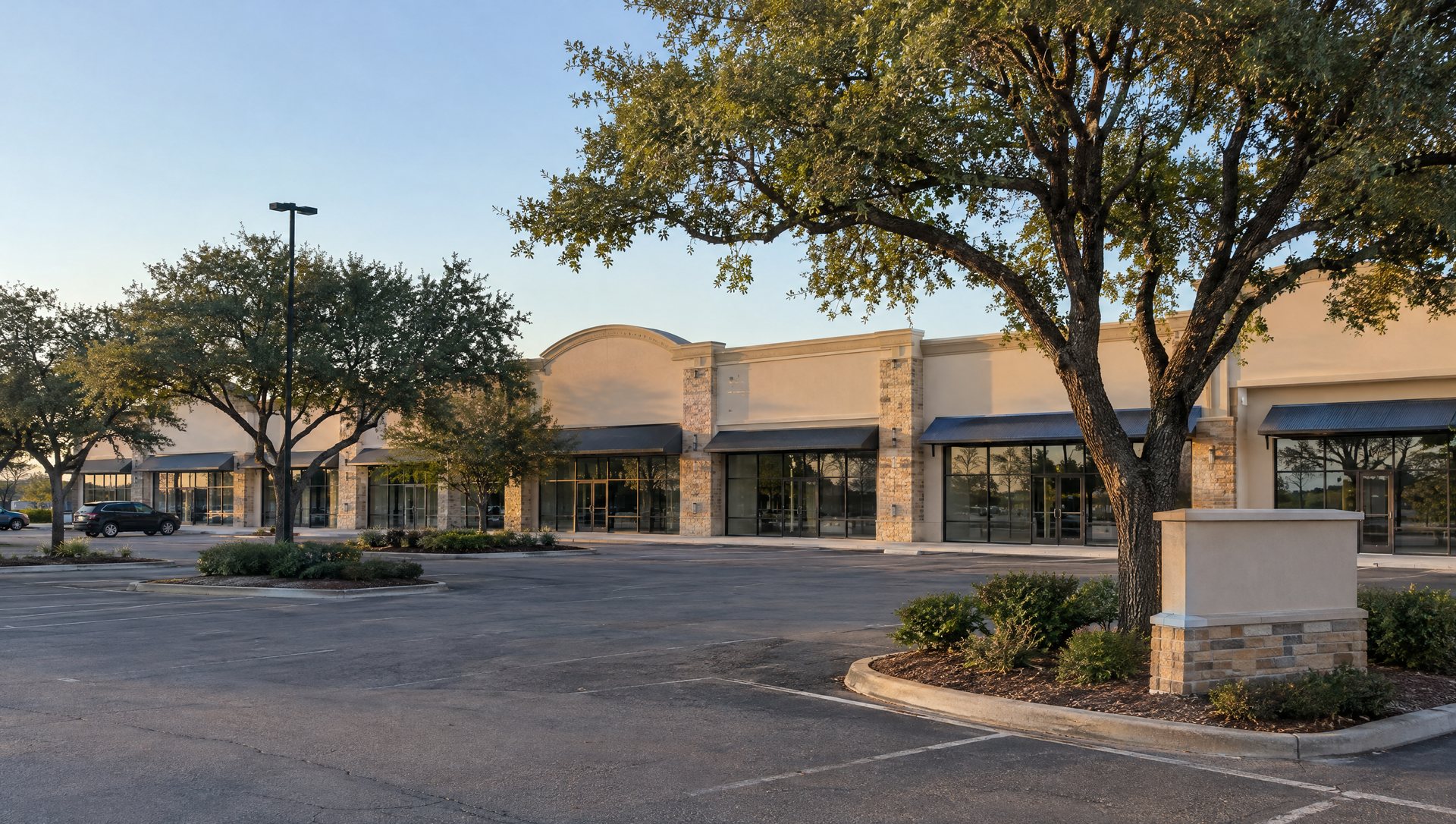
- The landlord’s ground rules. Ask whether exterior lights are allowed, and read your lease for anything on alterations, signs or vendors. Ask in writing whether drilling into stucco, stone or storefront frames is allowed, who may go on a flat roof, and whether roof access affects the roof warranty.
- The property manager. Many managed properties have vendor rules. One large Texas management company has vendors register through a compliance service that collects license and insurance information, a W-9 and a signed vendor agreement. Ask your manager about their process and timing.
- Brand or franchise standards. A chain may have rules on colors, sign visibility or approved vendors.
- Common areas. In a shopping center, the parking lot, islands, monument signs and shared walkways usually belong to the landlord. Ask before you plan anything outside your own storefront.
- Site walk, proposal, written yes. Send the installer’s written proposal to the landlord and keep their written approval with your lease.
Name one person who can approve the design, sign the contract and answer the crew on install day. Jobs stall when three people each think someone else is deciding.
What insurance paperwork should a commercial installer show?
Ask any commercial installer for a certificate of liability insurance before work starts, and know what that paper does not do. Your lease and your insurance agent answer your specific case.
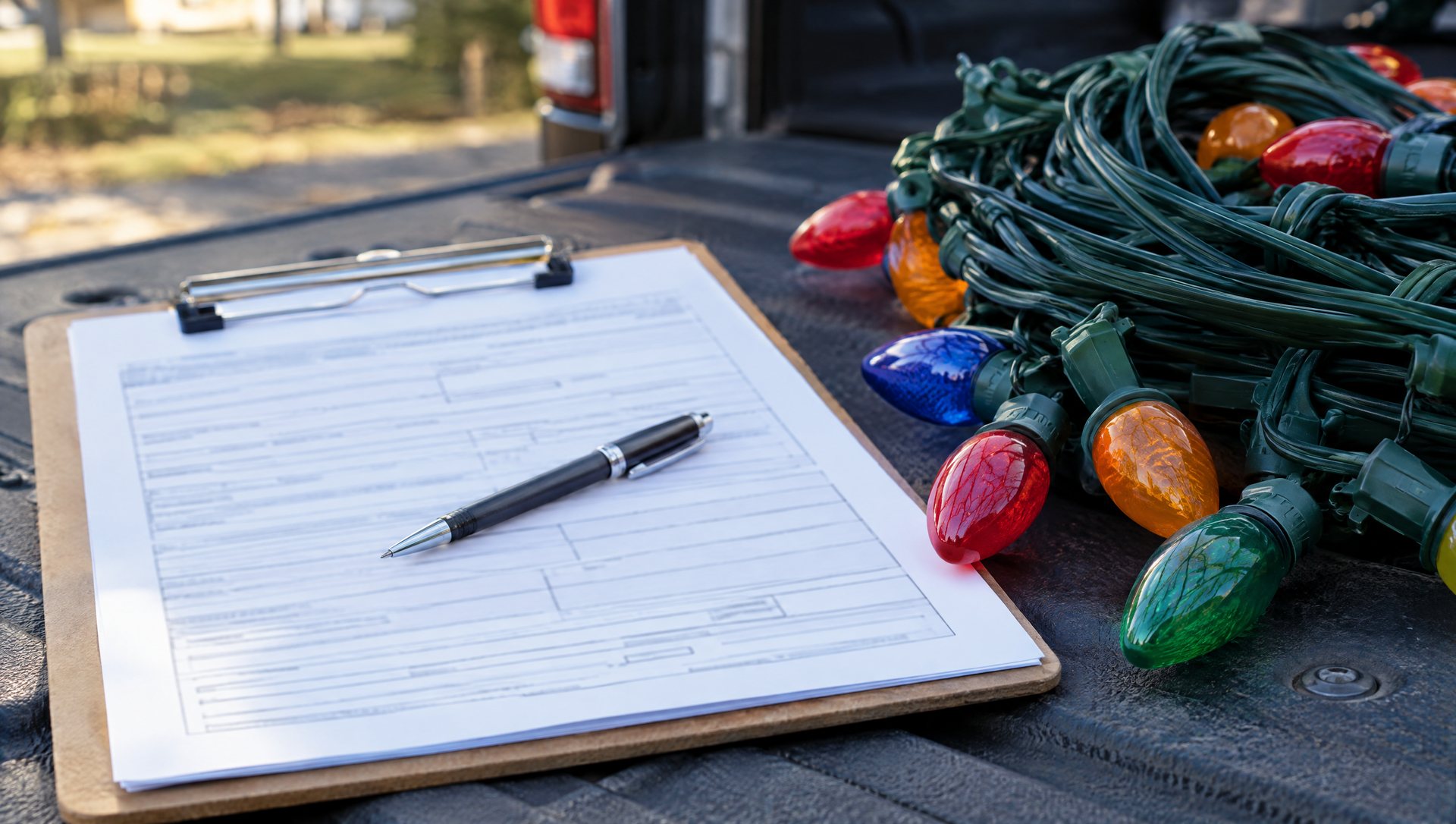
A certificate is a summary, not coverage
In Texas, a certificate of insurance summarizes a policy for someone outside it. Texas Insurance Code chapter 1811 says a certificate cannot change the policy and gives the holder no contract rights. The usual form is ACORD 25, on the Texas Department of Insurance list of approved forms.
So if your lease requires the landlord, or you, to be an additional insured on a vendor’s policy, a name typed on the certificate does not do it. IRMI’s insurance glossary describes that status as something added to the policy itself. Ask for a copy of the endorsement.
General liability does not cover the crew
Commercial general liability insurance covers claims from other people, such as injury to a customer or damage to your building. The Texas Department of Insurance says it is not meant to be workers’ compensation, which is optional for most private employers in Texas, according to the TDI workers’ compensation guide. TDI also links a coverage lookup for checking an employer. So “we’re insured” does not tell you what happens if an installer falls from a ladder on your property.
Questions to ask every installer, Sapien included:
- Can you send a certificate of liability insurance naming our company as the certificate holder?
- If our lease requires it, can you add the landlord or us as an additional insured, and send the endorsement?
- How are your workers covered if one of them is hurt on our property?
Sapien is fully insured. Some leases set the insurance limits a vendor must carry, and your insurance agent can read that clause for you. Our list of questions to ask any Christmas light installer covers the rest of the vetting.
Do commercial holiday lights need a permit or an electrician in Austin?
Inside the City of Austin, temporary holiday lighting needs no electrical permit. A new outlet or circuit does, and that work belongs to a licensed electrician. This is general information from the code text as of October 2026, not legal advice; our overview of Texas lighting regulations covers the wider rules.
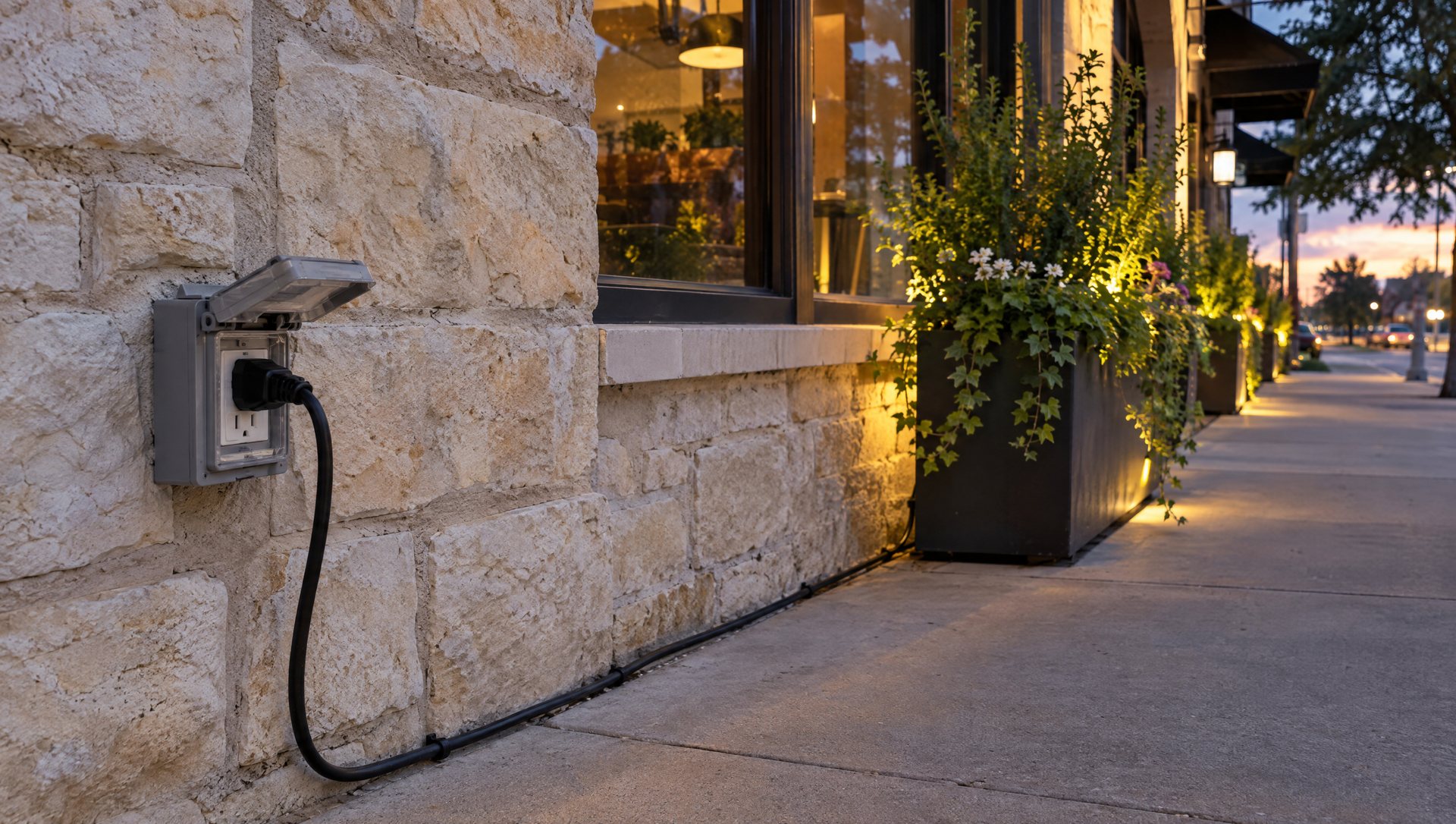
Austin’s permit rule
Austin’s electrical code requires a permit for electrical work unless it is on an exempt list, and that list includes installing “temporary holiday decorative lighting” (City Code 25-12-113). A new receptacle or circuit is not on the list. Its permit must be pulled by an electrical contractor licensed by the Texas Department of Licensing and Regulation (TDLR) and registered with the City.
Outside Austin’s jurisdiction, ask your own city or county building department; the rule may differ.
Texas licensing
Texas law bars anyone from performing or offering to perform electrical work without a license (Occupations Code chapter 1305). The chapter carves out holiday lighting installed by landscapers, “excluding any required power source”. The statute does not define “landscaper”, so we won’t tell you who it covers. It does make one line clear: a new outlet, circuit or hardwired connection is electrical work for a licensed electrician.
TDLR’s list of licensed programs has no license for holiday-light installers. An electrician does hold one, and you can check it with TDLR’s license search. Sapien installs plug-in seasonal lighting only.
The 90-day temporary rule
The National Electrical Code allows temporary holiday decorative lighting for up to 90 days. OSHA’s 29 CFR 1910.305 says the same for workplaces, “not to exceed 90 days for Christmas decorative lighting”, and says temporary wiring must come down when its purpose ends. OSHA rules bind employers, so they apply to a business in a way they do not to a homeowner.
Example: lights installed November 1 reach 90 days on January 30, 2027. Lights installed October 15 reach it on January 13.
Will your building’s power handle the lights?
A storefront display can often run on a few ordinary outdoor outlets. The questions are where they are, what shares their circuits, and how cords reach the lights.
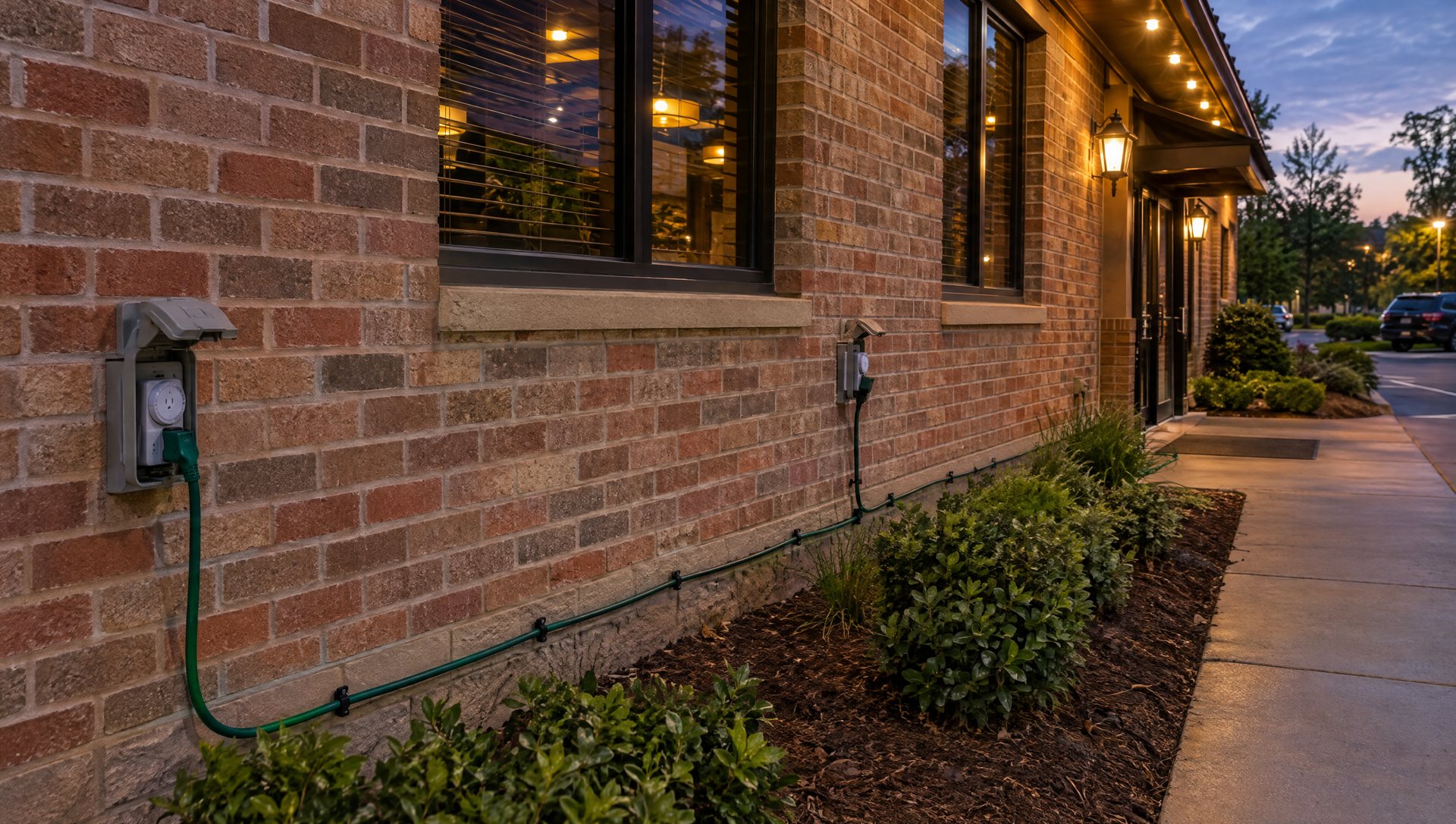
Start with an outlet inventory
- Walk the outside of the building and note every exterior outlet.
- Note which are protected by a GFCI (ground-fault circuit interrupter). The Consumer Product Safety Commission says to plug outdoor lights only into GFCI-protected outlets.
- Ask what else is on each circuit. In a strip center, an outside outlet may share a breaker with a sign, a patio heater or something inside the store.
- Check every tree you want lit for a nearby outlet. Parking-island trees may have none, and a cord across a drive aisle is a trip and vehicle hazard. The choices are an existing outlet on a light pole or in the island, if the landlord allows it; a new outlet added by a licensed electrician; or leaving that tree out.
- Find out who can reset a breaker after hours, and where the panel is.
The 80% planning rule
A 15-amp circuit at 120 volts carries 1,800 watts, and a 20-amp circuit 2,400 watts. The electrical code treats a load that runs three hours or more as continuous, and holiday lights on an evening timer fit that description. The planning rule is to keep a continuous load at or below 80% of the breaker rating. That leaves 1,440 watts on a 15-amp circuit and 1,920 watts on a 20-amp circuit, minus whatever else is plugged in (NOARK Electric explains the 80% figure).
Example, using one listing of 0.58 watts per LED C9 bulb (typical LED C9s draw about 0.6 to 1 watt): 400 feet of roofline with bulbs every 12 inches is 400 bulbs, about 232 watts. Add ten wrapped trees using three 4.8-watt LED mini sets each, another 144 watts. The total is about 376 watts, about a quarter of the 1,440-watt planning limit on a 15-amp circuit. The same roofline in 7-watt incandescent C9 bulbs, the figure Christmas Lights Etc’s wattage guide uses, would draw 2,800 watts, more than a 15- or 20-amp circuit can carry. That gap is the main reason commercial displays have gone LED; our LED vs. incandescent comparison runs the numbers.
Cords, doors and walkways
The Electrical Safety Foundation International (ESFI) says not to run extension cords through doorways or windows (ESFI extension cord safety tips), and OSHA bars it in workplaces. We’d also keep cords off customer walkways and out of exit paths.
When to stop and call an electrician
ESFI lists warning signs that call for an electrician: breakers that trip often, warm or discolored outlet plates, buzzing, a burning smell, or a tingle when you touch something (ESFI on overloaded circuits). Stop too if the plan only works with cords run inside the building, or if an outdoor outlet has no GFCI protection. Those are wiring problems, not lighting problems.
What to light on an office, retail center or restaurant
Light what people see first, at the distance and speed they see it. A driver at 40 miles an hour sees a roofline and a row of trees. A shopper walking up sees the door, the windows and the planters.
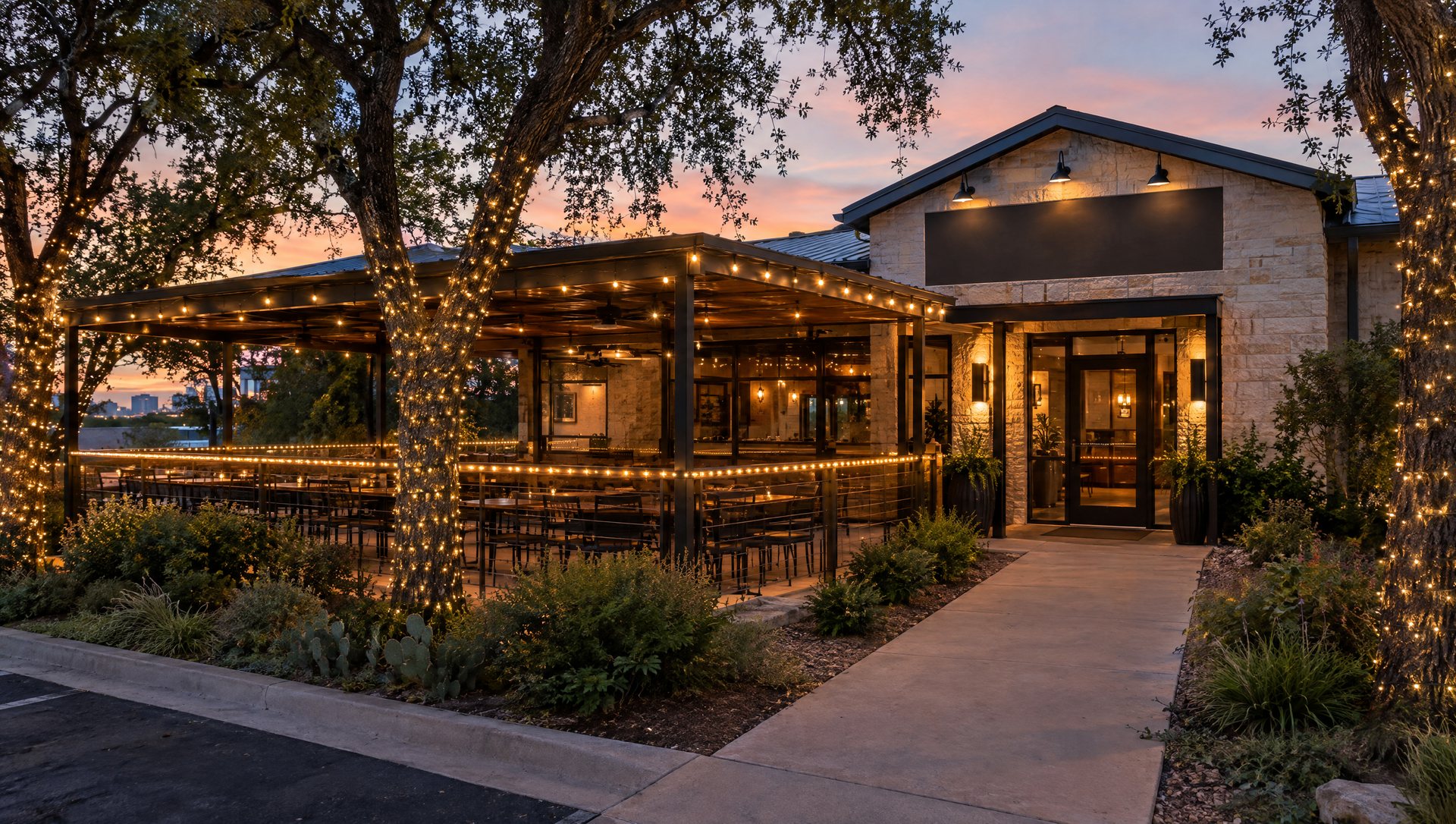
A single storefront usually starts with the fascia line, the door and the window outlines, with the sign kept readable.
| Property | Often lit first | What to watch |
|---|---|---|
| Restaurant | Entry, patio rails and trees, roofline | Patio heaters and cords sharing circuits; guests walking at night |
| Office building | Entry, front trees, monument sign area | Lights on when nobody is there; set a timer |
| Retail center | Parking-island trees, entry drives, building corners | Lifts, after-hours work, outlets far apart; island trees may have no outlet |
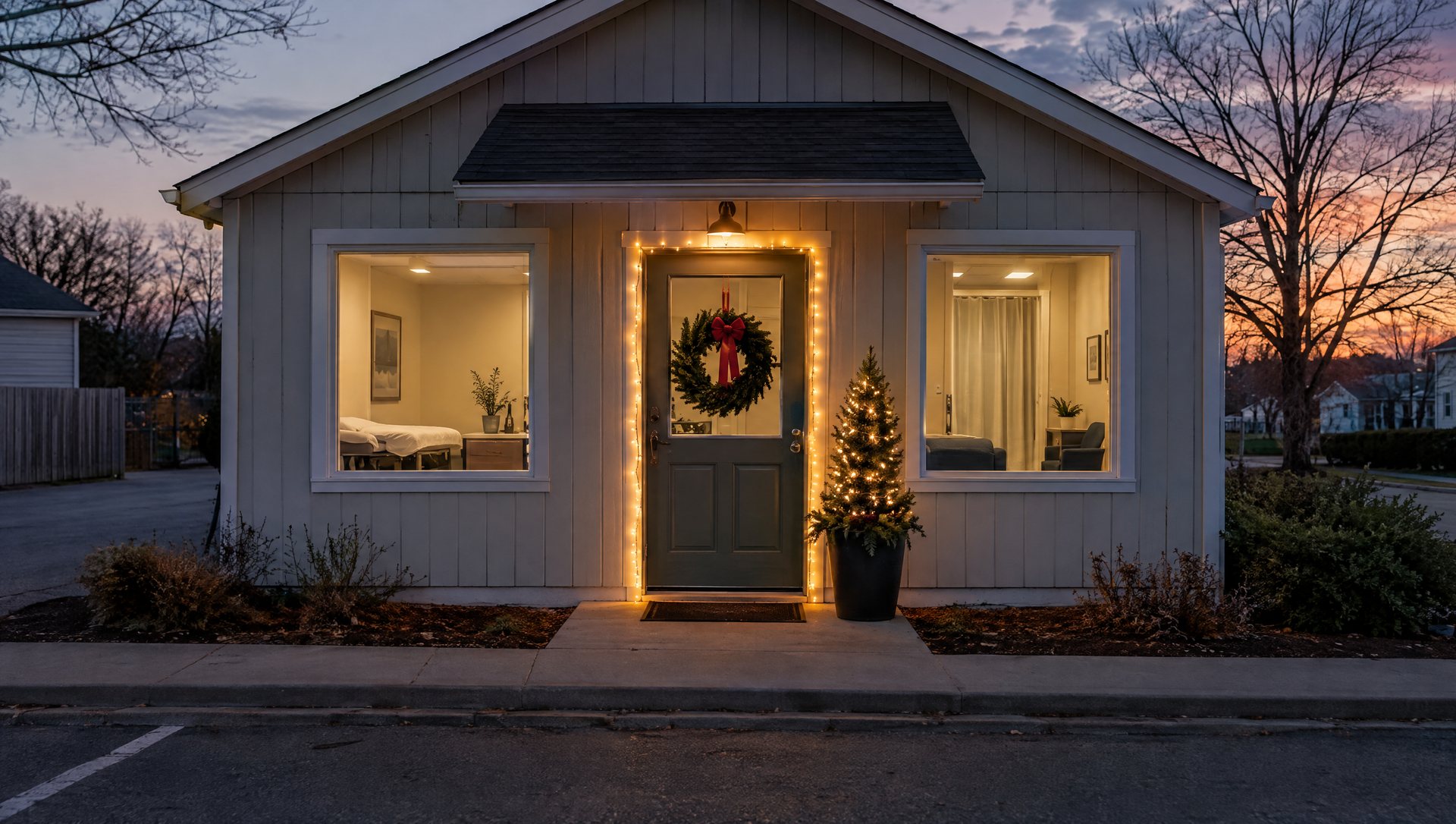
| Single office or clinic | Door, one or two trees, a wreath | An installer’s minimum charge may exceed a job this small |
Bulb size follows viewing distance: C9 bulbs read from the road, mini lights up close and on trees. Our guide to C9 Christmas lights covers the larger bulbs in detail.
Can you light your sign or logo?
Treat lit words and logos as a sign question and ask the City before you install. The City of Austin’s sign permits page says outdoor signs need a permit and that some are exempt under code section 25-10-101. Whether a lit holiday message fits those exemptions is a question for Development Services, or for your own city outside Austin.
The simpler rule: lights should frame the sign you already have, not hide it.
Can you wrap the trees out front?
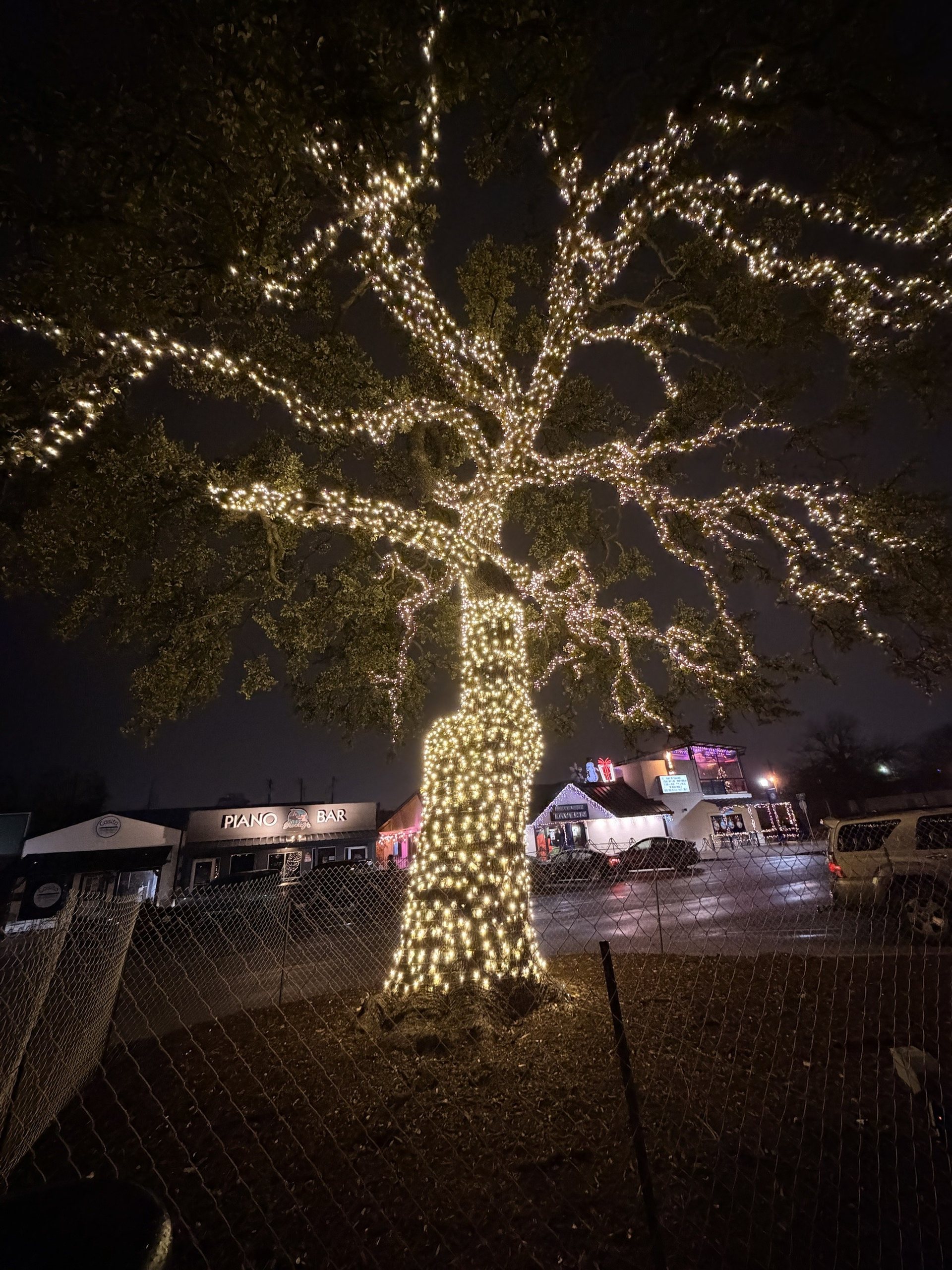
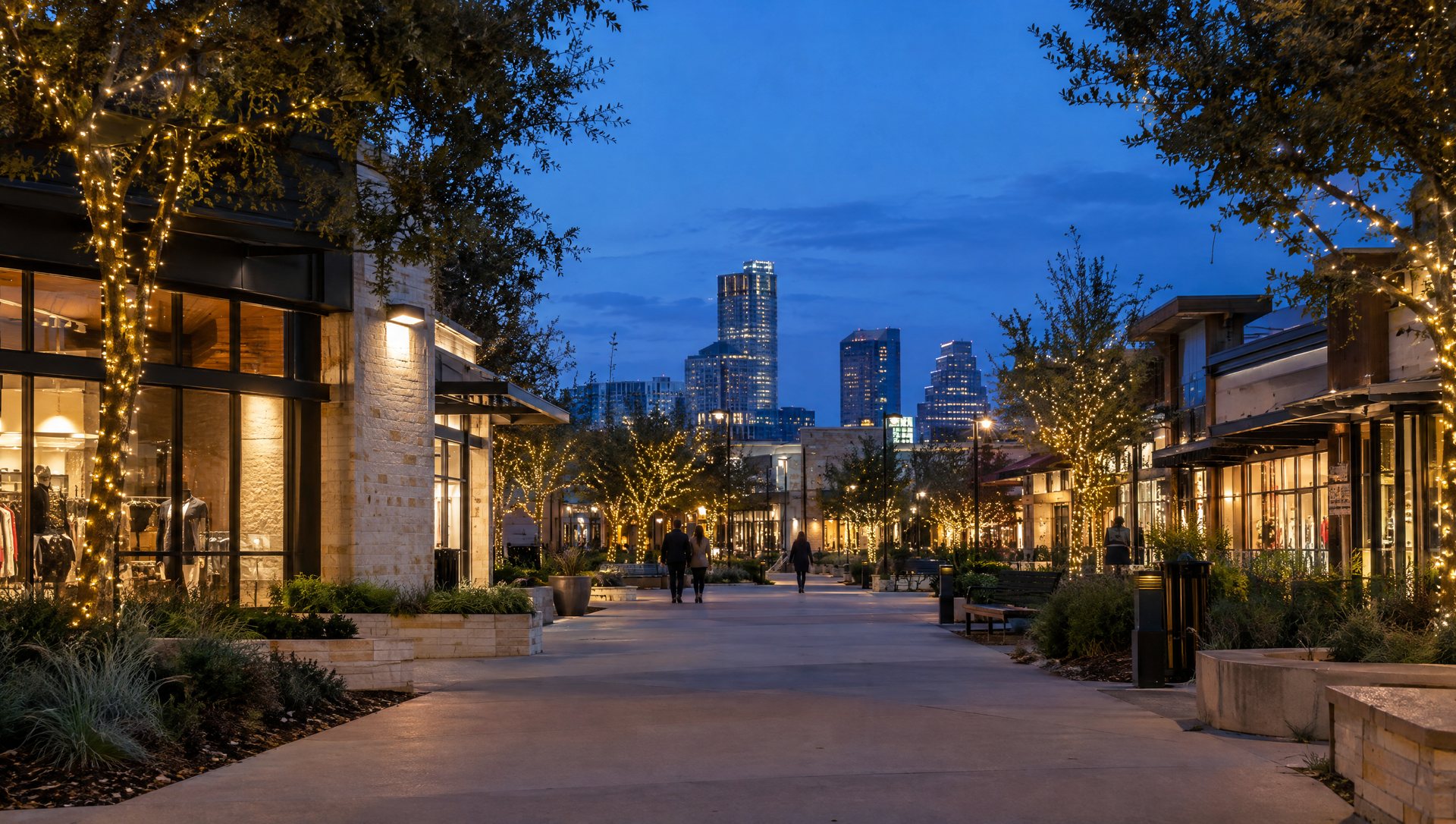
Usually yes for trees on the property, with the owner’s OK and a way to power them. Street trees are different, and oaks need care in any season. Trees are the most visible thing on many commercial lots after the roofline, and a row of wrapped trunks needs no roof access. Three ways to light a tree:
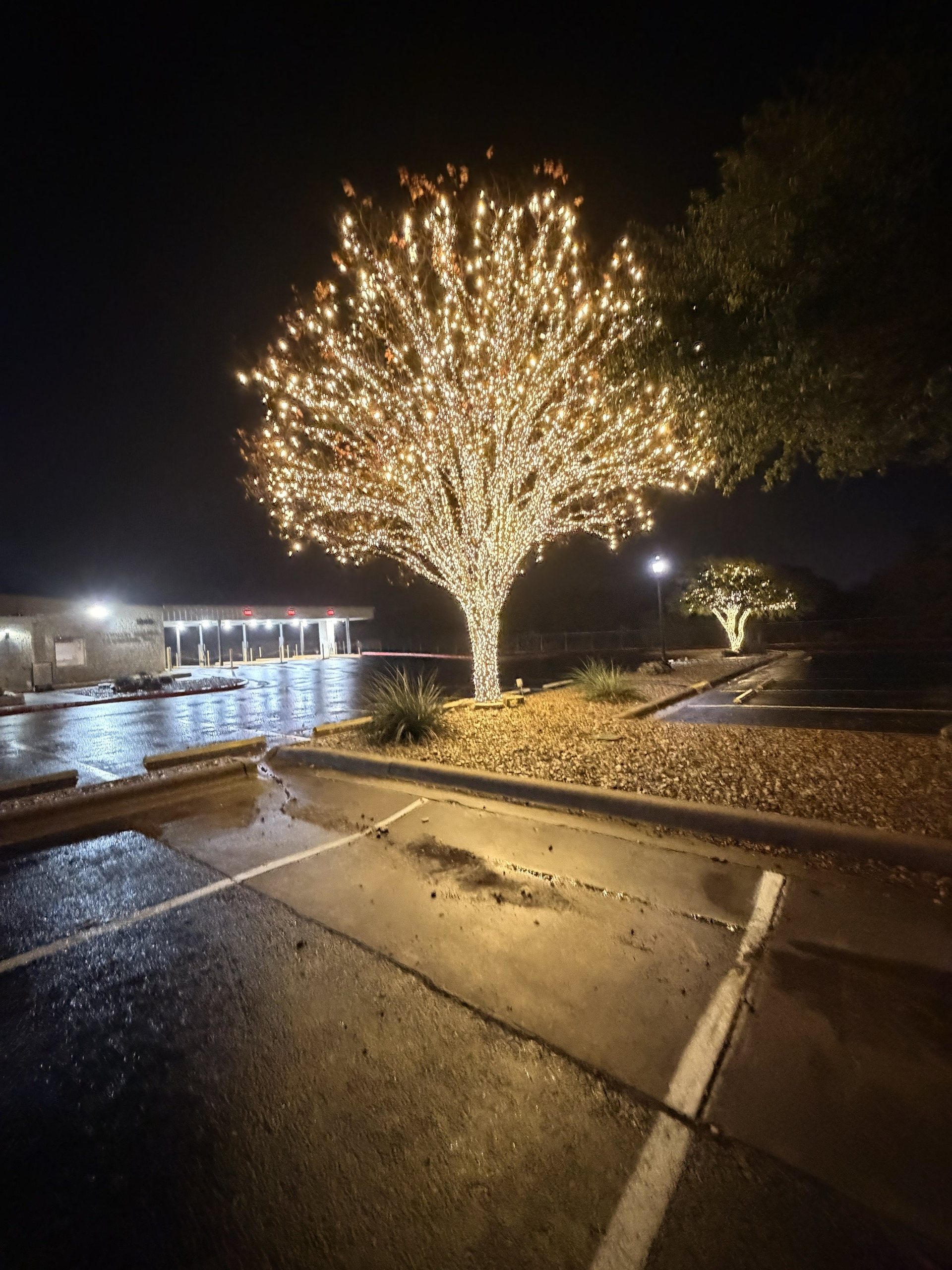
- Trunk wrap: lights spiraled up the trunk from the ground, usually to where the main limbs split.
- Trunk-and-limb wrap: the spiral continues out along the main limbs.
- Canopy lighting: lights laid through the outer branches so the crown glows.
Trunk circumference, the number of limbs wrapped and the gap between turns set how many feet of lights a tree takes, and footage sets the price. A thick live oak and a slim crape myrtle (also spelled crepe myrtle) of the same height are far apart in footage. Our guide to what tree wrapping costs works through the numbers.
Street trees may be public trees
Trees between the sidewalk and the street may belong to the City. Austin’s tree ordinance defines a public tree as one with at least two-thirds of its trunk diameter on public property. It requires the urban forester’s approval to maintain, remove or damage one, and a violation is a Class C misdemeanor of up to $100 per offense (Austin City Code chapter 6-3). We found no City rule on holiday lights in trees. Before wrapping a tree in the right of way, call Austin 3-1-1 and ask.
Oaks and tree health
- Paint any oak wound right away. The Texas A&M Forest Service oak wilt guidelines say to paint all cuts and wounds on oaks immediately, regardless of season. A limb snapped during install or takedown counts.
- No nails or screws in the tree. Small removable staples only as anchors where a wrap won’t hold, pulled at takedown. Every hole in oak bark is a wound, so on oaks we recommend a staple-free wrap.
- Take wraps off every year. The Morton Arboretum explains that wire left around a trunk or branch cuts into the bark as the wood grows and can kill the limb.
- Mind the wires. If a person, ladder, lift or light string cannot stay 10 feet from an overhead power line, stop. Austin Energy asks to be contacted before work closer than that.
For more on the trees most Austin lots are built around, see how to light a live oak.
Commercial-grade lights: buy them or have them supplied?
Commercial-grade sets use sealed one-piece sockets and screw-on connectors. Suppliers estimate 6 to 8 seasons for them against 2 to 3 for retail sets (Creative Displays and Christmas Designers). Those are seller estimates, not test results. A business has two ways to get them:
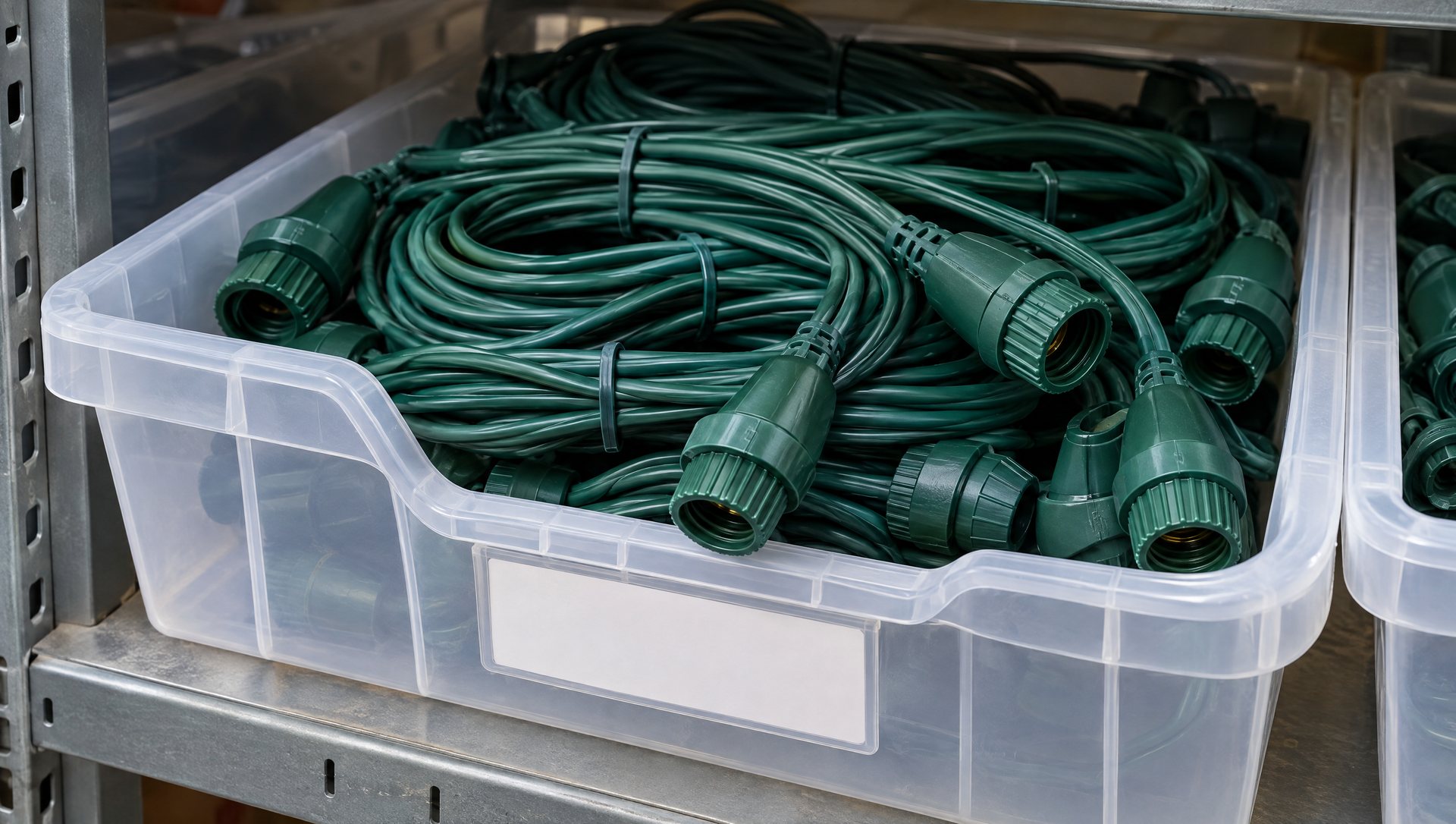
- Buy them. You own and store them, and pay for install and removal each year. This suits a business with storage space that will reuse the design.
- Have the installer supply them. Some installers include the lights in one rate with clips, installation, takedown and storage, and keep the lights after the season. The Christmas Lights HQ pricing guide describes this model.
Either way, the quote should say who owns the lights at the end of the season. Our guide to whether installers provide the lights covers both models in more detail.
If you want accent lighting all year, look at permanent track lighting instead. Our permanent lighting guide explains that option.
How much does commercial Christmas lighting cost?
Commercial Christmas lighting prices in Austin range widely and climb with footage, height and trees. Few installers publish commercial prices, so treat each figure below as one source’s number on one date, all checked October 2026. None is Sapien’s price.
| Source and date | What it says |
|---|---|
| One Austin installer’s cost post, November 2024 | Commercial quotes from $2,500; small businesses $2,500 to $5,000; large commercial properties $8,000 to $25,000 and up |
| Strandr’s guide for installers, updated October 2026 | Typical budgets it tells installers to expect: restaurants $2,000 to $15,000; offices $3,000 to $30,000; retail centers $10,000 to $100,000 |
| Christmas Lights HQ pricing guide, March 2026 | Commercial garland at $20 to $35 per foot |
The Strandr and Christmas Lights HQ figures are advice to installers on what to charge, not surveys of what businesses paid. The 2024 figures are two seasons old.
What moves a commercial quote
- Footage of roofline, parapet and window outline.
- Height, since a lift adds rental and setup time.
- Trees, each priced by trunk size and how far the wrap goes.
- Working hours, such as after-closing installs.
- Service terms: how fast someone comes back when a section goes dark.
- Ownership: supplied-and-kept lights, bought lights, or your own.
Ask every installer whether sales tax is included in the quote, and line two quotes up against the five items in the first section. For why any installed price runs higher than the lights alone, see why Christmas light installation is so expensive.
When should a business book, install and turn on?
Start with approvals. A landlord letter, a vendor registration and a brand check each run on someone else’s calendar. Strandr’s guide for installers says retail properties tend to decide in June to August for a November install, and restaurants in September to November.
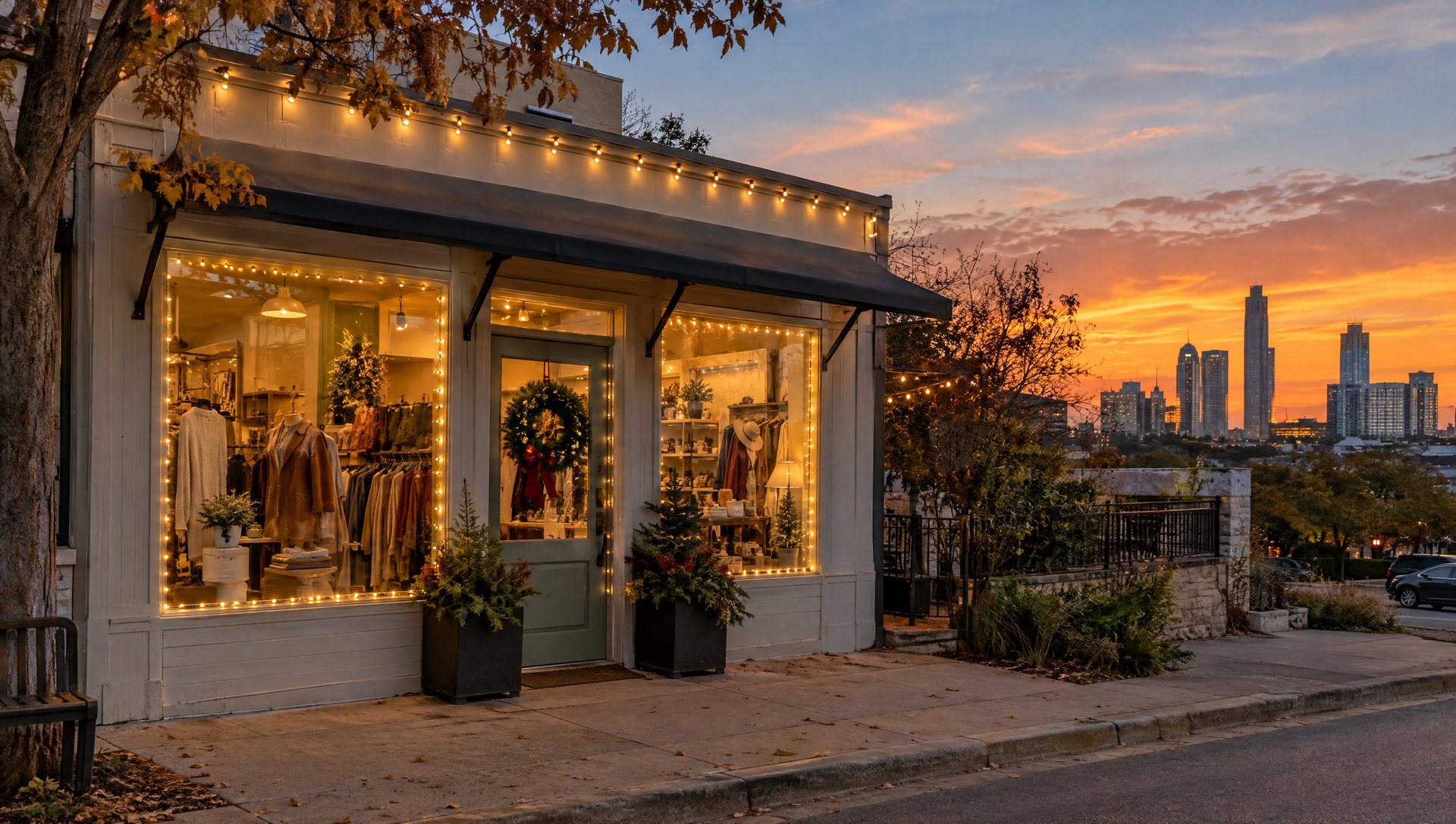
For retail, a natural lights-on target is the weekend after Thanksgiving. In 2026 that is Black Friday, November 27, and Small Business Saturday, November 28. Working back from that date, an install in early November leaves time for fixes before the weekend.
What hours should the lights run?
Set the lights to come on at sunset and go off when the business closes or at a fixed hour. In Austin the earliest sunset of the year is 5:30 PM, from about November 27 through the first week of December 2026, and dusk ends about 5:56 PM. A fixed 6 PM start misses the first half hour. A photocell (dusk sensor) or astronomic timer follows sunset for you. NOAA’s sunset table for Austin has the exact times.
NFPA and ESFI say to switch decorative lights off when no one is there or to use a timer. For a business that closes at night, that means an off time; see whether to leave Christmas lights on all night.
Check the timer’s rating against the load. As of October 2026, Intermatic lists its HB51K photocell timer at 8.3 amps and its HB11K mechanical timer at 15 amps. An LED display is a light load. An incandescent roofline can exceed both.
For running cost, watts times hours per night, divided by 1,000, gives kilowatt-hours per night (Virginia Cooperative Extension). Example: the 376-watt LED display above, run 6 hours a night for 40 nights, uses about 90 kWh. Multiply by the energy rate on your electric bill.
What happens when wind or rain knocks the lights out?
Commercial displays face the same December problems as homes, wind and wet connections, with more height and exposure.
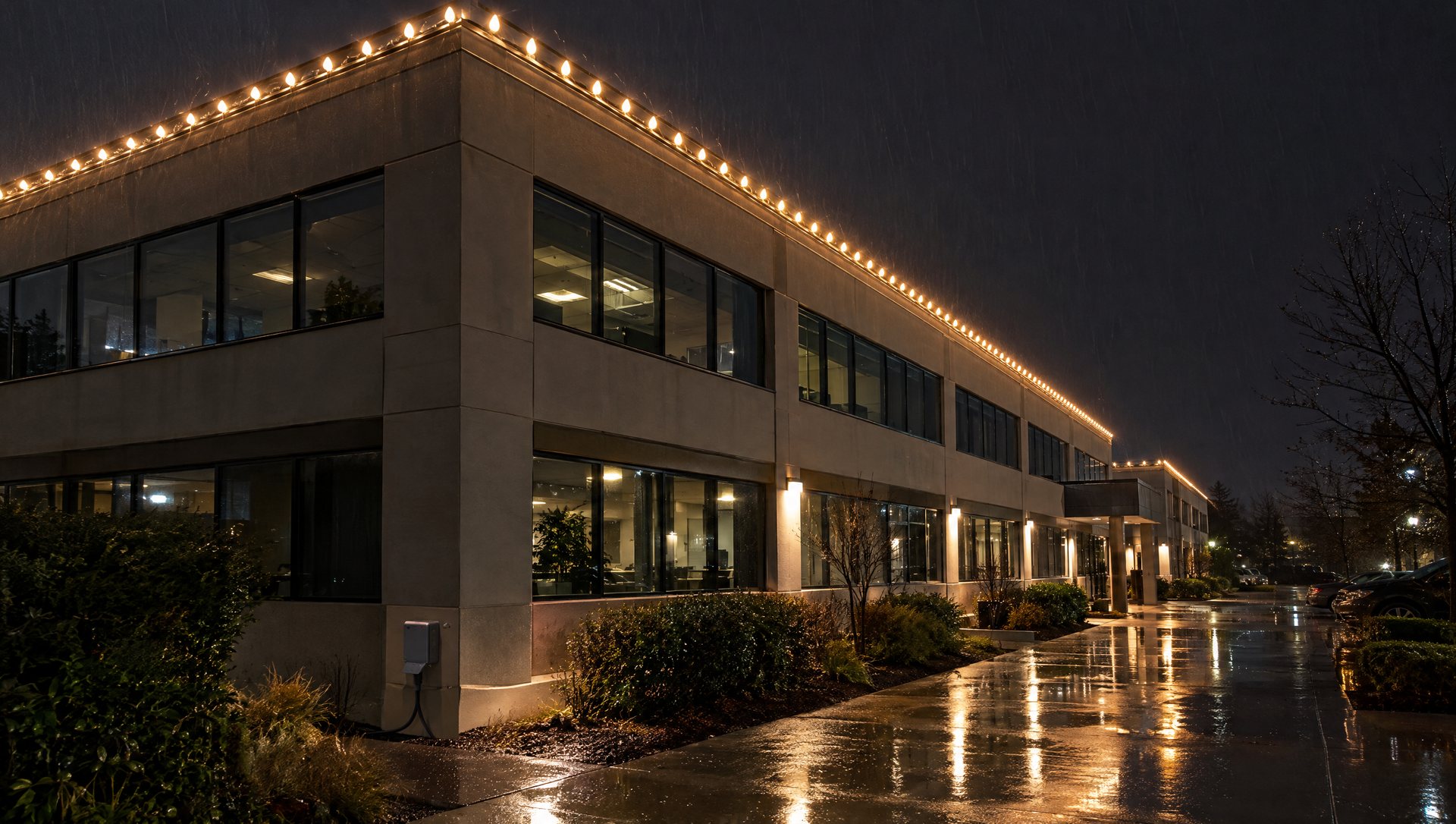
Wind. Austin’s winter cold fronts can bring strong north winds. In late December 2025, the National Weather Service issued a Wind Advisory for Travis and Williamson counties with gusts up to 45 mph. Runs on parapets and tall facades are more exposed than on a one-story house. Ask the installer how parapet runs are held down, and how many clips per foot they use on the windward side.
Rain and GFCI trips. When outdoor lights trip a GFCI in the rain, the GFCI is doing its job: water has reached a connection and current is leaking. Pro suppliers say long runs with many connections add to that leakage, so we’d split a large display across more than one GFCI outlet. ESFI says to keep connections out of standing water, and suppliers say not to bypass a GFCI. If the lights trip a breaker or GFCI at night, turn them off at the timer and call whoever installed them. Do not reset it over and over, and do not move the lights to an outlet without GFCI protection. If it keeps tripping after the lights are fixed, have an electrician check the circuit. For the home-scale version of this problem, see why Christmas lights flicker or go out.
Name one person on staff who reports outages and resets breakers, and give the installer that person’s number.
When do the lights come down?
Plan takedown when you sign, and put the date in the contract. Your landlord may set a date too. Tree wraps should come off every year so they do not girdle the trunk. Sapien’s takedown window is January 2 to 15.
Do Christmas lights bring more customers to a business?
We found no study that shows holiday lights raise a business’s sales or foot traffic, so we will not promise that they do. To judge your own season, keep simple records:
- Install, lights-on and takedown dates, and the nightly hours from the timer.
- Nights with an outage, and how long the fix took.
- Photos from the street and the parking lot, and what customers and staff said.
- Everything else that changed in December: weather, events, promotions, road work.
One December compared with the next tells you little unless you note what else changed. The records still show what to light again and what to fix in next year’s contract.
When we’d tell you to do something else
- A small storefront that only wants window displays. Lights inside the window may be all you need, and staff can put them up.
- The landlord says no, or will not answer. Do not sign with anyone until you have a written yes.
- The plan needs new outlets. Hire a licensed electrician first and schedule the lights after.
- You want lights on most of the year. Look at permanent lighting instead.
- A chain with a national lighting program. Your brand may require its own vendor. Ask head office first.
- A budget below an installer’s minimum. A wreath, a lit door frame and one wrapped tree may be the right size job. Ask the minimum first.
How Sapien handles commercial work
Sapien does commercial and residential Christmas light installation in Austin, plug-in seasonal lighting only. Here is where Sapien stands:
- Pricing: quoted per property after a site walk. There is no set starting price for commercial work, because footage, height and trees vary so much.
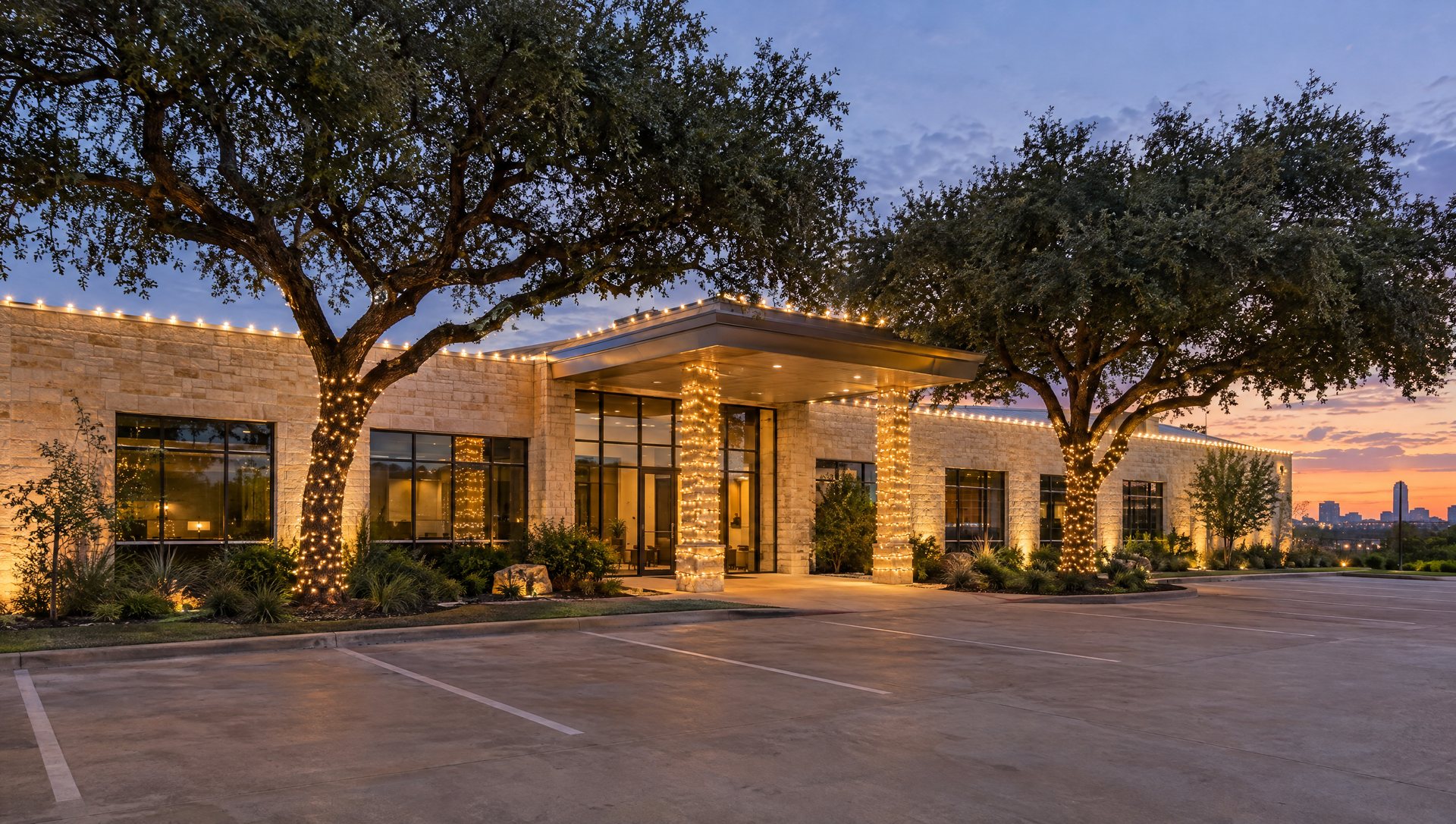
- What’s included: a custom design, commercial-grade lights and clips, installation, repairs if anything goes dark during the season, and takedown in January.
- Early install, later turn-on: yes. We can install early and set the timer to start on the night you choose.
- Takedown: January 2 to 15.
- Power: we work from your existing outlets. If the plan needs a new outlet or circuit, that goes to a licensed electrician first.
- Insurance, access and billing: Sapien is fully insured. Ask us the same questions you would ask any installer, from the insurance list above to how high we can reach on your building and how billing works, and get the answers in writing before you sign.
What to have ready for a site walk
Any installer’s walk-through goes faster with these in hand:
- The landlord’s written ground rules, or the name of whoever gives them.
- Any vendor or insurance requirements from your lease or property manager.
- Where the exterior outlets are, and who can open the electrical panel.
- The date you want the lights on, and the one person who approves the design.
On the walk, expect the installer to check outlets and circuits, heights and lift access, attachment surfaces, which trees can be powered, and where crews can park.
To set one up, call or text (737) 777-9099, or use the contact page. Tell us the property address, who makes the decision and the date you want the lights on; a few daytime photos of the front of the building help us plan the walk. The basics of the service are on our Christmas light installation in Austin page.
Frequently asked questions
Can our own maintenance staff hang the lights instead?
They can, if your landlord allows it. Plan it like any other job at height, and read our light installation safety checklist first. Stop and call a professional if anyone would need to walk a roof, work from a lift they are not trained on, or come within 10 feet of an overhead power line.
Can we light the HOA entrance or a shared monument sign?
Only with the approval of whoever owns it. For an HOA that means a board decision, and for a shopping center it means the landlord. Our guide to HOA entrance Christmas lights covers the board side.
Will the lights damage our building?
NFPA advises fastening lights with clips, not nails. Ask the installer how they will attach lights to your fascia, parapet, stone or metal, and whether anything gets drilled. Then check the answer against your landlord’s rules.
Who is responsible if someone trips on a cord?
That depends on your lease and the installer’s contract and insurance, so ask your insurance agent. Before install, ask the installer how cords will be routed and fastened, and keep cords out of walkways and doorways.
Sources
- City of Austin Code chapter 25-12, article 4 (electrical code) (permit rule, holiday lighting exemption, who may pull a permit; read October 2026)
- Texas Occupations Code chapter 1305 (electrician licensing, holiday-lighting carve-out)
- TDLR: Programs licensed and regulated (no holiday-light installer license) and TDLR license search
- OSHA: 29 CFR 1910.305 (90-day temporary wiring for Christmas lighting, removal, cords through doorways in workplaces)
- NFPA blog: holiday lighting and the NEC (90-day rule; section 590.3(B) in the 2023 NEC and 590.5(B) in the 2026 NEC; December 2025)
- TDLR: 2026 NEC adoption notice (Texas on the 2026 NEC from September 1, 2026)
- Texas Insurance Code chapter 1811 (what a certificate of insurance can and cannot do)
- Texas Department of Insurance: Certificates of insurance (ACORD 25 on the approved list)
- IRMI glossary: Additional insured
- Texas Department of Insurance: Commercial general liability insurance (what CGL covers; not workers’ compensation)
- Texas Department of Insurance: Workers’ compensation guide and coverage verification
- FirstService Residential Texas: Vendor services (example of a management company’s vendor registration)
- CPSC: Do’s and don’ts of holiday decorating (GFCI-protected outlets for outdoor lights)
- NOARK Electric: 80% vs 100% rated breakers (continuous-load planning rule)
- Christmas Lights Etc: How many watts and amps Christmas lights use (7-watt incandescent C9 figure)
- ESFI: Extension cord safety tips, ESFI: Outdoor decoration safety tips and ESFI: Don’t overload your home
- S4 Lights: Why GFCIs trip Christmas lights (leakage from wet connections; long runs add up) and The Christmas Light Emporium: GFCI tripping (do not bypass a GFCI)
- NFPA: Winter holiday safety tip sheet (lights off when away or asleep; clips, not nails)
- City of Austin: Sign permits (permits for outdoor signs; exemptions in 25-10-101)
- Austin City Code chapter 6-3: Trees and vegetation (public trees, urban forester approval, penalty)
- Texas A&M Forest Service: Pruning guidelines for prevention of oak wilt
- Morton Arboretum: Caring for trees as you light your landscape (girdling)
- Austin Energy: Safety on the job (10 feet from overhead lines)
- Creative Displays: Pro-grade vs retail Christmas lights and Christmas Designers: Retail vs commercial lights (construction and supplier life estimates)
- Christmas Lights HQ: Christmas light installation pricing guide (advice to installers: crew hours, commercial garland, supplied-and-kept model; March 30, 2026)
- Strandr: Commercial Christmas light installation guide (advice to installers: budgets by property type, buying cycle; updated October 4, 2026)
- Dozr: Towable boom lift rental in Austin (lift rental example; October 2026)
- U.S. Small Business Administration: Small Business Saturday (2026 date)
- NOAA Global Monitoring Laboratory: Austin sunrise and sunset table, 2026 and the U.S. Naval Observatory data service (earliest sunset and end of civil twilight)
- Intermatic HB51K and the Intermatic plug-in timer catalog (timer ratings, as of October 2026)
- Virginia Cooperative Extension: Estimating appliance energy use (kWh formula)
- National Weather Service Austin/San Antonio Wind Advisory issued December 27, 2025, in effect December 28-29 (archived text from Iowa Environmental Mesonet)
- Christmas Light Source product listings for a Minleon LED C9 bulb (0.58 watts) and a 50-light 5mm LED set (4.8 watts), read October 4, 2026 (inputs to the load example)
- One Austin-area installer’s November 2024 cost post, opened October 4, 2026. We do not name or link other installers.
About the author. Rick Philip owns Sapien Lighting & Installation in Austin, Texas.