



Battery-Operated Outdoor Christmas Lights: Runtime, Brightness and When They Make Sense
A typical small battery-operated outdoor Christmas light string on three AA batteries runs somewhere between about 25 and 100 hours on fresh alkalines. On a six-hour timer, that’s roughly 4 to 16 nights per set of batteries, so over an Austin season you’ll change them several times. That makes battery lights a great answer for a wreath, a mailbox or a planter with no outlet nearby, and a poor answer for anything bigger.
This guide shows the math so you can work out your own number, then walks through where batteries earn their place and where a plug-in plan wins. Our Austin installation service handles plug-in rooflines and trees; this is about the small spots where batteries really are the easier answer.
The runtime math in one line
Battery packaging rarely tells you anything useful about runtime. “Up to 200 hours” might mean the lowest setting until the LEDs are barely glowing. So do the math yourself:
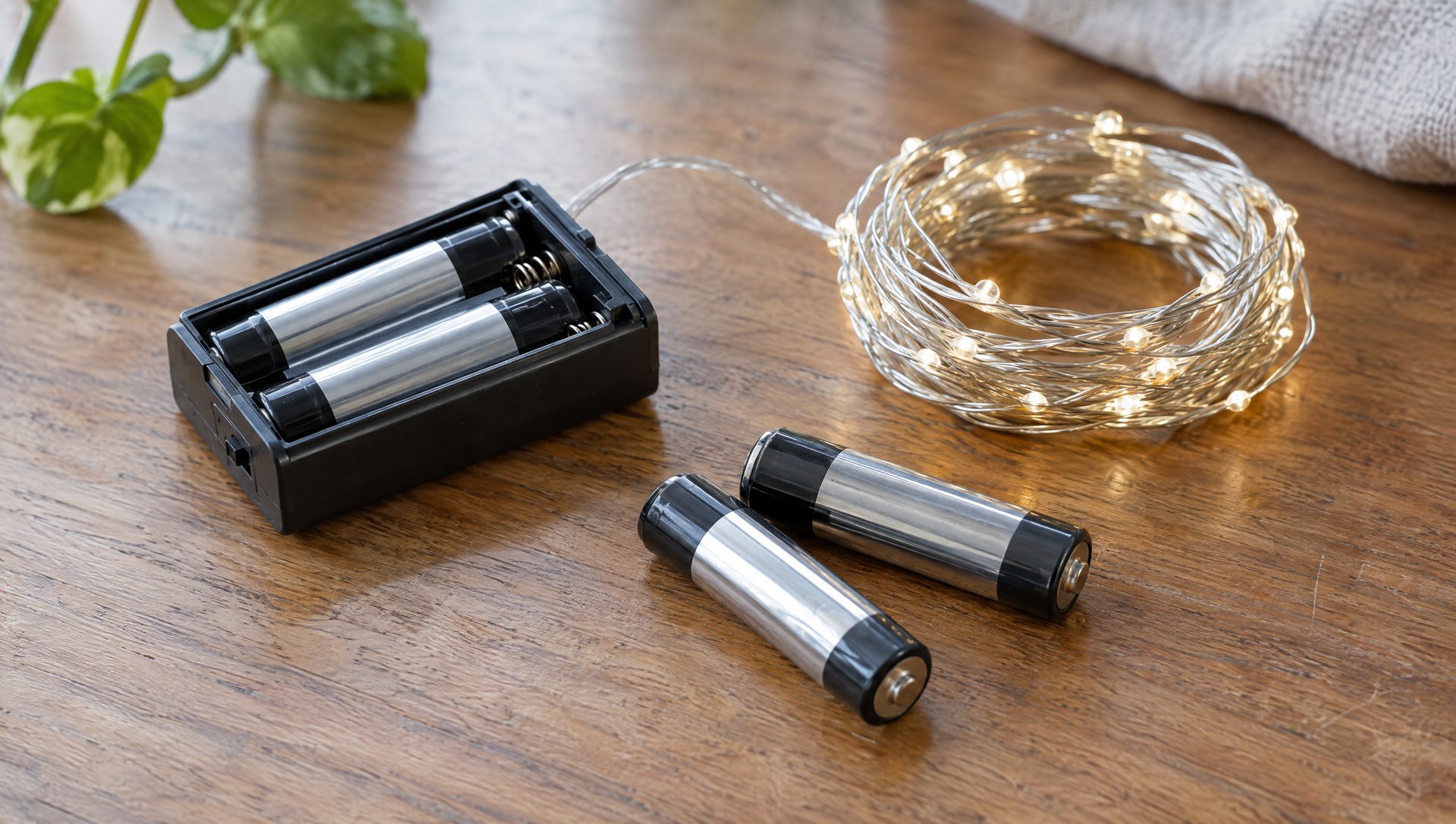
Runtime in hours = battery capacity (mAh) ÷ current draw of the string (mA).
For capacity, an alkaline AA holds roughly 2,500 to 3,000 milliamp-hours at the light loads holiday strings draw. Energizer’s E91 datasheet shows about 3,000 mAh at a 25 mA load and about 2,500 mAh at 100 mA. Three AAs in a pack are wired in series, so the pack still holds about that capacity, at 4.5 volts instead of 1.5.
Using a conservative 2,500 mAh:
| String draws | Hours | Nights at 6 hrs | Battery sets for a 37-night season |
|---|---|---|---|
| 25 mA | ~100 | ~16 | 3 |
| 50 mA | ~50 | ~8 | 5 |
| 100 mA | ~25 | ~4 | 9 |
Those draws are illustrations, not ratings for any particular product. Small 3×AA micro-light strings commonly fall somewhere in that range, and more LEDs, brighter modes and twinkle effects push the number up.
Worked example: one wreath, Thanksgiving to New Year’s
Say you light a battery wreath from Thanksgiving night, November 26, through January 1. That’s 37 nights.
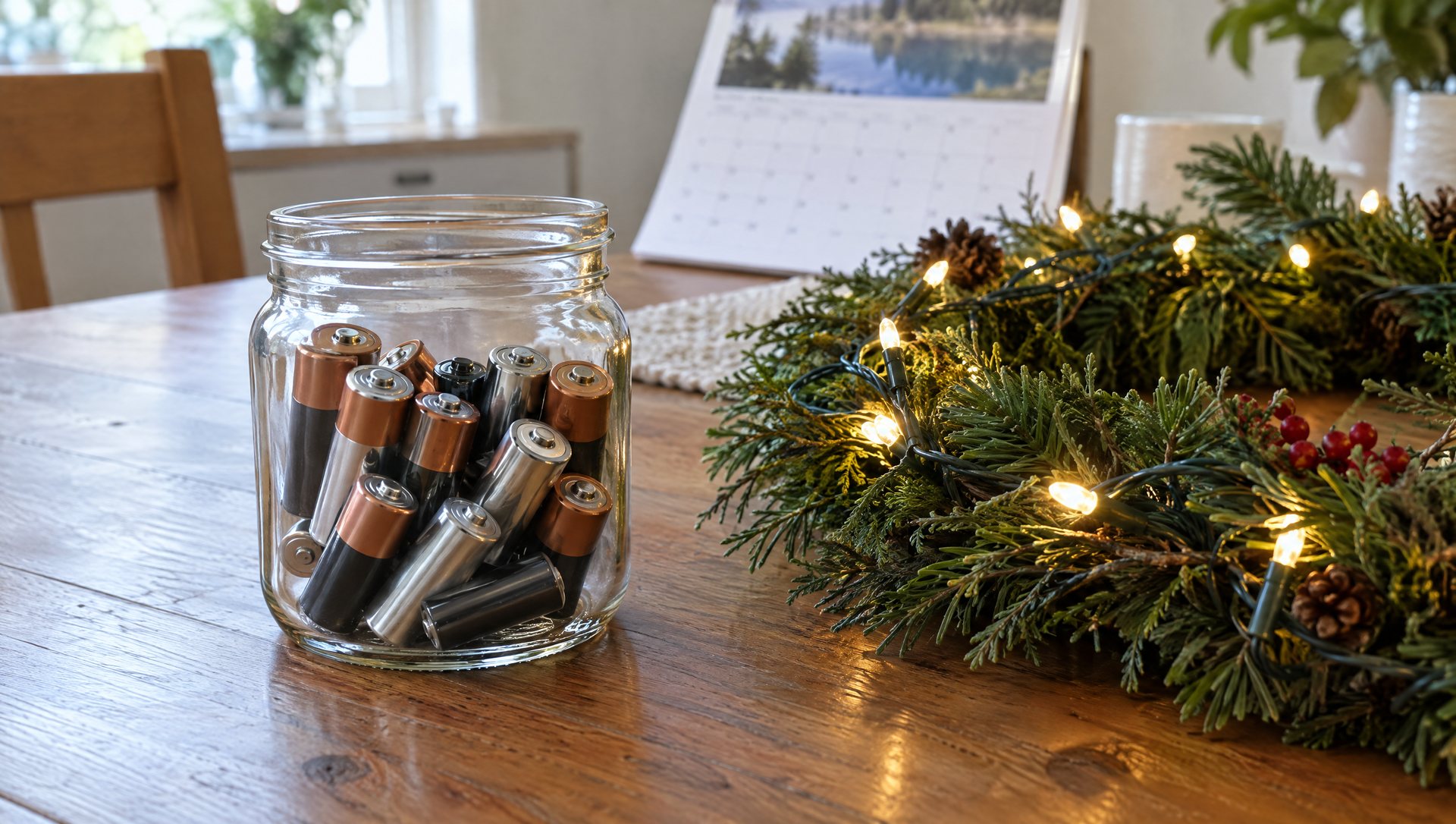
- The wreath’s string draws 50 mA (the middle row of the table; measure yours as shown in the next section).
- Six hours a night uses 50 × 6 = 300 mAh.
- A fresh set of alkalines (2,500 mAh) lasts 2,500 ÷ 300 = about 8 nights.
- 37 nights ÷ 8 = about 4.6, so you’ll put in 5 sets of batteries, 15 AA cells, for the season.
Change one input and the answer moves a lot. Run the same wreath four hours a night instead of six, and a set lasts about 12 nights; you’ll need 3 sets, 9 cells. Add a second wreath and a lit planter on the same schedule, and the season budget becomes 45 cells, plus a battery change every week or so across three decorations.
That’s the real cost of battery lights: not the money, which is modest, but the chore. Decide up front how many battery changes you’re willing to make in December, and size the plan to that.
A battery-change routine that actually sticks
The plans that fail are the ones where the batteries die on a Tuesday and nobody notices until the weekend. Three habits fix that:
- Pick a change day. If your math says a set lasts eight nights, change every wreath and planter on the same day each week, whether they look dim or not. One trip, every decoration, no guessing.
- Keep the spares where the lights are. A small zip bag of fresh cells in the coat closet by the front door beats a trip to the junk drawer in the dark.
- Write the date inside the battery box lid with a marker when you change them. On a decoration that people see every day, it’s easy to lose track of when the last change was.
And keep the used cells out of the fresh bag. A pile of mixed half-dead batteries is how weak cells end up back in the wreath.
Measure your string’s draw in two minutes
If you own a basic multimeter, you can get the real number instead of guessing.
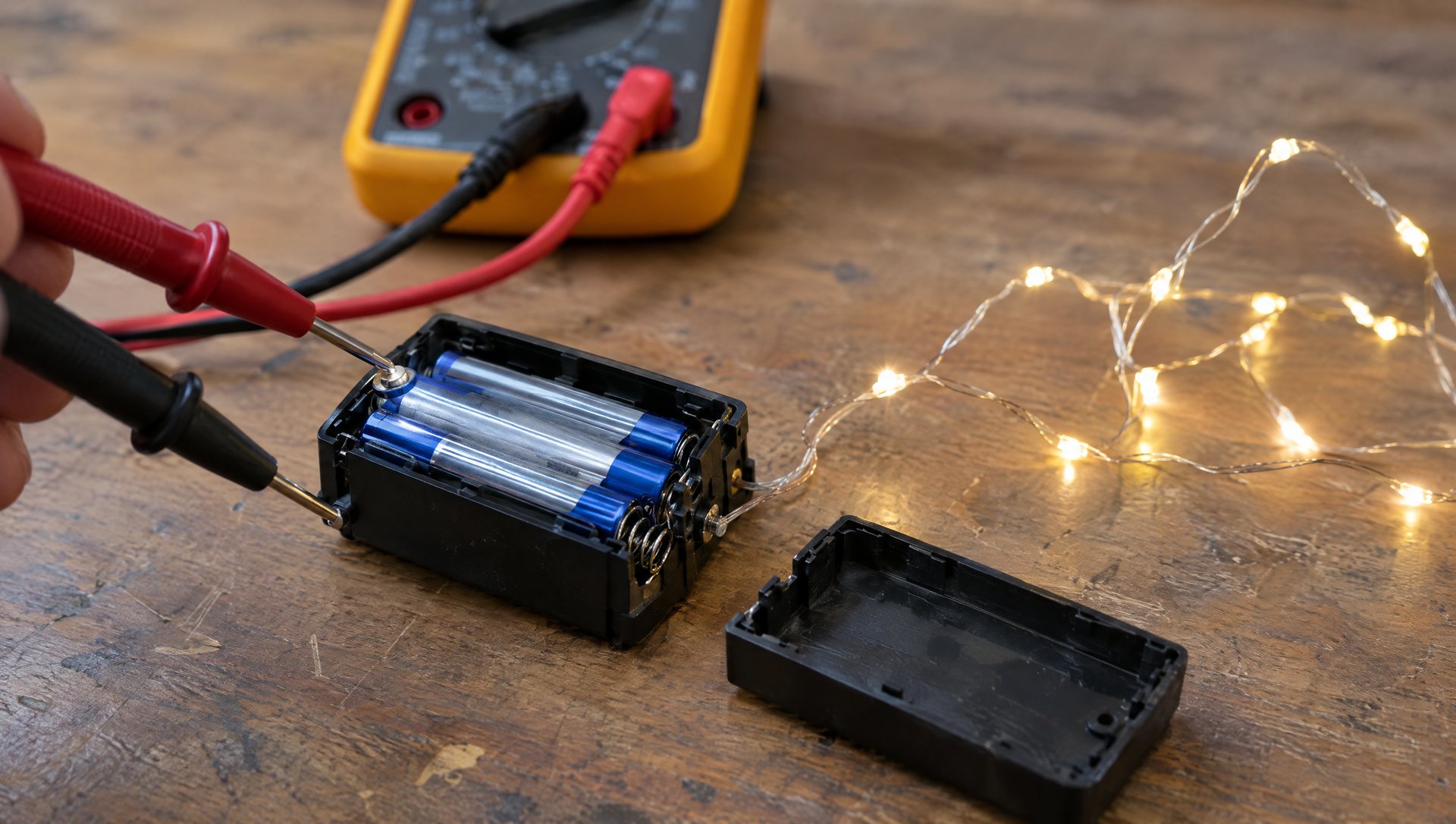
- Set the meter to DC current, milliamps (and move the red lead to the mA jack if your meter has one).
- Switch the lights on in the steady mode you plan to use.
- Open the battery box and lift one end of one battery off its contact.
- Touch the red probe to that battery’s terminal and the black probe to the contact it normally touches. The meter completes the circuit, the lights come back on, and the display shows the draw.
- Note the reading, and take one in twinkle or flash mode if you plan to use it.
No multimeter? Run the lights on fresh batteries with the timer set and count the nights until they look dim from where people will see them. That’s your practical runtime, and it’s a better number than any package claim.
Lights dim before they die
Alkaline voltage sags steadily as the cells drain, and LED strings dim along with it. A string can be technically on but too dim to read from the street days before it goes dark.

For a wreath seen from the doorstep, a little dimming is fine for a while. For a mailbox at the end of a long driveway, “on” may stop being useful halfway through the batteries’ life. When you test, note the night it starts to look weak, not the night it goes out. Plan your battery changes around that night.
Lithium, alkaline or rechargeable?
This is the real buying decision, and the right answer depends on how often you want to change batteries.
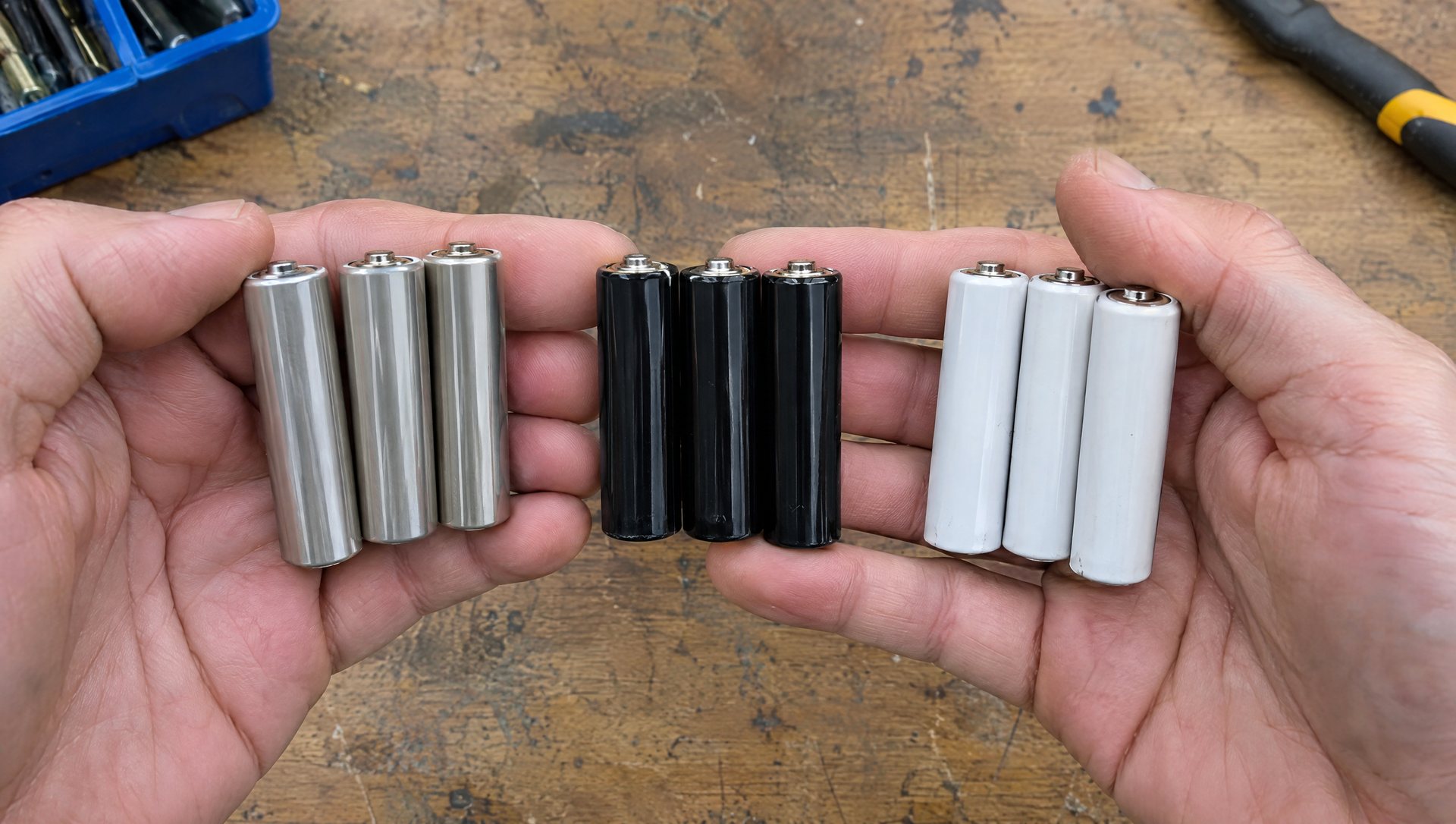
- Alkaline AA. The default and the cheapest per cell. Roughly 2,500 to 3,000 mAh at these loads. Fine for most wreaths and planters.
- Lithium AA (such as Energizer L91). Rated from −40°F to 140°F, lighter and longer-lasting, and they hold their voltage better as they drain, so the lights stay brighter for more of their life. They cost several times as much as alkalines. Use them only if the light’s maker allows them.
- NiMH rechargeable. 1.2 volts per cell instead of 1.5, so a 3-cell pack delivers about 3.6 volts instead of 4.5. Many strings run noticeably dimmer or flicker on them. Some are designed for it; check the manufacturer’s instructions before switching.
Whatever you use, never mix old and new cells, or different types, in one pack. Energizer warns that mixing increases the risk of leakage and cuts runtime. Change all three at once.
Our take: alkalines for decorations you can reach easily, lithium for the one spot that’s a pain to get to, and rechargeables only for products built for them.
Does cold weather drain the batteries?
Battery chemistry slows as temperatures approach freezing, Energizer notes in the same FAQ. In Austin, that matters on the occasional hard freeze, not on most December nights. The National Weather Service puts the normal December low at Austin’s Camp Mabry station at 43.4°F.

So if a cold snap dims your wreath, don’t rush out to buy different lights. Wait for it to pass, and if the lights are still weak on the next mild night, swap in fresh cells.
How battery light timers work
Most battery strings use a repeating cycle, usually 6 hours on and 18 hours off, that starts the moment you switch them on. Switch them on at the time you want them lit every evening, say 5:30 pm in December, and they’ll repeat that schedule daily.

Two catches. A battery change restarts the cycle, so change batteries at that same time of day or your lights will drift to a strange schedule. And a 6-hour timer is a schedule, not a battery life; it tells you nothing about how many nights the batteries will last.
Watch one full cycle the first night to make sure it shuts off when you expect. A string that never turns off will drain its batteries in a quarter of the time.
Is the battery box really outdoor-rated?
Check the whole product, not just the wire. Identical-looking fairy lights are sold with indoor and outdoor battery boxes, and the indoor version has a simple snap lid with no seal. Look for an outdoor rating on the package and a gasketed or screw-closed compartment.
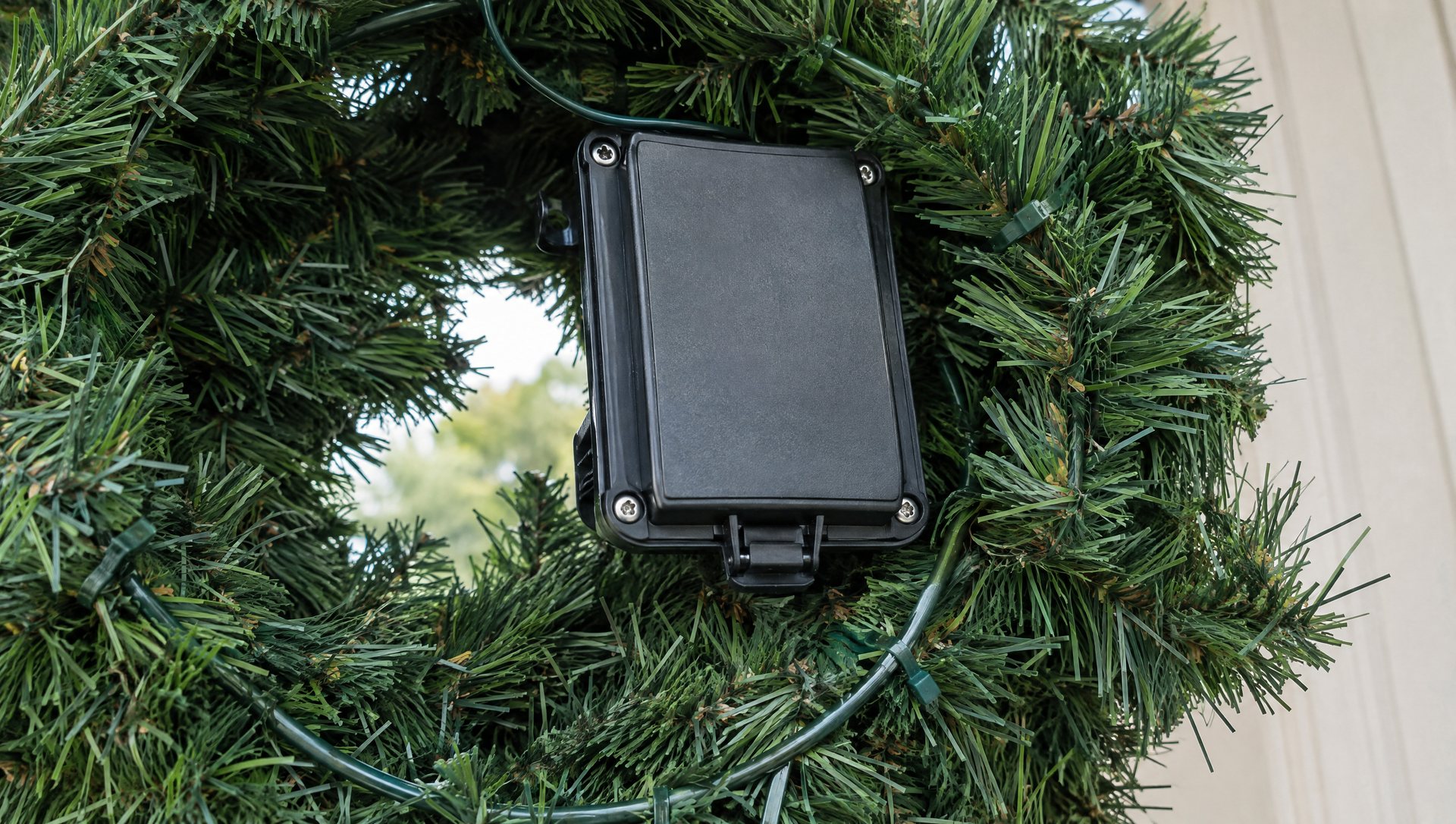
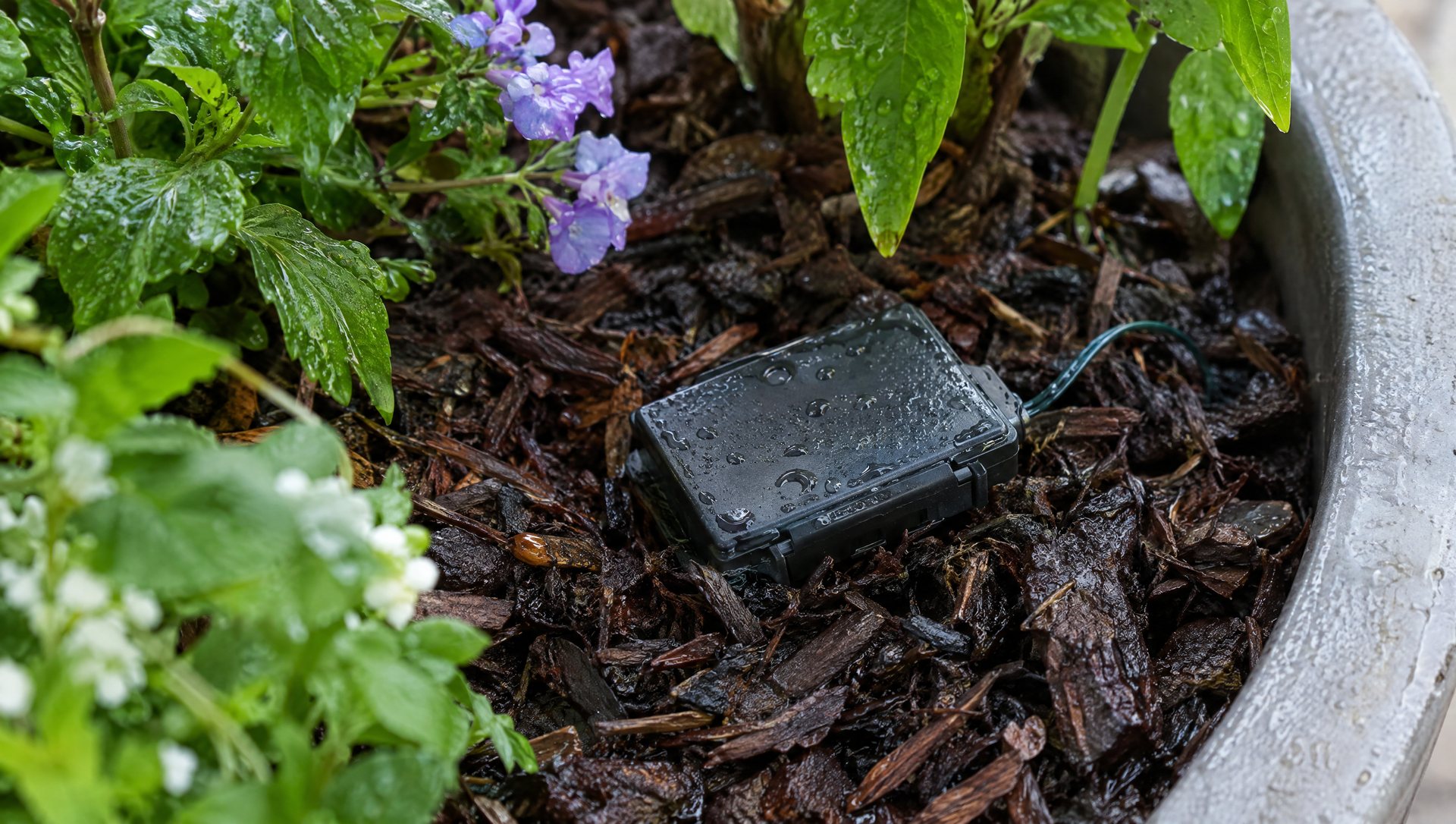
A covered porch still gets wind-driven rain, and planters hold water at the bottom. Mount the pack with its opening facing down or sideways, never buried in mulch or soil. Don’t seal an indoor pack in a plastic bag either; it traps condensation inside, which is worse than the rain.
Where battery lights earn their place
The front-door wreath. This is the best use there is. No cord crossing a door that opens twenty times a day, no cord pinched in the latch. Check the pack’s depth if you have a storm door, and set the box where you can reach the switch without pulling on the wire. Our door decorations guide covers sizing and hanging.

Mailboxes and planters. Good, at modest scale. A few lit points on a strong shape work better than trying to make a bright mini tree out of a tiny set. Our guide to garage, mailbox and small-spot lighting has layouts.
Porch garland. Fine if every pack is reachable from the floor. A pre-lit 9-foot battery garland usually has one pack; a 30-foot porch means four packs to change.
Lanterns and window candles. Flameless candles with built-in timers are a natural fit, and they cost almost nothing to run.
Apartment balconies. No outlet, no permission to run cords, a lease that says no hooks. Batteries solve all of that. See our balcony guide for renters.
Why batteries are a poor choice for trees and rooflines
A trunk-and-limb tree wrap uses far more light length than the tree’s height suggests, which means many battery strings, many packs and many changes. Run the numbers: ten battery strings at five battery sets each is 50 battery changes in a season, many of them on a ladder. Battery power doesn’t make that work any safer.

Rooflines are worse. You’d be climbing to change batteries in the dark every week. Rooflines and trees belong on a plug-in plan with a timer.
Battery vs solar vs plug-in
Battery works anywhere, including deep shade, but needs regular changes.

Solar needs a panel that gets several hours of direct sun, which a north-facing porch or a yard under live oaks may not get in December, when days are at their shortest. Solar stakes often run dimmer and quit earlier after a cloudy day.
Plug-in is the brightest and lowest-maintenance option once a safe, GFCI-protected power route exists, and it’s cheaper to run than most people expect. For example, take a plug-in LED garland drawing 10 watts (an illustration, not a specific product) running 6 hours a night for 37 nights: 10 × 6 × 37 = 2,220 watt-hours, or 2.2 kWh. At Austin Energy’s residential rates checked in October 2026, about 14.7¢ per kWh in Tier 3 counting the energy charge and pass-through charges, that’s roughly 33 cents for the season (about 27 cents at the Tier 2 rate of 12.2¢). Compare that to 15 AA cells.
If you have an outlet within reach and a route that doesn’t cross a door or a walkway, plug-in wins. If you don’t, batteries are the honest answer for small pieces. A new outdoor outlet is a job for a licensed electrician.
What we’d skip
- Battery packs that need a ladder for routine changes. If you can’t reach it from the ground, it shouldn’t run on batteries.
- Indoor fairy-light boxes hidden outside. An unsealed box lets in rain and condensation, and the contacts corrode.
- Rechargeables in lights not designed for them. Dim, flickering lights and a disappointing first night.
- Buying a yard’s worth before testing one. Put one string out for a week and count the nights.
- Leaving dead batteries in over the off-season. Pull the cells before you store the decorations. Remove leaking or damaged cells as soon as you spot them, and follow ESFI’s holiday safety guidance for the rest of the display.
If you’ve got a front porch with no outlet and you’re not sure what will work, text a daytime photo of the entry to (737) 777-9099 or use our contact page.
Sources
About the author. Rick Safeman owns Sapien Lighting & Installation in Austin, Texas.